Contemporary jewelry is inextricably linked with the moment in which it is created, frequently reflecting current social, cultural and political issues such as environmental consciousness, identity and sustainability. It’s informed by fashion trends, from the chokers of the 1990s to the large chain necklaces of the early 2000s.
Jewelry is one of the oldest forms of adornment. Lockets made of silver or gold have been treasured gifts for hundreds of years, for example, and charm bracelets, which have existed since prehistoric times, didn’t become especially popular until the 19th-century reign of Queen Victoria. For many centuries, fine jewelry was used primarily to express wealth or status through lavish materials. Then, in the 1960s, a concept known as the “critique of preciousness” emerged, with jewelers creating pieces that did not get their value from gemstones or precious metals. Instead, it was the jeweler’s artistic vision that was prized and elevated.
This shift still informs Contemporary jewelry being made by artists today. Whether they are using cheap, found materials and working with provocative geometric shapes or seeking out the rarest stones, they are imbuing their work with meaning through their skills, techniques and ideas. Innovative designers such as Elsa Peretti, who popularized sculptural sterling-silver jewelry for Tiffany & Co., and David Yurman, who twisted metal into the simple yet striking Cable bracelet, have also influenced the direction of Contemporary jewelry’s forms and aesthetics.
Meanwhile, technological advancements like metal alloys and laser engraving have led to new possibilities in jewelry design. Now, edgy makers and brands as well as minimalist designers are pushing Contemporary jewelry forward into the 21st century.
Find a collection of Contemporary rings, earrings, necklaces and other jewelry on 1stDibs.
The pearl has been synonymous with ladylike elegance since the Tudor period — learn what to look for when shopping for vintage and antique pearl jewelry as well as how to tell the origin of a pearl with our handy primer.
Every woman at some point in her life desires a simple strand of pearls. They are elegant, timeless, versatile — just ask Coco Chanel or Jacqueline Kennedy — and valuable. In 1917, Pierre Cartier famously traded a double-strand of natural pearls for a Fifth Avenue mansion, the Cartier brand’s flagship store ever since. And if you were born in the beginning of summer, pearl is the June birthstone.
It is possible to tell where a pearl originated from its appearance. Akoyas are usually round and white — the classic pearl, if you will. South Sea pearls are normally larger and vary in color; orangey yellow ones are not uncommon. Tahitian pearls are mostly black but can also be gray or brown, and between the Akoya and the South Sea varieties in size. Freshwater pearls, or Orientals, run the gamut in terms of color and size, but in shape, they tend to resemble Rice Krispies. Another important distinction is a round pearl versus a baroque pearl. A round pearl is self-explanatory, but there are two types of baroque pearls: symmetrical and asymmetrical. In general, the symmetrical variation commands a higher valuation. Within a strand of pearls, uniformity is prized — the more the individual pearls resemble one another, the more valuable the strand.
According to the Gemological Institute of America (GIA), the earliest recorded mention of a pearl was in 2206 BC by a Chinese historian. Centuries later, Christopher Columbus made it a point to visit pearl fisheries during his 15th-century exploration of the Caribbean. Since the late-19th century, the Japanese have been at the forefront of cultivating pearls, when jeweler Kokichi Mikimoto successfully cultured the world’s first pearl in 1893.
On 1stDibs, find vintage and antique pearl necklaces, pearl earrings and other accessories.
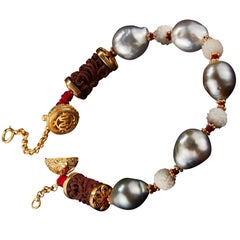
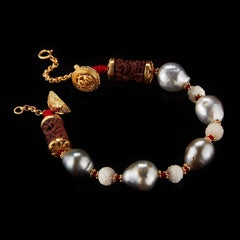
From the dazzling glass and shellwork jewelry favored by the Roman gentry to traditional Buddhist ceremonial mala, antique and vintage beaded bracelets have a storied history that spans centuries. These simple yet elegant accessories have held many different meanings in many different cultures.
The ancient Egyptians wore beaded bracelets whose symbolism was connected to specific colors of stones. The rosaries of Catholicism likewise infused sacred meaning in each bead. Native Americans used beads made from whelk and clamshells, known as wampum, as a form of money.
Craftsmanship, materials and design have all contributed to making the beaded bracelet an object of importance and value. Today, wearing a beaded bracelet is a subtle way to make a bold statement. These all-occasion items pair perfectly with both casual and formal attire and never look out of place, no matter whose wrists they’re adorning.
Browse the 1stDibs collection of beaded bracelets — and other types of bracelets — to explore the variety and beauty of these unique pieces that reflect an ever-evolving form of jewelry.