1850s Art

1,249 Results
to
70
1,011
130
51
31
30
Overall Width
to
Overall Height
to
7,824
22,155
169,815
241,733
2,190
2,408
4,757
6,541
6,092
16,324
21,795
27,338
19,623
14,276
5,595
828
17
9
4
2
2
1
705
358
332
288
230
167
159
127
87
71
69
68
67
51
49
47
42
41
41
41
1,056
186

Use search to find more

116
87
63
59
16

Use search to find more

Period: 1850s
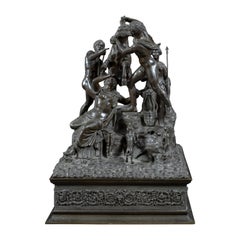
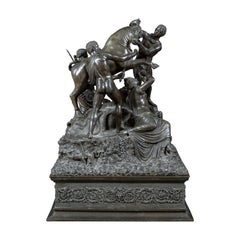
Roman Bronze Sculpture - 19th Century Mythological Group - The Farnese Bull

Roman Bronze Sculpture - 19th Century Mythological Group - The Farnese Bull

Located in Varmo, IT

Bronze sculptural group - The Farnese Bull (The Punishment of Dirce) - Rome, 19th century. 39.5 x 39.5 x h 54 cm. Technique in brief: Sculptural group in cast and chased bronze, br...

Category

Old Masters 1850s Art

Materials

Bronze

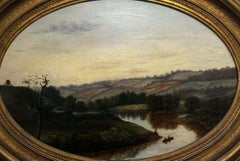
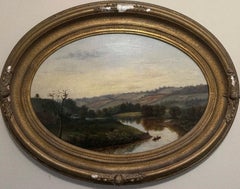
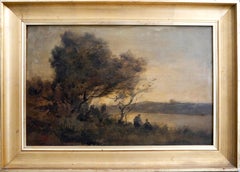
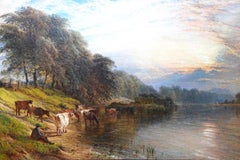
Dawn at the River
Dawn at the River

Dawn at the River

Located in North Clarendon, VT

Wonderful Hudson River School painting, oil on canvas. Obviously painted by a talented artist, unsigned and a mystery for you to solve. Canvas stamped Edward Dechaux NY. An amazing...

Category

Hudson River School 1850s Art

Materials

Oil

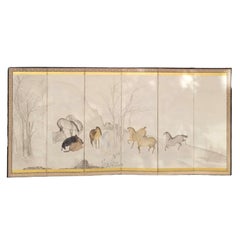
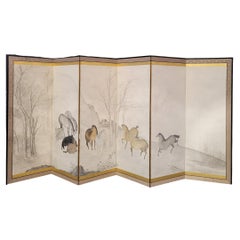
Hasegawa School Edo Folding Screen with Horses Byobu Horses Japan

Hasegawa School Edo Folding Screen with Horses Byobu Horses Japan

Located in Valladolid, ES

One of a kind and incredible six-panel Hasegawa school folding screen, featuring horses, is an exceptional piece. "Scene with Wild Horses" (Kōgen Bashu-zu in Japanese) is in the styl...

Category

Edo 1850s Art

Materials

Paper

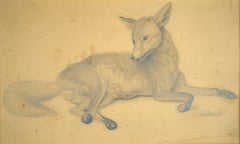
Vigilant Fox - The psyche of the fox -

Vigilant Fox - The psyche of the fox -

By Carl Friedrich Deiker

Located in Berlin, DE

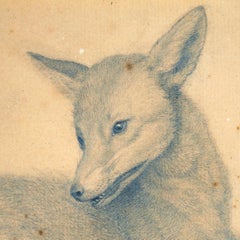
Carl Friedrich Deiker (1838 Wetzlar - 1892 Düsseldorf). Vigilant fox. Pencil drawing on brown paper, 18 × 29.5 cm (inside measurement), 31.5 x 43.5 cm (mount), signed and dated "Deiker [18]54" at lower right. - a little bit stained, with a light water stain at lower right About the artwork Carl Friedrich Deiker's consummate ability to depict animals is already evident in this early work. He brought a whole new psychological dimension to animal painting, so that one could literally speak of animal portraits. The naturalistic appearance of the fox alone makes it seem alive. Every strand of muscle, even every hair, is captured, which requires an intensive artistic study of animal anatomy and physiology. But the fox's real liveliness comes not from its natural appearance, but from its internal movement: Stretched out, it has been brought out of rest. It turns around and, with its ears pricked up, looks intently in the direction from which it has seen something. His mouth is slightly open and his pointed teeth are bared, as if he were growling. Tension gradually takes hold of his whole body. While the hind legs were still in a relaxed position, closely observed by Deiker, one front leg was already raised, ready to begin a rising movement. The fox seems so alarmed with all its senses that one gets the impression that, at any moment, its tail will move jerkily and the animal will jump up. While wild animals have traditionally been portrayed as beasts or anthropomorphised, often for caricatural purposes, Deiker explores their inherent nature by attempting to capture their psychic impulses. The wild animal is neither bestial nor human, but a creature in its own right, valued by Deiker for its own sake. In this way, he brought the dignity of the animal into representation and raised animal painting to a whole new artistic level. About the artist Carl Friedrich Deiker was the son of the drawing teacher Christian Friedrich Deiker and the younger brother of the animal painter Johannes Deiker. In addition to the family art lessons, Christian Friedrich shared a studio with his brother Johannes at Braunfels Castle, Deiker attended the drawing academy in Hanau, and from 1858 he was a student at the Karlsruhe Art Academy, where he studied under the landscape painter Johann Wilhelm Schirmer. Carl Friedrich Deiker was already in demand as an artist during his first year: Grand Duke Frederick I of Baden, Margrave Max of Baden and Grand Duke Michael of Russia bought hunting scenes by him. In 1859 he went on a study trip to the Reinhardswald. Just as the Barbizon School had rediscovered the landscape, Deiker opened up the forest for animal painting. From 1861-64 Deiker had his own studio in Karlsruhe, then moved to Düsseldorf, where his brother Johannes followed four years later. Deiker married a daughter of the landscape painter Karl Hilger and remained in Düsseldorf until his death. In 1868 he finally achieved international fame with his painting 'Pursued Noble Deer' and was regarded as a virtuoso new founder of animal painting. "Deiker brought for the first time a truly great artistic quality to animal painting [...]". - Hans Vollmer From 1870 he participated in the academic art exhibitions in Berlin, Dresden, Munich and Hanover. He was also very busy as an illustrator. He drew for the Gartenlaube, the Salon, the Universum, and produced many of the finely illustrated hunting and animal books of the period. He also worked as a printmaker, while his oil paintings circulated as reprints by Franz Dinger. From 1865 to 1892 Deiker was a member of the artists' association Malkasten. Carl Friedrich Deiker's life's work was honoured with a large posthumous memorial exhibition at the Düsseldorf Kunsthalle in 1892. His son Carl Deiker, born in 1879, also became a painter. Selection of art museums that own works by Carl Friedrich Deiker: Hamburger Kunsthalle / Kunsthalle Karlsruhe / Kunstmuseum Düsseldorf / Wallraff Richartz Cologne. Selected Bibliography H. Schmidt: Johannes and...

Category

Naturalistic 1850s Art

Materials

Pencil

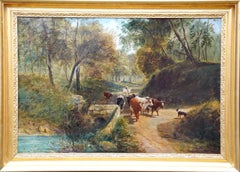
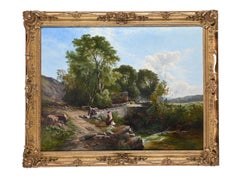
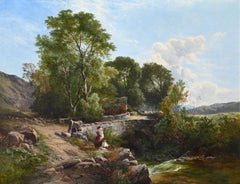
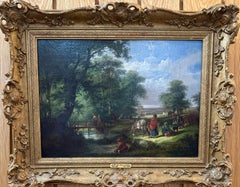
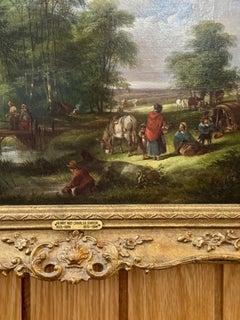
19th century English Victorian oil landscape with figures, a stream and trees

19th century English Victorian oil landscape with figures, a stream and trees

By Henry John Boddington

Located in Woodbury, CT

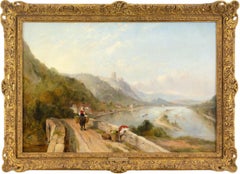
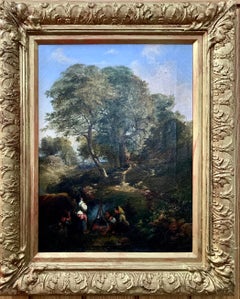
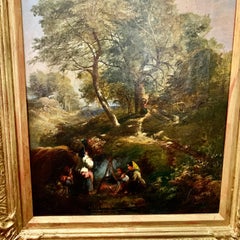
Henry John Boddington. 19th century English landscape with figures by a riverside. Simply one of the finest quality English landscape Ive ever had the pleasure of owning . This i...

Category

Victorian 1850s Art

Materials

Canvas, Oil

French school Landscape river scene Signed

French school Landscape river scene Signed

Located in Zofingen, AG

➡️ Beautiful study Landscape⬅️ Title: Sur les bords du Loing (Seine et Marne France) Jean Baptiste Camille Corot Medium: Oil on canvas Period: Likely mid-19th century Framing: A wid...

Category

Tonalist 1850s Art

Materials

Gesso, Canvas, Oil, Stretcher Bars

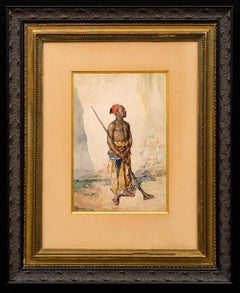
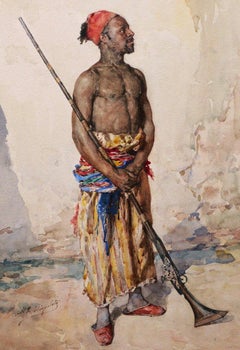
Orientalist "Moorish Soldier Holding a Rifle" Manuel Garcia Hispaleto

Orientalist "Moorish Soldier Holding a Rifle" Manuel Garcia Hispaleto

Located in SANTA FE, NM

"Moorish Soldier Holding a Rifle" Manuel Garcia Hispaleto (Spanish, 1836-1898) Watercolor on paper Signed lower left "MGHispaleto" Original wood frame with gilded stucco 18 3/4 x 12 1/2 (33 1/2 x 26 frame) inches Manuel García Hispaleto, originally Manuel García y Martínez (22 November 1836, Seville -26 December 1898, Madrid) was a Spanish painter known for portraits and costumbrista (genre) scenes. His brother, Rafael García...

Category

Realist 1850s Art

Materials

Watercolor, Handmade Paper

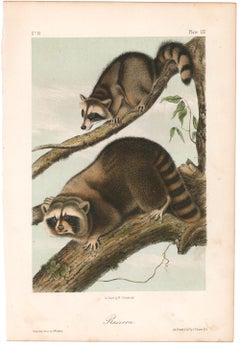
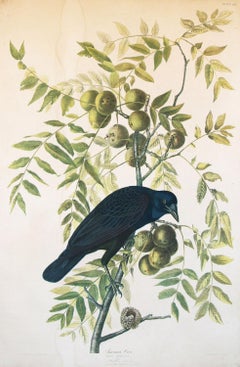
American Crow 1858 Chromolithograph by J.J. Audubon Plate, Julius Bien Edition

American Crow 1858 Chromolithograph by J.J. Audubon Plate, Julius Bien Edition

By John James Audubon

Located in Paonia, CO

American Crow by J.J. Audubon from his Birds of America folio shows an adult male crow in a Black Walnut bush with a nest of a Ruby-Throated Hummingbird in a branch below the crow. This original chromolithograph plate no. 226 is in good condition with a repairable water mark in the image on the left side as can be seen in the photos. The ” Birds of America” by John James...

Category

Naturalistic 1850s Art

Materials

Lithograph

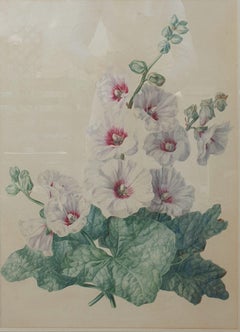
Watercolor 19th French school flowers hollyhocks large Academic

Watercolor 19th French school flowers hollyhocks large Academic

Located in PARIS, FR

French school of the mid-19th century Watercolor 51 x 37 cm (69 x 55 cm with frame) Signed and dated at the bottom “M. C. / 1857” The hollyhock comes from China, passing through Sy...

Category

1850s Art

Materials

Watercolor

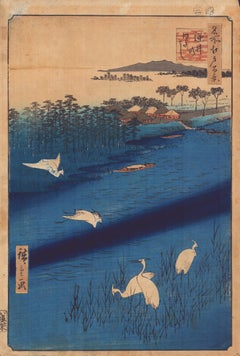
The Ferry at Sakasai - One Hundred Famous Views of EDO 名所江戸百景

The Ferry at Sakasai - One Hundred Famous Views of EDO 名所江戸百景

By Utagawa Hiroshige (Ando Hiroshige)

Located in BRUCE, ACT

Hiroshige (1797-1858) - One Hundred Famous Views of EDO 名所江戸百景 Artist: 広重 Hiroshige (1797-1858) Series: One Hundred Famous Views of EDO (名所江戸百景) Title: The Ferry at Sakasai (逆井のわたし...

Category

1850s Art

Materials

Woodcut

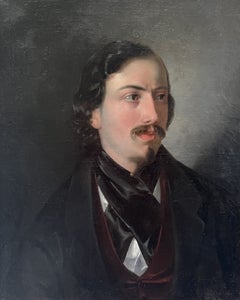
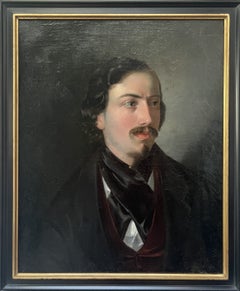
Portrait of a Young Man, Romantic School, circa 1840–1855 oil on canvas

Portrait of a Young Man, Romantic School, circa 1840–1855 oil on canvas

Located in Paris, FR

Portrait of a Young Man, Romantic School, circa 1840–1855 oil on canvas Dimensions (without frame): 22.4 x 18.1 in (57 x 46 cm) Dimensions (framed): 24.8 x 20.5 in (63 x 52 cm) Bust...

Category

Romantic 1850s Art

Materials

Oil

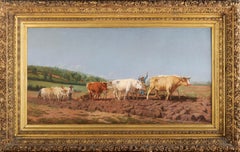
Ploughing in the Nivernais

Ploughing in the Nivernais

By Rosa Bonheur

Located in BELEYMAS, FR

Studio of Rosa Bonheur (Bordeaux 1822 – Thomery 1899) Ploughing in the Nivernais Oil on canvas H. 62 cm; W. 120 cm (97 x 154 cm including frame) Unsigned Ploughing in the Nivernais ...

Category

French School 1850s Art

Materials

Canvas, Oil

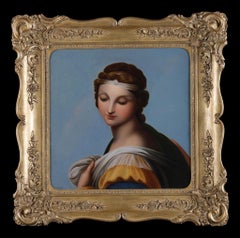
Chinese Qing Dynasty Reverse Painted Glass Painting 19th C.

Chinese Qing Dynasty Reverse Painted Glass Painting 19th C.

Located in Dallas, TX

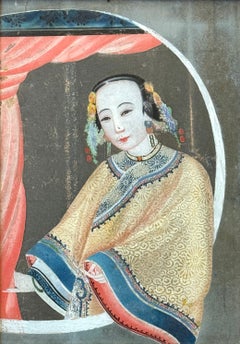
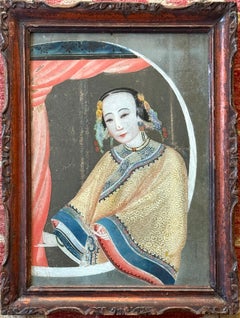
19th Century Chinese Glass reverse Painted Figure Of A Dignifies Woman dressed in a decorated gold silk robe with ornate colorful jewelry. Circa 1825 Chinese export Signed on verso. ...

Category

Qing 1850s Art

Materials

Glass, Oil

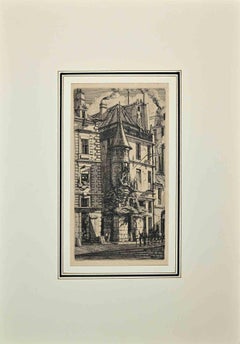
Tourelle de la Rue de la Tixeranderie - Etching by C. Meryon - 1852

Tourelle de la Rue de la Tixeranderie - Etching by C. Meryon - 1852

By Charles Meryon

Located in Roma, IT

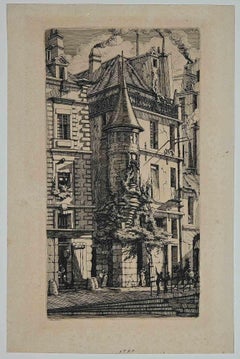
Tourelle de la rue de la Tixeranderie is an original Modern Artwork realized in the half of the 19th Century by Charles Meryon (sometimes Méryon, 23 November 1821 – 14 February 1868). Original Etching. Fine impression printed by the artist. II/III state on V. Total dimensions: 24 x 12 cm. Passepartout is included. Excellent conditions of sheet. Reference: Salimbeni no.163; Schneiderman n. 24; Delteil n. 29. Charles Meryon (sometimes Méryon, 23 November 1821 – 14 February 1868). He was a French artist who worked almost entirely in etching, as he suffered from color blindness. Although now little-known in the English-speaking world, he is generally recognized as the most significant etcher of 19th century France. His most famous works by him are a series of views powerfully conveying his distinctive Gothic vision of Paris. He also suffered from mental illness, dying in an asylum. Meryon had sketched in Athens, Algiers and other exotic places he had visited, and by late 1840 decided to take lessons in drawing from the Toulon...

Category

Modern 1850s Art

Materials

Etching

Landscape near Bordeaux

Landscape near Bordeaux

By Louis Alexandre Cabié

Located in BELEYMAS, FR

Louis-Alexandre CABIÉ (Dol-de-Bretagne 1853 - Bordeaux 1939) Landes at Pessac, near Bordeaux - Gironde Oil on canvas H. 126 cm; W. 201 cm Signed lower left Louis Cabié, a renowned a...

Category

French School 1850s Art

Materials

Canvas, Oil

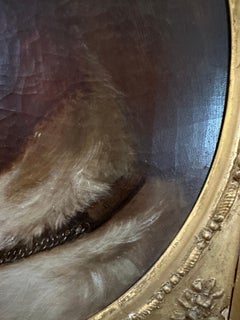
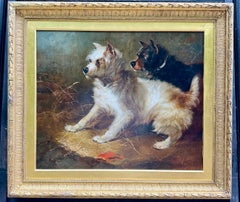
English 19th century portrait of two seated King Charles Cavalier Spaniels dogs

English 19th century portrait of two seated King Charles Cavalier Spaniels dogs

By James Cassie

Located in Woodbury, CT

James Cassie was born at Keithhall near Inverurie, Aberdeenshire, the son of a prosperous tea and spirit merchant. Although briefly a pupil of the artist James Giles, Cassie was largely self-taught. He began his career as a painter of animals and portraits, but on moving to Aberdeen he increasingly turned his attention to local seascapes and coastal scenes, especially at dawn and sunset. He favored these outdoor scenes but continued to paint some domestic subjects and portraits throughout his life. In 1869 he moved to Edinburgh and was elected an associate of the Royal Scottish Academy. Shortly before his death in 1879 he was elected an Academician. This piece is framed in its original frame and the painting is signed lower right and inscribed on the reverse. From the inscription on the reverse, this painting was purchased from an important house sale...

Category

Victorian 1850s Art

Materials

Oil, Wood Panel

LE PETIT CAVALIER SUR BOIS.

LE PETIT CAVALIER SUR BOIS.

By Jean Baptiste Corot

Located in Santa Monica, CA

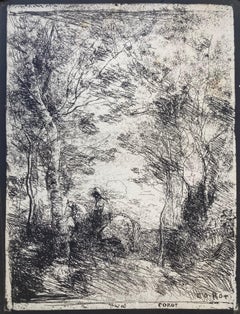
JEAN-BAPTISTE CAMILLE COROT (1876 - 1875) LE PETIT CAVALIER SUR BOIS. 1854 (1921) (Delteil 42) Cliché-verre on thin vellum. Signed in plate at bottom. 8 1/4 x 6 5/16” (sheet size)....

Category

Realist 1850s Art

Materials

Photographic Paper, Etching

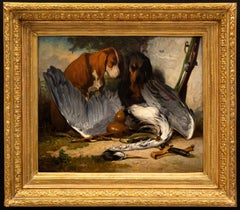
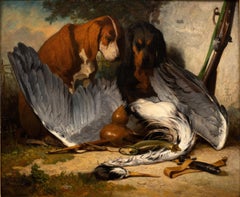
"Still Life and Hunting Dogs, 1851" P. M. Guillemin (French, 1800-1874)

"Still Life and Hunting Dogs, 1851" P. M. Guillemin (French, 1800-1874)

Located in SANTA FE, NM

"Still Life and Hunting Dogs, 1851" P. M. Guillemin (French, 1800-1874) Monogrammed "EG" on right side. Oil on cradle board 26 x 21 (36 x 31 frame) inches Stunning example and un...

Category

Romantic 1850s Art

Materials

Oil, Wood Panel

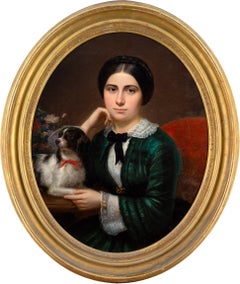
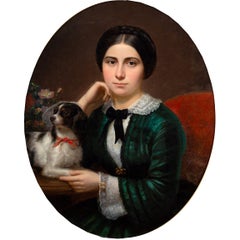
Mid-19th-Century French School, Portrait Of A Young Woman With Her Dog

Mid-19th-Century French School, Portrait Of A Young Woman With Her Dog

Located in Cheltenham, GB

This charming mid-19th-century French oil painting depicts a young woman seated alongside her beloved dog. It's signed with the initials ‘HP’ and dated 1854. There's an appealing di...

Category

French School 1850s Art

Materials

Canvas, Oil

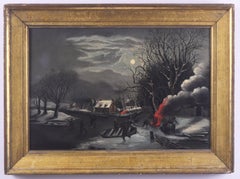
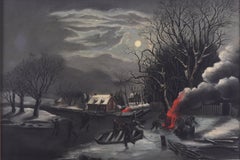
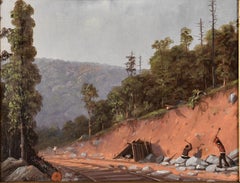
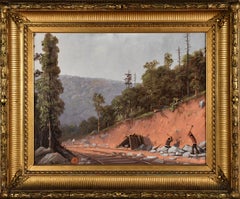
"Building the Allegheny Railroad, Pennsylvania" Alfred Wall, Scalp Level School

"Building the Allegheny Railroad, Pennsylvania" Alfred Wall, Scalp Level School

Located in New York, NY

Alfred S. Wall (American, 1825-1896) Untitled (Building the Railroad), 1859 Oil on canvas 14 1/2 x 18 1/2 inches Signed and dated lower left For Christmas, 2008, the Pittsburgh Post-Gazette featured Alfred Wall's painting, Old Saw Mill from the collection of the Westmoreland Museum of American Art in Greensburg, PA. It was painted in 1851 in the town of Lilly, Pennsylvania in the Allegheny Mountains. The newspaper description stated that "though the saw mill is long gone, it still conveys all the warmth and coziness of this time of year. The article, written by Patricia Lowry, continued: At first glance, Alfred S. Wall's painting of a saw mill in snowy woods triggers nostalgia for the coziness of a log cabin, the smell of a wood-burning fire and the warming of chilled hands and feet beside it. But as sentimental as it seems on the surface, Mr. Wall's painting has a deeper and unexpected context. This is more than a painting about sled-riding children and early industry planted in the middle of virgin forest. Intended or not, this is a painting about conquering the great divide of the Allegheny Mountains. For the third consecutive year, the Post-Gazette features a winter-scene painting on the cover of the Christmas Day newspaper. This year's painting, Old Saw Mill, was selected by co-publisher and editor-in-chief John Robinson Block and executive editor David Shribman during a visit to the Westmoreland Museum of American Art in Greensburg. Mr. Wall, listed as a portrait painter in the 1850 census, was about 26 when he painted Old Saw Mill in 1851. The self-taught artist was born in Mount Pleasant, Westmoreland County, to William and Lucy Wall, who'd emigrated from England around 1820. An artistic sensibility ran in the family: William was a sculptor who carved ornate tombstones here; Alfred's children, A. Bryan and Bessie, were landscape painters, as was Alfred's older brother, William Coventry Wall. For more than a century the Walls formed a prominent art dynasty in Pittsburgh, and Alfred, eventually a partner in the city's most prestigious art gallery, was well known as a painter, dealer and restorer. In Old Saw Mill, two wood cutters, each holding an axe, meet outside the mill; one points in the direction of the forest. On the other side of the stream, one child pulls another down the hillside on a sled. Just behind the hill's slope, the roof of a building appears, perhaps the home of the sawyer. The luminous, late afternoon light comes from the northwest, casting lengthening shadows on the snow under a darkening sky. The saw mill in "Old Saw Mill" likely would have been impossible to track down had Mr. Wall, presumably, not written on the back of the painting: "old saw mill near Jct. 4, Portage RR, Pa." "There was no Junction 4," said Mike Garcia, park ranger at the Allegheny Portage Railroad National Historic Site, about 90 miles east of Pittsburgh near Gallitzen, Cambria County. "But there was an Inclined Plane No. 4 at Lilly, and there was a saw mill there." In fact, there were at least six saw mills at Lilly over the years, said longtime resident Jim Salony, president of the Lilly-Washington Historical Society. But when he saw an image of the painting, Mr. Salony had no trouble coming up with a location. While there are no known photographs of the saw mill, he believes it stood near the intersection of Portage and Washington streets, next to Bear Rock Run. Mr. Salony, retired academic dean at Mount Aloysius College, didn't know exactly when the mill was torn down, but it's been gone since at least the late 1800s. He was pleased to learn of the painting, even though that knowledge came too late for inclusion in a new book about Lilly, The Spirit of a Community, for which he served as primary author and editor. It runs to more than 700 pages. For a little town -- population 869 last year -- Lilly has a lot of history. Nestled in a bowl on the western slope of the Allegheny Mountains about 3 miles south of Cresson, Lilly was first settled in 1806 by Joseph Meyer and his family, who named their 332-acre land patent Dundee. Although the Meyers had left by 1811, other settlers followed, but the community didn't flourish until the 1830s, when the Allegheny Portage Railroad began its 23-year-run through the town. For 200 years the Alleghenies had stood as an impediment to trade and travel between Pittsburgh and the east. A canal from Philadelphia to Pittsburgh would change that and compete with New York's Erie Canal. But a portage railroad would have to be built, on which teams of horses would lead the canal boats over the mountains. Engineer Sylvester Welch began his surveying from the small settlement at Lilly. The railroad would require 10 inclined planes, some quite steep, between Hollidaysburg and Johnstown. To build it, trees had to be cut along a 120-foot-wide right-of-way for 36 miles, along which track and engine houses had to be built. William Brown, who owned the saw mill on Bear Rock Run, built at least one of the engine houses at Inclined Plane No. 4; an 1834 contract also included fencing the dwelling lots at the head and foot of the plane. Lilly is located at what was the foot of Inclined Plane No. 4., giving the community one of its early informal names, Foot of Four. Named in 1883 for Richard Lilly, who'd completed the grist mill there, Lilly had another early name: Hemlock, so dubbed by a Portage Railroad traveler who smelled the bark stripped from the trees at the saw mill. Because there isn't another Allegheny Portage Railroad location like it, where a cut in the mountains opens into a bowl, Mr. Salony thinks it was Lilly that Charles Dickens wrote about following his trip from Harrisburg to Pittsburgh on the Pennsylvania Canal in late March 1842, describing what he saw after emerging from "the bottom of the cut": "It was very pretty while traveling, to look down into a valley full of light and softness, catching glimpses through the tree-tops of scattered cabins; children running to the doors; dogs bursting out to bark, who we could see without hearing; terrified pigs scampering homeward; families sitting out in their rude gardens; cows gazing upward with a stupid indifference; men in their shirt-sleeves looking on at their unfinished houses, planning out to-morrow's work; and we riding onward, high above them, like a whirlwind." To get to Lilly, Mr. Wall may have taken the Pennsylvania Canal from his home in Allegheny City, now the North Side. He'd married young, at 21, to Sarah Carr in 1846, the same year he began his career as an artist. By 1880 they were living in a brick townhouse at 104 (later 814) Arch St., now demolished. Across the river in Pittsburgh he shared a studio at 67 Fourth Ave. with his brother William; they later moved to Burke's Building, today the city's oldest office building at 209-211 Fourth. But often they worked outdoors, sometimes as part of the colony of artists that grew up around painter George Hetzel beginning in the late 1860s at Scalp Level...

Category

Hudson River School 1850s Art
Materials

Canvas, Oil

Mount Washington,  New Hampshire

Mount Washington, New Hampshire

By Edmund Darch Lewis

Located in Saratoga Springs, NY

Edmund Darch Lewis (1835-1910) Mount Washington, New Hampshire 50 x 58 inches, signed & dated 1859 Description The area near Mount Washington in New Hampshire was visited by m...

Category

Hudson River School 1850s Art
Materials

Canvas, Oil