1930s Art

to
888
3,455
1,254
914
538
354
Overall Width
to
Overall Height
to
7,743
21,914
164,667
227,143
2,033
2,309
5,000
6,563
5,891
15,112
20,699
25,952
18,728
14,112
5,526
2,535
512
404
242
111
108
104
72
13
12
5
2
2
3,659
2,391
320
3,964
1,801
1,651
1,180
1,154
724
466
445
436
361
335
320
294
292
289
233
229
225
222
186
2,025
1,627
1,363
1,199
889
261
145
107
90
60
1,813
1,129
3,511
2,657
Period: 1930s
Joan Miro, The Air, from Verve, Revue Artistique, 1938

Joan Miro, The Air, from Verve, Revue Artistique, 1938

By Joan Miró

Located in Southampton, NY

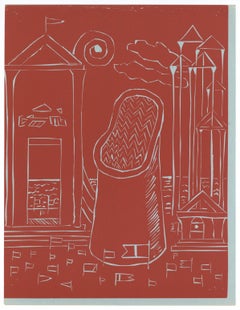
This exquisite lithograph by Joan Miro (1893–1983), titled L'air (The Air), from Verve, Revue Artistique et Litteraire, Vol. I, No. 3, originates from the 1938 issue published by Editions de la revue Verve, Paris, under the direction of Teriade, Editeur, Paris, and printed by Mourlot Freres, Paris, 1938. This lyrical and atmospheric composition embodies Miro's fascination with the invisible rhythms of nature and the poetry of movement. L'air captures the ethereal and weightless essence of the natural world through his fluid linework and organic forms, evoking a sense of freedom and transformation. The work reflects Miro's deep belief in the interconnectedness of all living things and his pursuit of an art that transcends material boundaries to reach the spiritual realm. Created during one of the artist's most innovative periods, this piece demonstrates the harmony between abstraction and imagination that defines his unique visual language. Executed as a lithograph on velin du Marais paper, this work measures 14 x 10.5 inches. Signed in the plate and unnumbered as issued. The edition exemplifies the superb craftsmanship of the Mourlot Freres atelier, renowned for its collaborations with the leading modernists of the 20th century. Artwork Details: Artist: Joan Miro (1893–1983) Title: L'air (The Air), from Verve, Revue Artistique et Litteraire, Vol. I, No. 3, 1938 Medium: Lithograph on velin du Marais paper Dimensions: 14 x 10.5 inches Inscription: Signed in the plate and unnumbered as issued Date: 1938 Publisher: Editions de la revue Verve, Paris, under the direction of Teriade, Editeur, Paris Printer: Mourlot Freres, Paris Catalogue raisonne references: Dupin, Jacques, et al. Miro Graveur. D. Lelong, 1984, illustration 1310. Miro, Joan, et al. Joan Miro: Lithographs. Leon Amiel, 1972, illustration 6. Condition: Well preserved, consistent with age and medium Provenance: From Verve, Revue Artistique et Litteraire, Vol. I, No. 3, published by Editions de la revue Verve, Paris, 1938 About the Publication: Verve, Revue Artistique et Litteraire was one of the most influential art periodicals of the 20th century, founded in Paris in 1937 by the visionary Greek-born publisher Teriade (Stratis Eleftheriades). Conceived as a synthesis of art and literature, Verve brought together the greatest modern artists and writers of its time—Henri Matisse, Pablo Picasso, Marc Chagall, Georges Braque, Joan Miro, Fernand Leger, and others—alongside poets and philosophers such as Paul Eluard, Albert Camus, and Jean-Paul Sartre. Each issue was a work of art in itself, luxuriously printed by master lithographers such as Mourlot Freres and produced in collaboration with leading typographers and designers. Verve became a platform for avant-garde creativity, publishing original lithographs and essays that reflected the evolving spirit of modernism. Matisse collaborated closely with Teriade from the magazine's inception, producing some of its most iconic issues, including those devoted to his paper cut-outs. The final Verve issue of 1958, which featured La Tristesse du Roi and the Nu Bleu series, stands as a testament to Matisse's enduring genius and to the publication's legacy as the definitive meeting of art, poetry, and printing craftsmanship in 20th-century France. About the Artist: Joan Miro (1893–1983) was a Catalan painter, sculptor, printmaker, and ceramicist whose visionary imagination and lyrical abstraction made him one of the most influential and beloved artists of the 20th century. Born in Barcelona, Miro drew inspiration from Catalan folk art, Romanesque frescoes, and the luminous landscapes of Mont-roig del Camp, developing a deep connection to nature that infused his work with vitality and symbolism. After formal training at the Escola d'Art in Barcelona, he absorbed the lessons of Post-Impressionism and Cubism before moving to Paris in the early 1920s, where he became a leading figure in the Surrealist movement. There, Miro forged a personal visual language of biomorphic shapes, floating symbols, and radiant color harmonies that reflected both spontaneity and spiritual depth. In creative dialogue with peers such as Alexander Calder, Alberto Giacometti, Salvador Dali, Wassily Kandinsky, Marcel Duchamp, and Man Ray, he helped revolutionize modern art by dissolving the boundaries between abstraction and dream imagery. Miro's inventive approach extended far beyond painting, embracing sculpture, ceramics, and monumental public commissions that redefined how art could interact with space and emotion. His expressive freedom and gestural abstraction profoundly influenced later artists including Jackson Pollock, Mark Rothko, Alexander Calder, Jean Dubuffet, Antoni Tapies, and Joan Mitchell, inspiring generations who sought to merge instinct, color, and imagination. Today, Miro's work remains a cornerstone of modernism, prized by collectors and celebrated in major museums worldwide. His highest auction record was achieved by Peinture (Etoile Bleue) (1927), which sold for £23,561,250 (approximately $37 million) at Sotheby's, London, on June 19, 2012. Joan Miro L'air, Miro Verve...

Category

Surrealist 1930s Art

Materials

Lithograph

'The Yankee' — America's Cup, 1934

'The Yankee' — America's Cup, 1934

By Jacques La Grange

Located in Myrtle Beach, SC

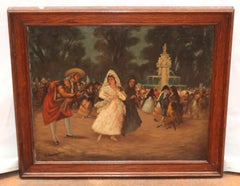
Jacques La Grange, 'The Yankee', color woodcut, edition 500, 1934. Signed and numbered '25/500' in pencil. A fine impression, with fresh colors, on cream wove paper, with margins (1 1/8 to 1 1/4 inches), in excellent condition. A work from La Grange’s celebrated series of woodcuts 'Drama and Color in the America's Cup Races'. Image size 10 x 10 11/16 inches (254 x 271 mm); sheet size 12 1/4 x 13 1/4 inches (311 x 337 mm). Archivally matted to museum standards, unframed. When the artist created this print in 1934, the 'Yankee' was one of the most promising yachts eligible for the America's Cup but ultimately 'Rainbow' was chosen to defend against England's 'Endeavor' in that year's race. The 'Endeavor' was built for Thomas Sopwith who used his aviation design expertise to ensure the yacht was the most advanced of its day with a steel hull and mast. She was launched in 1934 and won many races in her first season but the Cup challenge was blighted by a strike of Sopwith's professional crew prior to departing for America. Forced to rely mainly on keen amateurs, who lacked the necessary experience, the campaign failed. 'Rainbow' won the series 4–2. This was one of the most contentious of the America's Cup battles and prompted the headline "Britannia rules the waves and America waives the rules." ABOUT THE ARTIST Jacques La Grange was born in Clanwilliam (near Cape Town) in South Africa in 1895. He studied at London University and later immigrated to the United States. La Grange established himself as a painter, illustrator, and printmaker specializing in nautical subjects. He and his wife, Helen La Grange, published 'Drama and Color in the America's Cup Races' in 1934 and 'Clipper Ships of America and Great Britain 1833-1869', in 1936. Both were deluxe hardcover limited edition volumes with signed original color woodblock prints. La Grange had solo exhibitions at the Buchanan Gallery in 1929; the Babcock Gallery and the 56th Street Gallery, New York, in 1930; and at the Nicholas Roerich...
Category

American Modern 1930s Art

Materials

Woodcut

A Man's Wife
A Man's Wife

A Man's Wife

By Norman Rockwell

Located in Fort Washington, PA

Medium: Charcoal and Pencil on Paper Dimensions: 31.00" x 23.75" Signature: Inscribed and Signed. Signed and inscribed 'To Steve Kovac/sincerely/Norman/Rockwell' (lower right) Proven...

Category

1930s Art

Materials

Paper, Charcoal, Pencil

Umberto Brunelleschi, Untitled, from The Tales of Boccaccio, 1934 (after)

Umberto Brunelleschi, Untitled, from The Tales of Boccaccio, 1934 (after)

By Umberto Brunelleschi

Located in Southampton, NY

This exquisite lithograph and pochoir after Umberto Brunelleschi (1879–1949), titled Sans titre (Untitled), originates from the celebrated album Les contes de Boccace (The Tales of B...

Category

Art Deco 1930s Art

Materials

Lithograph, Stencil

Umberto Brunelleschi, Untitled, from The Tales of Boccaccio, 1934 (after)

Umberto Brunelleschi, Untitled, from The Tales of Boccaccio, 1934 (after)

By Umberto Brunelleschi

Located in Southampton, NY

This exquisite lithograph and pochoir after Umberto Brunelleschi (1879–1949), titled Sans titre (Untitled), originates from the celebrated album Les contes de Boccace (The Tales of B...

Category

Art Deco 1930s Art

Materials

Lithograph, Stencil

Umberto Brunelleschi, Untitled, from The Tales of Boccaccio, 1934 (after)

Umberto Brunelleschi, Untitled, from The Tales of Boccaccio, 1934 (after)

By Umberto Brunelleschi

Located in Southampton, NY

This exquisite lithograph and pochoir after Umberto Brunelleschi (1879–1949), titled Sans titre (Untitled), originates from the celebrated album Les contes de Boccace (The Tales of B...

Category

Art Deco 1930s Art

Materials

Lithograph, Stencil

Byron Browne, (Abstraction)

Byron Browne, (Abstraction)

By Byron Browne

Located in New York, NY

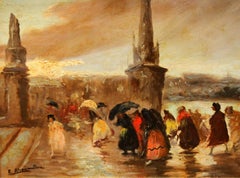
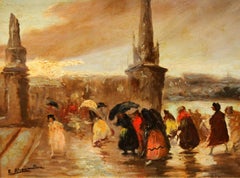
This print was made for the American Abstract Artists Portfolio, 1937. All the images were lithographs made on zinc plates. Usually they were signed in the image -- on the plate, as ...
Category

Abstract 1930s Art

Materials

Lithograph

Jean Lurcat, S.O.S., from Eight Drawings, 1933 (after)

Jean Lurcat, S.O.S., from Eight Drawings, 1933 (after)

By Jean Lurçat

Located in Southampton, NY

This exquisite heliogravure after Jean Lurcat (1892–1966), titled S.O.S., from the folio Jean Lurcat Huit Dessins (Jean Lurcat Eight Drawings), originates from the 1933 edition publi...

Category

Surrealist 1930s Art

Materials

Lithograph

'Negro' — California WPA Social Realism – Slavery

'Negro' — California WPA Social Realism – Slavery

Located in Myrtle Beach, SC

Nicholas Panesis, 'Negro', 1934, color lithograph, edition 18. Signed, dated, titled, and numbered 8/28 in pencil. Initialed in the stone, lower right. A fine impression, with fresh colors, on buff wove paper, with margins (1 1/8 to 2 3/8 inches). Minor glue staining at the extreme sheet edges verso, where previously taped (not visible recto), otherwise in excellent condition. Very scarce. Matted to museum standards, unframed. Image size 10 5/8 x 8 1/2 inches; (270 x 216 mm); sheet size 14 13/16 x 10 15/16 inches (376 x 278 mm). Created for the California Works Progress Administration, Federal Art Project (WPA). Impressions of this work are held in the public collections of La Salle University Art Museum (Philadelphia), U.S. General Services Administration, and Weisman Art Museum (University of Minnesota). ABOUT THE ARTIST Born in Massachusetts, Nicholas Panesis (1913-1967) studied art at Syracuse University, NY, and went on to teach ceramics at Alfred University, NY. Panesis moved to San Francisco in the early 1930s shortly before settling in Los Angeles, where he worked for different animation studios...

Category

American Realist 1930s Art

Materials

Lithograph

Jean Cocteau, Untitled, from The White Book, 1930

Jean Cocteau, Untitled, from The White Book, 1930

By Jean Cocteau

Located in Southampton, NY

This exquisite lithograph and pochoir with hand coloring by Jean Cocteau (1889–1963), titled Sans titre (Untitled), from the album Le Livre blanc (The White Book), precede dun fronti...

Category

Modern 1930s Art

Materials

Lithograph, Stencil

Rank and File, Redbook Magazine Illustration

Rank and File, Redbook Magazine Illustration

By Ralph Coleman

Located in Fort Washington, PA

Date: 1933 Medium: Oil on Canvas Dimensions: 28.00" x 36.00" Signature: Signed Lower Left 1933 Interior Redbook Magazine, November 1933 A large signed and dated oil on canvas by no...

Category

1930s Art

Materials

Canvas, Oil

Hans Jean Arp, Constellations, from XXe siecle, 1938

Hans Jean Arp, Constellations, from XXe siecle, 1938

Located in Southampton, NY

This exquisite woodcut by Hans Jean Arp (1886–1966), titled Constellations, from the album XXe siecle, Chroniques du jour, 13 rue Valette (5e), Directeur G. di San Lazzaro, Sommaire ...

Category

Modern 1930s Art

Materials

Woodcut

A Young Girl Reading a Book, Pointillist Artist

A Young Girl Reading a Book, Pointillist Artist

Located in Stockholm, SE

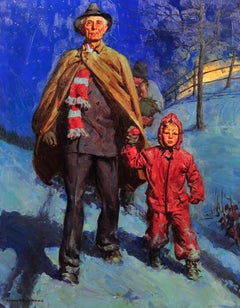
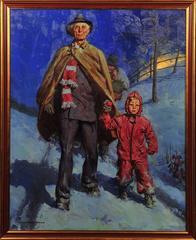
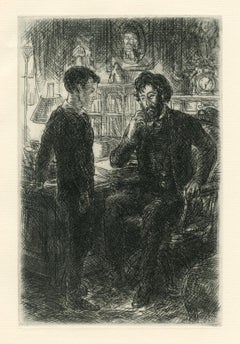
"A Young Girl Reading a Book" is a captivating portrait by Swedish artist Gustaf Arnolds. Arnolds was a prolific painter whose roots began in Vingåker and later in Ronneby from his teenage years. His educational journey in art took him through prestigious institutions such as Althins målarskola and the Tallbergska grafikskolan in Stockholm, followed by a significant period at the Konstakademien, Stockholm, between 1904 and 1909. His talent and dedication were recognized early on, earning him a scholarship to Paris, a city that would deeply influence his artistic direction. This particular work, likely painted shortly after his return to Sweden, reveals a profound influence from his time in Paris. It portrays a young girl absorbed in reading a book, a simple yet profound subject that Arnolds imbues with a sense of tranquility and introspection. The background hints at a serene landscape, dotted with quaint houses, a nod to the everyday beauty surrounding us. What sets this piece apart is Arnolds’ technique, reminiscent of pointillism but distinguished by longer, more expressive brush strokes that add a vibrant texture and depth to the canvas. This method showcases Arnolds' unique adaptation of the techniques he encountered during his Parisian studies, particularly during his interactions with Nils Dardel...
Category

Pointillist 1930s Art

Materials

Masonite, Oil

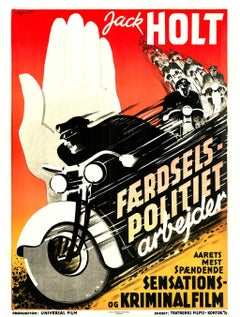
Original Jack Holt  Motorcycle - Crash Donovan vintage movie poster

Original Jack Holt Motorcycle - Crash Donovan vintage movie poster

Located in Spokane, WA

Original 1930s Danish Movie Poster – "Færdsels-Politiet Arbejder" (Crash Donovan) Featuring Jack Holt – Vintage Police Crime Action Artwork – Rare Universal Film Collectible movie...

Category

Art Deco 1930s Art

Materials

Lithograph

"End of Winter"
"End of Winter"

"End of Winter"

By John E. Berninger

Located in Lambertville, NJ

Jim’s of Lambertville is proud to offer this artwork by: John Berninger (1897 - 1981) A Pennsylvania landscape painter living in Allentown, John Berninger is described by art writer, Geoff Gehman, as being in the "outer ring of the New Hope School." His career was devoted to depicting his region in realist-impressionist style, especially snowscenes and landmarks such as Meyers Bridge in Allentown. Berninger studied with Orlando Gray Wales, Arlington Lindenmuth and Walter Emerson Baum, and then was an art instructor at the Kline-Baum School in Allentown. In 1934, he was selected as one of four students of Baum into the Circulating Picture Club of the Philadelphia Art Alliance, and two years later, he became Curator at the Allentown Art Museum, which had just been founded by Baum. Berninger's wife, Mabel, assisted him and served as museum curator and secretary of the Circulating Picture Club. In 1939, he joined the jewelry store, Wuchter and Berninger, as a partner, and advertised his paintings by placing them in the store's window. A local publisher and art enthusiast, Robert Rodale, saw his work there and years later, in 2004, held the first major exhibition of Berninger's artwork. The next year, Berninger's work was represented in the Allentown Museum exhibit, "Allentown Impressions: Views of City Parks". A frequent painting companion was Karl Buesgen...

Category

American Impressionist 1930s Art

Materials

Canvas, Oil

Peggy O'Neil, Redbook Magazine Interior Illustration, 1932

Peggy O'Neil, Redbook Magazine Interior Illustration, 1932

By Mead Schaeffer

Located in Fort Washington, PA

Illustration for “Women America Remembers: Peggy O’Neil” by Arthur D. Howden Smith for The Red Book Magazine, published March 1930, illustrated pages 20-21. This painting by Mead Schaeffer depicts a romantic encounter between Peggy O'Neil and her first husband, John Timberlake. The accompanying caption reads: "It was inevitable that Peggy should fall in love—and she did, with John Timberlake, who had little besides his face to recommend him." It was created in 1930 for the third installment of The Red Book Magazine’s “Women America Remembers” series, which features stories of women famous for “personality, beauty, wit or audacity, or because of the tragedy left in their train.” Margaret ("Peggy") O'Neil Eaton remains a figure of historical intrigue, primarily for her central role in the "Petticoat Affair," a significant political scandal during Andrew Jackson's presidency. The circumstances surrounding Peggy’s marriage to John Eaton, occurring shortly after the death of her first husband, John Timberlake, and her family’s background as tavern-keepers, coupled with her perceived impudent personality, subjected her to intense social scrutiny in Washington D.C. Upon John Eaton's appointment as Secretary of War, Peggy faced social ostracism led by Floride Calhoun, wife of Vice President John Calhoun...

Category

1930s Art

Materials

Canvas, Oil

"Salomé" pochoir

"Salomé" pochoir

By (after) André Derain

Located in Henderson, NV

Medium: pochoir (after the gouache). This pochoir illustrates a scene from Oscar Wilde's "Salomé". It was printed in 1938 at the atelier Saudé of Paris and published by The Limited E...

Category

Fauvist 1930s Art

Materials

Lithograph, Stencil

"Salomé" pochoir

"Salomé" pochoir

By (after) André Derain

Located in Henderson, NV

Medium: pochoir (after the gouache). This pochoir illustrates a scene from Oscar Wilde's "Salomé". It was printed in 1938 at the atelier Saudé of Paris and published by The Limited E...

Category

Fauvist 1930s Art

Materials

Lithograph, Stencil

Pennsylvania Farm
Pennsylvania Farm

Pennsylvania Farm

By Marion Butler Ewald

Located in North Clarendon, VT

A beautiful Pennsylvania Farm painted by Marion Butler Ewald. Strong, bright and bold. Her career was short but her impact was impressive. 18" x 16" sight, 22.5" x 20.5" framed, oil ...

Category

Post-Impressionist 1930s Art

Materials

Oil

"Jeune Fille, " Original Sepia Portrait Etching signed by Marie Laurencin

"Jeune Fille, " Original Sepia Portrait Etching signed by Marie Laurencin

By Marie Laurencin

Located in Milwaukee, WI

"Jeune Fille" is an original sepia etching by Marie Laurencin. The artist's stamped signature is in the lower right. This piece features a delicate portrait of a young girl. 13" x 9 7/8' paper 9" x 5 1/2" image 20 7/8" x 17 3/8" frame Marie Laurencin (October 31, 1883 - June 8, 1956) was a French painter and printmaker. Laurencin was born in Paris, where she was raised by her mother and lived much of her life. At 18, she studied porcelain painting in Sèvres. She then returned to Paris and continued her art education at the Académie Humbert, where she changed her focus to oil painting. During the early years of the 20th century, Laurencin was an important figure in the Parisian avant-garde. A member of both the circle of Pablo Picasso, and Cubists associated with the Section d'Or, such as Jean Metzinger, Albert Gleizes, Robert Delaunay, Henri le Fauconnier and Francis Picabia, exhibiting with them at the Salon des Indépendants (1910-1911) and the Salon d'Automne (1911-1912). Laurencin's works include paintings, watercolors, drawings, and prints. She is known as one of the few female Cubist painters, with Sonia Delaunay, Marie Vorobieff, and Franciska Clausen...

Category

Modern 1930s Art

Materials

Etching

Jon Corbino, Montana Earthquake, 1936, lithograph

Jon Corbino, Montana Earthquake, 1936, lithograph

By Jon Corbino

Located in New York, NY

Works by Jon Corbino (1905-1964) feature drama. Here he's showing us the chaos produced by a major earthquake in rural Montana in 1936 -- an actual historical event. The horses (ear...

Category

American Modern 1930s Art

Materials

Lithograph

AFTER THE VICTORY, PROPHECY OF ISAIAH, WPA ERA Circa 1930s

AFTER THE VICTORY, PROPHECY OF ISAIAH, WPA ERA Circa 1930s

By Saul Rabino

Located in Surfside, FL

A wartorn composition of a soldier on the left, a Jewish blacksmith in the middle and a little shepherd on the right. This is a lithograph pastel and colored pencil on paper. Saul R...

Category

Modern 1930s Art

Materials

Pastel, Color Pencil, Lithograph

"Still Life" original lithograph

"Still Life" original lithograph

By Max Weber

Located in Henderson, NV

Medium: original lithograph. Printed in 1930 in an edition of 250 and published in New York by The Downtown Gallery. Size: 10 x 6 3/4 inches (252 x 172 mm). Signed in the plate; not ...

Category

1930s Art

Materials

Lithograph

1930s original Art Deco poster for Dubonnet - Vin tonique au quinquina

1930s original Art Deco poster for Dubonnet - Vin tonique au quinquina

Located in PARIS, FR

During the 1930s, Art Deco reigned supreme as a symbol of modernity and elegance. Charles Delavat's iconic poster for Dubonnet, created around 1930, epitomizes this era of sleek design and vibrant allure. At its center is a stylish woman, the epitome of Art Deco fashion, holding a glass of Dubonnet with confidence and allure. The poster's bold geometric shapes, rich colors, and dynamic composition reflect the era's spirit of sophistication and cultural dynamism. Delavat's work not only promoted Dubonnet but also captured a lifestyle—luxurious, modern, and vibrant. It remains a timeless example of how advertising merged with art to create enduring symbols of style and glamour. In the realm of Art Deco design, Charles Delavat's Dubonnet poster...

Category

Art Deco 1930s Art

Materials

Linen, Paper, Lithograph

1939 Powerful WWII french poster - Subscribe to Armament Bonds

1939 Powerful WWII french poster - Subscribe to Armament Bonds

Located in PARIS, FR

Designed by J. Kap in 1939, this powerful poster titled "Souscrivez aux Bons d’Armement" (Subscribe to Armament Bonds) was a key piece of French wartime propaganda at the dawn of Wor...

Category

1930s Art

Materials

Paper, Lithograph