1930s Art

to
955
3,461
1,239
899
537
347
Overall Width
to
Overall Height
to
7,593
21,425
163,275
225,226
2,006
2,280
4,983
6,532
5,792
15,021
20,670
25,705
18,623
13,956
5,382
2,513
521
400
231
123
112
105
70
14
12
5
2
2
3,628
2,389
316
3,925
1,787
1,637
1,159
1,147
723
455
441
436
357
347
316
288
287
276
241
226
225
219
190
1,997
1,582
1,348
1,213
870
261
128
107
82
61
1,769
1,131
3,462
2,666
Period: 1930s
1930's British Oil Painting Portrait of Westminster School Boy in Uniform

1930's British Oil Painting Portrait of Westminster School Boy in Uniform

Located in Cirencester, Gloucestershire

"Young Westminster" by Kathleen Emily Temple-Bird (British 1879 - 1962) signed and dated 1931 oil painting on canvas, framed framed: 33 x 24 canvas: 29 x 20 inches condition: very go...

Category

English School 1930s Art

Materials

Oil

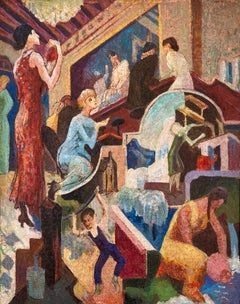
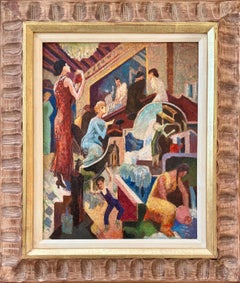
Antique American School 1930s NYC Surrealist Abstract Gold Gilt Oil Painting

Antique American School 1930s NYC Surrealist Abstract Gold Gilt Oil Painting

Located in Buffalo, NY

Antique American school modernist mixed media painting. Oil on board with gold leaf assemblage, circa 1930. Unsigned. Image size, 13L x 17H. Housed in a period wood frame most li...

Category

Abstract 1930s Art

Materials

Canvas, Oil

Kirk Hutton 'Commissionaire's Dog' Archival Photograph by Getty, 16x20

Kirk Hutton 'Commissionaire's Dog' Archival Photograph by Getty, 16x20

Located in San Rafael, CA

A hotel commissionaire talking to a small dachshund dog in Piccadilly Circus, London. Original Publication: Picture Post - 2 - In The Heart of the Empire - pub. 1938 (Photo by Kurt H...

Category

Contemporary 1930s Art

Materials

Photographic Paper

Dunes on California Coast, c 1930s

Dunes on California Coast, c 1930s

By Carl Sammons

Located in Pasadena, CA

Consigned to the gallery, Pasadena, California; By descent to a private collector, Encino, California; Acquired in 1998 by a private collector, San Carlos, Palo Alto, and Oceanside, California; From the Santa Barbara Historical Society Signed "Carl Sammons" on lower right Description This luminous coastal landscape by Carl Sammons is a striking example of the artist’s signature plein air style, depicting the rolling coastal dunes and lush vegetation of California’s shoreline. Best known for his depictions of Carmel and Monterey, the composition and palette of this work suggest inspiration from the Monterey Peninsula dunes. Sammons’ ability to merge vibrant, clean color with a sense of atmospheric perspective is evident here in the interplay of bright, sunlit sands and the rich greens of windswept foliage. His vibrant yet naturalistic color harmonies, crisp edges, and keen sensitivity to light bring the fleeting beauty of the coastal environment to life. The hazy eucalyptus grove in the background adds a distinctive regional touch, situating the composition firmly within California’s coastal identity. Sammons’ paintings of California’s unique landscapes played a significant role in documenting the natural beauty of the state during the early 20th century. Connection to the Monterey Art Colony By the 1920s and 1930s, Sammons became closely associated with the Monterey art colony, an influential hub for plein air painters such as Armin Hansen (1886–1957), William Ritschel (1864–1949), and Percy Gray...

Category

Impressionist 1930s Art

Materials

Oil, Board, ABS

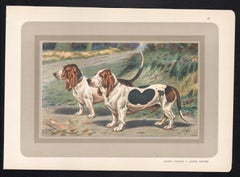
LA PARADE
LA PARADE

Georges RouaultLA PARADE, 1932

$1,100Sale Price|43% Off

LA PARADE

By Georges Rouault

Located in Santa Monica, CA

GEORGES ROUAULT (1871 – 1958) La PARADE 1932 (CR.203, W.211) color etching and aquatint 1932. Edition 270. Frontispiece from “Cirque”. Signed in plate as i...

Category

Modern 1930s Art
Materials

Etching

La Femme Visible
La Femme Visible

La Femme Visible

By Salvador Dalí­

Located in Hollywood, FL

ARTIST: Salvador Dali TITLE: La Femme Visible MEDIUM: original Heliogravure - Etching in the book titled "La Femme Visible" SIGNED: Hand Signed by Salvador Dali on the frontispie...

Category

Surrealist 1930s Art

Materials

Etching

Love Mirror Oil on Canvas, Signed Magazine Cover, Circa 1937, 17x13

Love Mirror Oil on Canvas, Signed Magazine Cover, Circa 1937, 17x13

Located in Miami, FL

Love Mirror, True Experiences magazine cover, February 1937 by Female Illustrator and Pupl Artist Georgia Warren Oil on canvas 17 x 13 inches (43.2 x 33.0 cm) Signed lower left: War...

Category

American Realist 1930s Art

Materials

Canvas, Oil

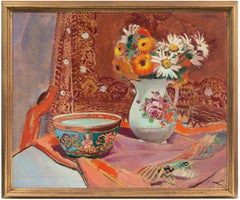
Icart, Sans titre, Le Sopha (after)

Icart, Sans titre, Le Sopha (after)

By Louis Icart

Located in Southampton, NY

La pointe sèche etching on vélin de Rives filigrané à notre nom paper. Paper size: 9.5 x 7.5 inches; image size: 6.5 x 4.5 inches. Inscription: unsigned and unnumbered, as issued. No...

Category

Modern 1930s Art
Materials

Drypoint, Etching

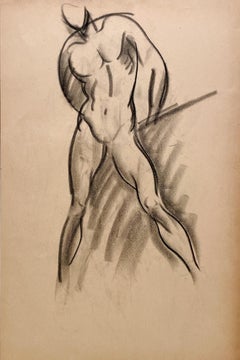
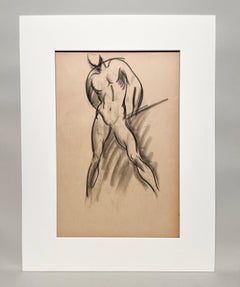
Cubist Nude

Cubist Nude

Located in New Orleans, LA

A gorgeous Margaret Trumbull Jennings cubist charcoal on paper circa 1930-40. Sister of the well-known artist Alice Trumbull Mason with who she studied and travelled. Jennings studied with Hans Hofmann and the Arts Students League NYC. As well as in Europe with Lhote, Leger, and Ozenfant. These drawings were executed under Hofmann tutelage and descended in the family to Alice Mason...

Category

Cubist 1930s Art

Materials

Paper, Charcoal

The Discus Thrower
The Discus Thrower

The Discus Thrower

By Claire J. R. Colinet

Located in Los Angeles, CA

Art Deco patinated bronze titled "The Discus Thrower" by Claire Jean Roberte Colinet (1880-1950) Raised on a circular green marble base and the attached to a square lacquered metal b...

Category

Art Deco 1930s Art

Materials

Bronze

Icart, Sans titre, Le Sopha (after)

Icart, Sans titre, Le Sopha (after)

By Louis Icart

Located in Southampton, NY

La pointe sèche etching on vélin de Rives filigrané à notre nom paper. Paper size: 9.5 x 7.5 inches; image size: 6.5 x 4.5 inches. Inscription: unsigned and unnumbered, as issued. No...

Category

Modern 1930s Art
Materials

Drypoint, Etching

Still Life of Vase and Statue - Penina Kishore 1936

Still Life of Vase and Statue - Penina Kishore 1936

Located in North Clarendon, VT

Fun art deco still life by Yaddo Art Colony member Penina Kishore c. 1936. Very little is know about the artist. She illustrated several books including one about the Yaddo colony an...

Category

Art Deco 1930s Art

Materials

Oil

'Diver' — 1930s American Modernism

'Diver' — 1930s American Modernism

By Rockwell Kent

Located in Myrtle Beach, SC

Rockwell Kent, 'Diver', wood engraving, 1931, edition 150, Burne Jones 88. Signed, and titled 'The Diver' in pencil.. A brilliant, black impression, on cream, wove Japan paper; the f...

Category

American Modern 1930s Art

Materials

Woodcut

North on West Street (West Side Highway NYC Cityscape)

North on West Street (West Side Highway NYC Cityscape)

By De Hirsch Margules

Located in Wilton Manors, FL

De Hirsh Margules (1899-1965). North on West Street , 1939. Watercolor on Arches wove paper. Signed and dated in pencil by artist lower margin. Sheet measures 15 x 22 inches. Framed measurement: 27 x 34 inched. Incredibly vibrant and saturated color with no fading or toning of sheet. Provenance: Babcock Galleries, NYC De Hirsh Margules (1899–1965) was a Romanian-American "abstract realist" painter who crossed paths with many major American artistic and intellectual figures of the first half of the 20th century. Elaine de Kooning said that he was "[w]idely recognized as one of the most gifted and erudite watercolorists in the country". The New York Times critic Howard Devree stated in 1938 that "Margules uses color in a breath-taking manner. A keen observer, he eliminates scrupulously without distortion of his material." Devree later called Margules "one of our most daring experimentalists in the medium" Margules was also a well-known participant in the bohemian culture of New York City's Greenwich Village, where he was widely known as the "Baron" of Greenwich Village.[1] The New York Times described him as "one of Greenwich Village's best-known personalities" and "one of the best known and most buoyant characters about Greenwich Village. Early Life De Hirsh Margules was born in 1899 in the Romanian city of Iași (also known as Iasse, Jassy, or Jasse). When Margules was 10 weeks old, his family immigrated to New York City. Both of his parents were active in the Yiddish theater, His father was Yekutiel "Edward" Margules, a "renowned Jewish actor-impresario and founder of the Yiddish stage." Margules' mother, Rosa, thirty-nine years younger than his father, was an actress in the Yiddish theater and later in vaudeville. Although Margules appeared as a child actor with the Adler Family[11] and Bertha Kalich, his sister, Annette Margules, somewhat dubiously continued in family theater and vaudeville tradition, creating the blackface role of the lightly-clad Tondelayo (a part later played on film Hedy Lamarr) in Earl Carroll's 1924 Broadway exoticist hit, White Cargo. Annette herself faced stereotyping as an exotic flower: writing about her publicist Charles Bouchert stated that "Romania produces a stormy, temperamental type of woman---a type admirably fitted to portray emotion." His brother Samuel became a noted magician who appeared under the name "Rami-Sami." Samuel later became a lawyer, representing magician Horace Goldin, among others. A family portrait including a young De Hirsh, a portrait of Rosa and Annette together, and individual photos of Rosa and Edward can be found on the Museum of the City of New York website. At around age 9 or 10, Margules took art classes with the Boys Club on East Tenth Street, and his first taste of exhibition was at a student art show presented by the club. By age 11, he had won a city-wide prize (a box camera) at a children's art show presented by the department store Wanamakers. As a young teenager, Margules was already displaying a characteristic kindness and loyalty. Upon hearing that two friends (one of them was author Alexander King), were in trouble for breaking a school microscope, the nearly broke Margules gave them five dollars to repair the microscope . Margules had to approach a wealthy man that Margules had once saved on the subway from a heart attack. Margules didn't reveal the source of the five dollars to King until twenty-five years later. In his late teens, Margules studied for a couple of months in Pittsburgh with Edwin Randby, a follower of Western painter Frederic Remington. Thereafter he pursued a two-year course of studies in architecture, design and decoration at the New York Evening School of Art and Design, while working as a clerk during the day at Stern's Department Store. He was encouraged in these artistic pursuits by his neighbor, the painter Benno Greenstein (who later went by the name of Benjamin Benno). Artistic career In 1922, Margules began work as a police reporter for the City News Association of New York .Margules then considered himself something of an expert on art, and the painter Myron Lechay is said to have responded to some unsolicited analysis of his work with the remark "Since you seem to know so much about it, why don't you paint yourself?" This led to study with Lechay and a flurry of painting. Margules' first show was in 1922 at Jane Heap's Little Review Gallery. Thereafter Margules began to participate in shows with a group including Stuart Davis, Jan Matulka, Buckminster Fuller (exhibiting depictions of his "Dymaxion house") in a gallery run by art-lover and restaurateur Romany Marie on the floor above her cafe. Jane Heap, left, with Mina Loy and Ezra Pound During the 1920s, Margules traveled outside of the country a number of times. In 1922, with the intent of reaching Bali, he took a job as a "'wiper on a tramp steamer where [he] played nursemaid to the engine." He reached Rotterdam before he turned back. He would return to Rotterdam shortly thereafter. In 1927, Margules took a lengthy leave of absence from his day job as a police reporter in order to travel to Paris, where he "set up a studio in Montmartre's Place du Tertre, on the top floor of an almost deserted hotel, a shabby establishment, lacking both heat and running water." He studied at the Louvre and traveled to paint landscapes in provincial France and North Africa. Margules also joined the "Noctambulist" movement and experimented with painting and showing his artwork in low light.Jonathan Cott wrote that: the painter De Hirsch Margulies sat on the quays of the Seine and painted pictures in the dark. In fact, the first exhibition of these paintings, which could be seen only in a darkened room, took place in [ Walter Lowenfels'] Paris apartment. Elaine de Kooning remarked that studying the works of the Noctambulists confirmed Margules' "direction toward the use of primary colors for perverse effects of heavy shadow." It was also in Paris that Margules initially conceived his idea of "Time Painting", where a painting is divided into sectors, each representing a different time of day, with color choices meant to evoke that time of day. In Paris, his social circle included Lowenfels, photographer Berenice Abbott, publisher Jane Heap, composer George Anthiel, sculptor Thelma Wood, painter André Favory, writer Norman Douglas, writer and editor George Davis, composer and writer Max Ewing, and writer Michael Fraenkel. Upon his return to New York in 1929, Margules attended an exhibition of John Marin's paintings. While at the exhibition, he "launched into an eloquent explanation of Marin to two nearby women", and was overheard by an impressed Alfred Stieglitz. The famous photographer and art promoter invited Margules to dine with his wife, the artist Georgia O'Keeffe, and his assistant, painter Emil Zoler. Stieglitz thereafter became a friend and mentor to Margules, becoming for him "what Socrates was to his friends." Alfred Stieglitz Stieglitz introduced Margules to John Marin, who quickly became the most important painterly influence upon Margules. Elaine de Kooning later noted that Margules was "indebted to Marin and through Marin to Cézanne for his initial conceptual approach - for his constructions of scenes with no negative elements, for skies that loom with the impact of mountains." Margules himself said that Marin was his "father and ... academy." The admiration was by no means unreciprocated: Marin said that Margules was "an art lover with abounding faith and sincerity, with much intelligence and quick seeing." Stieglitz also introduced Margules to many other artistic and intellectual figures in New York. With the encouragement of Alfred Stieglitz, Margules in 1936 opened a two-room gallery at 43 West 8th Street called "Another Place." Over the following two years there were fourteen solo exhibitions by Margules and others, and the gallery was well-respected by the press. It was in this gallery that the painter James Lechay, Myron's brother, exhibited his first painting. In 1936, Margules first saw recognition by major art museums when both the Museum of Modern Art and the Museum of Fine Arts, Boston purchased his works. In 1942, Margules gave up working as a police reporter, and apparently dedicated himself thereafter solely to an artistic vocation. "The Baron of Greenwich Village"[edit] Margules made his mark not only as an artist, but also as an outsized personality known throughout Greenwich Village and beyond. To local residents, Margules was known as the "Baron", after Baron Maurice de Hirsch, a prominent German Jewish philanthropist. Margules was easily recognizable by the beret he routinely wore over his long hair. Writer Charles Norman said that he "dressed with a flair for sloppiness." He was said to "know everybody" in Greenwich Village, to the extent that when the novelist and poet Maxwell Bodenheim was murdered, Margules was the first one the police sought to identify the body. Margules' letters show him interacting with art world figures such as Sacha Kolin, John Marin and Alfred Stieglitz, as well as with prominent figures outside the art world such as polymath Buckminster Fuller and writer Henry Miller. Most of his friends and acquaintances found Margules a generous and voluble man, given to broadly emotionally expressive gestures and acts of kindness and loyalty. In 1929, he exhibited an example of this loyalty and fellow-feeling when he appeared in court to fight what the wrongful commitment of his friend, writer and sculptor Alfred Dreyfuss, who appeared to have been a victim of an illicit attempt to block an inheritance. The Greenwich Village chronicler Charles Norman described the bone-crushing hugs that Margules would routinely bestow on his friends and acquaintances, and speaks of the "persuasive theatricality" that Margules seemed to have inherited from his actor parents. Norman also wrote about Margules' routine acts of kindness, taking in homeless artists, constantly feeding his friends and providing the salvatory loan where needed. Norman also notes that Margules was blessed with a loud and good voice, and was apt to sing an operatic air without provocation. The writer and television personality Alexander King said I think the outstanding characteristics of my friend's personality are affirmation, emphasis, and overemphasis. He chooses to express himself predominantly in superlatives and the gestures which accompany his utterances are sometimes dangerous to life and limb. Of the bystanders, I mean. King also spoke with affectionate amusement about Margules' pride in his cooking, speaking of how "if he should ever invite you to dinner, he may serve you a hamburger with onions, in his kitchen-living room, with such an air of gastronomic protocol, such mysterious hints and ogliing innuendoes, as if César Ritz and Brillat-Savarin had sneaked out, only a moment before, with his secret recipe in their pockets." Margules was such a memorable New York personality that comic book writer Alvin Schwartz imagined him at the Sixth Avenue Cafeteria in a risible yet poignant debate with Clark Kent about whether Superman had the ability to stop Hitler. Margules' entrenchment in the Greenwich Village milieu can be seen in a photograph from Fred McDarrah's "Beat Generation Album" of a January 13, 1961 writers' and poets' meeting to discuss "The Funeral of the Beat Generation", in Robert Cordier [fr]'s railroad flat at 85 Christopher Street. Among the people in the same photograph are Shel Silverstein...

Category

American Modern 1930s Art

Materials

Watercolor, Rag Paper

Lyngenfjord Mountain Landscape, Norway

Lyngenfjord Mountain Landscape, Norway

Located in Stockholm, SE

The subject is a tranquil mountainous landscape from the Lyngenfjord region, framed by the dramatic peaks of the Lyngen Alps in the distance. In the center rises a distinctive double...

Category

1930s Art

Materials

Oil, Board

'The Beach at Kaiganji in Sanuki Province'  — Lifetime Impression

'The Beach at Kaiganji in Sanuki Province' — Lifetime Impression

By Kawase Hasui

Located in Myrtle Beach, SC

Kawase Hasui, 'The Beach at Kaiganji in Sanuki Province (Sanuki Kaiganji no hama),' from the series Collected Views of Japan II, Kansai Edition (Nihon fûkei shû II Kansai hen), woodblock print, 1934. A very fine, atmospheric impression, with fresh colors; the full sheet, in excellent condition. Signed 'Hasui' with the artist’s seal 'Kawase', lower left. Published by Watanabe Shozaburo with the Watanabe ‘D’ seal indicating an early impression printed between 1931 - 1941. Stamped faintly 'Made in Japan' in the bottom center margin, verso. Horizontal ôban; image size 9 3/8 x 14 1/4 inches (238 x 362 mm); sheet size approximately 10 5/16 x 15 1/2 inches ( 262 x 394 mm). Collections: Art Institute of Chicago; Austrian Museum of Applied Arts (Vienna); Honolulu Museum of Art; Museum of Fine Arts, Boston; National Museum in Warsaw; University of Wisconsin-Madison. ABOUT THE ARTIST “I do not paint subjective impressions. My work is based on reality...I can not falsify...(but) I can simplify…I make mental impressions of the light and color at the time of sketching. While coloring the sketch, I am already imagining the effects in a woodblock print.” — Kawase Hasui Hasui Kawase...

Category

Showa 1930s Art

Materials

Woodcut

'Poppy' — Art Deco Pochoir from the acclaimed portfolio 'RELAIS'

'Poppy' — Art Deco Pochoir from the acclaimed portfolio 'RELAIS'

By Edouard Benedictus

Located in Myrtle Beach, SC

Edouard Benedictus, 'Poppy' from the portfolio 'Relais', plate 14, color pochoir, 1930. Signed in the matrix, in the center bottom margin. A superb, richly-inked impression, with fresh, vibrant colors, including metallic gold and silver inks, on heavy, cream wove paper; the full sheet with margins (1 3/8 inches), in excellent condition. Published by Éditions Vincent, Fréal et Cie, Paris. The pochoir production is by Jean Saudé, the French printmaker known for his mastery of the technique and the author of the first how-to book on the pochoir process. Matted to museum standards, unframed. Image size 14 3/8 x 11 inches (365 x 279 mm); sheet size 17 1/4 x 13 7/8 inches (438 x 352 mm). Impressions of this work are held in the following museum collections: Cooper-Hewitt National Design Museum Library (Smithsonian), Metropolitan Museum of Art, Minneapolis Institute of Art, New York Public Library, Toledo Museum of Art, Victoria and Albert Museum (London), Virginia Museum of Fine Arts. ABOUT THIS WORK The Pochoir process is a refined stencil-based technique employed to create multiples or to add color to prints produced in other mediums. Characterized by its crisp lines and rich color, the print-making process was most popular from the late 19th century through the 1930s, with its center of activity in Paris. The pochoir process began with the analysis of an image’s composition, including color tones and densities. The numerous stencils (made of aluminum, copper, or zinc) necessary to create a complete image were then designed and hand-cut by the 'découpeur.' The 'coloristes' applied watercolor or gouache pigments through the stencils, skillfully employing a variety of different brushes and methods of paint application to achieve the desired depth of color and textural and tonal nuance. The pochoir process, by virtue of its handcrafted methodology, resulted in the finished work producing the effect of an original painting, and in fact, each print was unique. ABOUT THE ARTIST Edouard Benedictus (1878 -1930), artist, designer, composer, and chemist, was born and died in Paris. A highly-regarded designer and art critic of the Art Nouveau era, Benedictus gained renown as a colorist and creator of Art Deco-inspired geometric and floral motifs. His work had a significant influence on international fashions in clothing, home furnishings, graphic design, and decorative objects of the period, earning him commissions from leading European design firms. In 1925 he was invited to represent Art Deco textile design...

Category

Art Nouveau 1930s Art

Materials

Stencil

'Chion-in Temple Gate' from 'Eight Scenes of Cherry Blossoms' — Jizuri Seal

'Chion-in Temple Gate' from 'Eight Scenes of Cherry Blossoms' — Jizuri Seal

By Hiroshi Yoshida

Located in Myrtle Beach, SC

Hiroshi Yoshida, 'Chion-in Temple Gate (Sunset)' from the series 'Eight Scenes of Cherry Blossoms (Sakura hachi dai: Sakura mon)', color woodblock print, 1935. Signed in brush 'Yoshida' and in pencil 'Hiroshi Yoshida'. A superb, early impression, with fresh colors; the full sheet with margins, on cream Japan paper; an area of slight toning in the top right sheet corner, not affecting the image, otherwise in excellent condition. Marked with a jizuri (self-printed) seal, upper left margin. Self-published by the artist. Image size 9 5/8 x 14 3/4 inches (444 x 375 mm); sheet size 10 7/8 x 16 inches (276 x 406 mm). Archivally sleeved, unmatted. Provenance: M. Nakazawa, Tokyo. Literature: Japanese Landscapes of the 20th Century (Hotei Publishing calendar), 2001, May. Collections: Honolulu Museum of Art, Museum of Fine Arts, Boston. ABOUT THE IMAGE Located in Kyoto, Chionin is the main temple of the Jodo sect of Japanese Buddhism, one of the most popular Buddhist sects in Japan, having millions of followers. The Sanmon Gate, Chionin's entrance gate, standing 24 meters tall and 50 meters wide, it is the largest wooden temple gate in Japan and dates back to the early 1600s. Behind the gate, a broad set of stairs leads to the main temple grounds. ABOUT THE ARTIST Painter and printmaker Yoshida Hiroshi (1876-1950) is regarded as one of the greatest artists of the Japanese 'shin hanga' (New Print) movement. Yoshida was born as the second son of Ueda Tsukane in Kurume, Fukuoka Prefecture, a schoolteacher from an old samurai family. In 1891 he was adopted by his art teacher Yoshida Kasaburo in Fukuoka and took his surname. In 1893 he went to Kyoto to study painting, and the following year to Tokyo to join Koyama Shotaro's Fudosha private school; he also became a member of the Meiji Fine Arts Society. These institutions taught and advocated Western-style painting, greatly influencing Yoshida’s artistic development. In 1899 Yoshida had his first American exhibition at Detroit Museum of Art (now Detroit Institute of Art), making the first of many visits to the US and Europe. In 1902 he helped reorganize the Meiji Fine Arts Society, renaming it the Taiheiyo-Gakai (Pacific Painting...

Category

Showa 1930s Art

Materials

Woodcut

Farm Tragedy (Untitled)

Farm Tragedy (Untitled)

Located in Los Angeles, CA

Farm Tragedy (Untitled), c. 1930s, mixed media on plaster on panel, unsigned, 22 1/8 x 32 inches; label verso reads: "New York Artists Equity Association, New York, NY," provenance i...

Category

American Modern 1930s Art

Materials

Mixed Media

'Abstract Boats' — American Modernism, WPA

'Abstract Boats' — American Modernism, WPA

By Leon Bibel

Located in Myrtle Beach, SC

Leon Bibel, 'Abstract Boats', color serigraph, 1938, edition 12. Signed, dated, and numbered ' /12' in pencil. A fine, painterly impression, with fresh colors, on buff wove paper; t...

Category

American Modern 1930s Art

Materials

Screen

"Mr Knife, Miss Fork"

"Mr Knife, Miss Fork"

By Max Ernst

Located in Henderson, NV

Medium: gelatin silver print (photogram). Printed in 1931 and published in Paris for the journal Arts et Metiers Graphiques. A photogram was an experimental technique conceived by Ma...

Category

Surrealist 1930s Art

Materials

Photogram

'Mountain Climber' — American Modernism

'Mountain Climber' — American Modernism

By Rockwell Kent

Located in Myrtle Beach, SC

Rockwell Kent, 'Mountain Climber', wood engraving, 1933, edition 250, Burne Jones 93. Signed in pencil. A brilliant, black impression, on cream, wove Japan paper; the full sheet with margins (2 9/16 to 3 5/8 inches); slight skinning at the top sheet edge verso, where previously hinged; otherwise, in excellent condition. Archivally matted to museum standards, unframed. Image size 7 7/8 x 5 7/8 inches (200 x 149 mm); sheet size 14 x 11 1/8 inches (356 x 283 mm). Printed by Pynson Printers, New York. Distributed by The Print Club of Cleveland, Publication No. 11, 1933. Literature: 'Rockwellkentiana,' Harcourt, Brace and Company, New York, 1933. '101 of The World’s Greatest Books', edited by Spencer Armstrong, 1950. Impressions of this work are held in the following museum collections: Akron Art Institute, Burne Jones Collection, IL; Cincinnati Art Museum; Cleveland Museum of Art; Columbus Gallery of Fine Arts; Crystal Bridges Museum of American Art; Davis Museum at Wellesley College; Fine Art Museums of San Francisco; H. M. de Young Museum; Hermitage Museum; Kent Collection, NY; Library of Congress; Memorial Art Gallery, University of Rochester; Metropolitan Museum of Art; New York Public Library; Philadelphia Museum of Art; Princeton University Library; Smithsonian American Art Museum, Spector Collection, NY; SUNY, Plattsburg. ABOUT THE ARTIST Rockwell Kent (1882-1971), though best known as a painter, graphic artist, and illustrator, pursued many careers throughout his life, including architect, carpenter, explorer, writer, dairy farmer, and political activist. Born in Tarrytown, New York, Kent was interested in art from a young age. These ambitions were encouraged by his aunt Jo Holgate, an accomplished ceramicist. Jo came to live with the family after Kent’s father passed away in 1887 and took him to Europe as a teenager, undoubtedly kindling his interest in exploring the world. Kent attended the Horace Mann School in New York City, where he excelled at mechanical drawing. His family’s financial circumstances prevented him from pursuing a career in the fine arts; however, after graduating from Horace Mann in 1900, Kent decided to study architecture at Columbia University. Before matriculating at Columbia, Kent spent the first of three consecutive summers studying painting at William Merritt Chase’s art school in Shinnecock Hills, Long Island. There he found a community of mentors and fellow students who encouraged him to pursue his interest in art. At the end of Kent’s third summer at Shinnecock, Chase offered him a full scholarship to the New York School of Art, where he was a teacher. Kent began taking night classes at the art school in addition to his architecture studies but soon left Columbia to study painting full-time. In addition to Chase, Kent took classes with Robert Henri and Kenneth Hayes Miller, where his classmates included the artists George Bellows and Edward Hopper. Kent spent the summer of 1903 assisting the eccentric painter Abbott Handerson Thayer at his studio in Dublin, New Hampshire—a position he secured through the recommendation of his Aunt Jo. Thayer’s naturalist lifestyle and almost mystical appreciation for natural phenomena greatly influenced Kent; he returned to Dublin for many years to visit Thayer and his family. Thayer gave the young artist time to pursue his work, and that summer Kent painted several views of the New Hampshire landscape, including Mount Monadnock. In 1905 Kent moved from New York to Monhegan Island in Maine, home to a summer art colony, where he continued to find inspiration in nature. Kent soon found success exhibiting and selling his paintings in New York, and in 1907, he was given his first solo show at Claussen Galleries. The following year he married his first wife, Kathleen Whiting (Thayer’s niece), with whom he had five children. The couple divorced in 1924, and Kent married Frances Lee the following year. They divorced after 15 years of marriage, and the artist married Sally Johnstone. For the next several decades, Kent lived a peripatetic lifestyle, settling in several locations in Connecticut, Maine, and New York. During this time he took several extended voyages to remote, often ice-filled, corners of the globe, including Newfoundland, Alaska, Tierra del Fuego, and Greenland, to which he made three separate trips. For Kent, exploration and artistic production were twinned endeavors, and his travels to these rugged, elemental locations inspired his visual art and his writings. He developed a stark, realist landscape style in his paintings and drawings that revealed both nature’s harshness and its sublimity. Kent’s human figures, which appear sparingly in his work, often allude to the mythic themes of isolation, individualism, heroism, and the quest for self-connection. Important exhibitions of works from these travels include the Knoedler Gallery’s shows in 1919 and 1920, featuring Kent’s Alaska drawings...

Category

American Modern 1930s Art

Materials

Woodcut

Max Eisler Eine Nachlese folio "Girlfriends II" collotype print

Max Eisler Eine Nachlese folio "Girlfriends II" collotype print

By (after) Gustav Klimt

Located in Palm Beach, FL

After Gustav Klimt, Max Eisler #1, Die Freundinnen II; multi-color collotype after 1916/17 painting in oil on canvas which was destroyed by fire in May 1945 at Immendorf Castle Lower Austria. Eisler’s choice to begin his 1931 portfolio of works by Klimt with Girlfriends II was both bold and prescient. Just 14 years later, the painting was tragically destroyed in a fire. With such a loss, this rare and exquisite image is all the more valuable by virtue of having been made in color. In works from his late period, Klimt continued his fascination with exploring female dynamics and their various forms of love. Girlfriends II is a fine example of how space, color and ornament play a noticeable role in the evolution of his symbolic language. Wide swaths of space in the background as well as the two female forms create the structure. Klimt’s strong brushstrokes show a painterly quality and a new move toward abstraction which feels very far away from his earlier work. Nor should Klimt’s economy of line be overlooked. His draughtsmanship is what infuses the female bodies with movement, emotion and a profundity of life. Both women confront the viewer’s gaze unselfconsciously, as if they are modern-day Viennese women stepping out of a Klimtesque ukiyo-e print. Characteristic of this late period, Klimt uses ornament...

Category

Vienna Secession 1930s Art

Materials

Paper

American School Signed Framed Nude Woman Portrait Impressionist Oil Painting

American School Signed Framed Nude Woman Portrait Impressionist Oil Painting

Located in Buffalo, NY

Vintage American school impressionist nude interior scene oil painting. Oil on canvas. Signed. Framed. Provenance from a Sag Harbor, NY collection. Measuring: 18 by 21 inches overall...

Category

Impressionist 1930s Art

Materials

Oil, Canvas

Flooded Mall (1934) - Silver Gelatin Fibre Print

Flooded Mall (1934) - Silver Gelatin Fibre Print

Located in London, GB

Flooded Mall (1934) - Silver Gelatin Fibre Print (Photo by H. F. Davis/Getty Images) A man crossing a stretch of floodwater with the help of two chairs after a storm caused floodi...

Category

Modern 1930s Art
Materials

Black and White, Silver Gelatin

Homme Nu Debout avec un Cheval

Homme Nu Debout avec un Cheval

By Pablo Picasso

Located in Fairlawn, OH

One of only a handful of etchings done in the style of the painting Guernica. from 1937, one the artist's most famous works. Homme Nu Debout avec un Cheval Drypoint, 1938 Unsigned (...

Category

French School 1930s Art
Materials

Drypoint