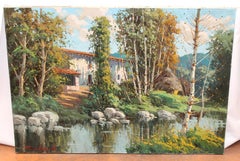
By Richard Irving Bowman
Located in Santa Cruz, CA
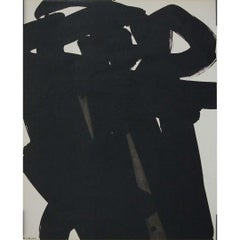
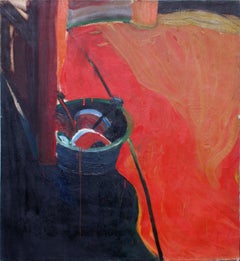
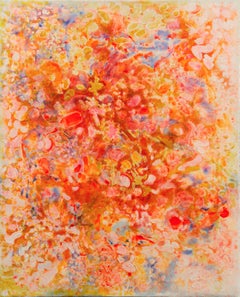
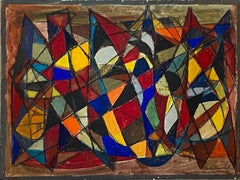
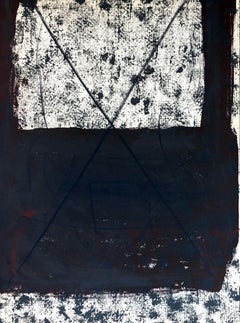
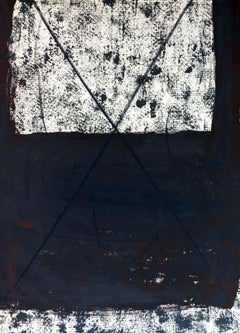
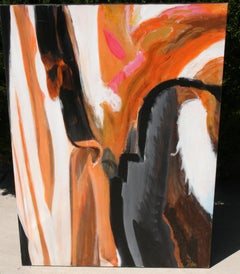
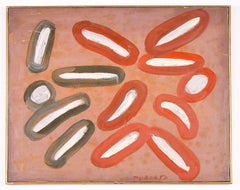
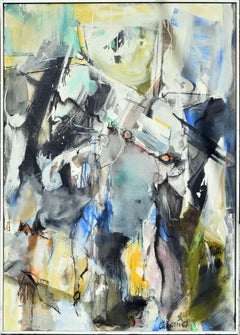
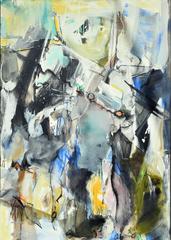
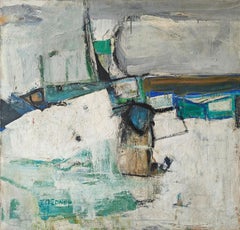
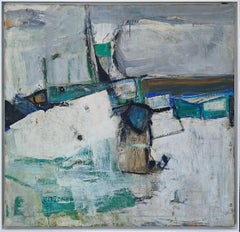
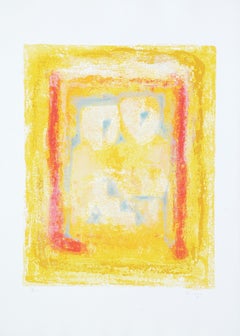
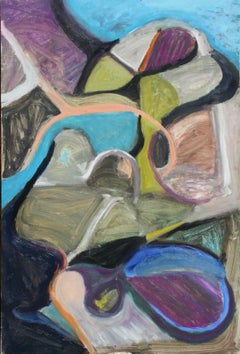
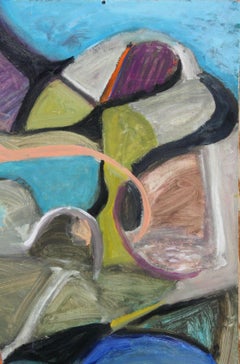
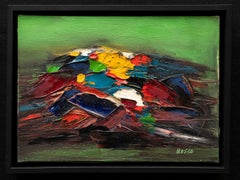
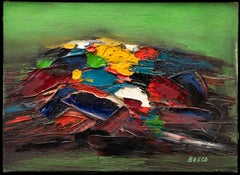
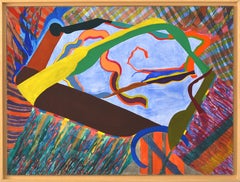
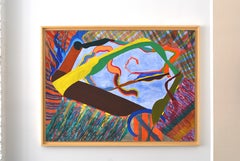
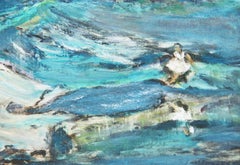
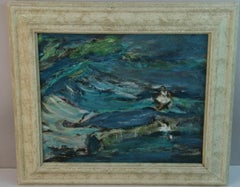
Signed lower left, 'R. Bowman' for Richard Irving Bowman (American, 1918-2001), titled, 'Kg. 55' (Kinetogenics 55) and dated February 1962. Additionally titled, on stretcher bar verso, 'Kg 55'.
Accompanied by a first edition copy of 'Richard Bowman: Radiant Abstractions', by Patricia Watts and Stefanie De Winter, published 2018.
Richard Bowman's work is featured in the July/August 2024 issue of Architectural Digest, in an article titled, 'Inside a 1920s LA Respite, Re-envisioned by Jamie Bush.
Richard Bowman was awarded a scholarship to study at the Art Institute of Chicago and received his Bachelor's degree in 1942. He subsequently attended the University of Iowa, receiving his Master's degree in 1945. Over the course of a long and distinguished career, Bowman exhibited internationally with success and was the recipient of numerous gold medals, prizes and juried awards.
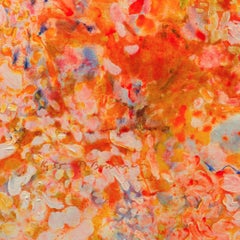
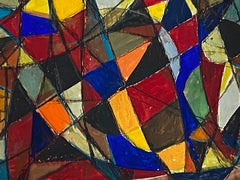
With the Kinetogenics Series, which he began in 1956, Bowman explored the intersection of color and light using contemporary advances in light theory and fluorescence technology. "For this series, he started using fluorescent enamel alkyd paint, which, Bowman stated, emitted an actual, measurable energy from the canvas. He combines his early concept of elemental radiants with the gestures of a mature Abstract Expressionist. Incorporating bold fluorescent strokes of orange, yellow and blue, which are activated by the ultraviolet in daylight, Bowman's new abstractions represented a synthesis of the physical and sensorial transmissions of energy. The combination of the artist's interests in nuclear physics, atoms, and dynamism with these vibrant colors reflected Bowman's increasing confidence as an unconventional artist working in an unconventional medium." (Richard Bowman: Radiant Abstractions, p. 13)
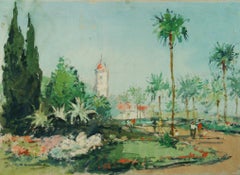
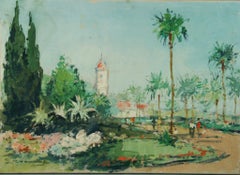
"The 'kinetogenic' series which Bowman has been painting recently, are whorls of pure energy in colors from the violet edges of the spectrum in vibrant relationship to the vivid primaries of the center. These paintings have much less sense of place or landscape than Bowman paintings we have seen before. The “Environs” group accompanying the energy pictures in this exhibition, are, on the other hand, specific about place: are of flower beds and branches of trees, painted with the same brilliant color intensity. This use of vibrant colors gives an all-over electric, textural effect in contrast to the after-image jump which obtains when the vibrants are painted flat and geometric. This textural mosaic effect is close to the vision of heat and passionate rhythm which was central to pre-Columbian art, and is still present in the Mexican arts and crafts, which were one of Bowman’s formative sources. It is interesting to note that several of the painters who have influenced many others to experiment with vibrancy and glow in color, found their own impetus in this direction while painting in Mexico. Bowman was one of the painters who was working with fluorescents when the general tendency was to paint with muck. One feels that using color thus leads the artist, as it did his pre-Columbian esthetic ancestors, in the direction where the ecstatic becomes mystic." (courtesy: Artforum, April 1964)
Thomas Albright writes of the artist, "Visiting Mexico on a traveling fellowship in the early 1940s, [Bowman] met Gordon Onslow-Ford, with whom he renewed a friendship after moving to San Mateo County in the early 1950s. His paintings, although gestural and abstract, were close in spirit to those of the Dynaton artists than to the mainstream of Abstract Expressionism. They constituted an intensely lyrical and metaphorical abstract Impressionism inspired by Bonnard and an intimacy with the natural environment. Bowman was also influenced by jazz improvisation and the jazz poetry of Kenneth Patchen, a close friend" (p. 263)
EDUCATION
Art Institute of Chicago, BFA, 1944
University of Iowa, MFA, 1949
AWARDS
1942 Edward L. Ryerson Foreign Traveling Fellowship, Art Institute of Chicago (Mexico)
1945 William M. R. French Memorial Gold Medal, Art Institute of Chicago
1952 Modern Painting Prize, Montreal Museum of Fine Arts
1972 Gift of Time Grant, Roswell Museum and Art Center, Roswell, New Mexico
SOLO EXHIBITIONS
1945 The Pinacotheca Gallery (Rose Fried Gallery) New York
1946 Milwaukee Art Institute, Wisconsin
1949 Swetzoff Gallery, Boston
1949 Bern Porter Gallery, Sausalito, CA
1950 Kinetic ... A commentary on the relationship of SCIENCE and ART. Stanford Art Gallery, Stanford University, Palo Alto, CA
1956 Stanford University, Palo Alto, CA
1957-1977 (every 18 months) Rose Rabow Galleries, San Francisco
1961 Richard Bowman: Paintings and Reflections.1943-1961. San Francisco Museum of Art
1970 Richard Bowman: Paintings from 1966-1970. San Francisco Museum of Art
1972 Richard Bowman: Paintings, 1943-1972. Roswell Museum and Art Center, New Mexico. Traveled to the Museum of Texas Tech University, Lubbock, 1972; and Sacred Heart Convent Gallery, Menlo Park, 1972
1986 Richard Bowman: Forty Years of Abstract Painting. Harcourts Modern Gallery, San Francisco
2000 Rock and Sun: Richard Bowman's Pioneer Abstractions of the 1940s. Steven Wolf Fine Arts, San Francisco
2019 Radiant Abstractions, Curated by Patricia Watts. the Landing Gallery, Los Angeles
TWO-PERSON EXHIBITIONS
1945 Room of Chicago Art: Paintings by Richard Bowman and Russell Woeltz. Art Institute of Chicago.
1947 Joan Mitchell and Richard Bowman: Oil Paintings. Harry and Della Burpee Art Gallery, Rockford, Illinois. Traveled to University of Illinois. Sponsored by Rockford Art Association.
1959 Gordon Onslow Ford and Richard Bowman. San Francisco Museum of Art
1990 Independent Abstraction: A Survey of Paintings by Richard Bowman and Emerson Woelffer. Harcourts Modern & Contemporary Art, San Francisco.
SELECT GROUP EXHIBITIONS
1943 Ras-Martin Gallery, Mexico City
1945 56th Annual American Exhibition of Oil Paintings. Art Institute of Chicago
1945 Art of This Century Gallery, New York
1947–48 Abstract and Surrealist American Art: Fifty-Eighth Annual Exhibition of American Paintings and Sculpture. Art Institute of Chicago. Curators: Daniel Catton Rich, Frederick A. Sweet, and Katherine Kuh. Catalogue.
1948 Fourth Summer Exhibition of Contemporary Art. State University of Iowa, Iowa City. Organized by Lester D. Longman. Included Milton Avery, Max Beckmann, Leonora Carrington, Max Ernst, Hans Hofmann, and others. Brochure.
1948 Joslyn Memorial Art Museum, Omaha, NE
1949 2nd Biennial Exhibition of Paintings and Prints. Walker Art Center, juried show, Minneapolis, 1949. Brooklyn Museum.
1951 [Group exhibition of University of Manitoba, Winnipeg, artists.] Montreal Museum of Fine Arts. Included William McCloy, Robert Gadbois, John Kacere, and other instructors from the School or Art, University of Manitoba.
1952 Sixty-ninth Annual Spring Show. Montreal Museum of Fine Arts. Bowman awarded Modern Painting Prize.
1953 Annual Exhibition of Canadian Painting. The National Gallery of Canada, Ottawa. Included John Kacere, William McCloy, Roland Wise, and Takao Tanabe.
1953 Winnipeg Group. Vancouver Art Gallery. Included William McCloy, John Kacere, Cecil Richards, Roland Wise.
1953–54 São Paulo Biennial of Modern Art, Second edition. Canadian section. Traveled to Caracas, Venezuela, and the Palacio de Bellas Artes, Mexico City. Catalogue.
1954 [Group exhibition of Winnipeg artists.] Art Gallery of Ontario, Toronto. Included Oscar Cah n, William McCloy, and Cecil Richards.
1954 Royal Ontario Museum, Toronto
1958 Esther Robles Gallery, Los Angeles
1959 Rabow Galleries, San Francisco. Included Julius Wasserstein, Gordon Onslow Ford, and Fred Reichman.
June 18, 1960 David Cole Gallery, Inverness, CA. Included Ruth Awasa, John Baxter, Nankoku Hidai, Onslow Ford, Fritz Rauh, David Simpson, and Jean Varda.
1961 Paintings from the Pacific: Japan, America, Australia, & New Zealand. Auckland City Art Gallery, New Zealand. Catalogue.
1961–62. Pittsburgh International Exhibition of Contemporary Paintings and Sculpture. Fine Arts Gallery, Carnegie Institute.
1962 50 California Artists. Whitney Museum of American Art, New York. Organized by the San Francisco Museum of Art, with assistance of the Los Angeles County Museum of Art. Traveled to Walker Art Center, Minneapolis, MN; Albright-Knox Gallery, Buffalo, NY; and Des Moines Art Center, IA. Catalogue.
February 1966 Contrasts. San Francisco Art Institute. Included Hassel Smith, Gordon Onslow Ford, and Ruth Asawa.
October 1967 Arleigh Gallery, San Francisco. Included Lee Mullican, Fred Reichman, Amalia Schulthess, and John Baxter.
1975 Gallery 865, San Francisco
1976 Painting and Sculpture in California: The Modern Era. San Francisco Museum of Modern Art.
1978 Creation. Galerie Schreiner, Basel, Switzerland. Included Joan Mir , Fritz Rauh, John Anderson, Ruth Asawa, J.B. Blunk, Roberto Matta, Lee Mullican, Gordon Onslow Ford, Wolfgang Paalen, Fritz Rauh, Yves Tanguy, and others. Accompanying book by Onslow Ford.
1984 A Personal Selection/Collection. David Cole Gallery, Inverness, CA. Forty-eight artists including Richard Diebenkorn, Claire Falkenstein, Richard Faralla, Sam Francis, Arthur Holman, Frank Lobdell, Ed Moses, Gordon Onslow Ford, Fritz Rauh, David Simpson, Amalia Schulthess, Jean Varda, Jack Wright, J.B. Blunk.
1987 Visions of Inner Space: Gestural Painting in Modern American Art. Wight Gallery, UCLA. Fifteen artists including Sam Francis, Morris Graves, John Anderson, Lee Mullican, Gordon Onslow Ford, Mark Tobey, and Ed Moses. Co-curated by Merle Schipper and Lee Mullican. Catalogue. Traveled to National Gallery of Modern Art, New Delhi, India, 1988
1997 Through the Light: An Exploration into Consciousness. Arts and Consciousness Gallery, John F. Kennedy University, Berkeley, California. Curated by Farbiba Bogzaran. Catalogue.
1998 Lee Mullican Memorial Exhibtion. Herbert Palmer Gallery, Los Angeles.
2007 The Rose Rabow Galleries Retrospective: 1959-1977. The 8 Gallery, San Franicsco.
2008 Landscapes of Consciousness: A Circle of Artists at the Beginning of Lucid Art. Weinstein Gallery, San Francisco. Included Gordon Onslow Ford, Fritz Rauh, John Anderson, and Jack Wright. Catalogue.
2016 Palm Springs Fine Art Fair, the Landing Gallery, Palm Springs, CA
2018 Ship of Dreams: Artists, Poets, and Visionaries of the S.S. Vallejo. Sonoma Valley Museum of Art, Sonoma, CA. Catalogue.
2019 FOG Design+Art. the Landing Gallery, San Francisco, CA
2020 FOG Design+Art. the Landing Gallery, San Francisco, CA
2022 FOG Design+Art. the Landing Gallery, San Francisco, CA
MUSEUM COLLECTIONS
Nora Eccles Harrison Museum of Art, Utah State University, Logan
Oakland Museum of California
San Francisco Museum of Modern Art
Santa Barbara Museum of Art, California
The Smart Museum of Art, University of Chicago
Taubman Museum of Art, Roanoke, Virginia
BOOKS AND CATALOGUES
1947 Rich, Daniel Catton. Abstract and Surrealist American Art: Fifty-Eighth Annual Exhibition of American Paintings and Sculpture. Chicago: Art Institute of Chicago.
1948 Fourth Summer Exhibition of Contemporary Art. Iowa City: State University of Iowa.
1956 Porter, Bern. Kinetic: A commentary on the relation of Science and Art in conjunction with a retrospective exhibition of paintings by Richard Bowman. Palo Alto: Stanford University Art Gallery.
1986 Kim Eagles-Smith, ed. Richard Bowman: Forty Years of Abstract Painting. San Francisco: Harold Parker in association with Harcourts Modern Gallery, Inc.
1961 Culler, George D. Richard Bowman, Paintings and Reflections, 1943-1901. San Francisco: San Francisco Museum of Art.
1962 Culler, George D. 50 California Artists. New York: Whitney Museum of American Art.
1972 Nordland, Gerald. Richard Bowman, Paintings, 1943-1972, Roswell, NM: Roswell Museum and Art Center.
1978 Onslow Ford, Gordon. Creation. Basel: Galerie Schreiner.
1987 Schipper, Merle. Visions of Inner Space: Gestural Painting in Modern American Art. Los Angeles: Frederick S. Wight Art Gallery, UCLA. With introduction by Lee Mullican.
1997 Bogzaran, Fariba. Through the Light: An Exploration into Consciousness. San
Francisco: Dream Creations.
2008 Bogzaran, Fariba. Landscapes of Consciousness: A Circle of Artists at the Beginning of Lucid Art. San Francisco: Weinstein Gallery.
2018 Bogzaran, Fariba, ed. Artists, Poets, and Visionaries of the S.S. Vallejo:
1949-1969. Inverness, CA: Lucid Art Foundation.
ARTICLES AND REVIEWS
[Review of Solo Exhibition at The Pinacotheca Gallery.] Art News. March 1945.
“Joan Mitchell, Richard Bowman Open TwoMan Show Tomorrow at Art Association Meeting.” Rockford Morning Star (IL). January 1947.
Robert Ayre. [Review of Exhibition, Montreal Mu-seum of Fine Arts.] Montreal Daily Star. 1951.
Ben Metcalfe. "Varsity Art Shock —A Morbid Hoax?" Winnipeg Tribune, December 3, 1951.
Beverly Wright. "Richard Bowman, abstract painter, has one-man show at Stanford Gallery." Palo Alto Times. February 17, 1956.
"Atomic Art Show at Stanford." San Francisco Chronicle. February, 19, 1956.
"P.A. Artist Portrays Energy in Oils." San Jose Mercury News. July 25, 1958.
Neita Crain Farmer. "A Solitary Voice: Richard Bowman's Paintings Say Something, In A New Way." Palo Alto Times. May 30, 1959.
Barbara Bladen. "Dick Bowman's Paintings Show Atomic Awareness," San Mateo Times. July 18, 1959.
Arthur Bloomfield. "Two Top Painters at San Francisco Museum." San Francisco Call Bulletin. July 31, 1959.
Alfred Frankenstein. "Slow and Fast Sculpture and Kinetogenics." San Francisco Chronicle. May 24, 1959.
"Paintings on Display: Bowman and Onslow Ford Show." San Francisco Weekly. July 1959.
Herman Wong. "Bowman's Art Seen At Show, Artist Builds Studio Near Hillside House." Red-wood City Tribune, September 15, 1960.
Dean Wallace. "Four Bring Their Art to Perfec-tion." San Francisco Chronicle. September 30, 1960.
Dean Wallace. "A Painter Looks at the Atom." San Francisco Chronicle. May 29, 1961.
Alfred Frankenstein. [Review of retrospective at San Francisco Museum of Art.] San Francisco Chronicle. November 12, 1961.
"International Art." Pittsburgh Post-Gazette, Sunday Magazine. October 29, 1961.
"Pacific Paintings Show Common Character-istics." The Press (Auckland, New Zealand). August 5, 1961.
Naomi Baker. "San Francisco's Art Is Viewed." San Diego Evening Tribune. January 26, 1962.
John Canaday. "Visitors From the West." New York Times. October 28, 1962.
Arthur Bloomfield. "Lost in a World They Were Never Made For." San Francisco News-Call Bulletin. August 3, 1963.
Arthur Bloomfield. "Bowman Paints His Own Path." San Francisco News-Call Bulletin. February 11, 1964.
"The Rockford Fifty States of Art Exhibition." Palo Alto Times. October 5, 1965.
Alfred Frankenstein. "Bowman's Radiant Ab-stract Art." San Francisco Chronicle. November 12, 1965.
Thomas Albright. "A Kind of Non-Art Show: Brilliant Work by Bowman." San Francisco Chronicle, February 14, 1970.
Paul Emerson, "Menlo Gallery Shows Bow-man Art: Major Retrospective Show." Palo Alto Times. October 6, 1972.
Arthur Bloomfield. "A Luxuriant Impact to Bowman Paintings." San Francisco Examiner. November 20, 1972.
Thomas Albright. "Two Artists Views of Na-ture." San Francisco Chronicle. October 9, 1974.
Arthur Bloomfield. "All But the Kitchen Sink." San Francisco Examiner. September 24, 1974.
Thomas Albright. "Realism Moves In." San Francisco Chronicle. Thursday, September 4, 1975.
Suzanne Muchnic. "Inspired Visions of Inner Worlds at UCLA." Los Angeles Times. January 10, 1988.
Reference:
Who Was Who in American Art 1564-1975: 400 Years of Artists in America, Peter Hastings Falk, Sound View Press 1999, Vol. 1, page 404; E. Benezit, Dictionnaire des Peintres, Sculpteurs, Dessinateurs, et Graveurs, Jacques Busse, 1999 Nouvelle Édition, Gründ 1911, Vol. 2, page 701; Art in the San Francisco Bay Area: 1945-1980, Thomas Albright, University of California Press, 1985, page 263; A Dictionary of Contemporary American Artists, Paul Cummings, St. Martin’s Press: New York 1966, page 66-67; Mallett’s Index of Artists, Supplement, Daniel Trowbridge Mallett, Peter Smith: New York 1948 Edition, R.R. Bowker Company 1940, page 31; Richard Bowman: Radiant Abstractions, essays by Patricia Watts and Stefanie De Winter, published by Watts Art...
Category
1960s Art
MaterialsCanvas, Oil, Alkyd