Old Masters Art

OLD MASTERS

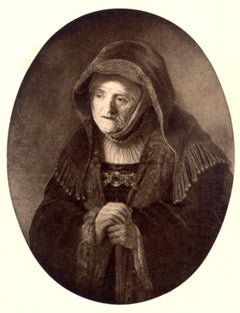
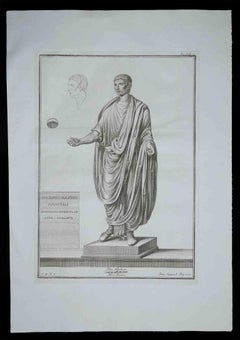
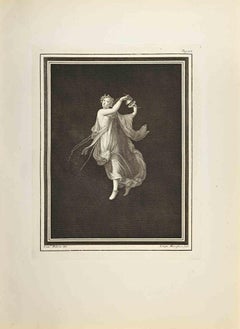
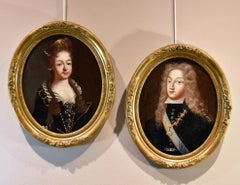
Encompassing centuries of change in Europe between 1300 and 1800, from booms of prosperity to bloody revolutions, Old Masters describes a wide range of artists. The informal term was derived from the title of an artist who trained in a guild long enough to become a master, such as Leonardo da Vinci, who studied in a Florence painters’ guild. However, Old Masters paintings, prints and other art is now used to refer to work made by any artist with a high level of skill in painting, drawing, sculpture or printmaking who worked during this era.

The 15th century’s expansive trade and commerce spread culture across borders. A vibrant period of art emerged, bolstered by studies of anatomy and nature that influenced a new visual realism. From Raphael and Michelangelo in the Renaissance to Rembrandt van Rijn and Johannes Vermeer in the Dutch Golden Age, artists expressed emotion, naturalism, color and light in new ways. El Greco and Paolo Veronese were leaders in the dramatic style of Mannerism, while Caravaggio and Peter Paul Rubens demonstrated the movement and meticulous detail of Baroque art.

Historically, most attention was concentrated on male artists, but recent research and exhibitions have elevated the impactful work of women such as Rachel Ruysch and Artemisia Gentileschi. In late-18th-century France, female artists like Adélaïde Labille-Guiard and Élisabeth Vigée Le Brun were prominent names. Nevertheless, access to the academies and guilds was highly restricted for women, and even those able to establish practices were expected to adhere to portraits and still lifes rather than the grand history paintings being created by men.

Find a collection of Old Masters prints, paintings, drawings and watercolors and other art on 1stDibs.

to
783
2,431
736
322
332
372
Overall Width
to
Overall Height
to
3,156
816
98
136
9
5
7
2
2
6
3
13
1
4
2,273
119,353
64,360
56,314
28,612
14,486
9,579
6,682
6,029
3,168
2,534
2,318
2,123
578
2,046
1,725
386
2,867
1,506
975
943
919
547
460
318
285
269
210
201
188
165
111
105
101
91
88
84
2,300
1,312
1,160
423
417
94
93
86
83
61
1,209
2,179
3,402
781
Style: Old Masters
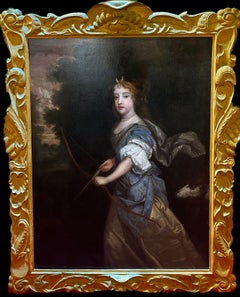
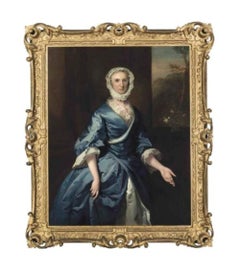
Joseph Highmore Portrait of a lady, 18th century

Joseph Highmore Portrait of a lady, 18th century

By Joseph Highmore

Located in York, GB

Portrait of a lady, traditionally identified as Grace Loftus,of Beverley hall yorkshire.Three-quarter-length, before a window. Dressed in blue and wearing a white bonnet. The paintin...

Category

1740s Old Masters Art

Materials

Oil

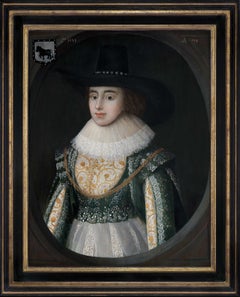
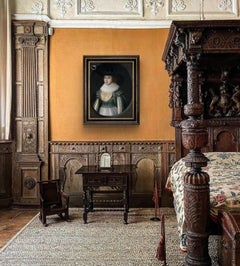
Rare Jacobean Portrait on Panel Lady Elizabeth Wheeler née Cole 1623 Historical

Rare Jacobean Portrait on Panel Lady Elizabeth Wheeler née Cole 1623 Historical

By Cornelius Johnson

Located in London, GB

A Rare Jacobean Portrait of Lady Elizabeth Wheeler (née Cole), 1623 Attributed to Cornelius Johnson (1593–1661) This remarkably rare early oil on panel, presented by Titan Fine Art, has emerged as far more than an anonymous “Portrait of a Lady.” Preserved in outstanding condition—its surface retaining exceptional clarity in the lace and textiles—it has only recently been reunited with the identity of its sitter: Elizabeth Cole (1607–1670), later Lady Elizabeth Wheeler, a Westminster gentlewoman whose later life brought her into intimate royal service as laundress for His Majesty’s person. That combination—high quality, uncommon survival, a newly identified sitter, and a life that intersects directly with the last acts of Charles I—places this portrait in a category of genuine rarity. It is not simply a beautiful Jacobean likeness; it is a rediscovered historical document - legible and compelling. The sitter is presented half-length against a dark ground, enclosed within a painted sculpted oval surround that functions like an architectural frame. This device, fashionable in the 1620s, concentrates the viewer’s attention and heightens the sense of social presentation: the sitter appears both physically and symbolically “set apart,” as if viewed through a refined aperture. The portrait’s immediate power, however, lies in the costume—an ensemble of striking modernity for c. 1623 and rendered with a precision that survives with remarkable crispness. She wears a deep green gown—a fitted overgown with open sleeves—over a finely embroidered linen jacket (a stiffened bodice/waistcoat garment). The sleeves form pronounced “wings” at the shoulder, a structurally assertive fashion detail of the early 1620s that enlarges the silhouette and signals sophistication. Beneath the green overlayer, the white linen jacket is richly ornamented in gilt embroidery. The goldwork is arranged as scrolling foliate forms—looping, curling tendrils punctuated by seed-like stippling—organised into balanced compartments across the bodice and sleeves. The motifs read as stylised botanical forms with rounded fruit-like terminals and leaf elements: not literal naturalism, but controlled abundance. The technique is described with extraordinary intelligence, mimicking couched metallic thread through patterned, “stitched” marks, while tiny dots and short dashes create a lively tactile shimmer. This embroidered jacket sits above a newly fashionable high-waisted, sheer apron or overskirt. The translucent fabric falls in soft vertical folds and is articulated with narrow lace-edged bands, giving the skirt a crisp rhythm of alternating sheer and patterned strips. At the neck, a fine ruff frames the face: a disciplined structure of pleated linen finished with delicate lace. Draped diagonally across the torso are long gold chains, painted to suggest weight and metallic gleam; they function both as ornament and as a further signifier of status. The cumulative effect is controlled luxury: she is not overloaded with jewels, but clothed in textiles whose cost and craftsmanship speak unmistakably. The recent sitter’s identification rests on heraldic and genealogical analysis: the arms shown on the painting correspond to those recorded for several families in armorial sources, but when the lines of descent are tested against survival and chronology, the viable bearer by 1623 resolves to Cole, and—crucially—to the London branch. That resolution matters because it anchors the portrait to a very specific social world: London/Westminster civic gentry and Crown administration, the milieu in which portraiture served as both self-fashioning and social instrument. The recent identification of the sitter (the London Cole branch of the family) is not merely genealogical; it has direct implications for authorship. A London-based mercantile or civic-gentry family would have ready access to leading immigrant artists, familiarity with heraldic display conventions, and the means to commission oil on panel, still standard among Netherlandish-trained painters. In that context, the portrait’s age inscription and date become especially revealing. The painting states the sitter to be nineteen years of age. Yet Elizabeth Cole’s birth in 1607 suggests she would be younger if the portrait is dated as early as 1623. The key insight is that the “incorrect” age is best understood not as a mistake but as a deliberate social adjustment, a performative statement rather than a documentary one. The most persuasive explanation is strategic. Portraits of high-status unmarried women were frequently made in connection with marriage negotiations. In the early 1620s, Elizabeth’s future husband, William Wheeler, was resident abroad at Middelburg in Zeeland in the Dutch Republic. If a portrait was intended to support or facilitate a match with an educated, ambitious man—“a man of learning and letters,” —then presenting a seventeen-year-old as nineteen would subtly reposition her as more mature and more nearly a peer in age, Wheeler being around twenty-two. The portrait thus becomes an instrument of alliance, not merely a likeness: an image designed to persuade, reassure, and elevate. This reading aligns perfectly with the period’s wider conditions. The early 1620s in England were charged with anxiety and expectation: James I’s later reign was marked by court faction, diplomatic tension, and the pressures of European conflict. The so-called “art market” was inseparable from these dynamics. Portraiture flourished because it served multiple functions: it fixed lineage, advertised alliance, signalled readiness for marriage, and projected the stability of elite households in an uncertain world. For Westminster families whose power came through office, portraiture was also a declaration of belonging—proof that administrative elites possessed the cultural polish traditionally associated with older aristocratic rank. Elizabeth’s later life vindicates the portrait’s impression of steadiness. Although no record survives of her marriage ceremony to William Wheeler, wills suggest she had married him by the mid-1630s, and there are strong grounds—consistent with the portrait’s implications—for a union already in place by the early 1630s, possibly earlier. Wheeler himself rose rapidly. By 1639 he held a manor at Westbury Leigh in Wiltshire and sought letters of denization due to overseas birth, enabling him to stand as Member of Parliament for Westbury. He leased the principal manor of Westbury the following year, coinciding with his election. In government service he became Remembrancer of the Exchequer and held office across regime change, a testament to administrative skill and political pragmatism. It is Elizabeth, however, who makes this portrait exceptional. She became laundress for His Majesty’s person, responsible for the washing and oversight of the King’s personal linen—an office that, despite its domestic description, required unusual trust, discretion, and access. Her role becomes visible in 1643 when she was granted a warrant signed by the Speaker of the House of Commons to follow the King to Oxford with her servant after the outbreak of the Civil War. She continued to serve during the King’s captivity after 1646, and at Carisbrooke Castle in 1647 she and her maid were implicated in smuggling secret correspondence to and from Charles I, in service of escape plans. After the King’s failed attempt to escape in March 1648, she was removed—yet the King’s trust persisted: he was permitted to send her remaining jewels in an ivory casket...

Category

17th Century Old Masters Art
Materials

Oil, Panel

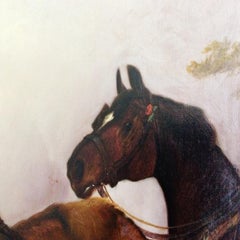
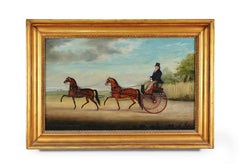
horse & carriage/gig , country scene, antique oil, by John Vine of Colchester

horse & carriage/gig , country scene, antique oil, by John Vine of Colchester

Located in York, GB

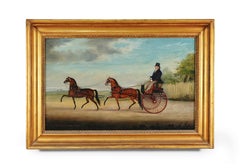
A fine antique oil painting, on canvas, of horses pulling a tandem at speed. signed and titled lower left, Vine Colchester 1834 This fine painting shows two horses pulling an open carriage /gig with gentleman in extensive landscape/park The size of the painting is approx 50 x 80 cms, whilst overall the size framed is 100cm x 71 cm This is a fine painting in very good condition housed in a gilt frame ready to hang Provenance: The E. W. Towler Collection, formerly of Glympton Park, Woodstock, Oxfordshire see details below The artist John Vine was born with a disability that did not appear to interfere with his ability to draw and paint, largely self-taught as an animal painter, as his reputation grew he exhibited at the Society of British Artists in Grosvenor Square. Based at Colchester he painted many different subjects including farms, houses, children and animals. Eric W. Towler was a remarkable man. He was born in 1900 and left school at the age of 12 to work in a Yorkshire pit and through a lifetime of hard work, self-improvement, luck and a refusal to limit his horizons achieved many of his aspirations. As a Yorkshireman through and through, he believed in ‘spending the brass in his pocket’ and over time he was successful enough to acquire enough ‘brass’ to enable his purchase of Glympton Park and furnish it as a traditional country house with all the trappings – in his case collections of...

Category

Mid-19th Century Old Masters Art

Materials

Oil

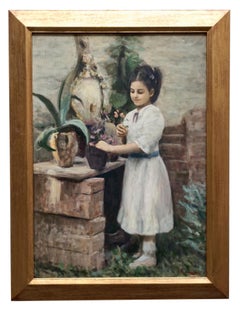
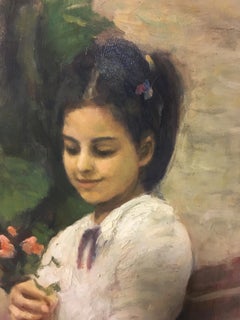
CHILD -Italian School - Figurative -  Italy Oil on canvas Painting

CHILD -Italian School - Figurative - Italy Oil on canvas Painting

Located in Napoli, IT

CHILD - Oil on canvas cm.70x50, Tonino Manna, Italy 2002 Frame available on request from our workshop. in this wonderful painting we admire a girl in a white dress who takes care of ...

Category

Early 2000s Old Masters Art

Materials

Canvas, Oil

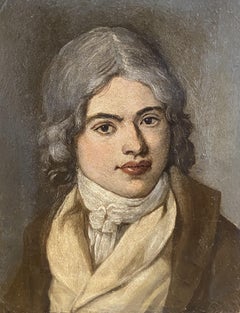
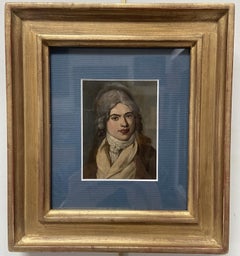
French school late 18th Century, Portrait of a young man, oil on metal

French school late 18th Century, Portrait of a young man, oil on metal

Located in Paris, FR

French school late 18th Century Portrait of a young man oil on metal 10.2 x 7.7 cm Framed under glass : 24.4 x 21.8 cm This small portrait painting, quite original in its technique...

Category

Late 18th Century Old Masters Art

Materials

Oil

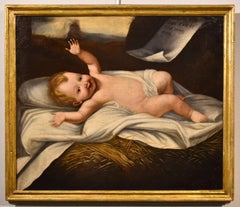
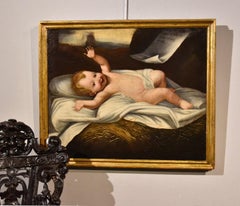
Child Jesus Paint Oil on canvas Old master 17th Century Baby Italian Religious

Child Jesus Paint Oil on canvas Old master 17th Century Baby Italian Religious

Located in Riva del Garda, IT

Lombard painter active in the 17th century Infant Jesus Oil painting on canvas 70 x 82 cm. - In antique frame 78 x 91 cm. This painting depicts an unusual and pleasant iconographic...

Category

17th Century Old Masters Art
Materials

Oil

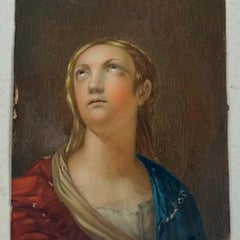
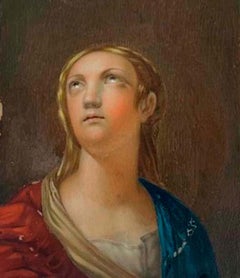
Virgen en miniatura - pintada sobre placa de hueso.

Virgen en miniatura - pintada sobre placa de hueso.

Located in Sant Celoni, ES

Muy interesante miniatura pintada sobre hueso o similar representando a una Virgen. De finales del siglo XIX. Gran calidad. La Virgen tiene una mirada muy mística. La pintura va co...

Category

Mid-19th Century Old Masters Art

Materials

Oil

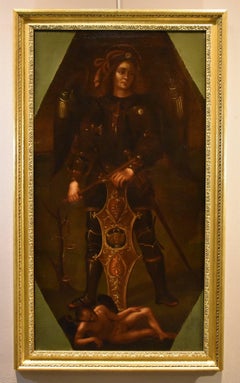
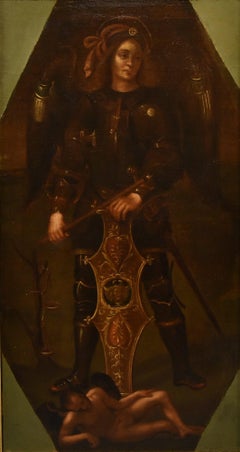
17th Century Knight Oil Painting on Canvas, Framed, Old Masters Style

17th Century Knight Oil Painting on Canvas, Framed, Old Masters Style

Located in Roma, IT

The Knight is an original oil painting on canvas realized during the XVII century by an anonymous artist. Provenance: Pecci-Blunt collection. Good condition...

Category

17th Century Old Masters Art
Materials

Oil, Canvas

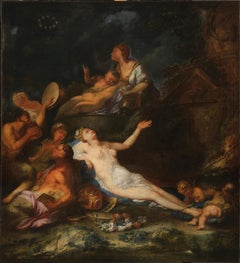
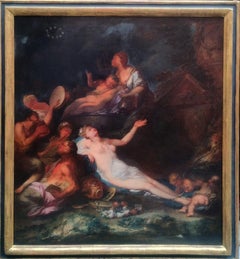
17th Century by Bartolomeo Guidobono Bacchanal with Maenads, Satyrs and Nymphs

17th Century by Bartolomeo Guidobono Bacchanal with Maenads, Satyrs and Nymphs

Located in Milano, Lombardia

Bartolomeo Guidobono (Savona, Italy, 1654 - Turin, Italy, 1709) Title: Bacchanal with Maenads, Satyrs and Nymphs Medium: Oil on canvas Dimensions: without frame 120 x 110 cm - with f...

Category

17th Century Old Masters Art
Materials

Canvas, Oil

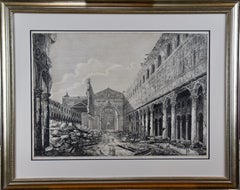
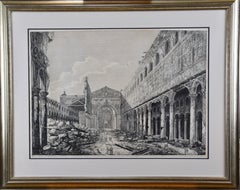
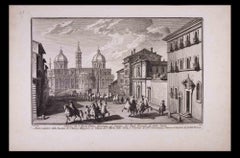
The Basilica of St. Paul in Rome, Early 19th Century Etching by Luigi Rossini

The Basilica of St. Paul in Rome, Early 19th Century Etching by Luigi Rossini

By Luigi Rossini

Located in Alamo, CA

"Rovina della gran Basilica di S. Paolo fueri le mura accaduta" (View of the Ruins of the Great Triumphal Arch of S. Paolo Fuori le Mura) from "Le Antichita Romane" (Ancient Rome), published in Rome in 1823. It depicts the destruction of the Basilica of St. Paul after the fire of 1823. People stand in the road and on the right observing the damage amid debris, which includes many fragments of columns. The etching is presented in a silver-color wood frame with an off-white double mat with a black inner mat. There are a few small spots, but it is otherwise in very good condition. See item # LU117324669722 for another Rossini etching...

Category

1820s Old Masters Art

Materials

Etching

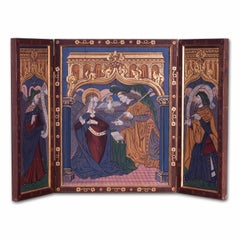
Turn of the 20th Century French tryptic depicting the Annunciation with 2 saints

Turn of the 20th Century French tryptic depicting the Annunciation with 2 saints

Located in Petworth, West Sussex

A. Lion (French, c. 1900) A tryptic depicting the Annunciation flanked by two Saints Signed “A. LION” (to the left of Mary) Oil on board Framed dimensions 23. ½ x 37. ½ in. (60 x 95...

Category

19th Century Old Masters Art

Materials

Oil, Board

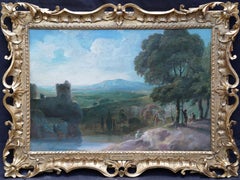
Landscape with Ruins and Figures - British 18thC Old Master art oil painting

Landscape with Ruins and Figures - British 18thC Old Master art oil painting

By Richard Wilson

Located in Hagley, England

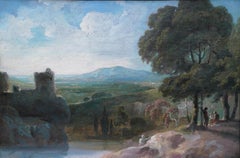
This superb British 18th century Old Master oil painting is attributed to circle of noted landscape artist Richard Wilson. Painted circa 1750 it is a stunning light, bright and airy expansive panoramic landscape. There is a river in the foreground and mountains in the background. On the left of the river stands some ruins and on the right, figures are resting under the trees. The palette of blues, greens and very varied and rich with some lovely pinky brown tones for the land on the right. The brushwork is also delicate but confidently executed. A superb example of a British Old Master landscape oil painting, finished off in a carved and gilt wood English Rococo frame with name plate. Provenance. The Asbjorn Lunde Foundation, Inc. Throughout his long life, Mr. Lunde supported more than forty museums in his native New York, across the United States, and in Europe with loans, gifts, and funding. Mr. Lunde was a proud New Yorker with roots in Norway. He was keenly interested in nineteenth-century Scandinavian and Swiss landscape painting, Old Master painting, and Asian decorative arts. According to an old label to the reverse, the present painting was once owned by James Northcote (1746-1831) who gave it to William Hillman on 25th May 183(0?) Property of the Bacot family. Christies stamps verso. Watson Gallery London. Remains of label verso. Condition. Oil on canvas, 26 inches by 18 inches and in good condition. Frame. Housed In a carved and gilt wood English Rococo frame bearing Richard Wilson name plate, 33 inches by 25 inches and in good condition. Richard Wilson RA...

Category

1750s Old Masters Art

Materials

Oil

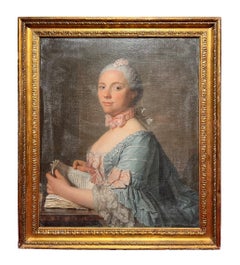
18th Century Circle of Jean-Étienne Liotard Portrait of a lady Oil on canvas

18th Century Circle of Jean-Étienne Liotard Portrait of a lady Oil on canvas

Located in Milano, Lombardia

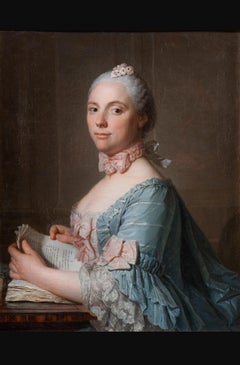
Circle of Jean-Étienne Liotard (Geneva, Switzerland, 1702 – 1789) Portrait of a lady Medium: Oil on canvas Dimensions: without frame 73 x 58 cm – with frame 87.8 x 73.7 x 4.5 cm Not ...

Category

18th Century Old Masters Art

Materials

Canvas, Oil

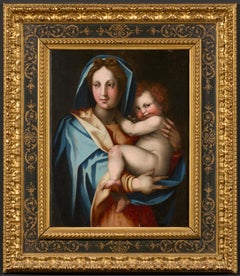
Madonna Child Del Sarto Paint Oil on table 16th Century Old master

Madonna Child Del Sarto Paint Oil on table 16th Century Old master

Located in Riva del Garda, IT

Madonna and Child Workshop of Andrea del Sarto, pseudonym of Andrea d'Agnolo di Francesco (Florence 1486 - 1530) Attributable to Jacopo di Giovanni di Francesco, known as Jacone (...

Category

16th Century Old Masters Art

Materials

Oil

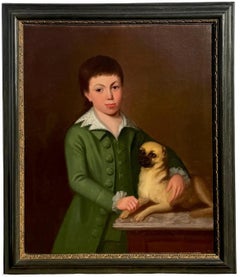
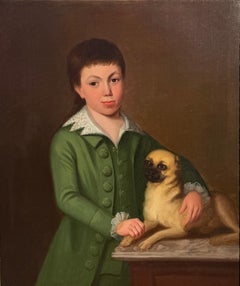
A Boy and His Pug Dog

A Boy and His Pug Dog

Located in Wiscasett, ME

Fantastic early portrait of a young man and his pug dog. This painting is most likely British, but it could also be from continental Europe. It dates from the late 18th to the early ...

Category

Early 19th Century Old Masters Art

Materials

Oil, Canvas

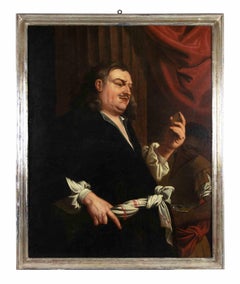
A Rich Merchant -  Painting by Unknown - 18th Century

A Rich Merchant - Painting by Unknown - 18th Century

Located in Roma, IT

A rich merchant is an original old master artwork realized in the 18th Century. Mixed colored oil painting on canvas depicting a merchant looking at a coin in his left hand. Provena...

Category

18th Century Old Masters Art

Materials

Oil

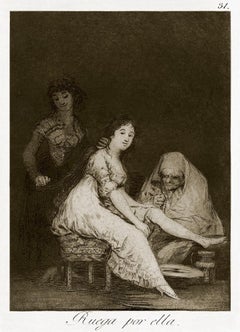
Ruega por Ella  - Etching by Francisco Goya - 1868

Ruega por Ella - Etching by Francisco Goya - 1868

By Francisco Goya

Located in Roma, IT

Ruega por Ella is an original etching realized by the great Spanish artist Francisco Goya and published for the first time in 1799. Original etching on paper. The plate is part of ...

Category

1860s Old Masters Art

Materials

Etching, Aquatint

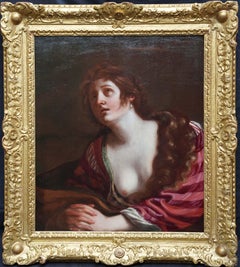
The Penitent Magdalene - Italian Baroque Old Master art portrait oil painting

The Penitent Magdalene - Italian Baroque Old Master art portrait oil painting

By Giovanni Francesco Barbieri (Il Guercino)

Located in Hagley, England

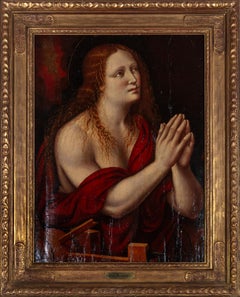
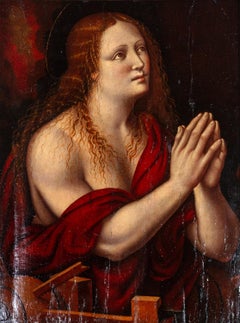
This stunning Italian Baroque Old Master portrait oil painting is attributed to the circle of Guercino, Giovanni Francesco Barbieri (1591 - 1666) and it is ascribed verso. The paint...

Category

17th Century Old Masters Art
Materials

Oil

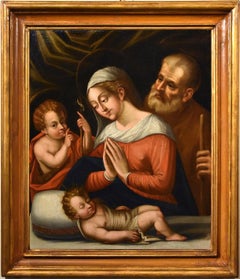
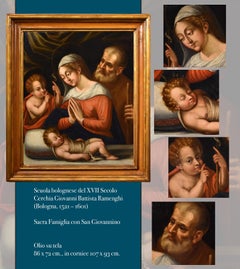
Holy Family Ramenghi Paint Oil on canvas Old master 17th Century Religious Art

Holy Family Ramenghi Paint Oil on canvas Old master 17th Century Religious Art

Located in Riva del Garda, IT

Bolognese school of the seventeenth century Circle Giovanni Battista Ramenghi, known as Bagnacavallo (Bologna, 1521 - 1601) Oil painting on canvas (86 x 72 cm. - With antique frame ...

Category

17th Century Old Masters Art
Materials

Oil

Still Life with Fishes and Oysters - Oil on Canvas - 17th Century

Still Life with Fishes and Oysters - Oil on Canvas - 17th Century

Located in Roma, IT

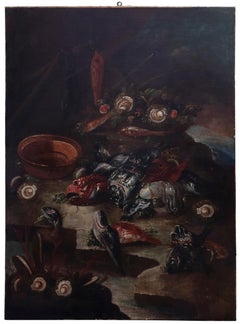
Still life with fishes and oysters is an original oil on canvas realized in the 17th Century by Neapolitan School Master. Impressive in size as well as for its vivid representation o...

Category

17th Century Old Masters Art
Materials

Oil

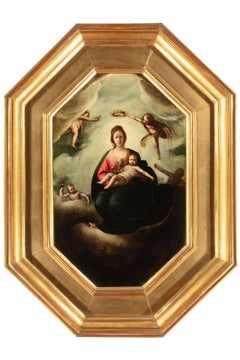
17th Century by Giovanni Stefano Danedi Madonna and Child Crowned by Angels

17th Century by Giovanni Stefano Danedi Madonna and Child Crowned by Angels

Located in Milano, Lombardia

Giovanni Stefano Danedi, called Montalto (Treviglio, Italy, 1612 - Milan, Italy, 1690) Title: Madonna and Child crowned by angels Medium: Oil on panel Dimensions: without frame 58 x ...

Category

17th Century Old Masters Art
Materials

Oil, Panel

Old Masters art for sale on 1stDibs.
Find a wide variety of authentic Old Masters art available for sale on 1stDibs. Works in this style were very popular during the 21st Century and Contemporary, but contemporary artists have continued to produce works inspired by this movement. If you’re looking to add art created in this style to introduce contrast in an otherwise neutral space in your home, the works available on 1stDibs include elements of orange, yellow, blue and other colors. Many Pop art paintings were created by popular artists on 1stDibs, including Charles Amand Durand, Giuseppe Vasi, Thomas Holloway, and Vincenzo Campana. Frequently made by artists working with Etching, and Paint and other materials, all of these pieces for sale are unique and have attracted attention over the years. Not every interior allows for large Old Masters art, so small editions measuring 0.4 inches across are also available. Prices for art made by famous or emerging artists can differ depending on medium, time period and other attributes. On 1stDibs, the price for these items starts at $11 and tops out at $1,495,000, while the average work sells for $546.