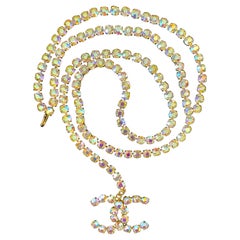
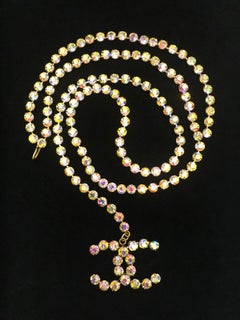
1995 Vintage Runway Chanel Iridescent Rhinestone CC Chain Belt Necklace
By Chanel
Located in Bangkok, TH
1995 Runway Chanel chain belt in multicolored rhinestones featuring a rhinestoned CC Charm. Seen on
Category
1995 Vintage Runway Chanel Iridescent Rhinestone CC Chain Belt Necklace
By Chanel
Located in Bangkok, TH
1995 Runway Chanel chain belt in multicolored rhinestones featuring a rhinestoned CC Charm. Seen on
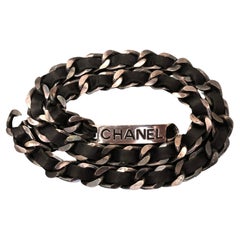
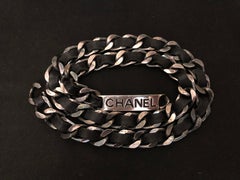
1995 Vintage CHANEL Silver Toned Black Leather Chain Belt Necklace
By Chanel
Located in Bangkok, TH
Vintage CHANEL lambskin leather chain belt in black and silver. This rugged and stylish belt is
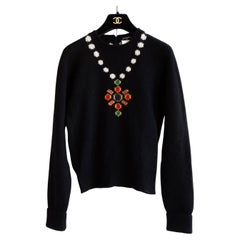
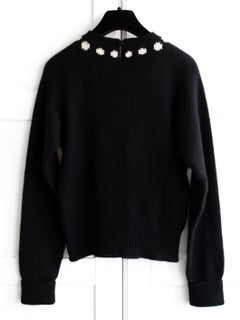
Chanel Vintage Fall 1995 Pearl Necklace Gripoix Black Cashmere 95A Sweater
By Chanel
Located in Jersey City, NJ
Rare black sweater from Chanel Fall 1995 collection. Knitted from soft black cashmere, this Chanel
In the years following the opening of her modest millinery shop, Gabrielle "Coco" Chanel became a pivotal designer of both fashionable casual wear and Paris haute couture as well as an icon and arbiter of 20th-century style with her bob haircut and pearls. Today vintage Chanel handbags, jackets and evening dresses are among the most sought-after clothing and accessories for fashion lovers all over the world.
The first Chanel shop was established in 1910 in Paris on rue Cambon by the young milliner Gabrielle Chanel (1883–1971), who had picked up the nickname “Coco” while working as a club singer. The boutique drew the attention of the Parisian fashion elite who popularized her wide-brimmed Chanel Modes hats. Soon she added a sportswear store in the Normandy resort town of Deauville, where Coco set the tone for her defining sense of style — traditionally masculine garments reimagined for feminine shapes, made from simple jersey fabric.
Effortless and elegant, Chanel's designs promoted comfort and grace in women’s wear that had been dominated in the previous century by complicated layers of fabric and cumbersome corsets. She followed this success with a couture house, opened in 1915 in Biarritz.
But Chanel was not born into a life of glamour. Following the death of her mother, her father left her in an orphanage where she lived until the age of 18. It was there that she learned to sew as well as appreciate the classic pairing of black and white as worn by the nuns.
In 1926, Chanel introduced her first little black dress, reclaiming a color that had once been reserved for mourning and working-class women. That same decade, she debuted her perfume, Chanel No. 5, as well as the Chanel suit with a fitted skirt, inspired by the boxy lines of men’s clothing and employing a sporty tweed.
Chanel closed her fashion operations during World War II, then returned to the industry in 1954 to design for the functional needs of modern women.
Structure and wearability endured in all of Chanel’s clothing and accessories, like the quilted leather 2.55 handbag — a 1955 update of a 1920s-era design — with its gold-chain shoulder strap that freed up a woman’s hands. The 1957 two-tone slingback pumps had a practical heel height while offering a bold statement in the black tip of the shoes. Her collarless jacket reacted against the constricting styles of Christian Dior's New Look, replacing them with a design that was timeless, an instant classic.
After Coco Chanel died in 1971, the brand underwent several changes in leadership, including fashion designer Karl Lagerfeld, who took over as artistic director in 1983. His collections for Chanel displayed his knack for synthesizing old and new, high and low. Lagerfeld revived Chanel ballet flats and thoroughly embraced the classic logo's interlocking CCs, which took the form of a clasp featured on so many of the rare Chanel bags that are much sought after today.
Vintage Karl Lagerfeld designs for Chanel dresses, coats and other clothing of the 1980s, '90s and 2000s riffed on its iconography, accenting a lexicon of Chanel-isms with tastes of the moment. And as the 1990s have become associated with styles adopted by today’s supermodels and influencers, vintage Chanel bags of the 1990s are among the most prized of the brand’s offerings.
Over the years, the company has continued to innovate, such as expanding into ready-to-wear fashion in 1978 and, in 2002, establishing a subsidiary company — Paraffection — dedicated to preserving the heritage skills of fashion artisan workshops. The House of Chanel still operates its flagship on rue Cambon in Paris, where it all began.
Browse vintage Chanel bags, evening dresses, shoes, jewelry and other clothing and accessories on 1stDibs.
For fashion lovers, the 1990s have become associated with styles adopted by today’s supermodels and influencers, who never wear the same thing twice. And because fast fashion didn’t yet exist, the design associated with 1990s fashion — vintage '90s handbags, clothing and accessories — has a quality appreciated by the millennial generation: authenticity.
If there was one concept unifying fashion in the 1990s, it was the lean silhouette. “Fashion is a game of proportion,” Alexander Fury wrote in the New York Times in 2016. “Narrow-shouldered and narrow-hipped, the ’90s were skinny.”
If it takes a practiced eye to identify that single concept, that’s because in truth, ’90s fashion was many things to many people. After the 1980s era of strong-shouldered working women, glossy aerobicized bodies and Madonna, fashion branched out.
The industry gained momentum from big-money relaunches of the great Paris houses Dior, Givenchy and Balenciaga, rescued at long last from the constraints of licensing. Japan and Belgium gave fashion new avant-garde ideas to play with. From America came denim, minimalism, '90s grunge fashion and hip-hop. From Italy came sex appeal. And Prada.
For the colorful corsets of her 1990 Portrait collection, audacious British designer Dame Vivienne Westwood drew on 18th-century oil paintings — her models donned the pearl choker necklaces that have become a social media star and a favorite of influencers and fashion lovers all over the world. For a jacket-and-shorts suit from her Fall/Winter 1996–97 Storm in a Teacup line, the designer used the extreme asymmetry of a tartan mash-up to confront, according to Westwood, “the horror of uniformity and minimalism.”
“The ethos of the time was, you could have style, you could be into all kinds of cool stuff. It wasn’t about money, it wasn’t about status,” says Katy Rodriguez, cofounder of Resurrection. In contrast, “our last 10 years have seen the domination of nonstop luxury, money and status.”
Vintage 1990s Chanel bags, for example, are among the most prized of the brand’s offerings — at Newfound Luxury, proprietor L. Kiyana Macon has "clients who only buy ’90s Chanel because they recognize that it is the best quality.”
Things were different in the ’90s, and the difference is reflected in the clothes. Pull up any recent “How to Do the 1990s” fashion article (or look at photos of current supermodels Gigi, Kendall and Bella), and you’ll see iconic '90s outfits — knee socks, cardigans, fanny packs, fishnet stockings, slip dresses, flannel shirts and combat boots.
Rodriguez has recently noticed something similar happening. Before COVID, customers searched 1990s stock “for very sexy Galliano, Dior, Cavalli — that kind of thing,” she explains, noting that just a few months ago, “people were posting [on social media] the poshest things they could.” Now, in the age of shutdown, “that would just look out of touch.”
Instead, people are looking for “things that are cool but also easy and comfortable, not necessarily super-luxe,” Rodriguez continues. They’re “heading back to the more avant-garde, anti-fashion designers, like Helmut Lang, [Martin] Margiela and [Ann] Demeulemeester.”
Late designer Franco Moschino shocked and titillated the ’80s fashion elite with his whimsical, irreverent parodies of bourgeois finery. Whether emblazoning a sober blazer with smiley faces or embellishing a skirt suit with cutlery, Moschino rendered high style with a hearty wink. He famously said, “If you can’t be elegant, at least be extravagant” — words that, with all due respect to Susan Sontag, epitomize the essence of camp.
Vintage Moschino pants, jackets and other '90s Moschino garments remain so bold and fresh today that even the house's former creative director, Jeremy Scott, drew on the brand's past and the pop culture of the decade for his debut collection in 2014.
Find vintage 90s dresses, skirts, sweaters and other clothing and accessories on 1stDibs — shop Thierry Mugler, Miuccia Prada, Jean Paul Gaultier and more today.
The rare looks nabbed by the pop star’s stylist are perfectly in tune with her new song, “Chanel.”
The artists put fresh spins on pieces from the ’90s and early aughts.
Hailey Bieber, Chase Sui Wonders and Kendall Jenner are among the stars recontextualizing the look.
The vintage piece was worn by Jamie Lee Curtis nearly 40 years ago.
This cheeky accessory is seriously fun.
For the brand’s 2014–15 ready-to-wear show in Paris, the designer was inspired by a most unexpected place: the supermarket.
It might not be as practical as a pair of mittens, but for something that looks this good, practicality really doesn't matter.
Only Chanel could elevate humble materials like denim and wicker to icon-level status.