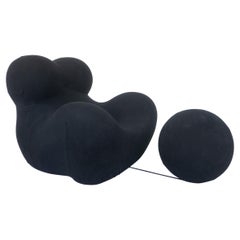
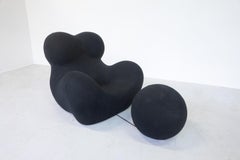
"Big Mama" Armchair & Ottoman by Gaetano Pesce for B&B Italia
By Gaetano Pesce
Located in Brussels, BE
"Big Mama" Armchair & Ottoman by Gaetano Pesce for B&B Italia
Category
Vintage 1960s Armchairs
Materials
Fabric
"Big Mama" Armchair & Ottoman by Gaetano Pesce for B&B Italia
By Gaetano Pesce
Located in Brussels, BE
"Big Mama" Armchair & Ottoman by Gaetano Pesce for B&B Italia
Fabric
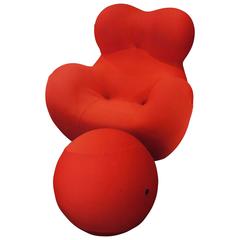
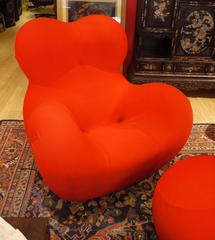
Gaetano Pesce "Big Mama" Chair and Ottoman, B & B Italia
By Gaetano Pesce
Located in Biarritz, FR
B & B Italia, chair and ottoman "Big Mama" by Gaetano Pesce.
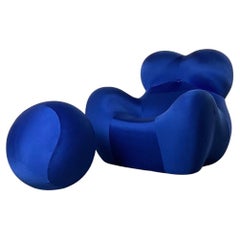
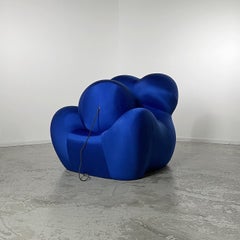
Armchair "la mama" by Gaetano Pesce for B&b Italia
By Gaetano Pesce
Located in PARIS, FR
In the early 1960s, the chemist Bayer developed a polyurethane foam with a new resin, allowing the creation of various and simple shapes. In the middle of the decade, the Italian des...
Fabric
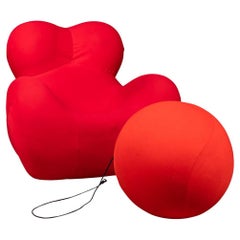
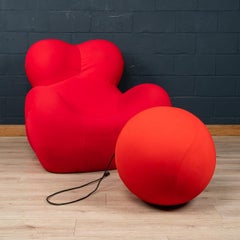
Sold
H 40.56 in W 47.25 in D 51.19 in
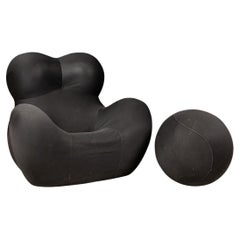
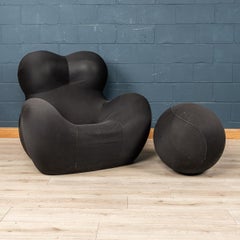
"Big Mama" Up Chair By Gaetano Pesce For B&B Italia, Italy, circa 2000
By B&B Italia, Gaetano Pesce
Located in Royal Tunbridge Wells, Kent
It was 1968 when Gaetano Pesce began experimenting at his Paris atelier with vacuum-packing the hippest material of the moment: polyurethane. Soon he’d developed a gravity-defying mo...
Fabric, PVC
Sold
H 40.56 in W 47.25 in D 51.19 in
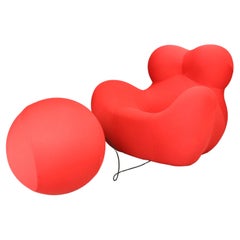
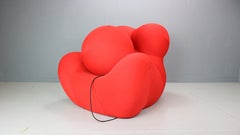
"Big Mama" Up Chair by Gaetano Pesce for B&B Italia, Italy, c.2000
By B&B Italia, Gaetano Pesce
Located in Royal Tunbridge Wells, Kent
It was 1968 when Gaetano Pesce began experimenting at his Paris atelier with vacuum-packing the hippest Material of the moment: polyurethane. Soon he’d developed a gravity-defying mo...
Fabric
Sold
H 40.56 in W 47.25 in D 51.19 in
"Big Mama" Up 5+6 Chair and ottoman By Gaetano Pesce For B&B Italia
By Gaetano Pesce, B&B Italia
Located in The Hague, NL
Iconic lounge chair + ottoman, model up 5+6 or donna or la mama, designed in 1969 by gaetano pesce for b&b italia.
Metal
Gaetano Pesce was of a generation of Italian architects who in the early 1960s rebelled against the industrial perfection of modernism by conceiving new furniture and objects that were at once expressive and eccentric in form; or you might say they were more like art than functionalist design.
Born in the picturesque coastal Italian city of La Spezia in 1939, Pesce was a precocious talent who could have forged a career as an artist but opted instead to go to Venice to study architecture because, as he has said, it was “the most complex of all the arts.” Rather than having new worlds opened to him at design school, however, Pesce found the rationalist curriculum oppressive in its insistence on standardization and prescribed materials and technologies.
Pesce wanted to explore the latest of both materials and technologies to create objects and buildings never before imagined, with what he called “personalities” that spoke to the issues of the day. He was keen to examine ways to diversify mass production so that each manufactured work could be distinct.
In 1964, Pesce met Cesare Cassina, of the forward-looking furniture company C&B Italia in Milan (now known as B&B Italia), for whom he would create many important designs, beginning with a collection of what he called “transformational furniture” — two chairs and a loveseat — made entirely out of high-density polyurethane foam. To make the pieces easy to ship and cost-efficient, he proposed that after being covered in a stretch jersey, they be put in a vacuum, then heat-sealed flat between vinyl sheets. Once the foam was removed from its packaging, the piece returned to its original shape — hence, the name Up for the series, which debuted in 1969.
In addition to these pieces, Pesce proposed for the collection something he referred to as an “anti-armchair,” which took the shape of a reclining fertility goddess, the iconic Donna.
Producing the piece's complex form turned out to be a technical challenge. Bayer, the foam’s manufacturer, deemed it impossible to accomplish. Pesce persisted and came up with a new procedure, demonstrating not only the designer’s key role in researching the nature and potential of new materials but also his vital importance in “doubting rules.” The Up chair and accompanying ottoman were born, and they were revolutionary in more ways than one.
In the early 1970s, Pesce began exploring one of his key concepts, the idea of the industrial originals. Employing a mold without air holes, and adding a blood-red dye to the polyurethane, he cast a bookcase that resembled a demolished wall, the rough edges of the shelves and posts resulting from fissures in the material made by trapped air.
Through his research into polyurethane, Pesce figured out a way to make a loveseat and armchair using only a simple wood frame and strong canvas covering as a mold. Since the fabric developed random folds during the injection process, the pieces were similar but not identical. Cassina named the suite of furnishings Sit Down and introduced it in 1975. By experimenting with felt soaked in polyurethane and resin, Pesce conceived I Feltri, another collection of armchairs introduced by Cassina in 1987.
Pesce went on to live a life that defied expectation and convention and along the way became one of the most seminal figures in art and design.
Find vintage Gaetano Pesce chairs, sofas, vases and more on 1stDibs.
Armchairs have run the gamut from prestige to ease and everything in between, and everyone has an antique or vintage armchair that they love.
Long before industrial mass production democratized seating, armchairs conveyed status and power.
In ancient Egypt, the commoners took stools, while in early Greece, ceremonial chairs of carved marble were designated for nobility. But the high-backed early thrones of yore, elevated and ornate, were merely grandiose iterations of today’s armchairs.
Modern-day armchairs, built with functionality and comfort in mind, are now central to tasks throughout your home. Formal dining armchairs support your guests at a table for a cheery feast, a good drafting chair with a deep seat is parked in front of an easel where you create art and, elsewhere, an ergonomic wonder of sorts positions you at the desk for your 9 to 5.
When placed under just the right lamp where you can lounge comfortably, both elbows resting on the padded supports on each side of you, an upholstered armchair — or a rattan armchair for your light-suffused sunroom — can be the sanctuary where you’ll read for hours.
If you’re in the mood for company, your velvet chesterfield armchair is a place to relax and be part of the conversation that swirls around you. Maybe the dialogue is about the beloved Papa Bear chair, a mid-century modern masterpiece from Danish carpenter and furniture maker Hans Wegner, and the wingback’s strong association with the concept of cozying up by the fireplace, which we can trace back to its origins in 1600s-era England, when the seat’s distinctive arm protrusions protected the sitter from the heat of the period’s large fireplaces.
If the fireside armchair chat involves spirited comparisons, your companions will likely probe the merits of antique and vintage armchairs such as Queen Anne armchairs, Victorian armchairs or even Louis XVI armchairs, as well as the pros and cons of restoration versus conservation.
Everyone seems to have a favorite armchair and most people will be all too willing to talk about their beloved design. Whether that’s the unique Favela chair by Brazilian sibling furniture designers Fernando and Humberto Campana, who repurposed everyday objects to provocative effect; or Marcel Breuer’s futuristic tubular metal Wassily lounge chair; the functionality-first LC series from Charlotte Perriand, Le Corbusier and Pierre Jeanneret; or the Eames lounge chair of the mid-1950s created by Charles and Ray Eames, there is an iconic armchair for everyone and every purpose. Find yours on 1stDibs right now.