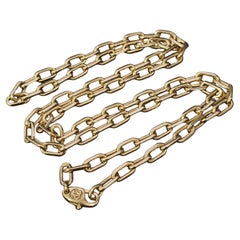
For its extraordinary range of bracelets, watches, rings and other adornments, French luxury house Cartier is undeniably one of the most well known and internationally revered jewelers in the world among clients both existing and aspirational.
Perhaps 1847 was not the ideal time to open a new watchmaking and jewelry business, as the French Revolution was not kind to the aristocracy who could afford such luxuries. Nevertheless, it was the year Louis-François Cartier (1819–1904) — who was born into poverty — founded his eponymous empire, assuming control of the workshop of watchmaker Adolphe Picard, under whom he had previously been employed as an assistant. Of course, in the beginning, it was a relatively modest affair, but by the late 1850s, Cartier had its first royal client, Princess Mathilde Bonaparte, niece of Napoleon Bonaparte, who commissioned the jeweler to design brooches, earrings and other accessories.
Under the leadership of Louis-François’s son, Alfred, who took over in 1874, business boomed. Royalty around the world wore Cartier pieces, including Tsar Nicholas II of Russia, the Maharaja of Patiala and King Edward VII, who had 27 tiaras made by the jewelry house for his coronation in 1902 and issued Cartier a royal warrant in 1904. (Today, the British royal family still dons Cartier pieces; Kate Middleton, Duchess of Cambridge, regularly sports a Ballon Bleu de Cartier watch.)
Cartier’s golden years, however, began when Alfred introduced his three sons, Louis, Pierre and Jacques, to the business. The brothers expanded Cartier globally: Louis reigned in Paris, Pierre in New York and Jacques in London, ensuring their brand’s consistency at their branches across the world. The trio also brought in such talents as Charles Jacqueau and Jeanne Toussaint.
One of Cartier’s earliest major successes was the Santos de Cartier watch — one of the world's first modern wristwatches for men. (Previously, a large number of people were using only pocket watches.) Louis designed the timepiece in 1904 for his friend, popular Brazilian aviator Alberto Santos-Dumont, who wanted to be able to check the time more easily while flying.
Cartier’s other famous timepieces include the Tank watch, which was inspired by the linear form of military tanks during World War I, and the so-called mystery clocks. Invented by watchmaker and magician Jean-Eugène Robert-Houdin and later crafted exclusively for Cartier in the house’s workshop by watchmaker Maurice Couët, the mystery clocks were so named because the integration of glass dials on which the clocks’ hands would seemingly float as well as structures that are hidden away within the base give the illusion that they operate without machinery.
On the jewelry side of the business, Cartier’s internationally renowned offerings include the Tutti Frutti collection, which featured colorful carved gemstones inspired by Jacques’s trip to India and grew in popularity during the Art Deco years; the panthère motif, which has been incorporated into everything from brooches to rings; and the Love bracelet, a minimal, modernist locking bangle inspired by medieval chastity belts that transformed fine jewelry.
While the Cartier family sold the business following the death of Pierre in 1964, the brand continues to innovate today, renewing old hits and creating new masterpieces.
Find contemporary and vintage Cartier watches, engagement rings, necklaces and other accessories on 1stDibs.
Vintage chain necklaces can make a statement on their own. What’s better than eye-catching chains of yellow gold or subtle silver to accessorize with everything from a designer evening dress to a comfortable sweatshirt?
Personal ornament in general has been around for eons. Ancient Egyptians designed jewelry and wore necklaces, rings and other accessories, and the excavation of King Tut’s burial chamber in 1922 had the greatest impact on Art Deco jewelry. When chain necklaces first took on some visibility in ancient civilizations, these items weren’t exactly democratic.
Chain necklaces were accessories that were relegated strictly to royal families and the upper class. In ancient times, pendant necklaces conferred prestige, for example. Wealthy Greeks and Romans opted for gold and silver necklaces that featured ornate pendants and semiprecious stones. By the Renaissance period, the pendant had replaced the brooch as the most worn type of jewelry. Pendant necklaces were commonplace, or pendants were simply strung on long gold chains.
Thankfully, jewelry became more accessible over time. And trends have come and gone, but the popularity of chain necklaces today owes in part to hip-hop culture. Big, chunky gold chains and diamond necklaces were the order of the day in publicity shoots and on album covers for rappers in the early 1980s onward, and a gold chain is still a mainstay in the ever-evolving and broadening hip-hop culture as we know it.
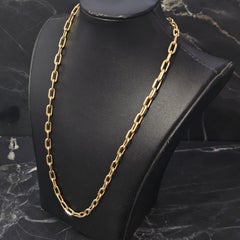
In our modern era, a number of chain-link necklaces are trending, worn alone or layered. The stylish links that have passed the test of time include oval links, paper-clip chains and more. The best way to discover your perfect fit is to zero in on a particular name and type of link.
While it was once key to accessorizing for a formal event, a vintage chain necklace now adds a fresh dynamic to any outfit at any time of day. Find yours on 1stDibs.