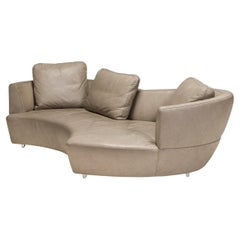
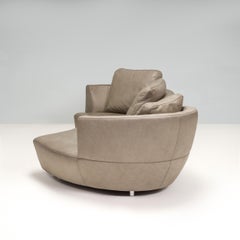
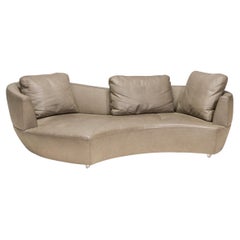
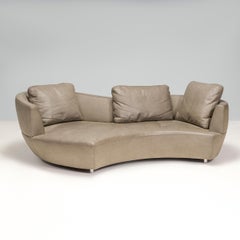
In 1974, Roche Bobois opened its first showroom in the United States on Madison Avenue in New York City. The celebrated luxury French furniture brand is now in 50 countries with more than 200 stores.
The Roche Bobois story has origins in 1950, when entrepreneur Jacques Roche converted an old Paris theater into two contemporary furniture boutiques so that his sons could help usher stunning Bauhaus-inspired work out of the shops and into French homes nearby.
At another showroom called Au Beau Bois, also in the French capital city, the Chouchan family was simultaneously selling home furnishings. The families met later, when Philippe and François Roche convened with Patrick and Jean-Claude Chouchan at a furniture exhibition in Copenhagen in 1960 and afterward produced a catalog announcing their partnership.
Minimal and modernist Scandinavian design had gained prominence in the furniture industry by 1960, rendering designers such as Kaare Klint and Poul Henningsen marquee names — and Roche Bobois's principals had taken notice. Following a national advertising campaign in Elle magazine a year later, the Scandinavian furniture that the newly minted Roche Bobois was importing to Paris became a huge success. Early promotional material from the firm likely included the sleek modular wall units crafted in rosewood by Danish furniture maker Poul Cadovius. It didn’t take long for Roche Bobois to shift toward producing its own contemporary furniture line.
When the popularity of cable television took hold in more major American cities during the 1970s, sofas and other seating became integral to contemporary living-room decor. Roche Bobois’s newly launched Les Contemporains series positioned its own sofas front and center, and it also offered plush lounge chairs designed by Mario Bellini.
Bold works from the company during the decade included Marc Berthier’s Pop Art–colored tubular metal desks and chairs — the latter covered with braided fabric — as well as one of Roche Bobois’s most enduring and well-known pieces, the Mah Jong sectional sofa created by sculptor, painter and designer Hans Hopfer. Anchored by few central elements, this modular lounge sofa can be combined or stacked, giving the buyer total freedom over its appearance and the ability to maximize comfort.
Since its inception, Roche Bobois has worked with many internationally renowned architects and designers on its collections, among them Paola Navone and Vladimir Kagan. Even fashion designers such as Missoni and Emanuel Ungaro have made contributions to the company’s lineup.
In 2010, Roche Bobois marked its 50-year anniversary by debuting a partnership with French fashion designer Jean Paul Gaultier. A decade later, Roche Bobois teamed up with Portuguese artist Joana Vasconcelos, who designed a collection of organically shaped sofas as well as vibrant, colorful accent pillows and rugs.
Roche Bobois’s offerings over the years have included everything from mid-century modern armchairs to Art Deco case pieces to sculptural outdoor cocktail tables framed in metal wire — shop these classics now on 1stDibs.
The late 19th and early 20th centuries saw sweeping social change and major scientific advances — both of which contributed to a new aesthetic: modernism. Rejecting the rigidity of Victorian artistic conventions, modernists sought a new means of expression. References to the natural world and ornate classical embellishments gave way to the sleek simplicity of the Machine Age. Architect Philip Johnson characterized the hallmarks of modernism as “machine-like simplicity, smoothness or surface [and] avoidance of ornament.”
Early practitioners of modernist design include the De Stijl (“The Style”) group, founded in the Netherlands in 1917, and the Bauhaus School, founded two years later in Germany.
Followers of both groups produced sleek, spare designs — many of which became icons of daily life in the 20th century. The modernists rejected both natural and historical references and relied primarily on industrial materials such as metal, glass, plywood, and, later, plastics. While Bauhaus principals Marcel Breuer and Ludwig Mies van der Rohe created furniture from mass-produced, chrome-plated steel, American visionaries like Charles and Ray Eames worked in materials as novel as molded plywood and fiberglass. Today, Breuer’s Wassily chair, Mies van der Rohe’s Barcelona chair — crafted with his romantic partner, designer Lilly Reich — and the Eames lounge chair are emblems of progressive design and vintage originals are prized cornerstones of collections.
It’s difficult to overstate the influence that modernism continues to wield over designers and architects — and equally difficult to overstate how revolutionary it was when it first appeared a century ago. But because modernist furniture designs are so simple, they can blend in seamlessly with just about any type of décor. Don’t overlook them.
Vintage couches and antique sofas have anchored living rooms for generations. The pieces most sought after today carry the deep-buttoned tufting of a Chesterfield or the low, sculptural ease of mid-century modern and Hollywood Regency design.
Styles to Know
Rolled arms and tufted backs point to Mid-Century Modern or Hollywood Regency pieces, while tight backs and turned legs skew more traditional. Velvet is enjoying a renewed moment across most of these silhouettes; see our velvet chesterfield sofa trend report for examples. A mid-century modern coffee table within reach and a vintage mirror nearby round out the seating area.
How to Choose the Right Vintage Sofa
A sofa's frame and upholstery history can be difficult to judge from photographs alone. Ask a seller for more information when a listing doesn't show the fabric or joinery clearly, and confirm whether the upholstery is original or has been redone. Each piece comes from a vetted 1stDibs seller, with era, designer and condition detailed, and the 1stDibs Promise stands behind every purchase.