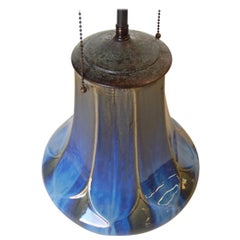
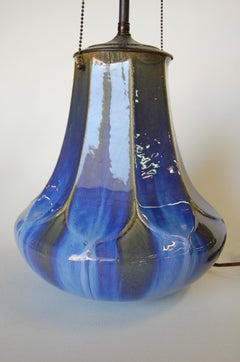
Best known for its stylish Vasekraft line, Fulper Pottery was a major producer of American art pottery, which grew out of the Arts and Crafts movement in the United States.
Like the Rookwood, Roseville and Van Briggle potteries, the Flemington, New Jersey–based Fulper flourished from the 1870s through the 1920s. During that period, U.S. consumers favored the fluid forms and cool color palette of Art Nouveau ceramics, as well as the practicality of the Craftsman style.
Unlike studio ceramics, in which each piece is hand thrown on a potter’s wheel, most art pottery — including vintage Fulper vases, bowls and other creations — was made using molds, yielding identical forms that were glazed in distinctive patterns like the butterscotch and cat’s-eye combination displayed in this 1915 example.
The company that became Fulper Pottery was founded in 1841. Initially a manufacturer of utilitarian ceramics ranging from crockery to drain pipes, it was bought in 1960 by Abram Fulper, who changed its name from Samuel Hill Pottery and retooled it to make more refined ceramics using the region’s red clay.
Incorporated as Fulper Pottery Co. in 1899 under the leadership of Abram’s two sons, it produced attractive utilitarian householdware such as its line of fireproof cookware and its Germ-Proof Filter, a sort of early water cooler used in public places.
The firm made its first forays into art pottery with a line of glazed vessels created by its master potter, John Kunsman, pieces from which were shown at the 1904 Louisiana Purchase Exposition and won an honorable mention. At that time, a series of World’s Fairs and museum shows were fueling a fascination among the public with East Asian art and design. In response, the American art pottery community began producing wares with glazes that recalled the brilliant colors and shimmering surfaces of Chinese ceramics. Fulper’s entry was its Vasekraft line, which launched in 1909.
Unfortunately, the original glazes employed were not entirely successful and, even more importantly, were expensive to produce.
In the 1910s, Fulper’s new ceramic engineer, Martin Stangl, revamped the Vasekraft line with glazes less like the Chinese and more akin to those of Roseville and Rookwood pottery, with more uniform coloration and matte surfaces. His designs ranged from bookends to candle holders, desk accessories, and lamps, all of which remained popular into the 1920s.
Following World War I, Fulper introduced new lines, such as Fulper Pottery Artware and Fulper Porcelaines, which were marketed specifically to women and featured delicate items for a fashionable dressing table, as well as a solid-color Fulper Fayence. After William Fulper’s death, in 1928, Stangl was named president, and in 1935 the Stangl Pottery line became the company’s only product. In 1978, Fulper was purchased by Pfaltzgraff.
Find vintage Fulper pottery for sale on 1stDibs.
Art Deco furniture is characterized by its celebration of modern life. More than its emphasis on natural wood grains and focus on traditional craftsmanship, vintage Art Deco dining chairs, tables, desks, cabinets and other furniture — which typically refers to pieces produced during the 1920s and 1930s — is an ode to the glamour of the “Roaring Twenties.”
ORIGINS OF ART DECO FURNITURE DESIGN
CHARACTERISTICS OF ART DECO FURNITURE DESIGN
- Bold geometric lines and forms, floral motifs
- Use of expensive materials such as shagreen or marble as well as exotic woods such as mahogany, ebony and zebra wood
- Metal accents, shimmering mirrored finishes
- Embellishments made from exotic animal hides, inlays of mother-of-pearl or ivory
ART DECO FURNITURE DESIGNERS TO KNOW
VINTAGE ART DECO FURNITURE ON 1STDIBS
Few design styles are as universally recognized and appreciated as Art Deco. The term alone conjures visions of the Roaring Twenties, Machine Age metropolises, vast ocean liners, sleek typography and Prohibition-era hedonism. The iconic movement made an indelible mark on all fields of design throughout the 1920s and ’30s, celebrating society’s growing industrialization with refined elegance and stunning craftsmanship.
Widely known designers associated with the Art Deco style include Émile-Jacques Ruhlmann, Eileen Gray, Maurice Dufrêne, Paul Follot and Jules Leleu.
The term Art Deco derives from the name of a large decorative arts exhibition held in Paris in 1925. “Art Deco design” is often used broadly, to describe the work of creators in associated or ancillary styles. This is particularly true of American Art Deco, which is also called Streamline Moderne or Machine Age design. (Streamline Moderne, sometimes known as Art Moderne, was a phenomenon largely of the 1930s, post–Art Nouveau.)
Art Deco textile designers employed dazzling floral motifs and vivid colors, and while Art Deco furniture makers respected the dark woods and modern metals with which they worked, they frequently incorporated decorative embellishments such as exotic animal hides as well as veneers in their seating, case pieces, living room sets and bedroom furniture.
From mother-of-pearl inlaid vitrines to chrome aviator chairs, bold and inventive works in the Art Deco style include chaise longues (also known as chaise lounges) and curved armchairs. Today, the style is still favored by interior designers looking to infuse a home with an air of luxury and sophistication.
The vintage Art Deco furniture for sale on 1stDibs includes dressers, coffee tables, decorative objects and more.
Antique table lamps became a category of their own once electricity moved light off the wall and onto furniture. The form split quickly: task-driven designs like the Anglepoise on one side, decorative ceramic and glass on the other.
Styles to Know
Base material shapes the light as much as the shade does: ceramic and glass diffuse a softer glow, while brass and metal read more directional. Layer the look with a mid-century modern floor lamp for ambient light, or set a pair on a mid-century modern nightstand for a bedroom.
How to Choose the Right Vintage Table Lamp
Buying individually rather than as a pair allows more flexibility when mixing eras across a room. For those shopping by name rather than by shape, the history of the Anglepoise lamp is worth a read. Each piece comes from a vetted 1stDibs seller, with era, designer and condition detailed, and the 1stDibs Promise stands behind every purchase.