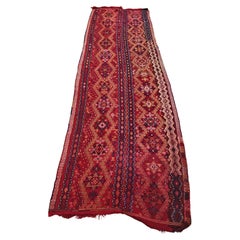
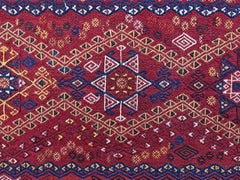
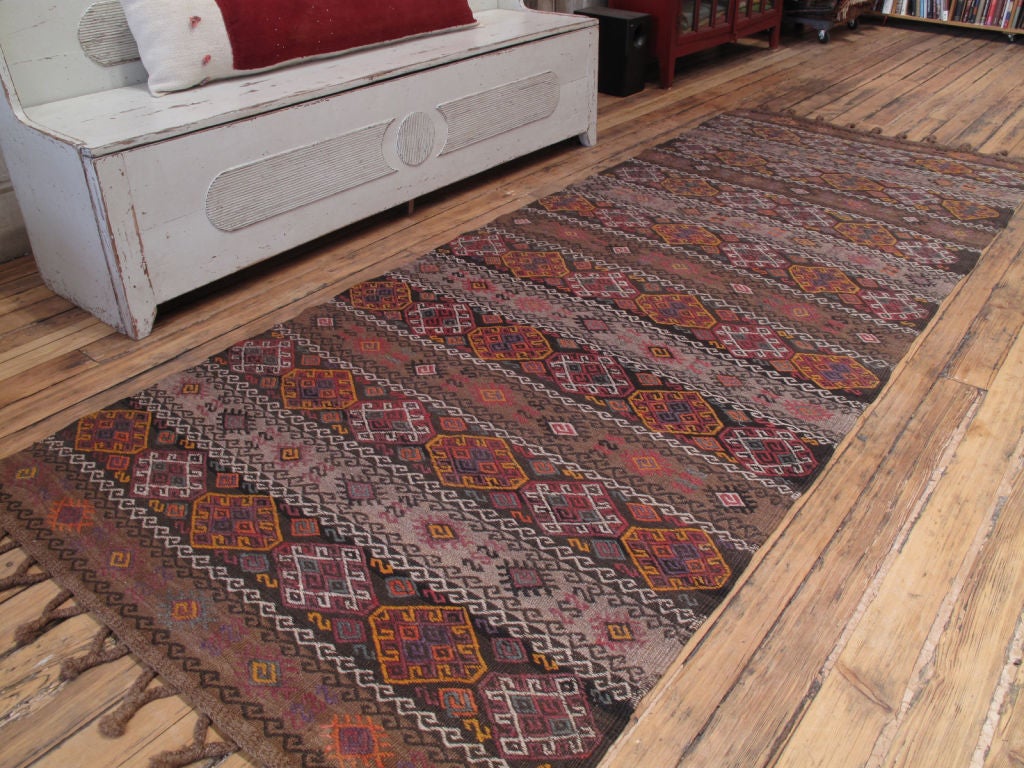
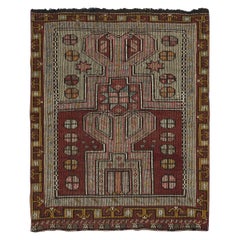
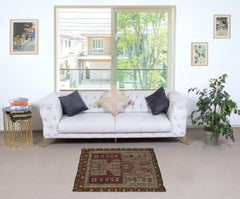
Find many varieties of an authentic jijim rug available at 1stDibs. A jijim rug — often made from
fabric,
wool and
brocade — can elevate any home. Whether you’re looking for an older or newer jijim rug, there are earlier versions available from the 19th Century and newer variations made as recently as the 20th Century. A jijim rug is a generally popular piece of furniture, but those created in styles are sought with frequency.
Antique and vintage Turkish rugs, with their ruby reds and misted blues, their entwined botanical designs and rhythmic geometries, are as beloved today as they were in the 13th century, when the Turks of the Seljuk Empire began weaving these vibrant carpets in Anatolia.
A Turkish rug is simply one made in Turkey or the former Ottoman empire, employing the region’s unique traditional methods and weaves. Varieties range from flat-woven kilims to lush knotted rugs, known as hali, many of which are created with Ghiordes, or Turkish, knots. Whereas in other knots, the weft (crosswise) yarn is wrapped around one warp (lengthwise) yarn, in Ghiordes knots, it is wrapped around two, imparting lushness and durability. In addition to knotting techniques, Turkish rugs differ in their motifs — naturalistic or stylized, geometric or figurative — which often reflect the region where they were made.
The main types of Turkish rugs, as Milan-based carpet dealer Alfredo Levi explains it, are kilim, typified by a plain slit-tapestry weave, which leaves a gap, or slit, between sections woven with different yarns in different colors; sumak, made with weft wrapping, for a sturdier flat-woven carpet; and cicim, which he describes as “a type of sumak with extra brocade techniques typical of the tribes and villages of central Anatolia.
Within each type, there are various regional styles. Among these are Bergama carpets, characterized by bright reds and strong medallions; thick-piled Tulu rugs; and Konya rugs, which Marco Polo is said to have called “the most beautiful in the world.” With their strong tribal motifs and hot-red wefts of especially luxurious wool, Konya carpets are especially prized by collectors.
Also treasured are Oushak (or Ushak) rugs, with their complex, intricate designs and warm earth tones of saffron, cinnamon, blue, ivory and gold; and Hereke carpets, originally created exclusively for Ottoman sultans, using the finest silk. For Jason Nazmiyal, of New York carpet dealer Nazmiyal Antique Rugs, “a good Turkish rug is when the colors are harmonious.” This is true of both modern and antique Turkish rugs, but the hues have changed over the centuries, thanks to both technology and changes in culture and taste.
Patterns, too, have evolved. Although many weavers continue to produce traditional designs, others reinterpret their cultural heritage in contemporary terms, with bolder ornamentation and more geometric motifs. Contemporary Turkish rugs also are seldom made by hand and often incorporate synthetics into the weave, for cost-effectiveness and a durability suited to 21st-century life.
Find antique and vintage Turkish rugs for your home on 1stDibs. At The Study, read about how to take care of your antique or vintage rug as well as how to choose the right rug for your space.