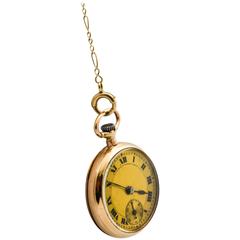
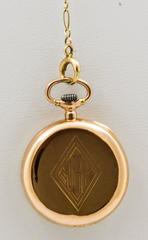
Rolex Yellow Gold Pocket Watch
By Rolex
Located in Dallas, TX
From Rolex’s very limited array of pocket watches, this 1920s watch is one of Rolex’s oldest timepieces.
Category
Vintage 1920s Swiss Modern Pocket Watches
Materials
14k Gold, Yellow Gold
Rolex Yellow Gold Pocket Watch
By Rolex
Located in Dallas, TX
From Rolex’s very limited array of pocket watches, this 1920s watch is one of Rolex’s oldest timepieces.
14k Gold, Yellow Gold
While the rise in popularity of vintage Rolex watches is of no surprise to aficionados, collectors and industry experts, when it comes to contemporary luxury wristwatches, Rolex is also often the first brand that springs to mind. Not only is the company revered for its precision timekeeping and impeccable craftsmanship, but its name was designed to be memorable.
Rolex's enviable worldwide recognition can be credited in part to the genius of company founder Hans Wilsdorf. When the German-born watch dealer and his brother-in-law, Alfred Davis, set up their London enterprise, in 1905, they called it Wilsdorf & Davis, according to the traditional formula.
But Wilsdorf was determined to come up with another name that was short, would look good on a watch dial and was easy to say and remember in several languages. In 1908, he trademarked the name Rolex, and by 1920, he had moved the company to Geneva and redubbed it as Montres Rolex S.A.
But the main reasons for the brand’s success are its aforementioned commitment to precision and unflagging pursuit of innovation. In 1926, the company introduced the aptly named Oyster model. With a screw-down crown and case back, both fitted with rubber gaskets, this was the first truly waterproof watch.
Five years later, Rolex upped the ante with the Oyster Perpetual. That model’s patented Perpetual movement contained a rotor mechanism enabling it to self-wind. In another trendsetting move, in 1945, the brand debuted the Datejust, with a date window prominently displayed on the dial.
The company’s two most iconic models are sports watches. Although the Submariner, which debuted in 1953, was developed as a dive watch, its waterproof case, solid construction and good looks made it a favorite of adventurers and urbanites alike, including James Bond, who wore it in classics like Dr. No and Goldfinger. The Daytona, the racing chronograph made famous by Paul Newman, is especially sought after by collectors. Newman’s personal Daytona, which hit the auction block in 2017, sold for $17.8 million.
Find vintage Rolex watches, bracelets and more on 1stDibs.
Rooted in centuries of history of adornment dating back to the ancient world, modern jewelry reimagines traditional techniques, forms and materials for expressive new pieces. As opposed to contemporary jewelry, which responds to the moment in which it was created, modern jewelry often describes designs from the 20th to 21st centuries that reflect movements and trends in visual culture.
Modern jewelry emerged from the 19th-century shift away from jewelry indicating rank or social status. The Industrial Revolution allowed machine-made jewelry using electric gold plating, metal alloys and imitation stones, making beautiful jewelry widely accessible. Although mass production deemphasized the materials of the jewelry, the vision of the designer remained important, something that would be furthered in the 1960s with what’s known as the “critique of preciousness.”
A design fair called the “Exposition Internationale des Arts Décoratifs et Industriels Modernes” brought global attention to the Art Deco style in 1925 and gathered a mix of jewelry artists alongside master jewelers like Van Cleef & Arpels, Mauboussin and Boucheron. Art Deco designs from Cartier and Van Cleef & Arpels unconventionally mixed gemstones like placing rock crystals next to diamonds while borrowing motifs from eclectic sources including Asian lacquer and Persian carpets. Among Cartier’s foremost design preoccupations at the time were high-contrast color combinations and crisp, geometric forms and patterns. In the early 20th century, modernist jewelers like Margaret De Patta and artists such as Alexander Calder — who is better known for his kinetic sculptures than his provocative jewelry — explored sculptural metalwork in which geometric shapes and lines were preferred over elaborate ornamentation.
Many of the innovations in modern jewelry were propelled by women designers such as Wendy Ramshaw, who used paper to craft her accessories in the 1960s. During the 1970s, Elsa Peretti created day-to-night pieces for Tiffany & Co. while designers like Lea Stein experimented with layering plastic, a material that had been employed in jewelry since the mid-19th century and had expanded into Bakelite, acrylics and other unique materials.
Find a collection of modern watches, bracelets, engagement rings, necklaces, earrings and other jewelry on 1stDibs.
Can you pull off a vintage pocket watch? Of course you can. With a suit and a waistcoat, a pocket watch can be a refreshing alternative to a wristwatch.
The earliest pocket watches were luxury items, and, owing to cost, they weren’t commonplace until the 19th century. Artfully crafted pocket watches were a symbol of wealth, and manufacturers such as Vacheron Constantin and Patek Philippe became known for theirs. (Today, they’re among the most sought after by collectors and enthusiasts.)
At the onset, pocket watches resembled small round table clocks, and pulling your small round table clock — perhaps of the silver variety — out of your breast pocket in front of someone else demonstrated unequivocally that you cared about punctuality. For collectors, pocket watches are big, and that means a larger canvas provided for functions without crowding the dial. For example, the Marius Lecoultre pocket watch — made circa 1890 — does everything but uncork your wine.
In the late 1800s, the open-face pocket watch became a staple on the American railroad. It was a requirement for railway workers to wear a pocket watch, as the timepieces were responsible for keeping conductors on schedule. This was a boon to the watchmaking industry, with companies like Hamilton, the Elgin National Watch Company and the Waltham Watch Company producing high-grade and workingman’s watches.
By the 1930s, wristwatches comprised the bulk of watch manufacturing in America, superseding the pocket watch. Suddenly, if you wanted to know the time, you merely glanced at your wrist. But given their vintage charm and our general appetite for good design, pocket watches are a piece of statement-making jewelry and today can prove complementary to your formal attire in a manner that is stylish and unconventional.
Let time take its course — browse a vast selection of antique and vintage pocket watches available on 1stDibs designed by legendary brands such as IWC, Cartier and more.