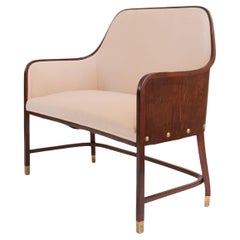
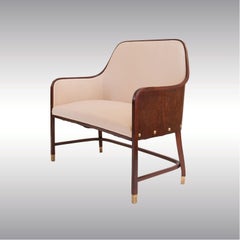
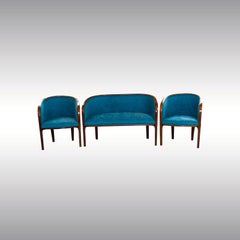
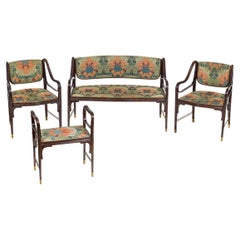
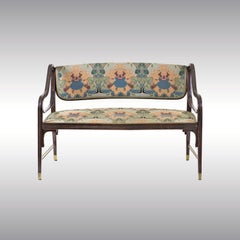
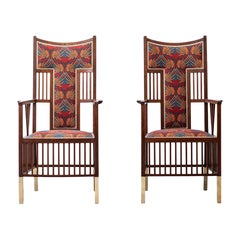
Thonet Bank

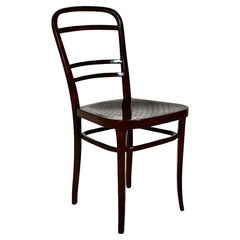
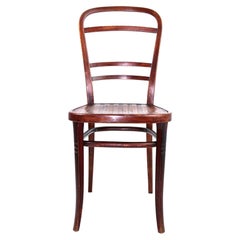
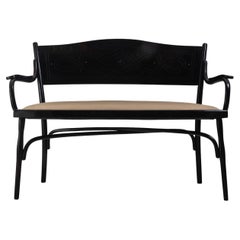
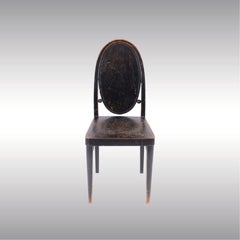
Jugendstil Otto Wagner Chair Beech 1902 Postal Saving Bank Vienna Thonet
By Thonet, Otto Wagner
Located in Vienna, AT
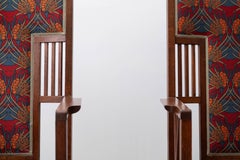
Postsparkasse 1902 for Thonet 1904/1906 Vienna. An iconic chair or side chair by the famed Austrian designer
Category

Early 20th Century Jugendstil Chairs

Materials

Beech

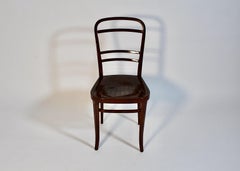
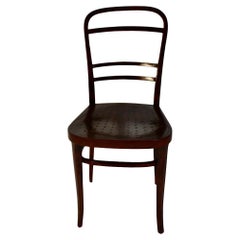
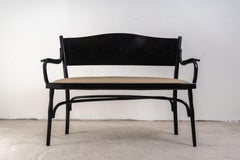
Otto Wagner Jugendstil One Chair Beech Postal Saving Bank Vienna 1902 Thonet
By Thonet, Otto Wagner
Located in Vienna, AT
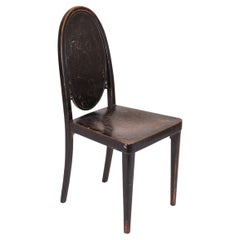
Bank Vienna - 1902 designed and manufactured 1904 / 1906 by Thonet. The chair shows a perforated seat
Category

Early 20th Century Austrian Jugendstil Chairs

Materials

Metal

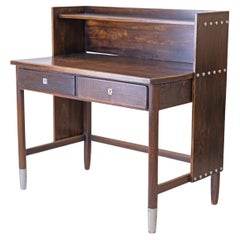
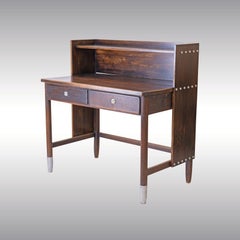
Original Otto Wagner for Thonet 1905 Writing Desk Postal Saving Bank Vienna
By Otto Wagner, Woka Lamps, Gebrüder Thonet Vienna GmbH
Located in Vienna, AT
Otto Wagner writing desk from the Postal Saving Bank in Vienna. Made by Thonet, Vienna. Otto Wagner
Category

Early 20th Century Austrian Jugendstil Desks and Writing Tables

Materials

Wood

Recent Sales

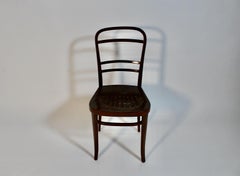
Otto Wagner, Rare Chair for the Vienna Post Saving Bank by Thonet, circa 1902
By Otto Wagner
Located in Vienna, AT
Rare side chair designed by famous Viennese Architect Otto Wagner for the Post Saving Bank in
Category

Antique Early 1900s Austrian Art Nouveau Chairs

Materials

Beech, Bentwood

Beech Nr. 126 Sofa by Michael Thonet for Thonet
By Michael Thonet
Located in Budapest, HU
Thonet Bank Nr 126 is a true masterpiece of furniture design, originally conceived before 1900 by
Category

Antique Early 1900s Austrian Art Nouveau Sofas

Materials

Leather, Beech

Beech Nr. 126 Sofa by Michael Thonet for Thonet
H 44.49 in W 36.62 in D 18.51 in
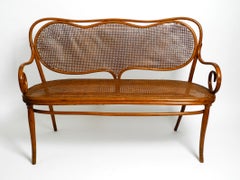
Bench No. 5 Thonet 1858 made of bent beech and wickerwork restoration needed
By Gebrüder Thonet Vienna GmbH
Located in München, DE
Beautiful, very rare original bench no. 5 by the Thonet brothers (Gebrüder Thonet) Vienna from 1859
Category

Antique 1850s Austrian Art Nouveau Loveseats

Materials

Wicker, Bentwood

People Also Browsed

Pair of Dutch Art Deco Armchairs with Inlay Motif in Oak and Velvet, 1930s
Located in Almelo, NL
Pair of Dutch Art Deco Armchairs with Inlay Motif in Oak and Velvet, 1930s A stylish and comfortable pair of Dutch Art Deco armchairs from the 1930s, thoughtfully designed with balan...
Category

Mid-20th Century Dutch Art Deco Armchairs

Materials

Metal

Japanese Old Artist's Drawing Board / Abstract Art Wall Decoration / Late 1900s
Located in Iwate-gun Shizukuishi-cho, Iwate Prefecture
This is a drawing board used by a Japanese painter. It is made by gluing together pieces of cardboard, and it is thought that the artist repeatedly painted on it. The colorful water...
Category

Late 20th Century Japanese Other Decorative Art

Materials

Paper, Paint

Antique Japanese wooden coffee table /Early 20th Century / Wabi-sabi sofa table
Located in Sammu-shi, Chiba
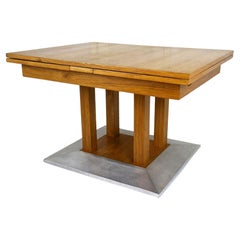
This low table combines a traditional Japanese wooden top and legs. The top is crafted from a single piece of luxurious cedar, enveloping the entire piece with its soft, warm grain. ...
Category

Early 20th Century Japanese Taisho Sofa Tables

Materials

Cedar

French Limed Oak Armoire
Located in Antwerp, BE
Limed oak two door armoire. Height 210 cm. Width 127 cm. Depth 64 cm.
Category

Late 20th Century French Mid-Century Modern Wardrobes and Armoires

Materials

Glass, Wood, Oak

French Limed Oak Armoire
$2,644
H 82.68 in W 50.01 in D 25.2 in
Art Deco wardrobe – France 1930
Located in Girona, Girona
Splendid Art Deco wardrobe with solid ash structure with bird’s eye maple veneer. Solid mahogany base. Back plate and handles in nickel-plated metal and original pink glass tubes. Wa...
Category

Vintage 1930s French Art Deco Wardrobes and Armoires

Materials

Nickel

Art Deco wardrobe – France 1930
$6,610 / set
H 73.04 in W 53.15 in D 19.49 in
Japanese Antique Low Table, Taisho Era (1912–1926), Wabi Sabi
Located in Hitachiomiya-shi, 08
This antique low table was crafted in the Taisho Era (1912–1926). Made of keyaki (Japanese zelkova) with naturally beautiful grain, the surface shows a softly worn, time-earned pati...
Category

Early 20th Century Japanese Taisho Center Tables

Materials

Wood

Japanese Old Iron Block 1950s-1970s / Display stand Wabi Sabi
Located in Chōsei District Nagara, JP
This is an old Japanese iron block, estimated to have been made in the early Showa period (1950s–1970s). At the time, it was used in ironworks as an anvil or workbench. Decades of us...
Category

Late 20th Century Japanese Showa Antiquities

Materials

Iron

Vitrine Cabinet Danish Gustavian. Blue Painted
Located in Kastrup, DK
A beautiful two-part Gustavian display cabinet, crafted in pine and painted in an elegant blue tone with a light grey interior. The upper section features a moulded cornice and two ...
Category

Antique Early 19th Century Danish Gustavian Vitrines

Materials

Brass

Vitrine Cabinet Danish Gustavian. Blue Painted
$5,590 Sale Price
20% Off
H 77.96 in W 52.17 in D 16.93 in
René Drouet Pair of Lounge Chairs in Olive Green Corduroy and Walnut
By René Drouet
Located in Waalwijk, NL
René Drouet, pair of lounge chairs, corduroy velvet, walnut, France, 1930s Designed by French decorator René Drouet, these club chairs are a quintessential example of French Art Dec...
Category

Vintage 1930s French Art Deco Lounge Chairs

Materials

Velvet, Walnut

Hungarian Art Deco Chest of Drawers in Walnut
Located in Houston, TX
Chest of drawers is made out of fine walnut wood. It has four-narrow drawers with round chrome handles and one wide drawer on the bottom. Chest is elevated by the rectangular base. H...
Category

Vintage 1930s Hungarian Art Deco Commodes and Chests of Drawers

Materials

Walnut

Art Deco Three-Door Armoire, circa 1930
Located in Antwerp, BE
This beautiful walnut armoire features a central door front flanked by two doors, which open to shelved storage. (Two shelves).  
Category

Early 20th Century Belgian Art Deco Wardrobes and Armoires

Materials

Wood, Walnut, Glass, Oak

Art Deco Three-Door Armoire, circa 1930
$3,365
H 74.02 in W 63 in D 15.36 in
Meiji Period Silver Oxidized Screen
Located in Fukuoka, JP
Meiji Period Silver Oxidized Screen Period: Meiji Size: 352 x 174 cm SKU: 2423 Step back in time with this Meiji period screen, where the allure of silver oxidation artfully c...
Category

Antique Late 19th Century Japanese Meiji Paintings and Screens

Materials

Silver Leaf

Meiji Period Silver Oxidized Screen
$4,170
H 68.51 in W 138.59 in D 1.19 in
Guan Kiln Style Celadon Vase
Located in San Francisco, CA
Guan Kiln Style Celadon Vase with Crackle Glaze A bottle shaped vase, elegantly finished in a soft, blue-green celadon glaze with the delicate crackle pattern characteristic of the ...
Category

20th Century Chinese Vases

Materials

Porcelain

Guan Kiln Style Celadon Vase
$768
H 11.5 in Dm 8 in
Breath-taking Spherical Chandelier with hand-blown glass pieces by Feders Mexico
Located in Mexico, DF
Breath-taking spherical chandelier with a distinctive Mexican mid-century modern style. Constructed with round hand-blown bubbled, textured glass pieces in assorted lively colors, pr...
Category

Vintage 1960s Mexican Modern Chandeliers and Pendants

Materials

Metal

Japanese Andon paper Lantern for tea ceremony
Located in Fukuoka, JP
Beautiful Japanese Andon lantern for tea ceremony . Wood frame with Awashi handmade paper and bamboo handle. A beautiful addition to any room! It can be used with simple candle an...
Category

20th Century Japanese Showa Lanterns

Materials

Bamboo, Paper

Japanese Andon paper Lantern for tea ceremony
$500
H 14.57 in W 10.63 in D 10.63 in
Striking Japanese Handmade Bronze and Polished Brass Vase
Located in Hopewell, NJ
Beautiful handmade art deco style vase from Japan having blackened cast bronze with polished brass overlay of stylized deer.
Category

Vintage 1960s Japanese Art Deco Vases

Materials

Brass, Bronze

Get Updated with New Arrivals
Save "Thonet Bank", and we’ll notify you when there are new listings in this category.

Thonet Bank For Sale on 1stDibs

Choose from an assortment of styles, material and more with respect to the thonet bank you’re looking for at 1stDibs. A thonet bank — often made from wood, beech and hardwood — can elevate any home. Find 8 options for an antique or vintage thonet bank now, or shop our selection of 6 modern versions for a more contemporary example of this long-cherished piece. Whether you’re looking for an older or newer thonet bank, there are earlier versions available from the 20th Century and newer variations made as recently as the 21st Century. Each thonet bank bearing modern or Art Nouveau hallmarks is very popular. Gebrüder Thonet Vienna GmbH, Otto Wagner and Adolf Loos each produced at least one beautiful thonet bank that is worth considering.

How Much is a Thonet Bank?

Prices for a thonet bank start at $1,064 and top out at $46,798 with the average selling for $2,260.

A Close Look at Art-nouveau Furniture

In its sinuous lines and flamboyant curves inspired by the natural world, antique Art Nouveau furniture reflects a desire for freedom from the stuffy social and artistic strictures of the Victorian era. The Art Nouveau movement developed in the decorative arts in France and Britain in the early 1880s and quickly became a dominant aesthetic style in Western Europe and the United States.

ORIGINS OF ART NOUVEAU FURNITURE DESIGN

CHARACTERISTICS OF ART NOUVEAU FURNITURE DESIGN

  • Sinuous, organic and flowing lines
  • Forms that mimic flowers and plant life
  • Decorative inlays and ornate carvings of natural-world motifs such as insects and animals 
  • Use of hardwoods such as oak, mahogany and rosewood

ART NOUVEAU FURNITURE DESIGNERS TO KNOW

ANTIQUE ART NOUVEAU FURNITURE ON 1STDIBS

Art Nouveau — which spanned furniture, architecture, jewelry and graphic design — can be easily identified by its lush, flowing forms suggested by flowers and plants, as well as the lissome tendrils of sea life. Although Art Deco and Art Nouveau were both in the forefront of turn-of-the-20th-century design, they are very different styles — Art Deco is marked by bold, geometric shapes while Art Nouveau incorporates dreamlike, floral motifs. The latter’s signature motif is the "whiplash" curve — a deep, narrow, dynamic parabola that appears as an element in everything from chair arms to cabinetry and mirror frames.

The visual vocabulary of Art Nouveau was particularly influenced by the soft colors and abstract images of nature seen in Japanese art prints, which arrived in large numbers in the West after open trade was forced upon Japan in the 1860s. Impressionist artists were moved by the artistic tradition of Japanese woodblock printmaking, and Japonisme — a term used to describe the appetite for Japanese art and culture in Europe at the time — greatly informed Art Nouveau. 

The Art Nouveau style quickly reached a wide audience in Europe via advertising posters, book covers, illustrations and other work by such artists as Aubrey Beardsley, Henri de Toulouse-Lautrec and Alphonse Mucha. While all Art Nouveau designs share common formal elements, different countries and regions produced their own variants.

In Scotland, the architect Charles Rennie Mackintosh developed a singular, restrained look based on scale rather than ornament; a style best known from his narrow chairs with exceedingly tall backs, designed for Glasgow tea rooms. Meanwhile in France, Hector Guimard — whose iconic 1896 entry arches for the Paris Metro are still in use — and Louis Majorelle produced chairs, desks, bed frames and cabinets with sweeping lines and rich veneers. 

The Art Nouveau movement was known as Jugendstil ("Youth Style") in Germany, and in Austria the designers of the Vienna Secession group — notably Koloman Moser, Josef Hoffmann and Joseph Maria Olbrich — produced a relatively austere iteration of the Art Nouveau style, which mixed curving and geometric elements.

Art Nouveau revitalized all of the applied arts. Ceramists such as Ernest Chaplet and Edmond Lachenal created new forms covered in novel and rediscovered glazes that produced thick, foam-like finishes. Bold vases, bowls and lighting designs in acid-etched and marquetry cameo glass by Émile Gallé and the Daum Freres appeared in France, while in New York the glass workshop-cum-laboratory of Louis Comfort Tiffany — the core of what eventually became a multimedia decorative-arts manufactory called Tiffany Studios — brought out buoyant pieces in opalescent favrile glass. 

Jewelry design was revolutionized, as settings, for the first time, were emphasized as much as, or more than, gemstones. A favorite Art Nouveau jewelry motif was insects (think of Tiffany, in his famed Dragonflies glass lampshade).

Like a mayfly, Art Nouveau was short-lived. The sensuous, languorous style fell out of favor early in the 20th century, deemed perhaps too light and insubstantial for European tastes in the aftermath of World War I. But as the designs on 1stDibs demonstrate, Art Nouveau retains its power to fascinate and seduce.

There are ways to tastefully integrate a touch of Art Nouveau into even the most modern interior — browse an extraordinary collection of original antique Art Nouveau furniture on 1stDibs, which includes decorative objects, seating, tables, garden elements and more.

Finding the Right Seating for You

With entire areas of our homes reserved for “sitting rooms,” the value of quality antique and vintage seating cannot be overstated.

Fortunately, the design of side chairs, armchairs and other lounge furniture — since what were, quite literally, the early perches of our ancestors — has evolved considerably.

Among the earliest standard seating furniture were stools. Egyptian stools, for example, designed for one person with no seat back, were x-shaped and typically folded to be tucked away. These rudimentary chairs informed the design of Greek and Roman stools, all of which were a long way from Sori Yanagi's Butterfly stool or Alvar Aalto's Stool 60. In the 18th century and earlier, seats with backs and armrests were largely reserved for high nobility.

The seating of today is more inclusive but the style and placement of chairs can still make a statement. Antique desk chairs and armchairs designed in the style of Louis XV, which eventually included painted furniture and were often made of rare woods, feature prominently curved legs as well as Chinese themes and varied ornaments. Much like the thrones of fairy tales and the regency, elegant lounges crafted in the Louis XV style convey wealth and prestige. In the kitchen, the dining chair placed at the head of the table is typically reserved for the head of the household or a revered guest.

Of course, with luxurious vintage or antique furnishings, every chair can seem like the best seat in the house. Whether your preference is stretching out on a plush sofa, such as the Serpentine, designed by Vladimir Kagan, or cozying up in a vintage wingback chair, there is likely to be a comfy classic or contemporary gem for you on 1stDibs.

With respect to the latest obsessions in design, cane seating has been cropping up everywhere, from sleek armchairs to lounge chairs, while bouclé fabric, a staple of modern furniture design, can be seen in mid-century modern, Scandinavian modern and Hollywood Regency furniture styles.

Admirers of the sophisticated craftsmanship and dark woods frequently associated with mid-century modern seating can find timeless furnishings in our expansive collection of lounge chairs, dining chairs and other items — whether they’re vintage editions or alluring official reproductions of iconic designs from the likes of Hans Wegner or from Charles and Ray Eames. Shop our inventory of Egg chairs, designed in 1958 by Arne Jacobsen, the Florence Knoll lounge chair and more.

No matter your style, the collection of unique chairs, sofas and other seating on 1stDibs is surely worthy of a standing ovation.