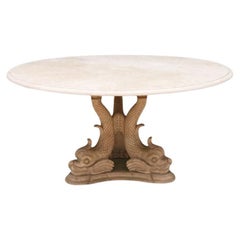
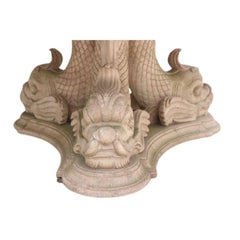
Stone Dining Table with Dolphin Base by Oscar De La Renta
By Oscar De La Renta
Located in Locust Valley, NY
Stone top table with three dolphin base by Oscar De La Renta.
Category
Late 20th Century Unknown Modern Dining Room Tables
Materials
Stone
Stone Dining Table with Dolphin Base by Oscar De La Renta
By Oscar De La Renta
Located in Locust Valley, NY
Stone top table with three dolphin base by Oscar De La Renta.
Stone
The name Oscar de la Renta is synonymous with enduring originality in fashion, and his work deeply influenced other designers throughout the latter half of the 20th century. Vintage Oscar de la Renta evening dresses and gowns — which often feature ruffles, dazzling prints, vibrant colors and dramatic silhouettes — exude elegant sophistication and femininity, while his exquisite scarves and shoes rounded out his sought-after collections.
De la Renta was born in the Dominican Republic in 1932. He was the youngest of seven children, the rest of whom were girls. At the age of 18, he left home for Madrid and studied painting at the San Fernando Royal Academy of Fine Arts. A natural talent for illustration earned him an apprenticeship with the legendary Spanish fashion designer Cristobal Balenciaga.
In 1961, de la Renta visited Paris, where he was hired as a couture assistant at Lanvin. Less than two years later, he moved to New York City. He designed a ready-to-wear collection for Elizabeth Arden and partnered with Jane Derby. He also began designing dresses for First Lady Jacqueline Kennedy. When Derby died in 1965, the label was named after de la Renta (he took full control in the 1970s). Shortly after, he married an editor-in-chief of French Vogue, Françoise de Langlade, whose own career in fashion began at Elsa Schiaparelli’s fashion house.
De la Renta served as president of the Council of Fashion Designers of America from 1973–76, and again from 1986–88. In 1981, the tradition of de la Renta dressing First Ladies continued. He quickly became one of Nancy Reagan’s favorite designers (as well as her lifelong friend).
De la Renta expanded his clothing lines throughout the 1990s but kept true to his feminine, polished style. He also continued to design for the First Ladies of the United States, and his pieces were worn by both Hillary Clinton and Laura Bush. At Balmain, de la Renta was the first Dominican to design for a French couture house.
Over the course of his career, de la Renta earned the CFDA Lifetime Achievement Award, the Coty Award and the Fragrance Foundation’s Perennial Success Award. He passed away in 2014.
In 2015, the Savannah College of Art and Design Museum of Fashion + Film showcased more than 80 of de la Renta's gowns at its inaugural exhibit.
On 1stDibs, find vintage Oscar de la Renta suits, blouses, accessories and handbags.
The late 19th and early 20th centuries saw sweeping social change and major scientific advances — both of which contributed to a new aesthetic: modernism. Rejecting the rigidity of Victorian artistic conventions, modernists sought a new means of expression. References to the natural world and ornate classical embellishments gave way to the sleek simplicity of the Machine Age. Architect Philip Johnson characterized the hallmarks of modernism as “machine-like simplicity, smoothness or surface [and] avoidance of ornament.”
Early practitioners of modernist design include the De Stijl (“The Style”) group, founded in the Netherlands in 1917, and the Bauhaus School, founded two years later in Germany.
Followers of both groups produced sleek, spare designs — many of which became icons of daily life in the 20th century. The modernists rejected both natural and historical references and relied primarily on industrial materials such as metal, glass, plywood, and, later, plastics. While Bauhaus principals Marcel Breuer and Ludwig Mies van der Rohe created furniture from mass-produced, chrome-plated steel, American visionaries like Charles and Ray Eames worked in materials as novel as molded plywood and fiberglass. Today, Breuer’s Wassily chair, Mies van der Rohe’s Barcelona chair — crafted with his romantic partner, designer Lilly Reich — and the Eames lounge chair are emblems of progressive design and vintage originals are prized cornerstones of collections.
It’s difficult to overstate the influence that modernism continues to wield over designers and architects — and equally difficult to overstate how revolutionary it was when it first appeared a century ago. But because modernist furniture designs are so simple, they can blend in seamlessly with just about any type of décor. Don’t overlook them.
Antique and vintage dining room tables have long been the anchor of the home's most social room. The round pedestal and long banquet forms most collected today trace back to the 18th and 19th centuries, when the dining room itself first came into fashion.
Styles to Know
Round and oval tables suit smaller or open-plan rooms, while rectangular pedestal and trestle tables remain the standard for larger, more formal spaces. A credenza adds extra serving storage nearby, and a vintage wall mirror overhead opens up the room. For layout ideas, browse 20 dining rooms arranged for entertaining.
How to Choose the Right Vintage Dining Table
A dining table is usually the largest piece in the room, which makes delivery details worth confirming: White Glove service, disassembly options, and the table's full length, leaves included, measured against the space you have. Every table comes from a vetted 1stDibs seller, with era, designer and condition detailed, backed by the 1stDibs Promise.