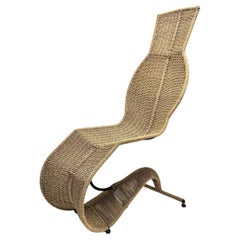
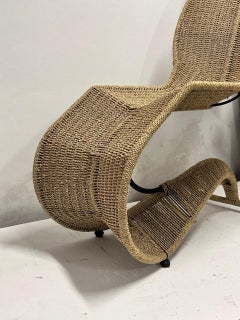
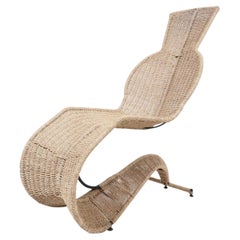
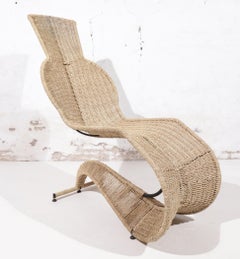
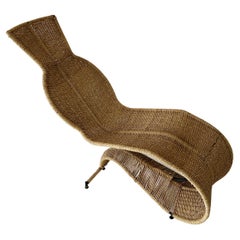
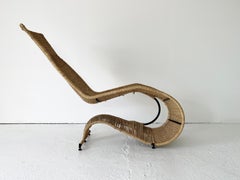
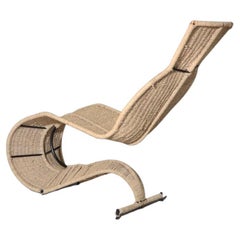
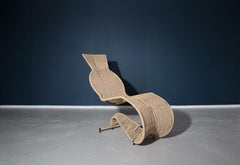
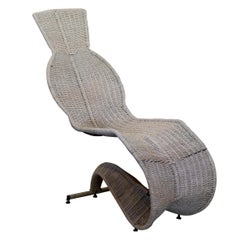
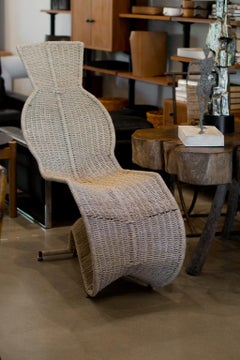
Artistic, innovative and entrepreneurial, the self-taught creator Tom Dixon has been a contemporary design-world maverick for more than three decades. From his revolutionary art-meets-design projects of the 1980s and throughout his dynamic and influential career as a designer of furniture, housewares and interiors, the only consistent note has been change. Dixon’s chief fascination is exploring new materials and new ways of constructing things.
Dixon was restless even as a young man. He enjoyed ceramics and drawing in high school but later dropped out of the Chelsea School of Art in London. While repairing his motorcycle in 1983, Dixon learned how to weld and took to the craft. He began making what he has called semi-functional objects from scrap metal (sometime as performance art in a nightclub), then formed a furniture studio–cum–think tank called Creative Salvage. Amid the ritzy excess of the ’80s, Dixon — along with designers such as Tejo Remy and Ron Arad — forged a new, attention-getting aesthetic with furniture made from found materials.
In 1987, Dixon began working for the Italian furniture manufacturer Cappellini, which put his best-known design, the slender, sinuous S chair, into production, followed by such pieces as the Pylon chair (1992), a wire lattice that resembles electrical transmission towers. Starting in the 1990s, Dixon expanded his interests rapidly. He started a company to manufacture the stackable plastic Jack light; joined the housewares retailer Habitat as creative director; and breathed new life into Artek, the venerable Finnish maker that Alvar Aalto and his wife Aino helped cofound. Since 2002, Dixon has run his namesake company fabricating furnishings from novel materials like brass foil-clad wood and “vacuum-metalized” glass.
The hallmark of Dixon’s design is his captivation with the process of creating pieces such as chairs, tables and lighting fixtures. “A kind friend once described me as a ‘vertebrate designer,’” Dixon has said. “That means that I design from the bones outwards and am not really interested in surface.”
Classic Dixon pieces are those that exhibit the manner of their making — from his early work in welded scrap metal to the woven rattan seats and backs of his Fat chair for Cappellini. There are two ways to approach Dixon designs: as a collector, or as a decorator. The former will seek Dixon’s one-off and limited edition works and prototypes. These historical artifacts carry high prices that range from around $8,000 to $50,000 and above. Those more interested in a dynamic look will find that manufactured Dixon designs — such as his Jack lights or his Melt pendant — can be found for prices that range from about $300 to $1,000. Either way, as you will see on 1stDibs, the designs of Tom Dixon have a singular allure that makes them a noteworthy element in any room.
Postmodern design was a short-lived movement that manifested itself chiefly in Italy and the United States in the early 1980s. The characteristics of vintage postmodern furniture and other postmodern objects and decor for the home included loud-patterned, usually plastic surfaces; strange proportions, vibrant colors and weird angles; and a vague-at-best relationship between form and function.
ORIGINS OF POSTMODERN FURNITURE DESIGN
- Emerges during the 1960s; popularity explodes during the ’80s
- A reaction to prevailing conventions of modernism by mainly American architects
- Architect Robert Venturi critiques modern architecture in his Complexity and Contradiction in Architecture (1966)
- Theorist Charles Jencks, who championed architecture filled with allusions and cultural references, writes The Language of Post-Modern Architecture (1977)
- Italian design collective the Memphis Group, also known as Memphis Milano, meets for the first time (1980)
- Memphis collective debuts more than 50 objects and furnishings at Salone del Milano (1981)
- Interest in style declines, minimalism gains steam
CHARACTERISTICS OF POSTMODERN FURNITURE DESIGN
- Dizzying graphic patterns and an emphasis on loud, off-the-wall colors
- Use of plastic and laminates, glass, metal and marble; lacquered and painted wood
- Unconventional proportions and abundant ornamentation
- Playful nods to Art Deco and Pop art
POSTMODERN FURNITURE DESIGNERS TO KNOW
VINTAGE POSTMODERN FURNITURE ON 1STDIBS
Critics derided postmodern design as a grandstanding bid for attention and nothing of consequence. Decades later, the fact that postmodernism still has the power to provoke thoughts, along with other reactions, proves they were not entirely correct.
Postmodern design began as an architectural critique. Starting in the 1960s, a small cadre of mainly American architects began to argue that modernism, once high-minded and even noble in its goals, had become stale, stagnant and blandly corporate. Later, in Milan, a cohort of creators led by Ettore Sottsass and Alessandro Mendini — a onetime mentor to Sottsass and a key figure in the Italian Radical movement — brought the discussion to bear on design.
Sottsass, an industrial designer, philosopher and provocateur, gathered a core group of young designers into a collective in 1980 they called Memphis. Members of the Memphis Group, which would come to include Martine Bedin, Michael Graves, Marco Zanini, Shiro Kuramata, Michele de Lucchi and Matteo Thun, saw design as a means of communication, and they wanted it to shout. That it did: The first Memphis collection appeared in 1981 in Milan and broke all the modernist taboos, embracing irony, kitsch, wild ornamentation and bad taste.
Memphis works remain icons of postmodernism: the Sottsass Casablanca bookcase, with its leopard-print plastic veneer; de Lucchi’s First chair, which has been described as having the look of an electronics component; Martine Bedin’s Super lamp: a pull-toy puppy on a power-cord leash. Even though it preceded the Memphis Group’s formal launch, Sottsass’s iconic Ultrafragola mirror — in its conspicuously curved plastic shell with radical pops of pink neon — proves striking in any space and embodies many of the collective’s postmodern ideals.
After the initial Memphis show caused an uproar, the postmodern movement within furniture and interior design quickly took off in America. (Memphis fell out of fashion when the Reagan era gave way to cool 1990’s minimalism.) The architect Robert Venturi had by then already begun a series of plywood chairs for Knoll Inc., with beefy, exaggerated silhouettes of traditional styles such as Queen Anne and Chippendale. In 1982, the new firm Swid Powell enlisted a group of top American architects, including Frank Gehry, Richard Meier, Stanley Tigerman and Venturi to create postmodern tableware in silver, ceramic and glass.
On 1stDibs, the vintage postmodern furniture collection includes chairs, coffee tables, sofas, decorative objects, table lamps and more.
Sit back, relax and get all of the ergonomic support you could ever need by introducing an alluring antique or vintage chaise longue in your living room or by your outdoor fire pit.
The chaise longue is an upholstered piece of furniture that was made popular in France in the early 16th century. This low reclining seat — a “long chair” in English — boasts an elongated form and low back that extends about half the length of the furnishing, affording the welcome opportunity for a sitter to put their feet up and relax. A comfortable common ground between sofas and daybeds, early iterations of chaise longues were discovered in Ancient Egypt and were later frequently used in both Greece and Rome.
In the late 1700s, the first chaise longues were imported to America, and English speakers have struggled with the name ever since. (In the United States, the term is frequently spelled “chaise lounge.”) So, how do you pronounce chaise longue? It sounds like “shayz lawng,” but limiting it to shayz is perfectly acceptable in the States.
Antique Victorian chaise longues and 19th-century chaise longues bring luxury and perhaps extravagance to your living space while mid-century modern chaise longues, designed by the likes of Adrian Pearsall, Vladimir Kagan or Milo Baughman, can alter an interior with dazzling geometric contours and richly varied textures.
On 1stDibs, find many kinds of chaise longues for your home — from sculptural works by Charlotte Perriand to plush and velvety Louis XVI pieces to minimalist contemporary versions to suit your understated decor.