Art by Medium: Etching

to
1,347
11,532
4,080
3,557
857
436
Overall Width
to
Overall Height
to
3,808
3,161
11,683
1,933
211
291
610
585
381
592
1,255
3,098
1,399
763
3,281
5,843
3,375
2,426
1,583
1,491
390
223
168
86
69
24
21
13
3
11,985
7,739
703
10,708
5,776
5,489
3,514
3,192
2,791
1,747
1,038
1,028
987
901
826
691
602
548
481
460
419
410
371
20,585
181,439
96,527
78,902
77,825
505
427
319
308
175
2,050
10,712
10,206
7,506
Medium: Etching
German Surrealist Hans Bellmer Etching Engraving Print Cecile Reims Surrealism
German Surrealist Hans Bellmer Etching Engraving Print Cecile Reims Surrealism
By Hans Bellmer

Located in Surfside, FL

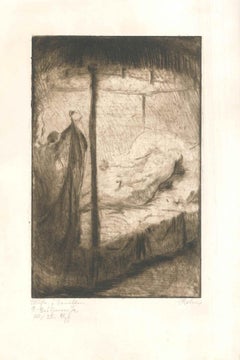
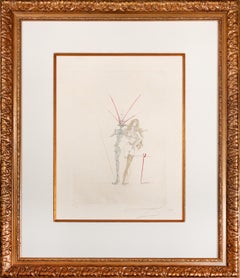
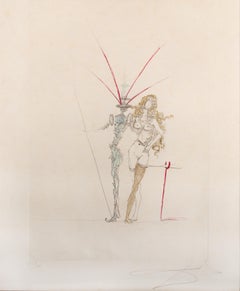
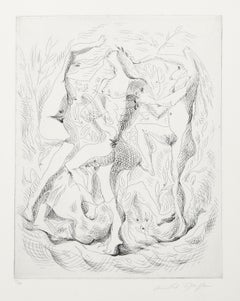
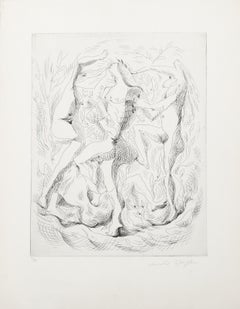
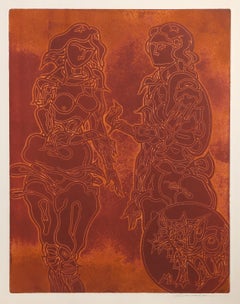
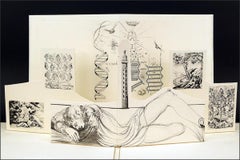
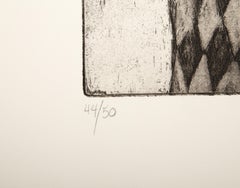
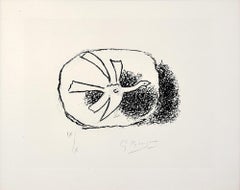
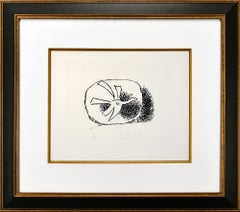
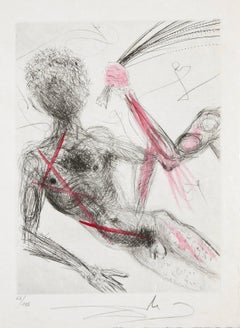
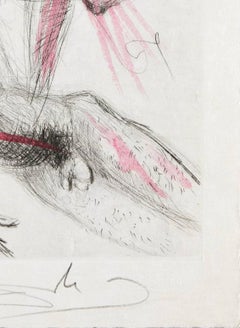
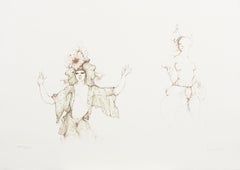
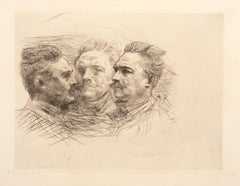
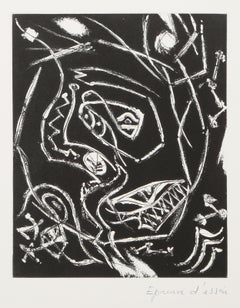
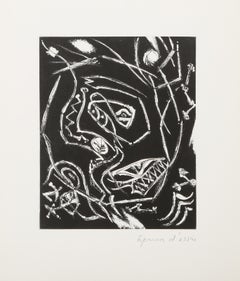
After Hans Bellmer (German, 1902-1975) Surrealist engraving, etching after drawings from a 1942 notebook, engraved in 1974-75 by Cecile Reims Printed by L'Atelier de Chalcographie du Louvre, Paris, Having printed monogram lower left in plate, pencil notations and #7/10 and 'Musee du Louvre' blindstamp verso Dimensions: Sheet 11 X 7.5, Plate size 6.5 X 4 Hans Bellmer ( 1902 – 1975) was a Polish born German artist, best known for his drawings, etchings that illustrates the 1940 edition of Histoire de l’œil, and the life-sized female sculpture mannequin dolls he produced in the mid-1930s. Historians of art and photography also consider him a Surrealist photographer. Bellmer was born in the city of Kattowitz, then part of the German Empire (now Katowice, Poland). Up until 1926, he worked as a draftsman for his own advertising company. Bellmer is most famous for the creation of a series of dolls as well as photographs of them. He was influenced in his choice of art form in part by reading the published letters of Oskar Kokoschka (Der Fetisch, 1925) and Surrealism. Bellmer's puppet doll project is also said to have been catalysed by a series of events in his personal life. Hans Bellmer takes credit for provoking a physical crisis in his father and brings his own artistic creativity into association with childhood insubordination and resentment toward a severe and humorless paternal authority. Perhaps this is one reason for the nearly universal, unquestioning acceptance in the literature of Bellmer's promotion of his art as a struggle against his father, the police, and ultimately, fascism and the state. Events of his personal life also including meeting a beautiful teenage cousin in 1932 (and perhaps other unattainable beauties), attending a performance of Jacques Offenbach's Tales of Hoffmann (in which a man falls tragically in love with an automaton), and receiving a box of his old toys. After these events, he began to actually construct his first dolls. In his works, Bellmer explicitly sexualized the doll as a young girl (his work bears connection to the works of Bathus). Hirschfeld has claimed (without further argumentation) that Bellmer initiated his doll project to oppose the fascism of the Nazi Party by declaring that he would make no work that would support the new German state. Represented by mutated forms and unconventional poses, his dolls (according to this view) were directed specifically at the cult of the perfect body then prominent in Germany. He visited Paris in 1935 and made contacts there, such as Paul Éluard, but returned to Berlin because his wife Margarete was dying of tuberculosis. He was part of the circle of Surrealist luminaries such as Man Ray, Marcel Duchamp, Max Ernst, Joan Miro, André Masson, René Magritte, Alberto Giacometti and Salvador Dali as well as women artists—such as Frida Kahlo, Dorothea Tanning and Leonora Carrington. Bellmer produced the first doll in Berlin in 1933. Long since lost, the assemblage can nevertheless be correctly described thanks to approximately two dozen photographs Bellmer took at the time of its construction. Standing about fifty-six inches tall, the doll consisted of a modeled torso made of flax fiber, glue, and plaster; a mask-like head of the same material with glass eyes and a long, unkempt wig; and a pair of legs made from broomsticks or dowel rods. One of these legs terminated in a wooden, club-like foot; the other was encased in a more naturalistic plaster shell, jointed at the knee and ankle. As the project progressed, Bellmer made a second set of hollow plaster legs, with wooden ball joints for the doll's hips and knees. There were no arms to the first sculpture, but Bellmer did fashion or find a single wooden hand, which appears among the assortment of doll parts the artist documented in an untitled photograph of 1934, as well as in several photographs of later work. Bellmer's 1934 anonymous book, The Doll (Die Puppe), produced and published privately in Germany, contains 10 black-and-white photographs of Bellmer's first doll arranged in a series of "tableaux vivants" (living pictures). The book was not credited to him, as he worked in isolation, and his photographs remained almost unknown in Germany. Yet Bellmer's work was eventually declared "degenerate" (entartete kunst) by the Nazi Party, and he was forced to flee Germany to France in 1938, where Bellmer's work was welcomed by the Surrealists around Andre Breton. He aided the French Resistance during the war by making fake passports. He was imprisoned in the Camp des Milles prison at Aix-en-Provence, a brickworks camp for German nationals, from September 1939 until the end of the Phoney War in May 1940. After the war, Bellmer lived the rest of his life in Paris. Bellmer gave up doll-making and spent the following decades creating erotic drawings, etchings, sexually explicit photographs, paintings, and prints of pubescent girls. In 1954, he met Unica Zürn...
Category

20th Century Art by Medium: Etching

Materials

Etching

Testa Quasi Colossale di Lucio Vero - Etching by P. Fontana

Testa Quasi Colossale di Lucio Vero - Etching by P. Fontana

By Francesco Cecchini

Located in Roma, IT

“Testa quasi colossale di Lucio Vero” (Almost colossal head of Lucio Vero) is a wonderful black and white etching on paper, realized by the Italian artist Pietro Fontana (Bassano Romano,1762 – Rome, 1837), after Teodoro Matteini (Pistoia, 1754 - Venice, 1831), as the inscriptions on plates on lower margins report “Teodoro Matteini del./ Pietro Fontana inc. Roma”. This original print is numbered on plate in Roman numerals on higher margin: “Tom II. /Tav. XXVI" and is a plate from the series "Illustrazioni de'Monumenti scelti Borghesiani già esistenti nella Villa sul Pincio (..)date ora per la prima volta in luce dal cav. Gio. Gherardo De Rossi e da Stefano Piale sotto la guida di Vincenzo Feoli", by Ennio Quirino Visconti, published by Stamperia de Romanis in Rome, 1821. This old master’s original prints representing a precious piece of the Borghese's collection, the marble bust of the Roman Empero Lucio Vero, is in excellent conditions with a usual yellowing of the paper at the edges, some light signs of the time( some light thinning of paper along the margin do not affect the image) but with fresh impression. Illustrazioni de' Monumenti scelti Borghesiani This collection in two volumes is a beautifully detailed catalog of classical sculptures collected by Prince Borghese (1730-1800) in his Villa on the Pincio. Ennio Quirino Visconti (1751 - 1818) wrote the texts that accompany the large branches depicting. To these writings, which were available by the son of the illustrious archaeologist, the publishers added only a few illustrations relating to some minor monument of which copper had already been engraved. The engraved title-plate are signed by draughtsmen like Agostino Tofanelli, Stefano Tofanelli, Bernardino Nocchi, Domenico de Angelis or Teodoro Matteini, and by engravers Pietro Fontana Veneto, P. Vitali, Pietro Bettelini, Giovanni Folo Veneto, Giovanni Brunetti da Ravenna, Giovanni Ottaviani, Francesco Cecchini, Gio. Batta. Leonetti, Girolamo Carattoni, Domenico Cunego, Luigi Cunego, Alessandro Mochetti, Luigi Pizzi, Angelo Campanella or Giacomo Bossi. The Volume I shows ancient full-length statues, of the Borghese warrior by Agasias (two plates), Greek gods and heroes and Roman famous historical figures; the last two plates represents antique Egyptian deities. There are plates representing ancient bas-reliefs, sarcophagi, of mythological subjects, the Borghese Vase, portrait busts, a vase on an altar, two statues of Amor; and two modern statues, by Bernini (the Apollo and Daphne, and the David). «Très bel ouvrage» writes Brunet, «Grand ouvrage, le seul qui mérite, parmi ceux sur la villa Borgese, de figurer dans le chapitre aux Galeries et Collections» Vinet said, looking at this plate. Pietro Fontana (Bassano Romano,1762 – Rome, 1837) The Italian artist and engraver, Pietro Fontana was active in Rome and specialized in subjects dealing with the Vatican and the Papacy. He started his career as a student of Raffaello Morghen...

Category

1820s Modern Art by Medium: Etching

Materials

Etching

Jean Jansem - Original Etching

Jean Jansem - Original Etching

By Jean Jansem

Located in Collonge Bellerive, Geneve, CH

Jean Jansem - Original Etching Title: Loneliness Dimensions: 40 x 30 cm Edition of 175 Paper: vélin de Rives 1974 Unsigned and unumbered as issued

Category

1970s Modern Art by Medium: Etching

Materials

Etching

"Le champ de ble" original etching

"Le champ de ble" original etching

By Adolphe APPIAN

Located in Henderson, NV

Medium: original etching. Printed on chine-colle paper in Paris by Delatre and published by the Gazette des Beaux-Arts in 1863. Image size: 4 x 7 1/2 inches (100 x 190 mm). Not signed.

Category

1860s Art by Medium: Etching

Materials

Etching

Francesco Clemente, Geography East

Francesco Clemente, Geography East

By Francesco Clemente

Located in New York, NY

GEOGRAPHY, EAST Year: 1992 Medium: 2-color, soft ground etching Paper Size: 28 x 25 inches (71 x 64 cm) Plate Size: 19 x 18 inches (48 x 46 cm) Edition: 60 Price: $6,000 Suite of f...

Category

1990s Contemporary Art by Medium: Etching

Materials

Etching

Playing Cards (10 of Hearts)

Playing Cards (10 of Hearts)

By Donald Sultan

Located in Vancouver, CA

Donald Sultan Playing Card Prints - Artist Proofs (APs) We are excited to offer a rare collection of Artist Proof (AP) prints from Donald Sultan's acclaimed playing card series. Lim...

Category

1990s Contemporary Art by Medium: Etching

Materials

Handmade Paper, Carbon Pencil, Aquatint

28: Thames East Indiaman

28: Thames East Indiaman

Located in Columbia, MO

Edward William Cooke was born in Pentonville. His father, George Cooke, and uncle William Bernard Cooke were also well-known line engravers. Growing up in an environment of artists,...

Category

1820s Naturalistic Art by Medium: Etching

Materials

Etching

Indistinct Clear - Fluctuating ambivalence -

Indistinct Clear - Fluctuating ambivalence -

Located in Berlin, DE

Karl Ludwig Mordstein (1937 Füssen - 2006 Wilszhofen), Undeutlicher deutlich, 1982. Color etching, e.a. (Epreuve d'artiste) 4/9, 22.5 x 28 cm (image), 40 x 45 cm (sheet), 43 x 48 cm ...

Category

1980s Abstract Art by Medium: Etching

Materials

Etching

"Un coin a Bruges" original etching

"Un coin a Bruges" original etching

By Jacques Beurdeley

Located in Henderson, NV

Medium: original etching. Catalogue reference: Sanchez and Seydoux 1910-7. Printed in Paris and published in 1910 by Gazette des Beaux Arts. Plate size: 8 1/4 x 6 inches (210 x 155 m...

Category

1910s Realist Art by Medium: Etching

Materials

Etching

7th Avenue Canyon
7th Avenue Canyon

7th Avenue Canyon

By Anton Schutz

Located in Fairlawn, OH

7th Avenue Canyon Etching, 1927 Signed and titled in pencil by the artist (see photo) Depicts what was then referred to s the Garment Disctrict in New York City. References And Exhib...

Category

1920s American Modern Art by Medium: Etching

Materials

Etching

Les Amours Jaunes The Rebel Poet

Les Amours Jaunes The Rebel Poet

By Salvador Dalí­

Located in Hollywood, FL

ARTIST: Salvador Dali TITLE: Les Amours Jaunes The Rebel Poet MEDIUM: Etching + Gold Flakes SIGNED: Hand Signed EDITION NUMBER: CLXII/CC MEASUREMENTS: 11" x 14.75" Framed: 19....

Category

1970s Surrealist Art by Medium: Etching

Materials

Etching

G. C. Goldman - Framed Contemporary Aquatint, Quiver Tree

G. C. Goldman - Framed Contemporary Aquatint, Quiver Tree

Located in Corsham, GB

A contemporary monochrome print of a Quiver Tree. Signed in graphite below plate lines. Titled to the lower margin and edition A/P (Artist Proof). Mounted in a fine black frame. On w...

Category

21st Century and Contemporary Art by Medium: Etching

Materials

Aquatint

Salt Marsh, Signed Etching by Harvey Kidder

Salt Marsh, Signed Etching by Harvey Kidder

By Harvey Kidder

Located in Long Island City, NY

Salt Marsh by Harvey Kidder, American (1918–2001) Date: circa 1985 Etching with Aquatint, signed and numbered in pencil Edition of 150 Size: 25 in. x 32 in. (63.5 cm x 81.28 cm)

Category

1980s American Modern Art by Medium: Etching

Materials

Etching, Aquatint

Untitled (Hands)

Untitled (Hands)

By Louisa Chase

Located in Long Island City, NY

Artist: Louisa Chase, American (1951 - 2016) Title: Hands (Black and White) Year: 1984 Medium: Etching, Signed and Numbered in Pencil Edition: 25 Paper Size: 12 x 12 Inches (30.48 x ...

Category

1980s Abstract Expressionist Art by Medium: Etching

Materials

Etching

Christ Church, Oxford 1965 etching by Richard Beer

Christ Church, Oxford 1965 etching by Richard Beer

By Richard Beer

Located in London, GB

To see our other views of Oxford and Cambridge, or Modern British Art, scroll down to "More from this Seller" and below it click on "See all from this Seller" - or send us a message ...

Category

1960s Modern Art by Medium: Etching

Materials

Etching, Aquatint

Chrysalides, Surrealist Etching by Andre Masson

Chrysalides, Surrealist Etching by Andre Masson

By André Masson

Located in Long Island City, NY

Andre Masson, French (1896 - 1987) - Chrysalides, Year: Circa 1947, Medium: Etching and Aquatint on Arches, signed and numbered in pencil, Edition: EA, Image Size: 10 x 14 inches, S...

Category

1940s Surrealist Art by Medium: Etching

Materials

Etching, Aquatint

original etching for Paroles Peintes

original etching for Paroles Peintes

Located in Henderson, NV

Medium: original etching. Executed in 1965 for the deluxe limited edition "Paroles Peintes II" portfolio, published in Paris by Lazar-Vernet. This impression is one of 150 printed on...

Category

1960s Abstract Art by Medium: Etching

Materials

Etching

Portrait d'Olga Picasso (Bloch 37; Baer 57)

Portrait d'Olga Picasso (Bloch 37; Baer 57)

By Pablo Picasso

Located in New York, NY

Drypoint etching, 1919-1920 on laid paper, printed later, 1961 #3 From the edition of 50 Signature Stamp Picasso, lower right and numbered, lower left plate: 6 by 3 7/8 in (151 by...

Category

1920s Modern Art by Medium: Etching

Materials

Drypoint, Etching

Plate IV, Le Cocu Magnifique

Plate IV, Le Cocu Magnifique

By Pablo Picasso

Located in Fairlawn, OH

Plate IV, Le Cocu Magnifique etching & aquatint, 1968 Unsigned on the print Signed on the portfolio justification page (see photo) From the unsigned edition of 200 impressions printe...

Category

1960s French School Art by Medium: Etching

Materials

Aquatint

Lettre a Marc Chagall II, Etching by Marc Chagall

Lettre a Marc Chagall II, Etching by Marc Chagall

By Marc Chagall

Located in Long Island City, NY

Marc Chagall, Russian (1887 - 1985) - Lettre a Marc Chagall II, Year: 1969, Medium: Etching, Edition: 190, Image Size: 8.75 x 5.75 inches, Size: 11 x 7.25 in. (27.94 x 18.42 cm), Pr...

Category

1960s Modern Art by Medium: Etching

Materials

Etching

Profile -  Etching by Giacomo Porzano - 1972

Profile - Etching by Giacomo Porzano - 1972

By Giacomo Porzano

Located in Roma, IT

Profile is an original contemporary artwork realized by Giacomo Porzano in 1972. Etching on paper. Hand signed, dated and numbered by artist with pencil. Edition of 50.

Category

1970s Contemporary Art by Medium: Etching

Materials

Etching

Le Gamin (The Kid)
Le Gamin (The Kid)

Le Gamin (The Kid)

By Édouard Manet

Located in Fairlawn, OH

Le Gamin (The Kid) Etching on laid paper, 1862 Signed in the plate upper left (see photo) As published in Theodore Duret, L'Histoire d'Edouard Manet et de Son Ouvre, 1902 (The first ...

Category

1860s Impressionist Art by Medium: Etching

Materials

Etching

Put Out More Flags

Put Out More Flags

By Howard Hodgkin

Located in London, GB

Initialled and dated in pencil, numbered from the edition of 75 (there were also 25 artist's proofs). Printed by Jack Shirreff at the 107 Workshop, Wiltshire. Commissioned and publi...

Category

1990s Abstract Art by Medium: Etching

Materials

Etching, Aquatint

LE COUPLE FROM SONGES (CRAMER 112)

LE COUPLE FROM SONGES (CRAMER 112)

By Marc Chagall

Located in Aventura, FL

Color etching with aquatint on Rives paper. From Songes portfolio. Hand signed and numbered by Marc Chagall. Cramer 112. Published by Éditions Gérald Cramer, Geneva. Printed by Lacou...

Category

1980s Surrealist Art by Medium: Etching

Materials

Paper, Etching, Aquatint

Faces

Faces

By Leonor Fini

Located in Columbia, MO

Leonor Fini was born in Argentina in 1907 but travelled and lived in Europe with her mother from a young age. By 1931, she was in Paris, in the full swing of the Surrealist movement....

Category

Mid-20th Century Surrealist Art by Medium: Etching

Materials

Etching

Tessuto Veneziano (c-5/10) contemporary bstract etching and chine colle print

Tessuto Veneziano (c-5/10) contemporary bstract etching and chine colle print

By Ann Aspinwall

Located in New York, NY

Printmaker Ann Aspinwall made this etching in 1999, while living in Venice. During those years she did several etchings that adhered to a certain principle. She drew a freehand line, as straight as possible; and beneath that line drew another, following as closely as possible the one above. Each successive line followed the line directly above, imitating all the curves and shakes. These imperfections, or deviations from the original line, became more and more prominent, each line being an interpretation of what came before it. Around that time, Aspinwall discovered the writing of John Dewey on the subject of rhythm in his Art as Experience (1934): Rhythm, writes Dewey, is an “ordered variation of changes.” There is no rhythm “when there is a uniformly even flow, with no variations of intensity or speed,” when “variations of pulse and rest do not occur.” “Variations of intensity are relative to the subject matter directly experienced. Each beat, in differentiating a part within the whole, adds to the force of what went before while creating a suspense that is a demand for something to come. It is not a variation in a single feature but a modulation of the entire pervasive and unifying qualitative substratum.” Ten years later Aspinwall returned to this plate. Looking at it again after a long time she perceived the strong influence of Venice; the texture calls to mind water and fabric. The artist was unable to decide on one color for an edition, so after printing many color proofs, she chose ten combinations of colored lines on colored Japanese papers. The prints evoke the light and surfaces of Venice. The title of the series, Tessuto Veneziano, means Venetian textile...

Category

2010s Contemporary Art by Medium: Etching

Materials

Archival Paper, ABS, Etching

Evening - The depth of the visible -

Evening - The depth of the visible -

Located in Berlin, DE

Max Clarenbach (1880 Neuss - Cologne 1952), Evening. Etching, 18 x 41 cm (platemark), 33.5 x 57 cm (frame), inscribed "Abend" in pencil at lower left, signed and dated "M. Clarenbach. 28.III.[19]09". Framed and mounted under glass. - Somewhat browned and slightly foxed. About the artwork The horizontally elongated etching depicts the panoramic view of a small town as seen from the other side of the river. There are gabled houses on the left and a mighty church spire on the right. The bourgeois houses and the large religious building indicate the urban character. These buildings are rendered in dark tones to emphasise the lighter row of houses in the centre of the picture, closer to the water. The chiaroscuro contrast creates two parallel planes that open up a space for the imagination of what the city could be. The imagination is stimulated by the almost entirely dark, barely recognisable buildings, while the arm of the river leading into the city further stimulates the imagination. However, as the silhouette of the city as a whole is reflected in the water, the parallel planes are perceived as a band of houses that stretches across the entire horizontality of the etching and seems to continue beyond the borders of the picture. The reflection has almost the same intensity as the houses themselves, so that the band of buildings merges with their reflection to form the dominant formal unit of the picture. Only the parallel horizontal hatching creates the convincing impression of seeing water, demonstrating Max Clarenbach's mastery of the etching needle. The water is completely motionless, the reflection unclouded by the slightest movement of the waves, creating a symmetry within the formal unity of the cityscape and its reflection that goes beyond the motif of a mere cityscape. A pictorial order is established that integrates everything in the picture and has a metaphysical character as a structure of order that transcends the individual things. This pictorial order is not only relevant in the pictorial world, but the picture itself reveals the order of the reality it depicts. Revealing the metaphysical order of reality in the structures of its visibility is what drives Clarenbach as an artist and motivates him to return to the same circle of motifs. The symmetry described is at the same time inherent an asymmetry that is a reflection on art: While the real cityscape is cut off at the top of the picture, two chimneys and above all the church tower are not visible, the reflection illustrates reality in its entirety. The reflection occupies a much larger space in the picture than reality itself. Since antiquity, art has been understood primarily as a reflection of reality, but here Clarenbach makes it clear that art is not a mere appearance, which can at best be a reflection of reality, but that art has the potential to reveal reality itself. The revealed structure of order is by no means purely formalistic; it appears at the same time as the mood of the landscape. The picture is filled with an almost sacred silence. Nothing in the picture evokes a sound, and there is complete stillness. There are no people in Clarenbach's landscape paintings to bring action into the picture. Not even we ourselves are assigned a viewing position in the picture, so that we do not become thematic subjects of action. Clarenbach also refrains from depicting technical achievements. The absence of man and technology creates an atmosphere of timelessness. Even if the specific date proves that Clarenbach is depicting something that happened before his eyes, without the date we would not be able to say which decade, or even which century, we are in. The motionless stillness, then, does not result in time being frozen in the picture, but rather in a timeless eternity that is nevertheless, as the title "Abend" (evening), added by Clarenbach himself, makes clear, a phenomenon of transition. The landscape of the stalls is about to be completely plunged into darkness, the buildings behind it only faintly discernible. The slightly darkened state of the sheet is in keeping with this transitional quality, which also lends the scene a sepia quality that underlines its timelessness. And yet the depiction is tied to a very specific time. Clarenbach dates the picture to the evening of 28 March 1909, which does not refer to the making of the etching, but to the capture of the landscape's essence in the landscape itself. If the real landscape is thus in a state of transition, and therefore something ephemeral, art reveals its true nature in that reality, subject to the flow of phenomena, is transferred to an eternal moment, subject to a supra-temporal structure of order - revealed by art. Despite this supratemporality, the picture also shows the harbingers of night as the coming darkening of the world, which gives the picture a deeply melancholy quality, enhanced by the browning of the leaf. It is the philosophical content and the lyrical-melancholic effect of the graphic that give it its enchanting power. Once we are immersed in the image, it literally takes a jerk to disengage from it. This etching, so characteristic of Max Clarenbach's art, is - not least because of its dimensions - a major work in his graphic oeuvre. About the artist Born into poverty and orphaned at an early age, the artistically gifted young Max Clarenbach was discovered by Andreas Achenbach and admitted to the Düsseldorf Art Academy at the age of 13. "Completely penniless, I worked for an uncle in a cardboard factory in the evenings to pay for my studies.” - Max Clarenbach At the academy he studied under Arthur Kampf, among others, and in 1897 was accepted into Eugen Dücker...

Category

Early 1900s Realist Art by Medium: Etching

Materials

Etching

Giovanni Battista Piranesi - Veduta di Roma - Etching

Giovanni Battista Piranesi - Veduta di Roma - Etching

Located in Sant Celoni, ES

(Mogliano 1720–1778 Roma) “Veduta degli avanzi del tablino della Casa aurea di Nerone detti volgarmente il Tempio della Pace”, 1774, aguafuerte sobre papel verjurado, firmado Cavalie...

Category

1770s Old Masters Art by Medium: Etching

Materials

Etching

43: Perca labrax, Basse

43: Perca labrax, Basse

By Edward Donovan

Located in Columbia, MO

Edward Donovan (1768–1837) was an Anglo Irish writer, natural history illustrator and amateur zoologist. Born in Cork, Ireland, Donovan was an avid collector of natural history speci...

Category

Early 1800s Art by Medium: Etching

Materials

Color, Etching

Countessian, 1983, Etching with Aquatint by Barry Nelson

Countessian, 1983, Etching with Aquatint by Barry Nelson

By Barry Nelson

Located in Long Island City, NY

Countessian Barry Nelson, British/American (1937) Date: 1983 Etching with Aquatint on Arches, signed, titled, numbered and dated in pencil Edition of AP Image Size: 29.5 x 20.25 inch...

Category

1980s Op Art Art by Medium: Etching

Materials

Etching, Aquatint

Dorothea Tanning(1910-2012) – Colour etching and aquatint on Arches paper - 1973

Dorothea Tanning(1910-2012) – Colour etching and aquatint on Arches paper - 1973

By Dorothea Tanning

Located in Varese, IT

Color etching and aquatint on Arches paper, edited in 1973. Limited edition of 100 copies, numbered as 31/100 in lower left corner. Paper size: 43x32 cm Very good conditions with de...

Category

1970s Surrealist Art by Medium: Etching

Materials

Paper, Etching

Salvador Dali - Six Eggs

Salvador Dali - Six Eggs

By Salvador Dalí­

Located in Collonge Bellerive, Geneve, CH

Salvador Dali - Six Eggs - Original Etching Dimensions: 38 x 28 cm Edition: 390 1967 On Rives Vellum References : Field 67-4 (p. 32-33) / Michler & Lopsinger 174 to 187.

Category

1960s Surrealist Art by Medium: Etching

Materials

Etching

Pablo Picasso -- Untitled from Le Cocu Magnifique

Pablo Picasso -- Untitled from Le Cocu Magnifique

By Pablo Picasso

Located in BRUCE, ACT

Pablo Picasso Untitled from Le Cocu Magnifique, 1966 Etching with aquatint Hand signed lower right Numbered 12 / 30 mage size: 22.5 × 32.5 cm Frame size: 50.5 x 58 x 2 cm Published ...

Category

1960s Art by Medium: Etching

Materials

Etching, Aquatint

NOCTURNE: PALACES

NOCTURNE: PALACES

By James Abbott McNeill Whistler (circle)

Located in Portland, ME

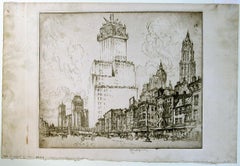
Whistler, James A. M. NOCTURNE: PALACES. Glascow 200, Kennedy 202. Etching and drypoint with platetone, 1879-80. From the Second Venice Set. Signed on the tab with the butterfly in pencil. Printed in sepia on laid paper with no visible watermark. Trimmed just outside the platemark, leaving the tab. In excellent condition. As with all of the Whistler Nocturnes, each impressions of this print is different, dependng on how Whistler wiped and manipulated the platetone. 11 5/8 x 7 7/8 inches (plate and sheet, plus the tab). Framed to 20 x 16 inches. Provenance: Collection of Thomas Jefferson Coolidge, Jr. with his collection stamp (Lugt 1429) verso; Kennedy Galleries, with its inventory number a65609 in pencil verso, and with another inscription, "FWCX" in pencil, verso. Thomas Jefferson Coolidge, 1831-1920, was a great-grandson of Thomas Jefferson, a powerful Boston businessman, and an Ambassador to France. In 1875 he became the manager of the largest textile mill in America, the Amoskeag Mill in Manchester New Hampshire, and had major financial interests in the textile, banking, railroad, publishing and electrical industries. In 1880 he became the President of the Atchison, Topeka & Santa Fe Railway. He was one of the founders of the United Fruit Company...
Category

1870s Art by Medium: Etching
Materials

Drypoint, Etching
31: Dutch Galliot

31: Dutch Galliot

Located in Columbia, MO

Edward William Cooke was born in Pentonville. His father, George Cooke, and uncle William Bernard Cooke were also well-known line engravers. Growing up in an environment of artists,...

Category

1820s Naturalistic Art by Medium: Etching

Materials

Etching

Untitled from Le Surrealisme en 1947, Surrealist Etching by Bruno Capacci

Untitled from Le Surrealisme en 1947, Surrealist Etching by Bruno Capacci

Located in Long Island City, NY

Bruno Capacci, Italian (1906 - 1996) - Untitled from Le Surrealisme en 1947, Year: 1947, Medium: Etching, Edition: 950, Size: 9 x 7.75 in. (22.86 x 19.69 cm), Printer: Mourlot, Pari...

Category

1940s Surrealist Art by Medium: Etching

Materials

Etching

Two Figures (One with Shadow)

Two Figures (One with Shadow)

By John Baldessari

Located in Calabasas, CA

Artist: John Baldessari Title: Two Figures (One with Shadow) Year: 1986 Medium: Etching with aquatint on Rives B.F.K paper Sheet: 20 1/2 x 20 inches (52.07 x 50.8 cm) Edition: 35; si...

Category

1980s Contemporary Art by Medium: Etching

Materials

Etching, Aquatint

YELLOW CALLA LILLIES

YELLOW CALLA LILLIES

By Jim Dine

Located in Portland, ME

Dine, Jim (American, born 1935). YELLOW CALLA LILLIES. D'Oench and Feinberg 19. Etching, soft-ground, drypoint, photogravure and electric tools, with hand-...

Category

1970s Art by Medium: Etching

Materials

Drypoint, Etching

RECLINING FIGURE (GREGORY EVANS)

RECLINING FIGURE (GREGORY EVANS)

By David Hockney

Located in Portland, ME

Hockney, David. RECLINING FIGURE. Etching and sugarlift aquatint in black, 1974. Edition of 75 published by Petersburg Press, London and printed on Inveresk paper. Signed, dated and ...

Category

1970s Art by Medium: Etching

Materials

Etching, Aquatint

East Side of the Chapel of St Paul, Westminster Abbey, architecture aquatint

East Side of the Chapel of St Paul, Westminster Abbey, architecture aquatint

'East Side of the Chapel of St Paul' Colour aquatint by John Bluck (active 1791-1819) after Frederick Mackenzie (1788-1854). Architectural interior with superb original colour. Fro...

Category

Early 19th Century Naturalistic Art by Medium: Etching

Materials

Engraving, Etching, Aquatint

Salvador Dali­ -- The 1914-18 War

Salvador Dali­ -- The 1914-18 War

By Salvador Dalí­

Located in BRUCE, ACT

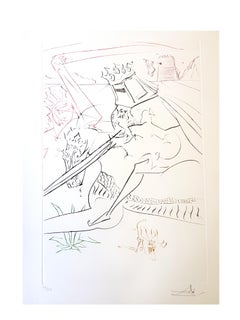
Salvador Dali The 1914-1918 War (Guerre de 1914-18) from the "Secret Poems by Apollinaire" suite, 1967 Hand-colored drypoint etching on Dali blind stamp Japon paper Signed lower r...

Category

1960s Art by Medium: Etching

Materials

Etching

Etching art for sale on 1stDibs.

Find a wide variety of authentic Etching art available on 1stDibs. While artists have worked in this medium across a range of time periods, art made with this material during the 20th Century is especially popular. If you’re looking to add art created with this material to introduce a provocative pop of color and texture to an otherwise neutral space in your home, the works available on 1stDibs include elements of yellow, orange, green and other colors. There are many well-known artists whose body of work includes ceramic sculptures. Popular artists on 1stDibs associated with pieces like this include Leo Guida, Salvador Dalí, Thomas Holloway, and Pablo Picasso. Frequently made by artists working in the Contemporary, Modern, all of these pieces for sale are unique and many will draw the attention of guests in your home. Not every interior allows for large Etching art, so small editions measuring 2.96 inches across are also available Prices for art made by famous or emerging artists can differ depending on medium, time period and other attributes. On 1stDibs, the price for these items starts at $55 and tops out at $3,119, while the average work can sell for $330.