1930s Art

to
952
3,432
1,250
905
534
351
Overall Width
to
Overall Height
to
7,706
21,687
163,562
226,856
2,013
2,277
4,940
6,521
5,853
15,026
20,545
25,755
18,664
14,085
5,503
2,532
510
399
243
108
108
103
70
12
12
5
2
2
3,626
2,382
317
3,944
1,793
1,646
1,170
1,155
724
461
447
441
355
342
314
294
288
287
240
227
223
219
190
2,013
1,615
1,355
1,179
883
261
142
107
82
61
1,791
1,122
3,481
2,643
Period: 1930s
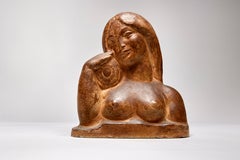
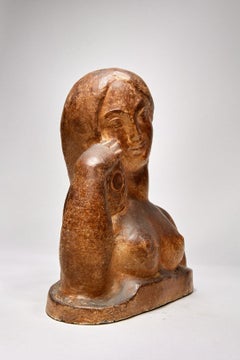
Bust of Josephine Baker, Mid-Century Ceramic Female Face

Bust of Josephine Baker, Mid-Century Ceramic Female Face

By Vally Wieselthier

Located in Beachwood, OH

Attributed to Vally Wieselthier (Austrian-American, 1895-1945) Bust of Josephine Baker, c. 1930 Ceramic Stamped on base 11.5 x 5.5 x 5.5 inches Vally Wieselthier (1895 Vienna--1945 ...

Category

1930s Art

Materials

Ceramic

”Admiring the Picture”

”Admiring the Picture”

By Benjamin Kopman

Located in Southampton, NY

Very well executed original gouache on archival paper by the well known American artist Benjamin Kopman. The scene depicts three figures admiring a picture. Signed lower left. Circa ...

Category

Ashcan School 1930s Art

Materials

Gouache, Archival Paper

"Petit-Montrouge" original etching

"Petit-Montrouge" original etching

By Roger Grillon

Located in Henderson, NV

Medium: original etching. This impression on Canson et Montgolfier wove paper was printed in 1937 in an edition of 500 for the "Paris 1937" portfolio. Printed at the atelier of Jean-...

Category

1930s Art

Materials

Etching

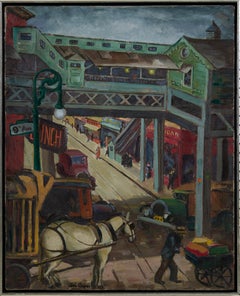
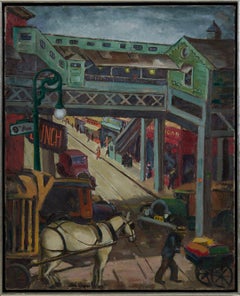
North on West Street (West Side Highway NYC Cityscape)

North on West Street (West Side Highway NYC Cityscape)

By De Hirsch Margules

Located in Wilton Manors, FL

De Hirsh Margules (1899-1965). North on West Street , 1939. Watercolor on Arches wove paper. Signed and dated in pencil by artist lower margin. Sheet measures 15 x 22 inches. Framed measurement: 27 x 34 inched. Incredibly vibrant and saturated color with no fading or toning of sheet. Provenance: Babcock Galleries, NYC De Hirsh Margules (1899–1965) was a Romanian-American "abstract realist" painter who crossed paths with many major American artistic and intellectual figures of the first half of the 20th century. Elaine de Kooning said that he was "[w]idely recognized as one of the most gifted and erudite watercolorists in the country". The New York Times critic Howard Devree stated in 1938 that "Margules uses color in a breath-taking manner. A keen observer, he eliminates scrupulously without distortion of his material." Devree later called Margules "one of our most daring experimentalists in the medium" Margules was also a well-known participant in the bohemian culture of New York City's Greenwich Village, where he was widely known as the "Baron" of Greenwich Village.[1] The New York Times described him as "one of Greenwich Village's best-known personalities" and "one of the best known and most buoyant characters about Greenwich Village. Early Life De Hirsh Margules was born in 1899 in the Romanian city of Iași (also known as Iasse, Jassy, or Jasse). When Margules was 10 weeks old, his family immigrated to New York City. Both of his parents were active in the Yiddish theater, His father was Yekutiel "Edward" Margules, a "renowned Jewish actor-impresario and founder of the Yiddish stage." Margules' mother, Rosa, thirty-nine years younger than his father, was an actress in the Yiddish theater and later in vaudeville. Although Margules appeared as a child actor with the Adler Family[11] and Bertha Kalich, his sister, Annette Margules, somewhat dubiously continued in family theater and vaudeville tradition, creating the blackface role of the lightly-clad Tondelayo (a part later played on film Hedy Lamarr) in Earl Carroll's 1924 Broadway exoticist hit, White Cargo. Annette herself faced stereotyping as an exotic flower: writing about her publicist Charles Bouchert stated that "Romania produces a stormy, temperamental type of woman---a type admirably fitted to portray emotion." His brother Samuel became a noted magician who appeared under the name "Rami-Sami." Samuel later became a lawyer, representing magician Horace Goldin, among others. A family portrait including a young De Hirsh, a portrait of Rosa and Annette together, and individual photos of Rosa and Edward can be found on the Museum of the City of New York website. At around age 9 or 10, Margules took art classes with the Boys Club on East Tenth Street, and his first taste of exhibition was at a student art show presented by the club. By age 11, he had won a city-wide prize (a box camera) at a children's art show presented by the department store Wanamakers. As a young teenager, Margules was already displaying a characteristic kindness and loyalty. Upon hearing that two friends (one of them was author Alexander King), were in trouble for breaking a school microscope, the nearly broke Margules gave them five dollars to repair the microscope . Margules had to approach a wealthy man that Margules had once saved on the subway from a heart attack. Margules didn't reveal the source of the five dollars to King until twenty-five years later. In his late teens, Margules studied for a couple of months in Pittsburgh with Edwin Randby, a follower of Western painter Frederic Remington. Thereafter he pursued a two-year course of studies in architecture, design and decoration at the New York Evening School of Art and Design, while working as a clerk during the day at Stern's Department Store. He was encouraged in these artistic pursuits by his neighbor, the painter Benno Greenstein (who later went by the name of Benjamin Benno). Artistic career In 1922, Margules began work as a police reporter for the City News Association of New York .Margules then considered himself something of an expert on art, and the painter Myron Lechay is said to have responded to some unsolicited analysis of his work with the remark "Since you seem to know so much about it, why don't you paint yourself?" This led to study with Lechay and a flurry of painting. Margules' first show was in 1922 at Jane Heap's Little Review Gallery. Thereafter Margules began to participate in shows with a group including Stuart Davis, Jan Matulka, Buckminster Fuller (exhibiting depictions of his "Dymaxion house") in a gallery run by art-lover and restaurateur Romany Marie on the floor above her cafe. Jane Heap, left, with Mina Loy and Ezra Pound During the 1920s, Margules traveled outside of the country a number of times. In 1922, with the intent of reaching Bali, he took a job as a "'wiper on a tramp steamer where [he] played nursemaid to the engine." He reached Rotterdam before he turned back. He would return to Rotterdam shortly thereafter. In 1927, Margules took a lengthy leave of absence from his day job as a police reporter in order to travel to Paris, where he "set up a studio in Montmartre's Place du Tertre, on the top floor of an almost deserted hotel, a shabby establishment, lacking both heat and running water." He studied at the Louvre and traveled to paint landscapes in provincial France and North Africa. Margules also joined the "Noctambulist" movement and experimented with painting and showing his artwork in low light.Jonathan Cott wrote that: the painter De Hirsch Margulies sat on the quays of the Seine and painted pictures in the dark. In fact, the first exhibition of these paintings, which could be seen only in a darkened room, took place in [ Walter Lowenfels'] Paris apartment. Elaine de Kooning remarked that studying the works of the Noctambulists confirmed Margules' "direction toward the use of primary colors for perverse effects of heavy shadow." It was also in Paris that Margules initially conceived his idea of "Time Painting", where a painting is divided into sectors, each representing a different time of day, with color choices meant to evoke that time of day. In Paris, his social circle included Lowenfels, photographer Berenice Abbott, publisher Jane Heap, composer George Anthiel, sculptor Thelma Wood, painter André Favory, writer Norman Douglas, writer and editor George Davis, composer and writer Max Ewing, and writer Michael Fraenkel. Upon his return to New York in 1929, Margules attended an exhibition of John Marin's paintings. While at the exhibition, he "launched into an eloquent explanation of Marin to two nearby women", and was overheard by an impressed Alfred Stieglitz. The famous photographer and art promoter invited Margules to dine with his wife, the artist Georgia O'Keeffe, and his assistant, painter Emil Zoler. Stieglitz thereafter became a friend and mentor to Margules, becoming for him "what Socrates was to his friends." Alfred Stieglitz Stieglitz introduced Margules to John Marin, who quickly became the most important painterly influence upon Margules. Elaine de Kooning later noted that Margules was "indebted to Marin and through Marin to Cézanne for his initial conceptual approach - for his constructions of scenes with no negative elements, for skies that loom with the impact of mountains." Margules himself said that Marin was his "father and ... academy." The admiration was by no means unreciprocated: Marin said that Margules was "an art lover with abounding faith and sincerity, with much intelligence and quick seeing." Stieglitz also introduced Margules to many other artistic and intellectual figures in New York. With the encouragement of Alfred Stieglitz, Margules in 1936 opened a two-room gallery at 43 West 8th Street called "Another Place." Over the following two years there were fourteen solo exhibitions by Margules and others, and the gallery was well-respected by the press. It was in this gallery that the painter James Lechay, Myron's brother, exhibited his first painting. In 1936, Margules first saw recognition by major art museums when both the Museum of Modern Art and the Museum of Fine Arts, Boston purchased his works. In 1942, Margules gave up working as a police reporter, and apparently dedicated himself thereafter solely to an artistic vocation. "The Baron of Greenwich Village"[edit] Margules made his mark not only as an artist, but also as an outsized personality known throughout Greenwich Village and beyond. To local residents, Margules was known as the "Baron", after Baron Maurice de Hirsch, a prominent German Jewish philanthropist. Margules was easily recognizable by the beret he routinely wore over his long hair. Writer Charles Norman said that he "dressed with a flair for sloppiness." He was said to "know everybody" in Greenwich Village, to the extent that when the novelist and poet Maxwell Bodenheim was murdered, Margules was the first one the police sought to identify the body. Margules' letters show him interacting with art world figures such as Sacha Kolin, John Marin and Alfred Stieglitz, as well as with prominent figures outside the art world such as polymath Buckminster Fuller and writer Henry Miller. Most of his friends and acquaintances found Margules a generous and voluble man, given to broadly emotionally expressive gestures and acts of kindness and loyalty. In 1929, he exhibited an example of this loyalty and fellow-feeling when he appeared in court to fight what the wrongful commitment of his friend, writer and sculptor Alfred Dreyfuss, who appeared to have been a victim of an illicit attempt to block an inheritance. The Greenwich Village chronicler Charles Norman described the bone-crushing hugs that Margules would routinely bestow on his friends and acquaintances, and speaks of the "persuasive theatricality" that Margules seemed to have inherited from his actor parents. Norman also wrote about Margules' routine acts of kindness, taking in homeless artists, constantly feeding his friends and providing the salvatory loan where needed. Norman also notes that Margules was blessed with a loud and good voice, and was apt to sing an operatic air without provocation. The writer and television personality Alexander King said I think the outstanding characteristics of my friend's personality are affirmation, emphasis, and overemphasis. He chooses to express himself predominantly in superlatives and the gestures which accompany his utterances are sometimes dangerous to life and limb. Of the bystanders, I mean. King also spoke with affectionate amusement about Margules' pride in his cooking, speaking of how "if he should ever invite you to dinner, he may serve you a hamburger with onions, in his kitchen-living room, with such an air of gastronomic protocol, such mysterious hints and ogliing innuendoes, as if César Ritz and Brillat-Savarin had sneaked out, only a moment before, with his secret recipe in their pockets." Margules was such a memorable New York personality that comic book writer Alvin Schwartz imagined him at the Sixth Avenue Cafeteria in a risible yet poignant debate with Clark Kent about whether Superman had the ability to stop Hitler. Margules' entrenchment in the Greenwich Village milieu can be seen in a photograph from Fred McDarrah's "Beat Generation Album" of a January 13, 1961 writers' and poets' meeting to discuss "The Funeral of the Beat Generation", in Robert Cordier [fr]'s railroad flat at 85 Christopher Street. Among the people in the same photograph are Shel Silverstein...

Category

American Modern 1930s Art

Materials

Watercolor, Rag Paper
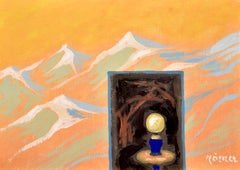
Neon Lighting WPA Mid 20th Century Social Realism American Scene Modern Figures

Neon Lighting WPA Mid 20th Century Social Realism American Scene Modern Figures

By Maurice Becker

Located in New York, NY

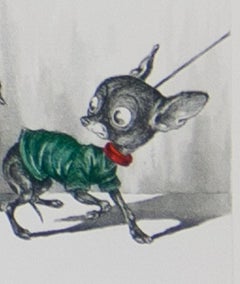
Neon Lighting WPA Mid 20th Century Social Realism American Scene Modern Figures MAURICE BECKER (1889-1975) 'Neon Lighting 17 1/4 x 13 3/4 inches Oil on masonite Signed, dated 1936 and titled on verso BIO Maurice Becker, painter, political cartoonist and social reformer, was born in 1889 either in Gorky or Niznij Novgorod, in Russia. His family came to the United States in 1892, to New York City. After high school, Becker worked in a clothing factory. He studied with Ash Can School artist Robert Henri in 1908, and exhibited in the famous 1913 Armory Show in New York City when he was only twenty-four years of age. At the Armory show, Becker showed a drawing of a dog's head...

Category

American Modern 1930s Art

Materials

Masonite, Oil

Girl with a Kid / - Caresses of innocence -

Girl with a Kid / - Caresses of innocence -

By Ary Bitter

Located in Berlin, DE

Ary Bitter (1883 Marseille - 1973 Paris), Girl with Kid, around 1930. Green patinated bronze with cast plinth loosely mounted on a white-veined dark green marble base. Dimensions of the plinth: 5 cm (height) x 80 cm (length) x 24 (width), dimensions of the bronze 28 cm (height) x 72 cm (length) x 18 cm (width). Weight of the bronze 18.2 kg, total weight 39.2 kg. Signed “Ary Bitter.” on the plinth and stamped “L N Paris J L” by the foundry Les Neveux de Jacques Lehmann...

Category

Art Deco 1930s Art

Materials

Bronze

'Diver' — 1930s American Modernism

'Diver' — 1930s American Modernism

By Rockwell Kent

Located in Myrtle Beach, SC

Rockwell Kent, 'Diver', wood engraving, 1931, edition 150, Burne Jones 88. Signed, and titled 'The Diver' in pencil.. A brilliant, black impression, on cream, wove Japan paper; the f...

Category

American Modern 1930s Art

Materials

Woodcut

Stoops in Snow
Stoops in Snow

Martin LewisStoops in Snow, 1930

$35,000Sale Price|30% Off

Stoops in Snow

By Martin Lewis

Located in Plano, TX

Stoops in Snow. 1930. Drypoint and sandpaper ground. McCarron catalog 89.state ii. 9 x 14 7/8 (sheet 13 1/4 x 18 7/16 ). Edition 115 recorded impressio...

Category

American Modern 1930s Art

Materials

Drypoint, Etching

Penacook Mill
Penacook Mill

Penacook Mill

Located in North Clarendon, VT

Beautiful New Hampshire impressionist painting of Penacook Mill, the Conticook River, and the village of Penacook NH by American Impressionist painter Margaret Masson. Oil on board,...

Category

American Impressionist 1930s Art

Materials

Oil

The Man in the Top Hat, American, Art Deco

The Man in the Top Hat, American, Art Deco

Located in Wiscasset, ME

Eugene Savage was born in Covington, Indiana. He began his art education at the Art Institute of Chicago, where he won a Prix de Rome scholarship to study at the American Academy in ...

Category

American Modern 1930s Art

Materials

Oil, Board

'Abstract Boats' — American Modernism, WPA

'Abstract Boats' — American Modernism, WPA

By Leon Bibel

Located in Myrtle Beach, SC

Leon Bibel, 'Abstract Boats', color serigraph, 1938, edition 12. Signed, dated, and numbered ' /12' in pencil. A fine, painterly impression, with fresh colors, on buff wove paper; t...

Category

American Modern 1930s Art

Materials

Screen

1934 original travel poster invites the viewer to discover Lake Thun

1934 original travel poster invites the viewer to discover Lake Thun

Located in PARIS, FR

This elegant 1934 travel poster invites the viewer to discover Lake Thun (Lac de Thoune), at the gateway to the Bernese Oberland, one of Switzerland’s most celebrated alpine regions....

Category

1930s Art

Materials

Paper, Lithograph

Original 'Produits Lavocat' vintage poster for Force and Energy

Original 'Produits Lavocat' vintage poster for Force and Energy

Located in Spokane, WA

Original vintage poster: Lavocat aliments irradies. Force, Energie par les produits. This is a classic French late Art Deco period poster featuring a buff rugby player almost outpacing a steed - due no doubt to Lavocat, an 'irradiated' food. Even today, the American FDA believes that irradiating food can burn off harmful bacteria, airborne germs, and other microbes which can adversely affect food. We love this poster's depth of color, texture, and oomph - powerful and very, very Art Deco. This poster is an original Art Deco lithograph. This poster is related more to sports and running than food, but food provides energy. Note that the red is cherry red since different monitors produce the red color of this poster in different qualities. Excellent condition, undated on the poster. Behind the rugby runner is a black horse that appears to be neck and neck...

Category

Art Deco 1930s Art

Materials

Lithograph

“Sailboat at Sunset”

“Sailboat at Sunset”

By Frederick Leo Hunter

Located in Southampton, NY

Original large scale oil painting on board of a large sailing ship in sunset. The artist is Frederick Leo Hunter. Signed by the artist lower right and dated 1933. Condition is goo...

Category

Post-Impressionist 1930s Art

Materials

Oil, Fiberboard

New York Skyline, NY; East River

New York Skyline, NY; East River

By Leon Dolice

Located in Middletown, NY

Etching on medium stock, cream wove paper, 5 15/16 x 10 3/16 inches (151 x 259 mm), full margins. Signed and titled in pencil, lower margin. A fine and detailed impression in dark bl...

Category

American Modern 1930s Art

Materials

Archival Paper, Etching

Pablo Picasso, The Three Musicians, from Chroniques du Jour, 1930 (after)

Pablo Picasso, The Three Musicians, from Chroniques du Jour, 1930 (after)

By Pablo Picasso

Located in Southampton, NY

This exquisite lithograph and pochoir after Pablo Picasso (1881–1973), titled Les Trois Musiciens (The Three Musicians), from the album, Pablo Picasso, 1930, originates from the 1930 edition published by Editions des Chroniques du Jour, Paris, and printed by L'Atelier Desjobert, Paris, 1930. Les Trois Musiciens (The Three Musicians) captures Picasso’s Cubist mastery at its height, translating one of his most celebrated compositions into the refined medium of lithograph and pochoir. The scene depicts three abstracted figures—a harlequin, a monk, and a pierrot—arranged in a complex geometric harmony that embodies both the structure and rhythm of modernity. Through vivid color and precise pochoir layering, Picasso’s interplay of form, shadow, and light transforms the musicians into a symphony of shape and sound, reflecting the artist’s enduring fascination with the relationship between visual art and music. Executed as a lithograph and pochoir on velin paper, this work measures 9.09 x 11.38 inches. Unsigned and unnumbered as issued. The edition exemplifies the refined craftsmanship of Editions des Chroniques du Jour and the technical excellence of L'Atelier Desjobert, one of the premier Parisian workshops specializing in pochoir and fine art lithography. Artwork Details: Artist: After Pablo Picasso (1881–1973) Title: Les Trois Musiciens (The Three Musicians), from the album, Pablo Picasso, 1930 Medium: Lithograph and pochoir on velin paper Dimensions: 9.09 x 11.38 inches (23.1 x 28.9 cm) Inscription: Unsigned and unnumbered as issued Date: 1930 Publisher: Editions des Chroniques du Jour, Paris Printer: L'Atelier Desjobert, Paris Catalogue raisonne references: Cramer, Patrick. Pablo Picasso, The Illustrated Books: Catalogue Raisonne. Patrick Cramer, 1983, illustration 18; Bloch, Georges. Pablo Picasso: Catalogue of the Printed Graphic Work 1904–1967. Kornfeld & Klipstein, 1968, illustration 98; Reusse, Gerhard. Pablo Picasso: The Illustrated Books, Catalogue Raisonne. Verlag Gerd Hatje, 1983, illustration 31 Condition: Well preserved, consistent with age and medium Provenance: From the album, Pablo Picasso, published by Editions des Chroniques du Jour, Paris, and printed by L'Atelier Desjobert, Paris, 1930 Notes: Excerpted from the album, This volume has been printed in MCC numbered examples, of which DL (LI to DC) constitute the edition in French and DCL (DCI to MCCL). The edition in English has been printed on behalf of E. Weyhe, 794 Lexington Avenue, New York (DCI to MC) and of A. Zwemmer, 78 Charing Cross Road, London, W. C.2. (MCI to MCCL). There have also been printed L examples on Arches paper with a lithograph by Picasso (I to L) distributed between the two editions, and some press examples. About the Publication: The album Pablo Picasso, published in 1930 by Editions des Chroniques du Jour, Paris, under the direction of Christian Zervos, stands among the earliest major printed tributes to the artist’s emerging international acclaim. Conceived as part of the publisher’s broader initiative to document and celebrate the modernist vanguard, the volume presented a series of lithographs and pochoirs interpreting Picasso’s drawings, watercolors, and gouaches from the preceding decade. Executed at the esteemed Atelier Desjobert, the edition combined the lithographic precision of line with the pochoir method’s hand-applied color, producing images of exceptional tonal depth and fidelity. Issued in both French and English, with distribution in Paris, New York, and London through E. Weyhe and A. Zwemmer, the album was limited to MCC copies, including a special suite of L examples on Arches paper containing an original lithograph by Picasso. The publication represented a vital collaboration between artist, publisher, and printer—uniting the intellectual rigor of Zervos’s art criticism with the material beauty of fine French printmaking. Today, Pablo Picasso, 1930 is recognized as a landmark in 20th-century art publishing, reflecting both the refinement of interwar Parisian craftsmanship and the international reach of Picasso’s genius. About the Artist: Pablo Picasso (1881–1973) was a Spanish painter, sculptor, printmaker, and ceramicist whose extraordinary vision revolutionized modern art and defined the visual language of the 20th century. A child prodigy from Malaga, Spain, Picasso's career spanned more than seven decades and encompassed an astonishing range of styles and innovations—from the melancholic Blue and romantic Rose periods to his pioneering invention of Cubism with Georges Braque, which shattered conventional notions of perspective and form. Influenced by the bold expressiveness of El Greco, the structure of Cezanne, and the vitality of African and Iberian sculpture, Picasso became a central figure of the Paris avant-garde, working in creative dialogue with contemporaries such as Henri Matisse, Alexander Calder, Alberto Giacometti, Salvador Dali, Joan Miro, Wassily Kandinsky, Marcel Duchamp, and Man Ray. His insatiable experimentation extended across painting, drawing, printmaking, ceramics, and sculpture, forever expanding the boundaries of artistic expression. A master of reinvention, Picasso profoundly shaped generations of artists who followed—from Andy Warhol, Roy Lichtenstein, David Hockney, and Jean-Michel Basquiat to Jeff Koons and Banksy—cementing his status as a timeless cultural icon whose works remain among the most sought after worldwide. His landmark painting Les Femmes d'Alger (Version O) achieved a record-breaking sale of 179,365,000 USD at Christie's, New York, on May 11, 2015, affirming Picasso's enduring legacy as one of the most influential and valuable artists in history. Pablo Picasso Les Trois Musiciens (The Three Musicians), Picasso 1930, Picasso Desjobert, Picasso pochoir...

Category

Cubist 1930s Art

Materials

Lithograph, Stencil

Cynthia (with Cat) /// Modern James Roy Hopkins Pet Nude Figurative Grass Sun

Cynthia (with Cat) /// Modern James Roy Hopkins Pet Nude Figurative Grass Sun

Located in Saint Augustine, FL

Artist: James Roy Hopkins (American, 1877-1969) Title: "Cynthia (with Cat)" *Monogram signed and dated by Hopkins lower right Year: 1937 Medium: Original Oil Painting on Canvas Framing: Recently framed in an Art Nouveau gold gesso moulding Framed size: 39.25" x 50.25" Canvas size: 34" x 45" Condition: In excellent condition. A large beautiful and well executed work. Notes: Provenance: private collection - Chicago, IL. Biography: James Roy Hopkins (1877-1969) was born in the rural farming community of Irwin, Ohio in 1877. His mother, Nettie Hopkins, painted with watercolors recreationally and encouraged her son’s artistic interests. Though he shared his mother's love of art, Hopkins initially entered Ohio State University in 1896 to study electrical engineering. However, he soon left and briefly enrolled in the Columbus School of Art before going to the Art Academy of Cincinnati where he studied with Frank Duveneck. In 1900, Hopkins moved to New York City and worked as a medical textbook illustrator. Two years later he made the pilgrimage to the art center of the western world at the time, Paris, France. While in Paris he improved his craft at the Académie Colarossi. Hopkins embraced Parisian life and socialized with and visited the studios of such great artists as Pierre...

Category

Impressionist 1930s Art

Materials

Canvas, Paint, Oil, Gesso

Female Bather (Nude Women)

Female Bather (Nude Women)

Located in Wilton Manors, FL

Ann Brockman (1895–1943) was an American artist who achieved success as a figurative painter following a successful career as an illustrator. Born in California, she spent her childhood in the American Far West and, upon marrying the artist William C. McNulty, relocated to Manhattan at the age of 18 in 1914. She took classes at the Art Students League where her teachers included two realist artists of the Ashcan School, George Luks and John Sloan. Her career as an illustrator began in 1919 with cover art for four issues of a fiction monthly called Live Stories. She continued providing cover art and illustrations for popular magazines and books until 1930 when she transitioned from illustrator to professional artist. From that year until her death in 1943, she took part regularly in group and solo exhibitions, receiving a growing amount of critical recognition and praise. In 1939 she told an interviewer that making money as an illustrator was so easy that it "almost spoiled [her] chances of ever being an artist."[1] In reviewing a solo exhibition of her work in 1939, the artist and critic A.Z Kruse wrote: "She paints and composes with a thorough understanding of form and without the slightest hesitancy about anatomical structure. Add to this a magnificent sense of proportion, and impeccable feeling for color and an unmistakable knowledge of what it takes to balance the elements of good pictorial composition and you have a typical Ann Brockman canvas."[2] Early life and training Brockman was born in Northern California in 1895 and spent much of her youth in nearby Oregon, Washington, and Utah.[1][3] She met the artist William C. McNulty in Seattle where he was employed as an editorial cartoonist. They married in March 1914 and promptly moved to Manhattan where he worked as a freelance illustrator.[4][5] At the time of their marriage, Brockman was 18 years old.[6] Over the next few years, her career generally followed that path that her husband had previously taken. His art training had been at the Art Students League beginning in 1908; she began her training there after moving to New York in 1914.[1] After an early career as an editorial cartoonist, he freelanced as a magazine and book illustrator beginning in 1914; she began her career as a magazine and book illustrator in 1919.[7] He embarked on a teaching career in the early 1930s and not long after, she began giving art instruction.[8][9] While they both adhered to the realist tradition in art, their usual subjects were different. His prominently depicted urban cityscapes in the social realist whereas hers generally focused on rural landscapes. He was best known for his etchings and she for her oils and watercolors.[8][10] Brockman returned to the Art Students League in 1926 to take individual instruction for a month at a time from George Luks and John Sloan.[1] Despite their help, one critic said McNulty's "sympathetic encouragement and guidance" was more important to her development as a professional artist.[11] Career in art In the course of her career as illustrator, Brockman would sometimes paint portraits of celebrities before drawing them, as for example in 1923 when she painted the French actress Andrée Lafayette who had traveled to New York to play title role in a film called Trilby.[12] She would also sometimes accept commissions to make portrait paintings and in 1929 painted two Scottish terriers on one such commission.[13] During this time, she also produced landscapes. In 1924 she displayed a New England village street scene painting in the Second Annual Exhibition of Paintings, Watercolors, and Drawings in the J. Wanamaker Gallery of Modern Decorative Art.[14] Available sources show no further exhibitions until in 1930 a critic for the Boston Globe described one of her portraits as "well done" in a review of a Rockport Art Association exhibition held that summer.[15] Between 1931 and her death in 1943, Brockman participated in over thirty group exhibitions and five solos.[note 1] Her paintings appeared in shows of the artists' associations to which she belonged, including the Rockport Art Association, Salons of America, Society of Independent Artists, and National Association of Women Painters and Sculptors.[17][19]Between 1932 and 1935, her paintings appeared frequently in New York's Macbeth Gallery.[20][23][25][27] She won an award for a painting she showed at the Art Institute of Chicago in 1940.[41] In 1942, the Whitney Museum bought one of the paintings she showed in its Biennial of that year.[10] Critical praise for her work steadily increased during the decade that ended with her untimely death in 1943. In 1932, her painting called "The Camera Man" was called "a clever piece of illustration."[21] Three years later, a painting called "Small Town" gave a critic "the impression of freshness, honesty, and skill".[29] In 1938, a critic described her "Folly Cove" as "masterful" and said "Pigeon Hill Picnic" was "sustained by excellence of execution".[48] At that time, Howard Devree of the New York Times saw "evidence of gathering powers" in her work and wrote "she imparts a dramatic feeling to landscape. She even manages this time to do trees touched by Autumn tints without calendar effect, which is no small praise."[51] Three years later, a Times critic reported Brockman had "set herself a new high" in the watercolors she presented,[52] and another critic said the gallery where she was showing had not "for some time" shown "so outstanding a solo exhibitor as Ann Brockman."[2] Shortly before her death, a critic for Art News maintained that she was "one of America's most talented women painters".[46] After she had died, a critic said Brockman's paintings "displayed real power", adding that she was "highly rated among the nation's professional artists" and was known to give "aid and encouragement, always with a smile," both artists and to her students.[10] in reviewing the memorial exhibition at the Kraushaar Galleries held in 1945, reviewers wrote about the strength and vibrancy of her personality, the quality of her painting ("every bit as good, possibly better than people had thought"),[53] called her "one of the best of our twentieth century women painters", and credited "her sense of the vividness of life" as a contributor to "the unusual breadth that is so characteristic of her work.[11] One noted that her work was "widely recognized throughout the country" and could be found in the collections of prominent museums, including the Metropolitan Museum of Art, the Whitney Museum of American Art, and the Art Institute of Chicago.[54] Writing in the Times, Devree wrote, "even those who had followed the steady growth of this artist for more than a decade, each successive show being at once an evidence of new achievement and an augury of still better work to come, may well be surprised at the combined impact of the selected paintings in the present showing,"[55] and writing in the Brooklyn Daily Eagle, A.Z Kruse said she had made "extraorginary accomplishments", painted with "inordinate distinction" showing a "lyrical majesty," and possessed "a keen esthetic sense which did not deviate from truth."[54] Artistic style (1) Ann Brockman, undated drawing, black chalk on paper, 18 x 22 inches (2) Ann Brockman, High School Picnic, about 1935, oil on canvas, 34 1/4 x 44 1/4 inches (3) Ann Brockman, untitled landscape, about 1943, watercolor and pencil on paper, 15 1/4 x 22 1/2 inches (4) Ann Brockman, North Coast, undated watercolor, 21 1/2 x 30 inches (5) Ann Brockman, On the Beach, 1942, watercolor on paper, 16 1/2 x 20 inches (6) Ann Brockman, Lot's Wife, 1942, oil on canvas, 46 x 35 inches (7) Ann Brockman, New York Harbor, 1934, watercolor on paper, 13 1/2 x 19 1/4 inches (8) Ann Brockman, Youth, 1942, oil on board, 13 1/2 x 11 1/2 inches Brockman was a figurative painter whose main subjects were rural landscapes and small-town and coastal scenes. She worked in oils and watercolors, becoming better known for the latter late in her career. Most of her paintings were relatively small. Although she made figure pieces infrequently, the nudes and circus and Biblical scenes she painted were seen to be among her best works. In 1938, Howard Devree wrote: "Her gray-day marines and coast scenes are familiar to gallery goers and are favorites with her fellow artists. Her figure pieces have attained a sculptural quality without losing warmth or taking on stiffness. One spirited circus incident of equestriennes about to enter the big tent compares not unfavorably with many of the similar pictures by a long line of painters who have been fascinated by the theme. She imparts a dramatic feeling to landscape. She even manages this time to do trees touched by Autumn tints without calendar effect, which is no small praise."[51] Similarly, a critic for Art Digest wrote that year: "Fluently and virilely painted, [her] canvases suggest a close affinity between nature and humans. The artist takes her subjects out in the open where they may picnic or bathe with space and air about them. A fast tempo is felt in the compositions of restless horses and nimble entertainers busily alert for the coming performance. Miss Brockman is also interested in portraying frightened groups of people, hurrying to safety or standing half-clad in the lowering storm light."[56] Her palette ranged from vivid colors in bright sunlight to somber ones in the overcast skies of stormy weather. Of the former, one critic spoke of the rich colors and "sun-drenched rocks" of her coastal scenes and another of her "summery landscapes of coves and picnics."[11][50] Of the latter, Howard Devree said she "painted so many moody Maine coast vignettes of lowering skies and uneasy seas that artists have been heard to refer to an effect as 'an Ann Brockman day'".[57] Brockman's handling of Biblical subjects can be seen in the oil called "Lot's Wife", shown above, Image No. 6. Her watercolor called "On the Beach" and her oil portrait called "Youth" may both indicate the "sculptural quality" that Devree said was typical of her figure pieces (Image No. 8, above). An example of Brockman's bright palette in a typical summer theme is the oil painting called "High School Picnic" shown above, Image No. 2. Next to it is a painting, an untitled landscape of about 1943 whose medium, watercolor on paper, shows off the sunny palette she often used (Image No. 3). Among the darkest of her works was an untitled 1942 drawing she made in black chalk (shown above, Image No. 1). In a book called Drawings by American Artists (1947), the artist and art editor Norman Kent noted that this study influenced her painting through its use of "forms" that were "elastic" and suggested "color". He said its "massing of dark and light" created "a definite mood" that was "impressionistic" and had "the strength of a man's work".[58] Brockman's undated watercolor called "North Coast" (shown above, Image No. 4) is an example of the paintings to which Kent referred. Illustrator (9) Ann Brockman, cover, March 12, 1917, Every Week magazine (10) Illustration of an article, "The Taking of a Salient" by Henry Russell...

Category

American Impressionist 1930s Art

Materials

Oil

original linocut

original linocut

By Ossip Zadkine

Located in Henderson, NV

Medium: original linoleum cut. Printed in 1938 for the rare fourth issue of the art revue XXe Siecle . Size: 12 1/2 x 9 5/8 inches (317 x 244 mm). Signed in the block (not by hand). ...

Category

1930s Art

Materials

Linocut

Monseignor St. Thomas

Monseignor St. Thomas

By Cyril Power

Located in New York, NY

Cyril Power (1872-1951) color linoleum cut, Monseignor St. Thomas, circa 1931, signed and titled in pencil at the lower right, apart from the edition of 60. Reference: Redfern 24. In very good condition, on buff oriental laid tissue, conservation matted, with margins, 13 7/8 x 11 1/8, the sheet 15 x 12 5/8 inches. A fine impression, with the colors fresh and vivid. Printed in four colors (yellow, red, blue and dark blue). The prints of the Grosvenor School artists were created by applying colors with successive blocks. The margins show the colors of each of these blocks (see illustration of the margin). The subject matter of this print relates to TS Eliot...

Category

Futurist 1930s Art

Materials

Linocut

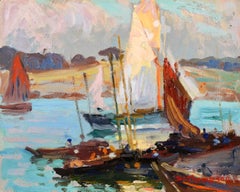
“Sailing off the Rocky Coast”

“Sailing off the Rocky Coast”

Located in Southampton, NY

Well executed oil on board painting of a sailboat off the rocky coast. Signed lower right. Circa 1930. Condition is excellent. The painting is housed in a faux wood molded frame wi...

Category

Post-Impressionist 1930s Art

Materials

Oil, Board

Original art deco Monopole Radio mermaid vintage French poster

Original art deco Monopole Radio mermaid vintage French poster

Located in Spokane, WA

Original 1934 Lithograph poster for TSF radio Monopole "une vague de puissance et d'harmonie" (a wave of power and harmony) with the beautiful mermaid strumming her harp. Archival...

Category

Art Deco 1930s Art

Materials

Lithograph

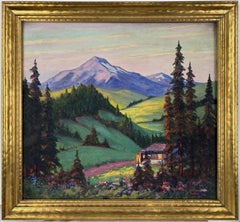
" Sunlit Mountains" Majestic Mount Jefferson And Mount Hood Oregon 1930s

" Sunlit Mountains" Majestic Mount Jefferson And Mount Hood Oregon 1930s

By Andrew Dobos

Located in Soquel, CA

" Sunlit Mountains" Majestic Mount Jefferson And Mount Hood Oregon 1930s A well executed oil on linen of two mountain peaks by California and Illinois artist Andrew Dobos (American/...

Category

American Impressionist 1930s Art

Materials

Linen, Oil

Male Nude
Male Nude

Male Nude

By M. Lambert

Located in Houston, TX

French pencil drawing of a nude male statue with bronze casting to leg by artist M. Lambert, circa 1930. Signed lower right. Original artwork on pap...

Category

1930s Art

Materials

Graphite

"Tommy"
"Tommy"

"Tommy"

By Gershon Benjamin

Located in Lambertville, NJ

Jim’s of Lambertville is proud to offer this artwork: Gershon Benjamin (1899 - 1985) An American Modernist of portraits, landscapes, still lives, and the urban scene, Gershon Ben...

Category

Modern 1930s Art

Materials

Oil, Board

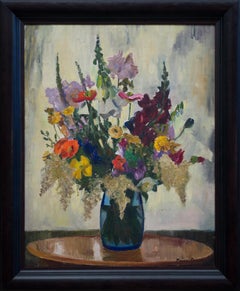
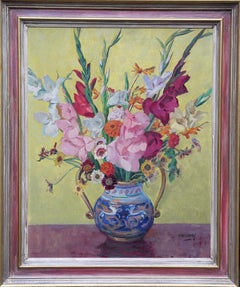
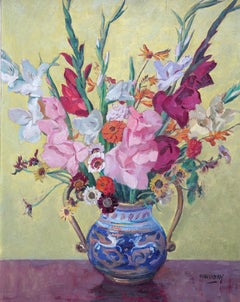
The Yellow Pitcher
The Yellow Pitcher

The Yellow Pitcher

By Charles Kvapil

Located in London, GB

'The Yellow Pitcher', oil on canvas, by Charles Kvapil (1939). A prolific painter of bouquets, the artist created dozens of tableaux with flowers as sub...

Category

Expressionist 1930s Art

Materials

Canvas, Oil

PULLING CORN (FODDER HOPPER)  - Scarce Print!

PULLING CORN (FODDER HOPPER) - Scarce Print!

By Bernard Joseph Steffen

Located in Santa Monica, CA

BERNARD (JOSEPH) STEFFEN (1907 – 1980) PULLING CORN (FODDER HOPPER) c. 1935-45 Color serigraph signed with a full signature below the image at the lower right sheet edge . Unknown e...

Category

Modern 1930s Art

Materials

Screen

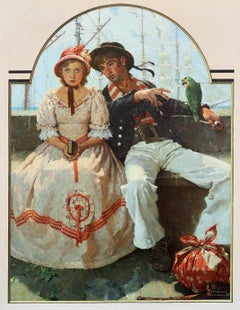
The Jester, Post Cover

The Jester, Post Cover

By Norman Rockwell

Located in Fort Washington, PA

Signed by Artist Lower Right The Saturday Evening Post, February 11, 1939, cover illustration Literature The Saturday Evening Post, February 11, 1939, cover illustration Thomas S....

Category

1930s Art

Materials

Oil

VALLEY RAMPARTS -
VALLEY RAMPARTS -

VALLEY RAMPARTS -

By Frances H. Gearhart

Located in Santa Monica, CA

FRANCES H. GEARHART (1869-1958) VALLEY RAMPARTS 1933 Color block print, signed and titled in pencil. 10 1/8 x 12 inches. Very large and good impression In generally good condition. ...

Category

Impressionist 1930s Art

Materials

Woodcut

Standing Male Nude, Arms Upraised (Kouros)

Standing Male Nude, Arms Upraised (Kouros)

By Gaston Lachaise

Located in Fairlawn, OH

Standing Male Nude, Arms upraised (Kouros) Graphite on wove paper, c. 1930 Signed lower right (see photo) Possibly exhibited in May 8-June 1,1973 at Alan Stone Gallery entitled Erotica, which lists Lachaise as one of the artists exhibited. Part of small group of drawings of the male nude, done late in the artist's life, many of which are in museums (MMA, FAMSF, Whitney, Yale, Princeton). Almost identical to the Lachaise drawing in the Fine Arts Museums of San Francisco, which is the same size and depicts the same model. (see photo) Very similar to the smaller Lachaise drawing in the Whitney Museum of American Art (Accession number 32.2). The Metropolitan Museum has a Lachaise male nude drawing with one arm upraised (Accession Number: 68.91.1) Provenance: Alan Stone Gallery, New York Alan Stone Projects, New York (see photo of label) Condition: excellent Archival framing with OP3 Acrylic for UV protection 22K gold leaf frame Image size: 17 3/4 x 12 inches Frame size: 26 1/2 x 20 1/2 inches Regarding Alan Stone Gallery: "Founded in 1960 by visionary connoisseur and dealer Allan Stone (1932 – 2006), the gallery known today as Allan Stone Projects has been admired for over half a century. Celebrated for his eclectic approach and early advocacy of pivotal artists of the 20th Century, Allan Stone was a leading authority on Abstract Expressionism, the New York dealer for Wayne Thiebaud for over forty years, and a passionate collector of Willem de Kooning, Franz Kline, Arshile Gorky, Joseph Cornell, John Graham and John Chamberlain. He also promoted and collected the work of a younger generation of artists, including Robert Arneson, Jack Whitten, Robert Mallary, Lorraine Shemesh...

Category

American Modern 1930s Art

Materials

Graphite

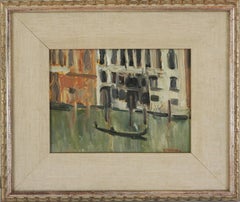
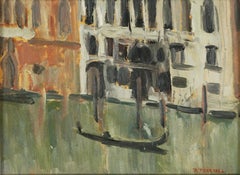
'St. Astruell, England' — British Post-Impressionism

'St. Astruell, England' — British Post-Impressionism

By Hayley Lever

Located in Myrtle Beach, SC

Hailey Lever, 'St. Astruell, England', watercolor, 1910. Signed in pencil, lower right. Titled and dated on the original inside mat. A fine spontaneous work, with fresh colors, on cr...

Category

Post-Impressionist 1930s Art

Materials

Watercolor

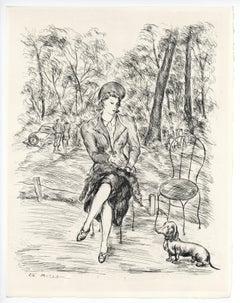
Icart, Composition, Le Sopha (after)

Icart, Composition, Le Sopha (after)

By Louis Icart

Located in Southampton, NY

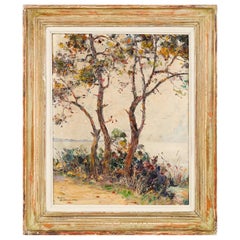
La pointe sèche etching on vélin de Rives filigrané à notre nom paper. Paper size: 9.5 x 7.5 inches; image size: 6.5 x 4.5 inches. Inscription: unsigned and unnumbered, as issued. No...
Category

Modern 1930s Art

Materials

Drypoint, Etching

Industrial Mural Study, Veterans Memorial Building, Santa Barbara WPA American

Industrial Mural Study, Veterans Memorial Building, Santa Barbara WPA American

Located in New York, NY

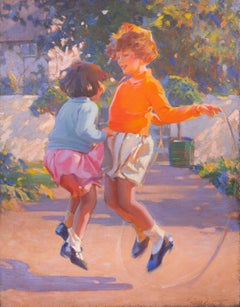
Industrial Mural Study, Veterans Memorial Building, Santa Barbara WPA American Joseph Edward Knowles (1907-1980) "Study for Industry Mural, Veterans Memorial Building, Santa Barbara, CA" 19 1/2 x 50 1/2 inches Oil on board, c. 1930s. Estate stamp verso Framed: 27 x 60 inches The completed mural is currently hanging on the wall, part of the building actually, at the Veterans Memorial Building in Santa Barbara. A photo of the work insitu is included in the attached photos. BIO Joseph Edward Knowles was born in Kendall, Montana, on June 15, 1907. He grew up in San Diego, California. At age twenty, two years before the beginning of the Great Depression, he moved north to another town on the coast of California---Santa Barbara. There he began studying fine art at the Santa Barbara School of the Arts* (1927-1930), under the supervision of Frank Morley Fletcher, previously director of the Edinburgh College of Art. Fletcher, who was trained in portraiture, landscape painting, and woodblock* printing, was a great influence on young Knowles. It was there that Knowles learned the art of color woodblock printmaking, a medium in which he showed great skill. Not long after completing his studies with Fletcher, Knowles began teaching art. For a period of thirty years, from 1930 to1960, he taught at the Cate School in Carpinteria, California. In 1934-1935, Knowles traveled throughout Europe, further developing his artistic skills in England, France, and Italy. Upon his return, he continued to teach art at various schools and institutions: Cate School, Crane Country School, extension classes at the University of California at Santa Barbara (UCSB), and at the Santa Barbara Museum of Art (SBMA). Knowles also served as an art education consultant for the County of Santa Barbara. In addition, he was founding co-director and president of the Santa Barbara Fine Arts Institute (1969-1972), which later developed a specialization in photography and became the Brooks Institute of Photography. Knowles died at his home in Santa Barbara on September 8, 1980. Much of Knowles' watercolor work is associated with what has been termed the "California School*," a loose grouping of artists throughout the state that included such figures as Millard Sheets, Phil Dike, Dong Kingman, George Post, and the Santa Barbara painters Dan Lutz and Standish Backus, Jr. The California School artists, including Knowles, were known for their fresh, direct, spontaneous style of watercolor painting. Knowles and other members of the school found inspiration in nature and the built environment alike, emphasizing elements of design in their exuberant, boldly stated, colorful scenes from everyday life. While painting in a representational* manner, Knowles generally avoided photographic realism, preferring subjective interpretation of his subjects. In this, as well as in his experimental approach and vigorous brushwork, he displayed a strongly modern sensibility. Knowles often used the wet-on-wet watercolor technique as he painted seascapes and landscapes, mostly along the California coast. He also employed dry-brush* techniques in many of his paintings, often leaving some of the white of the watercolor paper exposed. Some of the latter depict trees and other forms in a broken and airy manner that recalls Cezanne. Knowles' colored woodblock prints are more reserved and exact in their draftsmanship than his paintings. Spare, clean, lyrical lines are drawn to illustrate floral motifs and boat scenes with a touch of asymmetry conjuring Japanese woodblock prints. His murals from the post-World War II period are considerably more modern in their approach and show an emphasis on design and color. PROFESSIONAL ORGANIZATIONS California Watercolor Society (1940 - 1955) Santa Barbara Art Association (Vice President - 1952) ONE-MAN EXHIBITIONS Golden Gate International Exposition (GGIE) - San Francisco, California San Diego Fine Arts Gallery (SDMA) - San Diego, California Santa Barbara Museum of Art (SBMA) - Santa Barbara, California Cowie Galleries - Los Angeles, California Gallery de Silva - Santa Barbara, California Bradley Galleries - Santa Barbara, California MURALS Westmont College - Ellen Porter Hall Mural - Santa Barbara, California Safeway Grocery (now Vons Grocery on West Victoria Street) - Exterior Tile Mosaic - Santa Barbara, California Santa Barbara Bank & Trust - Interior Mosaic Panels, Santa Barbara, California Santa Barbara Girls Club - Interior Mosaic Mural - Santa Barbara, California Ernest Righetti High School - Mosaic Mural - Santa Maria, California Shell Oil Company - Mosaic Panel - California Beckman Instruments, Corporate Headquarters - Mosaic - Fullerton, California STAINED GLASS WINDOWS, WALLS and PANELS Katherine Thayer Cate Memorial Chapel - Cate School, Carpinteria, California William S. Porter Memorial Chapel - Cottage Hospital, Santa Barbara, California La Rinconada Building - Santa Barbara, California ILLUSTRATIONS "California's Wonderful Corner: True Stories for Children from the History of the Santa Barbara Region," by Walter A. Tompkins (1962 & 1975) China Designs: Two sets of dinnerware for Winfield China...
Category

American Realist 1930s Art

Materials

Oil, Board

Emil Ganso, (Reclining Nude)

Emil Ganso, (Reclining Nude)

By Emil Ganso

Located in New York, NY

A classic Emil Ganso nude. Quite large, the sheet is 14 1/8 x 21 inches and the image goes all the way across the sheet from left to right. Very delicately drawn - especially for Ganso.

Category

American Modern 1930s Art

Materials

Pencil

"Le Quai d'Orsay" original etching

"Le Quai d'Orsay" original etching

By Henri Lebasque

Located in Henderson, NV

Medium: original etching. This impression on Canson et Montgolfier wove paper was printed in 1937 in an edition of 500 for the "Paris 1937" portfolio. Printed at the atelier of Jean-...
Category

1930s Art

Materials

Etching

Female Nude Study Charcoal and Red Chalk Drawing by Georges Lucien Guyot

Female Nude Study Charcoal and Red Chalk Drawing by Georges Lucien Guyot

By Georges Lucien Guyot

Located in Atlanta, GA

French artist Georges Lucien Guyot (1885 - 1972) signed this charming woman nude study. This painting features a lovely design of a woman getting out of the bath and wiping with a towel. Only a few lines in charcoal and red chalk or sanguine mark the silhouette and posture and capture the model's expression. The red color emphasizes the color of the skin and imbues the lascivious movement. The sketches of the bath towel are only suggested, but they give the whole thing a lot of softness and an incredible illusion of movement. Signed on the bottom left corner: Georges Lucien Guyot. The artist employed a method known as "sanguine" (red chalk paint) which is red crayon or chalk. The drawing has a blood-red, reddish, or flesh coloration. For centuries, painters from the 15th and 16th centuries, including famous masters like Michelangelo, Raphael, and Leonardo da Vinci, have used it for drawing. The drawing has an elaborate off-white matte with acrylic glass protection and a modern wood frame with a deep-textured pattern in red and yellow. Measurements: With Frame: 20.87 in wide (53 cm) x 28.35 in high (72 cm) x 1 in deep (2.5 cm). View alone: 11.44 in wide (29 cm) x 18.94 in high (48 cm). Biography: Georges Lucien Guyot (born December 10, 1885, in Paris, where he died December 31, 1972) is a French artist, sculptor, and painter. From an early age, Georges Guyot showed artistic abilities, but the modest conditions of his parents did not allow him to study art. So he did his apprenticeship with a wood sculptor. Guyot excelled in copying works from the 15th, 16th, and 17th Centuries but rapidly showed an attraction for nature. This attraction led him to the Jardin des Plantes in Paris, where he could study wild animals and translate his observations into sculptures and paintings. A familiar figure of Montmartre, Georges Guyot was the guest of the Bateau-Lavoir from the time of Cubism. In 1931, he joined the group of Twelve, created by François Pompon and Jane Poupelet...
Category

Art Deco 1930s Art

Materials

Paper, Chalk, Charcoal, Pencil