Want more images or videos?
Request additional images or videos from the seller
1 of 3
John James Audubon"Californian Partridge", Hand Colored Lithograph, J.T. Bowen Edition1840
1840
Price:$658
$775List Price
About the Item
- Creator:John James Audubon (1785-1851, American, French)
- Creation Year:1840
- Dimensions:Height: 6.75 in (17.15 cm)Width: 10.25 in (26.04 cm)
- Medium:
- Movement & Style:
- Period:
- Condition:
- Gallery Location:Alamo, CA
- Reference Number:Seller: #27101stDibs: LU117325963182
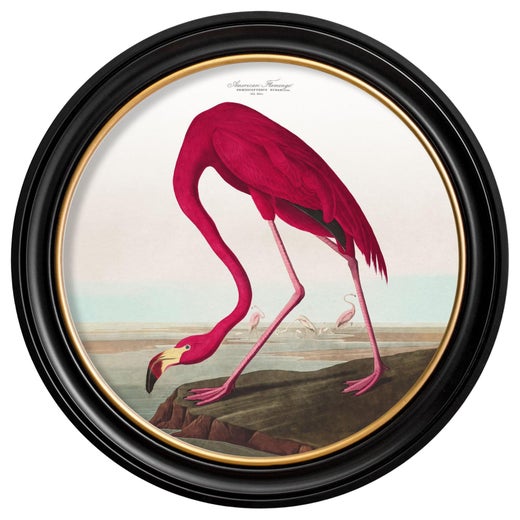
John James Audubon
John James Audubon (April 26, 1785, Les Cayes, Saint-Domingue (later Haiti) – January 27, 1851 (aged 65) Manhattan, New York, U.S.), born Jean-Jacques Audubon, was an American ornithologist, naturalist, and painter. He was notable for his expansive studies to document all types of American birds and for his detailed illustrations that depicted the birds in their natural habitats. His major work, a color-plate book entitled The Birds of America (1827–1839), is considered one of the finest ornithological works ever completed. Audubon identified 25 new species.
About the Seller
5.0
Platinum Seller
Premium sellers with a 4.7+ rating and 24-hour response times
Established in 2011
1stDibs seller since 2019
299 sales on 1stDibs
Typical response time: 1 hour
Authenticity Guarantee
In the unlikely event there’s an issue with an item’s authenticity, contact us within 1 year for a full refund. DetailsMoney-Back Guarantee
If your item is not as described, is damaged in transit, or does not arrive, contact us within 7 days for a full refund. Details24-Hour Cancellation
You have a 24-hour grace period in which to reconsider your purchase, with no questions asked.Vetted Professional Sellers
Our world-class sellers must adhere to strict standards for service and quality, maintaining the integrity of our listings.Price-Match Guarantee
If you find that a seller listed the same item for a lower price elsewhere, we’ll match it.Trusted Global Delivery
Our best-in-class carrier network provides specialized shipping options worldwide, including custom delivery.You May Also Like
Rabbits, German antique animal chromolithograph print.
Located in Melbourne, Victoria
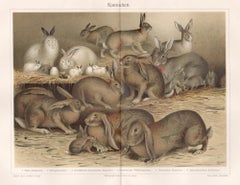
'Kaninchen'
(Rabbits)
German chromolithograph, circa 1910. Key in German to the types of rabbits at the bottom of the image. Central vertical fold as issued.
245mm by 305mm (shee...
Category
Early 20th Century Naturalistic Animal Prints
Materials
Lithograph
Native house birds, German antique chromolithograph print.
Located in Melbourne, Victoria
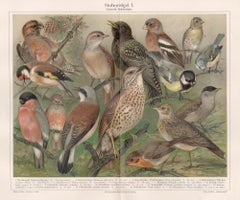
'Heimische Stubenvogel'
(Native house birds)
German chromolithograph, circa 1910. Key in German to the types of birds at the bottom of the image. Central vertical fold as issued.
...
Category
Early 20th Century Naturalistic Animal Prints
Materials
Lithograph
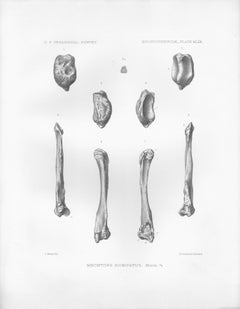
Brontops Robustus, antique Como Bluff dinosaur bone lithograph print
By Emil Crisand after Frederick Berger
Located in Melbourne, Victoria
'Brontops Robustus, Marsh 1/4'
Lithograph by Emil Crisand after the drawing by Frederick Berger, under the supervision of Othniel Charles Marsh. Depicts dinosaur fossil...
Category
Late 19th Century Naturalistic Animal Prints
Materials
Lithograph
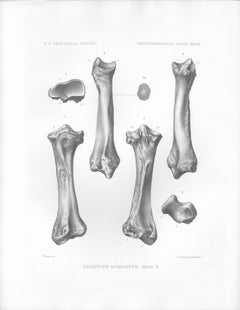
Brontops Robustus, antique Como Bluff dinosaur bone lithograph print
By Emil Crisand after Frederick Berger
Located in Melbourne, Victoria
'Brontops Robustus, Marsh 1/4'
Lithograph by Emil Crisand after the drawing by Frederick Berger, under the supervision of Othniel Charles Marsh. Depicts dinosaur fossil...
Category
Late 19th Century Naturalistic Animal Prints
Materials
Lithograph
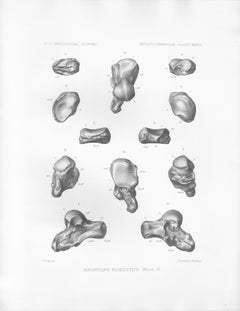
Brontops Robustus, antique Como Bluff dinosaur bone lithograph print
By Emil Crisand after Frederick Berger
Located in Melbourne, Victoria
'Brontops Robustus, Marsh 1/4'
Lithograph by Emil Crisand after the drawing by Frederick Berger, under the supervision of Othniel Charles Marsh. Depicts dinosaur fossil...
Category
Late 19th Century Naturalistic Animal Prints
Materials
Lithograph
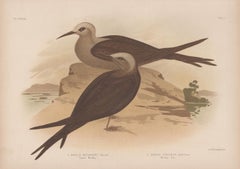
Lesser Moddy and Moddy Tern, antique sea bird chromolithograph print, 1889
By Gracius Broinowski
Located in Melbourne, Victoria
'Lesser Moddy and Moddy Tern'
Chromolithograph from Gracius Broinowski's 'The Birds of Australia' , 1887-1891.
Gracius Joseph Broinowski (1837-191...
Category
Late 19th Century Naturalistic Animal Prints
Materials
Lithograph
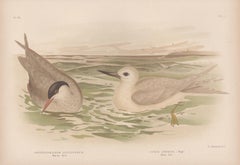
Marsh Tern and White Tern, antique sea bird chromolithograph print, 1889
By Gracius Broinowski
Located in Melbourne, Victoria
'Marsh Tern and White Tern'
Chromolithograph from Gracius Broinowski's 'The Birds of Australia' , 1887-1891.
Gracius Joseph Broinowski (1837-1913)...
Category
Late 19th Century Naturalistic Animal Prints
Materials
Lithograph
$95
H 10.04 in W 13.98 in
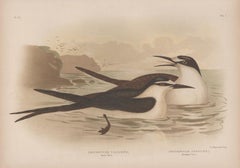
Sooty Tern and Panayan Tern, antique sea bird chromolithograph print, 1889
By Gracius Broinowski
Located in Melbourne, Victoria
'Sooty Tern and Panayan Tern'
Chromolithograph from Gracius Broinowski's 'The Birds of Australia' , 1887-1891.
Gracius Joseph Broinowski (1837-191...
Category
Late 19th Century Naturalistic Animal Prints
Materials
Lithograph
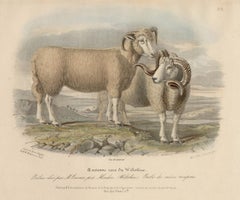
Wiltshire breed, sheep lithograph with original hand-colouring, circa 1845
By After William Shiels
Located in Melbourne, Victoria
'Ancienne Race de Wiltshire (The Old Wiltshire Breed)'
Lithograph with original hand-colouring by Hermann Eichens (1813-1886) from a drawing by W. Nicholson after a painting by Wil...
Category
Late 19th Century Naturalistic Animal Prints
Materials
Lithograph
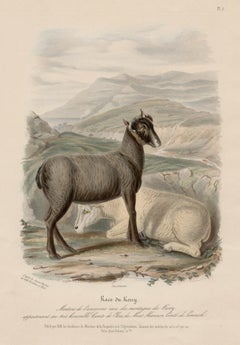
Kerry Breed, Irish sheep lithograph with original hand-colouring, circa 1845
By After William Shiels
Located in Melbourne, Victoria
'Race de Kerry' (The Kerry Breed)
Lithograph with original hand-colouring by Hermann Eichens (1813-1886) from a drawing by W. Nicholson after a painting by William Shiels.
From the...
Category
Late 19th Century Naturalistic Animal Prints
Materials
Lithograph
More From This Seller
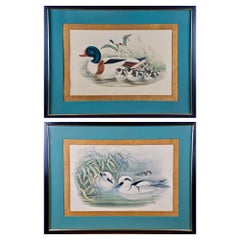
View AllPair of 19th C. Hand-colored Lithographs of Ducks by John Gould
By John Gould
Located in Alamo, CA
A pair of hand-colored lithographs of ducks entitled "Tadorna Vulpanser" (Sheldrake Ducks) and "Mergus Umbellus' (Smew or Nun Ducks) from John Gould's publication "Birds of Great Br...
Category
1860s Naturalistic Animal Prints
Materials
Lithograph
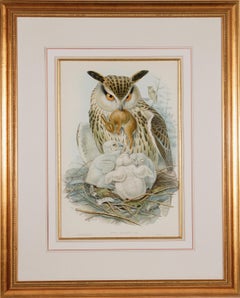
Eagle or Horned Owl: A Framed Original 19th C. Hand-colored Lithograph by Gould
By John Gould and Henry Constantine Richter
Located in Alamo, CA
This is a framed original 19th century hand-colored folio-sized lithograph entitled “Bubo Maximus" (Great Horned or Eagle Owl) by John Gould, from the supplement to his "Birds of Great Britain", published in London between 1862 and 1873. The print depicts an adult Eagle Owl about to feed her brood of babies who are in the their nest. A another adult (possibly the male) is seen in the distant background in the upper right.
This striking framed Gould...
Category
Mid-19th Century Naturalistic Animal Prints
Materials
Lithograph
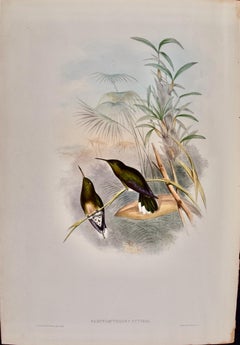
Cuvier's Sabre-wing Hummingbirds: A 19th C. Hand-colored lithograph by Gould
By John Gould and Henry Constantine Richter
Located in Alamo, CA
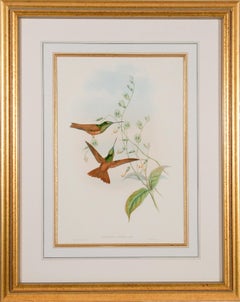
This is an original 19th century hand-colored folio-sized lithograph entitled "Campylopterus Cuvieri" (Cuvier's Sabre-wing Hummingbird) by John Gould, as plate 52 published in his "A Monograph of the Trochilidae, or Family of Humming-birds", published in London between 1849 and 1861. The print, which was drawn by Gould and Henry Richter and lithographed by Hullmandel and Walton, depicts two mostly green-colored hummingbirds with brown wings perched on a branch of a tropical long leafed plant, possibly bamboo with ferns in the background.
This beautiful Gould hand-colored hummingbird lithograph is augmented with gum-arabic paint. It is in very good condition, other than some discoloration at the edges of the upper and lower right corners and residual binding material where the print was bound in the 19th century publication. The original descriptive text page from Gould's 19th century publication is included.
There are several other unframed Gould hummingbird lithographs available on our 1stdibs and InCollect storefronts. Two or more of these striking lithographs would make an attractive display grouping. A discount is available for purchase of a set depending on the number. These additional Gould hummingbirds may be viewed by typing Timeless Intaglio...
Category
Mid-19th Century Naturalistic Animal Prints
Materials
Lithograph
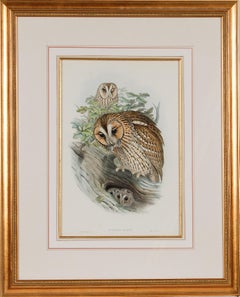
Tawny or Brown Owl: A Framed Original 19th C. Hand-colored Lithograph by Gould
By John Gould and Henry Constantine Richter
Located in Alamo, CA
This is a framed original 19th century hand-colored folio-sized lithograph entitled “Syrnium Aluco" (Tawny or Brown Owl) by John Gould, from his "Birds of G...
Category
Mid-19th Century Naturalistic Animal Prints
Materials
Lithograph
Bolivian Rainbow Hummingbirds: A Framed 19th C. Hand-colored Lithograph by Gould
By John Gould and Henry Constantine Richter
Located in Alamo, CA
This is an original framed 19th century hand-colored folio-sized lithograph entitled "Diphogena Aurora" (Bolivian Rainbow Hummingbirds) by John Gould, from his "Monograph of the Trochilidae, or Family of Hummingbirds", published in London in 1853. The print depicts two Bolivian Rainbow hummingbirds feeding on the nectar of small flowers on a branch.
This striking framed Gould hand-colored lithograph is presented in a antiqued gold frame, a gold-colored fillet, and a light tan French mat, embellished with a mint-colored broad band. The frame measures 32" high, 25.5" wide and 1.25" thick. The hand-coloring is enhanced by the use of gum-arabic paint on the hummingbirds heads and necks, giving them an iridescent appearance. The descriptive text page from Gould's original publication is included. It is affixed to the back of the frame in a clear sleeve. The piece is in excellent condition.
There are several other unframed Gould bird lithographs available on our 1stdibs and InCollect storefronts. Two or more of these striking lithographs would make an attractive display grouping. A discount is available for purchase of a set depending on the number. These additional Gould hummingbirds may be viewed by typing Timeless Intaglio in the 1stdibs or InCollect search field to be taken to our storefront.
John Gould (1804-1881]) was an English ornithologist and artist. He, like his American contemporary John James Audubon, published a number of books on birds in the mid 19th century, illustrated by hand-colored lithographs. His wife and fellow artist, Elizabeth Gould, and several other artists including Edward Lear and Henry Constantine Richter produced lithographs for his various publications. He has been considered the father of bird study in Australia and the Gould League in Australia is named after him. Charles Darwin referenced Gould’s work in his book, "On the Origin of Species" and Gould named a bird after Darwin; "Darwin's finches".
Gould began his career in London as a taxidermist, but in 1827 became the first curator and conservator at the museum of the Zoological Society of London. In this position naturalists brought him collections of birds from all over the world. He began creating drawings and eventually hand-colored lithographs with his wife and Edward Lear, which were the basis for his first publications. Darwin brought him specimens from the Galapagos Islands, including 12 species of finches which had never been described. In 1838, Gould and his wife travelled to Australia and their work led to the seven volume publication of “The Birds of Australia”. Gould had a fascination for hummingbirds and collected specimens of 320 varieties before ever seeing a live hummingbird on a trip to the United States in 1857. He eventually published “A Monograph of the Trochilidae, or Family of Humming-birds". Other large publications include: "The Birds of Europe"," A Monograph of the Ramphastidae, or Family of Toucans”, “A Synopsis of the Birds of Australia, and the Adjacent Islands”, “A Monograph of the Odontophorinae, or Partridges of America”, “The Birds of Asia”, “The Birds of Great Britain” and "The Birds of New Guinea and the Adjacent Papuan Islands, including many new species recently discovered in Australia".
John Gould (1804-1881) was a British ornithologist and illustrator who is best known for his monumental work, "The Birds of Europe," published between 1832 and 1837. Gould was born in Lyme Regis, Dorset, England, and began working as a taxidermist and natural history dealer in London in the 1820s. In 1827, Gould was appointed the first curator and preserver of birds at the Zoological Society of London, where he began to build his collection of specimens and began to study the birds of the world. He published his first monograph, "A Century of Birds from the Himalaya Mountains," in 1831, which included 80 plates of Himalayan birds. Gould continued to publish numerous volumes on the birds of the world throughout his life, including "The Birds of Australia" (1840-1848) and "The Birds of Great Britain" (1862-1873). His works were highly regarded for their accuracy and detail, and he was one of the most prominent ornithologists of his time.
In addition to his work as an ornithologist, Gould was also a successful businessman, and he used his profits to fund expeditions and to support the scientific community. He was elected a Fellow of the Royal Society in 1843, and he was awarded the Royal Medal...
Category
Mid-19th Century Naturalistic Animal Prints
Materials
Lithograph
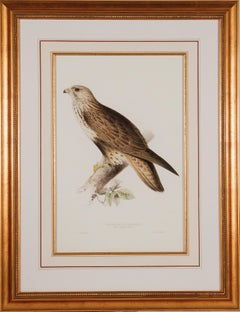
Rough-legged Buzzard: 19th C. Hand-colored Lithograph by J. Gould & Edward Lear
By Edward Lear
Located in Alamo, CA
This is an original 19th century hand-colored folio-sized lithograph entitled "Archibuteo Lagopus" (Rough-Legged Buzzard) by John Gould and Edward Lear, from Gould's "Birds of Great Britain", published in London between 1862 and 1873. The print depicts an adult Rough-Legged Buzzard perched on a branch of a tree looking to the left.
This beautiful framed Gould hand-colored lithograph is presented in a gold-colored wood frame and cream-colored French mat, embellished by a gold-colored fillet. The frame measures 33" high, 25.5" wide and 1.25" thick. It is in excellent condition
There are several other unframed Gould bird lithographs available on our 1stdibs and InCollect storefronts. Two or more of these striking lithographs would make an attractive display grouping. A discount is available for purchase of a set depending on the number. These additional Gould hummingbirds may be viewed by typing Timeless Intaglio in the 1stdibs or InCollect search field to be taken to our storefront.
John Gould (1804-1881]) was an English ornithologist and artist. He, like his American contemporary John James Audubon, published a number of books on birds in the mid 19th century, illustrated by hand-colored lithographs. His wife and fellow artist, Elizabeth Gould, and several other artists including Edward Lear and Henry Constantine Richter produced lithographs for his various publications. He has been considered the father of bird study in Australia and the Gould League in Australia is named after him. Charles Darwin referenced Gould’s work in his book, "On the Origin of Species" and Gould named a bird after Darwin; "Darwin's finches".
Gould began his career in London as a taxidermist, but in 1827 became the first curator and conservator at the museum of the Zoological Society of London. In this position naturalists brought him collections of birds from all over the world. He began creating drawings and eventually hand-colored lithographs with his wife and Edward Lear, which were the basis for his first publications. Darwin brought him specimens from the Galapagos Islands, including 12 species of finches which had never been described. In 1838, Gould and his wife travelled to Australia and their work led to the seven volume publication of “The Birds of Australia”. Gould had a fascination for hummingbirds and collected specimens of 320 varieties before ever seeing a live hummingbird on a trip to the United States in 1857. He eventually published “A Monograph of the Trochilidae, or Family of Humming-birds". Other large publications include: "The Birds of Europe"," A Monograph of the Ramphastidae, or Family of Toucans”, “A Synopsis of the Birds of Australia, and the Adjacent Islands”, “A Monograph of the Odontophorinae, or Partridges of America”, “The Birds of Asia”, “The Birds of Great Britain” and "The Birds of New Guinea and the Adjacent Papuan Islands, including many new species recently discovered in Australia".
John Gould (1804-1881) was a British ornithologist and illustrator who is best known for his monumental work, "The Birds of Europe," published between 1832 and 1837. Gould was born in Lyme Regis, Dorset, England, and began working as a taxidermist and natural history dealer in London in the 1820s. In 1827, Gould was appointed the first curator and preserver of birds at the Zoological Society of London, where he began to build his collection of specimens and began to study the birds of the world. He published his first monograph, "A Century of Birds from the Himalaya Mountains," in 1831, which included 80 plates of Himalayan birds. Gould continued to publish numerous volumes on the birds of the world throughout his life, including "The Birds of Australia" (1840-1848) and "The Birds of Great Britain" (1862-1873). His works were highly regarded for their accuracy and detail, and he was one of the most prominent ornithologists of his time.
In addition to his work as an ornithologist, Gould was also a successful businessman, and he used his profits to fund expeditions and to support the scientific community. He was elected a Fellow of the Royal Society in 1843, and he was awarded the Royal Medal...
Category
Mid-19th Century Naturalistic Animal Prints
Materials
Lithograph