1 of 13
UnknownFrench Clock Engravings S/31980
1980
$700List Price
About the Item
Authenticity Guarantee
In the unlikely event there’s an issue with an item’s authenticity, contact us within 1 year for a full refund. DetailsMoney-Back Guarantee
If your item is not as described, is damaged in transit, or does not arrive, contact us within 7 days for a full refund. Details24-Hour Cancellation
You have a 24-hour grace period in which to reconsider your purchase, with no questions asked.Vetted Professional Sellers
Our world-class sellers must adhere to strict standards for service and quality, maintaining the integrity of our listings.Price-Match Guarantee
If you find that a seller listed the same item for a lower price elsewhere, we’ll match it.Trusted Global Delivery
Our best-in-class carrier network provides specialized shipping options worldwide, including custom delivery.You May Also Like
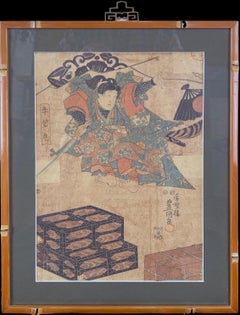
Kumasaka Chōhan to Ushiwakamaru - One of a Diptych Original Woodcut Print
By Utagawa Kunisada (Toyokuni III)
Located in Soquel, CA
Kumasaka Chōhan to Ushiwakamaru is a Japanese Ukiyo-e print created between 1848 and 1854 by artist Utagawa Kunisada (Japanese, 1786-1864). The print is a Diptych, and is part of the...
Category
1850s Realist Figurative Prints
Materials
Printer's Ink, Rice Paper, Woodcut
$1,100
H 18.5 in W 13.68 in D 0.38 in
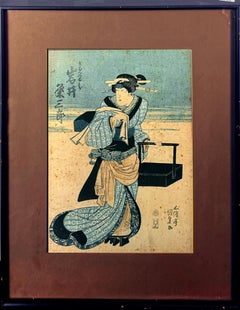
Ichimura Uzaemon XIII - actor as Okaji of Gion, 1862 "The Six Poetry Immortals"
By Utagawa Kunisada (Toyokuni III)
Located in Soquel, CA
Ichimura Uzaemon XIII - actor as Okaji of Gion, 1862 "The Six Poetry Immortals"
A Japanese Ukiyo-e woodcut print created circa 1862 by artist Utagawa Kunisada (Japanese, 1786-1864). ...
Category
1850s Realist Figurative Prints
Materials
Printer's Ink, Rice Paper, Woodcut
$850
H 21.75 in W 16.75 in D 1.25 in
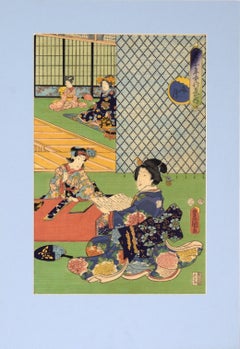
Annual Events for Young Murasaki (July) - Tales of Genji - Japanese Woodblock
By Utagawa Kunisada (Toyokuni III)
Located in Soquel, CA
Annual Events for Young Murasaki (July) - Tales of Genji - Japanese Woodblock
Rightmost panel a triptych, depicting monthly events for Wakamurasaki (Young Murasaki). This is the month of July. There appears to be a lesson taking place, possibly for writing or poetry.
Artist: Toyokuni III/Kunisada (1786 - 1864)
Publisher: Ebisu-ya Shoshichist
Presented in a new blue mat.
Mat size: 19"H x 13"W
Paper size: 14.5"H x 10"W
Commentary on the triptych:
In the Edo period, Tanabata was designated as one of the five seasonal festivals, and became an annual event for the imperial court, aristocrats, and samurai families, and gradually came to be celebrated by the general public. Its origins are said to be a combination of the Kikoden festival, which originated from the Chinese legend of Altair and the Weaver Girl, and Japan's ancient Tanabata women's faith. Ink is ground with dew that has accumulated on potato leaves, poems and wishes are written on five colored strips of paper, which are then hung on bamboo branches to celebrate the two stars that meet once a year. Although the illustration is a Genji painting...
Category
1850s Realist Figurative Prints
Materials
Printer's Ink, Rice Paper, Woodcut
$975
H 19 in W 13 in D 0.25 in
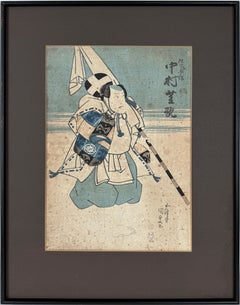
Kabuki actor Nakamura Shikan II by Utagawa Kunisada Edo Japanese Woodblock Print
By Utagawa Kunisada (Toyokuni III)
Located in Soquel, CA
Kabuki actor Nakamura Shikan II by Utagawa Kunisada Japanese Woodblock Print
Wonderful portrait of Nakamura Shikan II, a prominent kabuki actor, in the role of Kisen Hoshi Toyokuni ...
Category
1820s Realist Figurative Prints
Materials
Printer's Ink, Rice Paper, Woodcut
$550
H 21.75 in W 16.75 in D 1.25 in
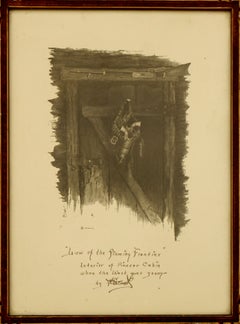
Law of The Flaming Frontier - 1920s Western Interior with Guns and Rifle
By Harold Edgar Wenck
Located in Soquel, CA
Wonderful print with artist's title and description (written in pen and ink) "'Law of the Flaming Frontier' Interior of Pioneer Cabin with a gun and a rifle in Tombstone AZ when the West was young." By Harold Edgar Wenck (American, 1886-1958), circa 1920s. Signed within print and hand-signed below title/description (in pen and ink). Presented in a giltwood period frame.
H. E. Wenck (also known as Joe) was born in Fort Assiniboine, Montana in 1896. According to an article in Arizona Kitty Kat...
Category
1920s Realist Interior Prints
Materials
Paper, Ink
$300 Sale Price
20% Off
H 16.5 in W 12.5 in D 0.5 in
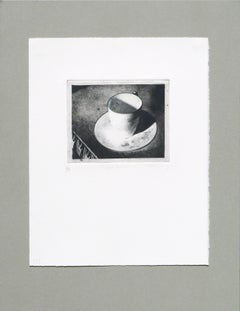
Cup & Saucer (Grandmother's Artifacts), Photo Etching Still-Life
By Claudette McElroy
Located in Soquel, CA
Unique photo etching of a cup and saucer by Claudette McElroy (American, b. 1943). Numbered (6/8), titled (Cup & Saucer), and signed (C. McElroy) alo...
Category
Late 20th Century Realist Still-life Prints
Materials
Paper, Ink, Etching
$380 Sale Price
20% Off
H 18.5 in W 14 in D 0.07 in
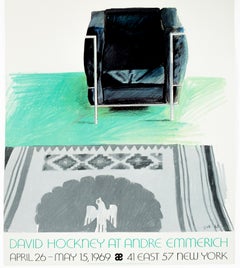
Vintage Le Corbusier '69 David Hockney Exhibition Poster Kilim southwest rug
By (after) David Hockney
Located in New York, NY
Shading in bright turquoise above a Southwestern style thunderbird Kilim rug adorns this original exhibition poster for David Hockney's 1969 show at Andre Emmerich, New York. This po...
Category
1960s Realist Interior Prints
Materials
Lithograph
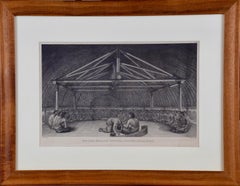
"Inside of a House in Nootka Sound" (Canada) from Captain Cook's 3rd Voyage
By John Webber
Located in Alamo, CA
"The Inside of a House in Nootka Sound" is an engraving created by William Sharp (1749-1824), from a drawing by John Webber (1752-1793), who was the artist on Captain James Cook's 3rd and final voyage of discovery. It is Plate 65 in "A Voyage to the Pacific Ocean Undertaken by the Command of His Majesty, for Making Discoveries in the Northern Hemisphere", the official British Admirality sanctioned journal published upon completion of the voyage in London in 1784 by Strahan & Cadell.
This engraving is presented in a Koa wood frame and a white mat. There are occasional tiny faint spots, but the print is otherwise in very good condition. Koa wood is legendary in Hawaii. Not only is this amazing wood native to Hawaii, but it is known for the deep rich colors and varied grain pattern. Koa has an honored heritage in Hawaii and is highly revered and sacred. The word “koa” means “warrior” in Hawaiian. The warriors of King Kamehameha the Great, created canoes and weapons from a wood plentiful on the Big Island of Hawaii. This wood became synonymous with the warriors themselves, and it became known as koa.
There are three other engravings listed form the official journal of Captain Cook's 3rd voyage available that are presented in identical Koa wood frames and mats. They would make a wonderful grouping for a display of 2, 3 or 4 prints. Please see listings: LU117324682432, LU117324684022, LU117324684062. A discount is available for a grouping depending on the number of items included.
Nootka Sound is on the west coast of Vancouver Island, British Columbia, Canada. It was explored by Captain Cook in 1778 after he discovered Hawaii during his 3rd voyage. He originally named it King George's Sound, but did record Nootka Sound, which he thought was its native name. Hawaii was originally called The Sandwich Islands in honor of The Earl of...
Category
1780s Realist Interior Prints
Materials
Engraving

$2,375
H 18.25 in W 24 in D 0.88 in
"King of the Friendly Islands" (Tonga); Engraving from Captain Cook's 3rd Voyage
By John Webber
Located in Alamo, CA
"Poulaho, King of the Friendly Islands, Drinking Kava" is an engraving created by William Sharp (1749-1824), from a drawing by John Webber (1752-1793), who was the artist on Captain James Cook's 3rd and final voyage of discovery. It was published in the atlas of "A Voyage to the Pacific Ocean Undertaken by the Command of His Majesty, for Making Discoveries in the Northern Hemisphere", the official British Admirality sanctioned journal published upon completion of the voyage in London in 1784 by Strahan & Cadell.
Captain Cook visited Tonga on his 3rd voyage, which he named The Friendly Islands because of the warm welcome he and his crew received, unlike some of the other more hostile Pacific islands. The engraving depicts Cook and his men observed a kava ceremony at the village of Mu’a on Tongatapu. King Paulaho sits in the centre foreground, his back to the spectator with a man kneeling before him. The ceremonial mat depicted behind Paulaho indicates that nobody was allowed to sit behind him. The figure in the centre holds a single cup, referring to the Tongan custom of offering the cup to the king first. Kava is native to the islands of the South Pacific and was first described for English readers in 1768 by Captain James Cook. The kava root has been used for centuries as a central feature of ceremonies and celebrations because it was able to bring about a calming and pleasant social atmosphere. The root was crushed and processed into coconut milk to become the focal ceremonial beverage, simply referred to as kava.
This engraving is presented in a Koa wood frame and a white mat. Koa wood is legendary in Hawaii. There are occasional faint spots, but the print is otherwise in very good condition. This amazing Koa wood is native to Hawaii and it is known for the deep rich colors and varied grain pattern. Koa has an honored heritage in Hawaii and is highly revered and sacred. The word “koa” means “warrior” in Hawaiian. The warriors of King Kamehameha the Great, created canoes and weapons from a wood plentiful on the Big Island of Hawaii. This wood became synonymous with the warriors themselves, and it became known as koa.
There are three other engravings listed from the official journal of Captain Cook's 3rd voyage available that are presented in identical Koa wood frames and mats (LU117324682422, LU117324684052, LU117324684032). They would make a wonderful grouping for a display of 2, 3 or 4 prints. A discount is available for a grouping depending on the number of items included.
Captain Cook is remembered as one of the greatest explorers and navigators in history. His explorations included Australia, New Zealand and islands of the South Pacific and the northwest coast of North America. Hawaii was discovered by Captain Cook during this voyage. Hawaii was originally called The Sandwich Islands in honor of The Earl of Sandwich...
Category
1780s Realist Figurative Prints
Materials
Engraving
$2,375
H 18.25 in W 23.5 in D 0.88 in
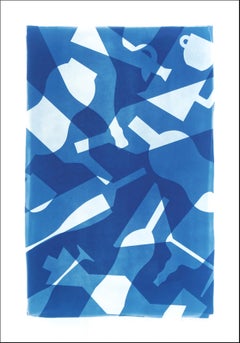
Bottles Patterns in Swimming Pool, Blue & White Kitchenware, Modern Still Life
Located in Barcelona, ES
"Bottles in Swimming Pool II" is a contemporary still-life monotype cyanotype portraying a kitchen scene. This is a unique piece made by layering paper cutouts and different exposure...
Category
2010s Realist Still-life Paintings
Materials
Watercolor, Monotype, Archival Paper
$552 Sale Price
20% Off
H 28 in W 20 in D 0.1 in