Want more images or videos?
Request additional images or videos from the seller
1 of 3
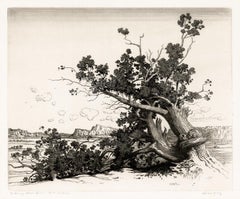
Richard PokornyBeethovenc. 1935
c. 1935
$350List Price
About the Item
About the Seller
5.0
Recognized Seller
These prestigious sellers are industry leaders and represent the highest echelon for item quality and design.
Platinum Seller
Premium sellers with a 4.7+ rating and 24-hour response times
Established in 1995
1stDibs seller since 2016
334 sales on 1stDibs
Typical response time: 1 hour
Associations
International Fine Print Dealers Association
Authenticity Guarantee
In the unlikely event there’s an issue with an item’s authenticity, contact us within 1 year for a full refund. DetailsMoney-Back Guarantee
If your item is not as described, is damaged in transit, or does not arrive, contact us within 7 days for a full refund. Details24-Hour Cancellation
You have a 24-hour grace period in which to reconsider your purchase, with no questions asked.Vetted Professional Sellers
Our world-class sellers must adhere to strict standards for service and quality, maintaining the integrity of our listings.Price-Match Guarantee
If you find that a seller listed the same item for a lower price elsewhere, we’ll match it.Trusted Global Delivery
Our best-in-class carrier network provides specialized shipping options worldwide, including custom delivery.You May Also Like
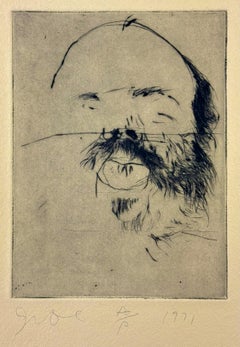
Jim Dine Rimbaud, the Coffee Exporter poet portrait drawing in earth tone sepia
By Jim Dine
Located in New York, NY
Jim Dine has expertly sketched the accomplished French poet and coffee trader Arthur Rimbaud. A vignette of dark brown surrounds his thin, fine features, which are defined with a flu...
Category
1970s Realist Portrait Prints
Materials
Etching
Self Portraits Jim Dine portfolio of nine self portrait etchings aquatint
By Jim Dine
Located in New York, NY
Jim Dine Self Portraits (1971)
Portfolio of nine drypoints, each from one 20.3 x 15.2 cm (8 x 6 inch) copper plate
Printed in brown-black on she...
Category
1970s Realist Portrait Prints
Materials
Etching, Aquatint
$9,500
H 20.5 in W 15.5 in
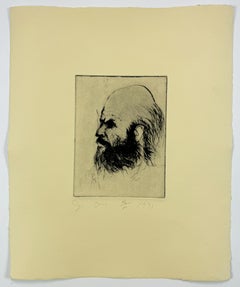
Self Portrait by Jim Dine (plate seven from Self Portraits portfolio 1971)
By Jim Dine
Located in New York, NY
Jim Dine, Self Portrait 1971
drypoint on Hodgkinson Hand Made Tone-Weave paper
Paper 18 x 14 in. / 46 x 36 cm
Plate 8 x 6 in. / 20 x 15 cm
plate seven from Self Portraits (1971) port...
Category
1970s Realist Portrait Prints
Materials
Etching, Drypoint
$1,500
H 20.5 in W 15.5 in
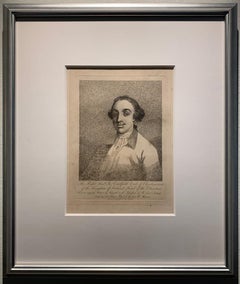
'Portrait of James Caulfield' by William Hogarth, Etching
By William Hogarth
Located in Oklahoma City, OK
This 21" x 18" etching was produced by William Hogarth in the mid-18th century. The work has been newly matted and framed with archival materials. The subject, identified as James Caulfield, 4th Viscount, 1st Earl of Charlemont (1728-1799), became commander in chief of the Irish Volunteers...
Category
1780s Realist Portrait Prints
Materials
Etching
$750
H 21 in W 18 in D 1 in
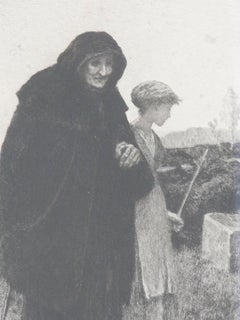
Homeless. 19th Century Etching
By Charles-Jean-Louis Courtry
Located in Brecon, Powys
A very poignant depiction. A H Marsh is one of the English artists who devoted themselves to the representation of pathetic subjects. The gravity of this painter's idea is always to ...
Category
Late 19th Century Realist Portrait Prints
Materials
Etching
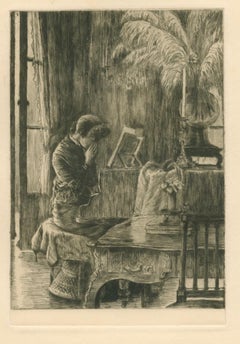
Renée Mauperin; Ten Etchings, Complete Set for novel by Goncourt Brothers
By James Jacques Joseph Tissot
Located in Middletown, NY
Renée Mauperin; Ten Etchings, Complete Set for the Illustrations to the Novel by Edmond and Jules de Goncourt 1882
Paris: G. Charpentier et Cie, 1882-1884.
The complete set of ten ...
Category
Late 19th Century Realist Interior Prints
Materials
Etching
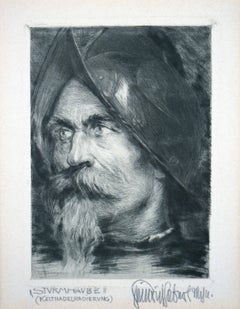
Balaclava - The target in sight -
Located in Berlin, DE
Heinrich Haberl (1869 Passau to 1934 Munich), Sturmhaube, c. 1900. drypoint, 14 x 10 cm (platemark), 28 x 21 cm (sheet size), 39 x 29 cm (passe-partout), titled "Sturmhaube" in lead at lower left and inscribed "Kaltnadelradierung", signed and locally inscribed "Heinrich Haberl Mchn. [Munich]" at lower right, inscribed again in lead on verso and with old collection stamp.
- slightly darkened, fixed and mounted
- The target in sight -
About the artwork
The theatrical "role-portrait" is to be seen against the background of the Rembrandt cult, which reached its climax at the end of the 19th century. The soldier seems to have stepped straight out of Rembrandt's Night Watch (1642) to fix something outside the picture with an alert and ready gaze. The steeply rising brim of the morion frames the gaze and thus perspectivises it as the actual 'pictorial action'. The gaze represents both the vigilant defence and the visionary goal of the battle.
Not only the subject, but also the style of the etching needle reflect Rembrandt's understanding of the times. Strong contrasts of light and dark are created in a virtuoso free stroke, without losing the effect of the reflections on the helmet and in the eyes. This shows a kinship with the early prints of Lovis Corinth, who also saw himself as an artist in the role of the knight. Against this background, Haberl's picture can also be seen as a representation of his artistic self-image.
About the artist
Heinrich Haberl first attended the art school in Nuremberg and from 1892 studied at the Munich Academy. There he was a master student of Johann Leonhard von Raab, Rudolf von Seitz, Franz von Defregger...
Category
Early 19th Century Realist Figurative Prints
Materials
Etching
General Wilhelm von Blume - Visionary retrospective -
Located in Berlin, DE
Bernhard Pankok (1872 Münster - 1943 Baierbrunn), General Wilhelm von Blume, 1915, aquatint etching, 34 x 29.5 cm (sheet size), 26 x 22 cm (plate size), signed in the plate at upper left, in pencil at lower right and dated in pencil at lower left.
- At lower left old collection stamp, at the right broad margin with a small spot, otherwise very good condition.
About the artwork
The 1915 aquatint etching of General Wilhelm von Blume is based on a 1912 oil painting in the LWL-Museum für Kunst und Kultur in Münster. A second oil portrait of the general by Pankok is in the Staatsgalerie Stuttgart. When Pankok painted the first oil portrait in 1912, the general had already been retired for 16 years. It is therefore a retrospective portrait. Accordingly, the orientation of his head is such that he is looking back in both the oil painting and the etching. Without fixing on anything in particular, he looks thoughtfully inwards and reflects on his life. Uniformed and highly endowed, it is his military activities in particular that he is reviewing attentively and, as his gaze reveals, quite critically.
Pankok has literally written the sum of his experiences on Wilhelm von Blume's face: The physiognomy is a veritable landscape of folds, furrows, ridges and gullies, all the more striking against the flat background. It is clear that each of the medals was also won through suffering. However, by breaking the boundaries of the picture, his bust appears as an unshakable massif, which gives the general a stoic quality.
The fact that the design of the portrait was important to Pankok can be seen from the different versions, the present sheet being the third and probably final revision, which Pankok dates precisely to 18 February 1915. Compared with the previous state, the light background now has a dark area against which the sitter's face stands out, the dark background in turn combining with the uniform to create a new tension in the picture.
Pankok's taking up of the portrait of the high-ranking military veteran and its graphic reproduction can also be seen in relation to the First World War, which had broken out in the meantime. In the face of modern weapons of mass destruction, Wilhelm von Blume's warfare and military writings were relics of a bygone, more value-oriented era.
About the artist
After studying at the Düsseldorf Art Academy from 1889 to 1891 under Heinrich Lauenstein, Adolf Schill, Hugo Crola, and Peter Janssen the Elder, Bernhard Pankok went to Munich in 1892, where he worked primarily as a graphic artist for the two major Jugendstil magazines "Pan" and "Jugend," which established his artistic success. Through this work he met Emil Orlik, with whom he had a lifelong friendship.
In 1897, he exhibited his first furniture, and in 1898, together with Richard Riemerschmid, Bruno Paul and Hermann Obrist...
Category
1910s Realist Portrait Prints
Materials
Etching
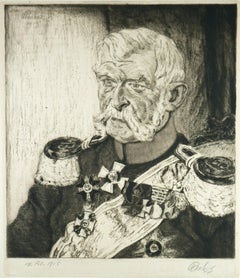
$573
H 13.39 in W 11.82 in D 0.4 in
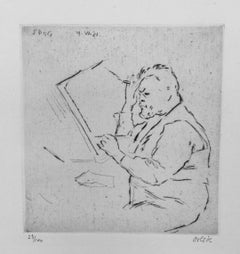
Portrait of Slevogt
By Emil Orlik
Located in New York, NY
Emil Orlik (1870-1932), Portrait of Slevogt, etching, 1921, signed in pencil and numbered (27/100) [also signed and dated in the plate], from the presumed edition of 100. In very goo...
Category
1920s Realist Portrait Prints
Materials
Etching
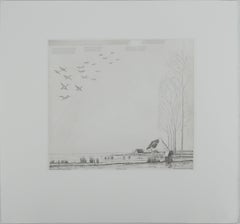
Brittany : The Flight of Ducks - Etching from Louvre Museum
By Jean-Emile Laboureur
Located in Paris, IDF
Jean-Emile LABOUREUR
Brittany : The Flight of Ducks
Original etching
Printed signature in the plate
On vellum 38 x 41 cm (c. 14.97 x 16.15 inch)
REFERENCE : Catalog raisonne Sylvai...
Category
Mid-20th Century Realist Portrait Prints
Materials
Etching
$358
H 14.97 in W 16.54 in
More From This Seller
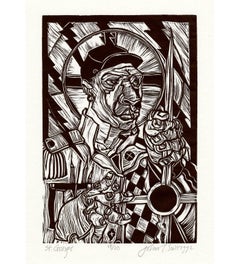
View AllSt. George — African American artist
By John Tarrell Scott
Located in Myrtle Beach, SC
John Tarrell Scott, 'St. George', woodcut, edition 20, 1992. Signed, dated, titled, and numbered '18/20' in pencil. A fine, black impression, on off-white, laid Japan paper, with ful...
Category
1990s Contemporary Portrait Prints
Materials
Woodcut
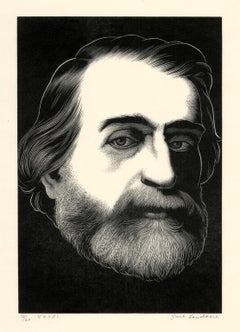
'Verdi' — American Modernism - Italian Opera Composer
By Paul Landacre
Located in Myrtle Beach, SC
Paul Landacre, 'Verdi', wood engraving, 1936, edition 60, (only 14 printed), Wien 188. Signed, titled, and numbered '10/60' in pencil. A fine impression, on cream, laid Japan paper, ...
Category
1930s American Modern Portrait Prints
Materials
Woodcut
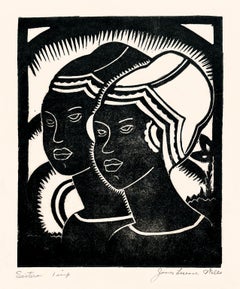
'Sisters' — Renowned Black American, Harlem Renaissance Artist
Located in Myrtle Beach, SC
James Lesesne Wells, 'Sisters', linocut, edition not stated but small, 1928. Signed, titled, and annotated 'imp' in pencil. A fine impression on off-white wove Japan paper, with wide margins (1 7/8 to 3 3/4 inches), in excellent condition. Printed by the artist. Very scarce. Matted to museum standards, unframed.
Image size 8 3/16 x 6 3/4 inches (208 x 171 mm); sheet size 13 1/2 x 10 3/4 inches (343 x 273 mm).
Exhibition and Literature: 'Narratives of African American Art and Identity: The David C. Driskell Collection,' The Art Gallery at the University of Maryland, extensive touring exhibition, 1998-2000.
Collections: Pennsylvania Academy of the Fine Arts, Smithsonian Institution (Anacostia Community Museum).
ABOUT THE ARTIST
“Wells is more than an artist with a deep concern for his fellow man. He carries many of his themes a step further into an apocalyptic world, a world of revelation and shifting lights. … He works on large blocks in a bold free style. … His work has a vigor, therefore, that is not often used in the medium today.”
—Jacob Kainen (painter, critic, and collector) from Richard J. Powell’s 1986 essay Phoenix Ascending: The Art of James Lesesne Wells.
James Lesesne Wells was an American painter, printmaker, educator, and pioneering figure of the Harlem Renaissance, whose work established a vital connection between African heritage, modernist form, and African American cultural identity. Known for his innovative use of linoleum and woodblock printing, Wells played a key role in shaping 20th-century African American art and inspired countless students throughout his lengthy career as a teacher at Howard University.
Born in Atlanta, Georgia, Wells' early exposure to the arts came through church and community, where African American cultural traditions were central. He pursued formal artistic training at Lincoln University in Pennsylvania (earning a B.A. in 1924), followed by studies at the Pennsylvania Academy of the Fine Arts and the Barnes Foundation, where he encountered European modernists as well as traditional African sculpture, which profoundly influenced his style.
Wells moved to New York in the late 1920s, swiftly immersing himself in the lively artistic and intellectual scene of Harlem. There, he became associated with artists, writers, and thinkers of the Harlem Renaissance, contributing to the growth of Black cultural identity. Considered a mentor to many famed artists of the Harlem Renaissance, Wells served as director of a summer art workshop in Harlem where his assistants included Charles Alston, Jacob Lawrence, and Palmer Hayden...
Category
1920s American Modern Figurative Prints
Materials
Linocut
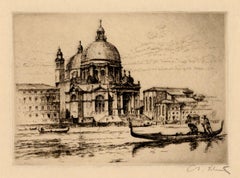
'Venice, Maria della Salute' — Serenissima Impressionism
By Anton Schutz
Located in Myrtle Beach, SC
Anton Schutz, 'Venice, Maria della Salute', etching, c. 1930. Signed and titled in pencil. A superb, richly-inked impression, with skillfully wiped plate tone, on cream wove paper, ...
Category
1930s Realist Figurative Prints
Materials
Etching
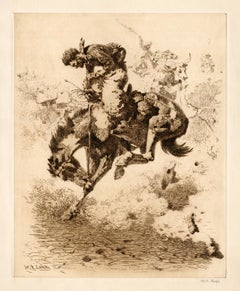
'Foul Rope (Left)' — Early American Southwest Rodeo
By William Robinson Leigh
Located in Myrtle Beach, SC
William Robinson Leigh, 'Foul Rope (Left)', etching, c. 1920, edition unknown but small. Signed in pencil and signed in the plate, lower left. A superb, richly-inked impression, in dark brown ink, on buff wove Umbria paper, the full sheet with margins (1 1/2 to 2 3/4 inches); slight toning at the sheet edges, otherwise in excellent condition. Very scarce. Archivally matted to museum standards, unframed.
Image size 14 7/8 x 11 15/16 inches (378 x 303 mm); sheet size 20 3/8 x 15 3/8 inches (518 x 391 mm).
ABOUT THE ARTIST
Born near Falling Waters, West Virginia, on a plantation a year after the Civil War and raised in Baltimore, William Robinson Leigh (1866 - 1955) became one of the foremost painters of the American West. His career spanning some seventy-five years, Leigh created some of the most iconic depictions of the Western landscape, with admirers referring to him as ‘The Sagebrush Rembrandt.’
The son of impoverished Southern aristocrats, Leigh received his first art training at age 14 from Hugh Newell at the Maryland Institute, where he was regarded as the best student in his class. From 1883 to 1895, he studied in Europe, mainly at the Royal Academy in Munich with Ludwig Loefftz. From 1891 to 1896, he painted six cycloramas or murals in the round, a giant German panorama.
In 1896, Leigh began working as a magazine illustrator for Scribner's and Collier's Weekly Magazine in New York City. He also painted portraits, landscapes, and genre scenes.
Leigh's trips to the Southwest began in 1906 when he agreed to paint the Grand Canyon with William Simpson, Santa Fe Railway advertising manager, in exchange for free transportation West. In 1907, he completed his Grand Canyon painting, which led to more commissions and an extensive painting trip through Arizona and New Mexico. These travels inspired him to paint western subjects for the next 50 years, and his primary interests were the Hopi and Navajo Indians.
In 1910, he traveled to Wyoming, where he painted in Yellowstone Park and created sketches, many of which he later converted into large canvases such as ‘Lower Falls of the Yellowstone’ (1915) and ‘Grand Canyon of the Yellowstone’ (1911).
In 1926, he traveled to Africa at the invitation of Carl Akeley for the American Museum of Natural History, and from this experience, wrote and illustrated 'Frontiers of Enchantment: An Artist's Adventures in Africa'. In 1933, he wrote and illustrated 'The Western Pony'. His adventures were chronicled in several popular magazines, including Life, the Saturday Evening Post, and Colliers.
For many years, Grand Central Art Galleries at the Biltmore Hotel handled his work exclusively in New York. In 1953, Leigh was elected an associate member of the National Academy of Design and became a full Academician in 1955.
In March 1999, the Historical Center of Cody, Wyoming, held an exhibition of his field sketches and finished works depicting his experiences near Cody early in the century. Between 1910 and 1921, when he often painted in the Carter Mountain vicinity, these years were considered pivotal to his artistic development and devotion to the Western landscape.
Leigh's work is held in many museum collections of American Western art...
Category
1920s Realist Animal Prints
Materials
Etching
'Old Cedars' – Early New Mexico Landscape, Southwest Regionalism
By George Elbert Burr
Located in Myrtle Beach, SC
George Elbert Burr, 'Old Cedars – New Mexico', etching, 1920, edition 40, Seeber 218. Signed and annotated '(c) George Elbert Burr Del. et Imp.' in pencil. ...
Category
1920s Realist Landscape Prints
Materials
Etching