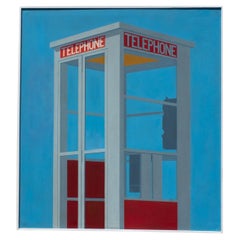
Jim Booth For Sale on 1stDibs
Find the exact jim booth you’re shopping for in the variety available on 1stDibs. Find
Pop Art versions now, or shop for
Pop Art creations for a more modern example of these cherished works. Making the right choice when shopping for a jim booth may mean carefully reviewing examples of this item dating from different eras — you can find an early iteration of this piece from the 20th Century and a newer version made as recently as the 21st Century. Adding a jim booth to a room that is mostly decorated in warm neutral tones can yield a welcome change — find a piece on 1stDibs that incorporates elements of
brown,
black,
gray and more. There have been many interesting jim booth examples over the years, but those made by
Rose Freymuth-Frazier,
James Rosenquist and
Jerry Siegel are often thought to be among the most thought-provoking. Artworks like these of any era or style can make for thoughtful decor in any space, but a selection from our variety of those made in
oil paint,
paint and
panel can add an especially memorable touch.
How Much is a Jim Booth?
The price for an artwork of this kind can differ depending upon size, time period and other attributes — a jim booth in our inventory may begin at $2,400 and can go as high as $7,450, while the average can fetch as much as $3,000.
Jim Houser for sale on 1stDibs
Jim Houser is a self-taught artist, musician, designer, and original member of the renowned artist collective Space1026 in Philadelphia. He is celebrated for his iconic patchwork paintings, color theory, stylized figures, and for challenging the definition of object versus painting. For PUSHING, Houser further develops his unique visual language through an emphasis on execution and concept. Centered with a focus on application and practice, Houser presents a complex body of unique pieces all interconnected by meditations on shapes, repurposing, and the inescapable weight of our current socio-political climate.
Jim Houser was born in 1973 in Philadelphia, Pennsylvania, the city where he currently resides. Houserʼs collages, paintings, and installations have been exhibited extensively in institutions such as the Laguna Art Museum and the Philadelphia Academy of Fine Art as well as galleries in Milan, Paris, Sydney, and São Paulo. His work is included in the permanent collection of the Philadelphia Museum of Art.
Houser layers acrylic on wood, fabric, and found objects, blurring the lines between collage and sculpture. when viewed as a whole, it becomes clear that all of his works are associative and directly related. This deceptively dimensional quality is further highlighted when the pieces are assembled into one of the artist’s elaborate installations, adding to the complexity of each individual piece by emphasizing greater interconnectivity to the body of work as a whole.
A Close Look at Modern Furniture
The late 19th and early 20th centuries saw sweeping social change and major scientific advances — both of which contributed to a new aesthetic: modernism. Rejecting the rigidity of Victorian artistic conventions, modernists sought a new means of expression. References to the natural world and ornate classical embellishments gave way to the sleek simplicity of the Machine Age. Architect Philip Johnson characterized the hallmarks of modernism as “machine-like simplicity, smoothness or surface [and] avoidance of ornament.”
Early practitioners of modernist design include the De Stijl (“The Style”) group, founded in the Netherlands in 1917, and the Bauhaus School, founded two years later in Germany.
Followers of both groups produced sleek, spare designs — many of which became icons of daily life in the 20th century. The modernists rejected both natural and historical references and relied primarily on industrial materials such as metal, glass, plywood, and, later, plastics. While Bauhaus principals Marcel Breuer and Ludwig Mies van der Rohe created furniture from mass-produced, chrome-plated steel, American visionaries like Charles and Ray Eames worked in materials as novel as molded plywood and fiberglass. Today, Breuer’s Wassily chair, Mies van der Rohe’s Barcelona chair — crafted with his romantic partner, designer Lilly Reich — and the Eames lounge chair are emblems of progressive design and vintage originals are prized cornerstones of collections.
It’s difficult to overstate the influence that modernism continues to wield over designers and architects — and equally difficult to overstate how revolutionary it was when it first appeared a century ago. But because modernist furniture designs are so simple, they can blend in seamlessly with just about any type of décor. Don’t overlook them.
Finding the Right Paintings for You
When paired with the perfect frame, the right antique and vintage paintings and other wall decorations can either subtly showcase your personality or steal the show altogether.
The earliest paintings were created on the walls of caves, proving even our ancient ancestors knew that striking artwork is meant to be on display. Cave paintings on an Indonesian island are reportedly older than the earliest cave art in Spain and France, and the figurative paintings back then were produced with inorganic pigments like iron oxide.
Later, the people of Ancient Greece — who learned about art from the Egyptians before them — conceived panel paintings of wax and tempera that were collected and publicly displayed. In the centuries that followed, artists would be commissioned to create large-scale wall murals and frescoed ceilings in sprawling European palaces and in the homes of the aristocracy.
Today, 1stDibs makes it easy for you to celebrate this rich history in your own home. Our collection of paintings includes Art Deco paintings, baroque art and a broad range of other categories. Search by material, period or other attributes to find the right fit — browse an array of 19th century landscape paintings in giltwood frames or abstract oil paintings and portraits made during the 1950s and ‘60s.
An understated contemporary work can complement your space’s color palette without drawing the focus away from the other pivotal design choices you’ve made over the years. Roy Lichtenstein’s Pop art, on the other hand, demands attention with its array of vibrant hues and subjects inspired by popular culture.
Whether you aim to create a gallery in your home or build a single, stunning focal point, you can find what you’re looking for in an extensive inventory of paintings on 1stDibs.