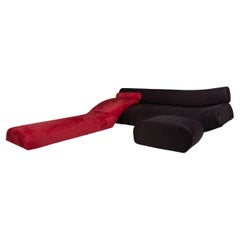
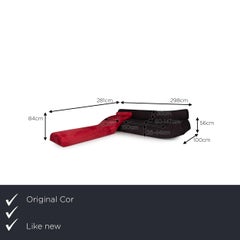
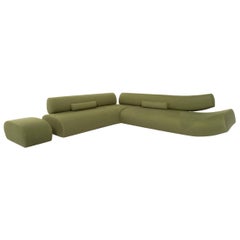
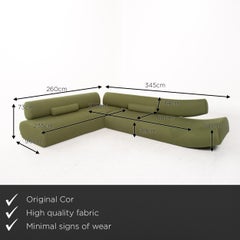
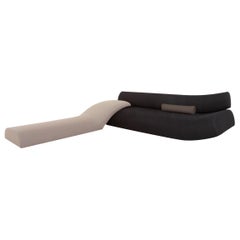
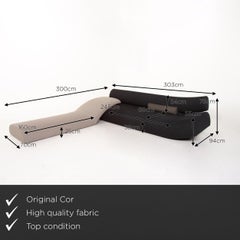
Cor is Latin for heart, and COR furniture exemplifies the qualities at the heart of exceptional design: practicality, comfort and style. The company's sofas, lounge chairs and coffee tables capture the essence of the best of mid-century modernism. Simple silhouettes, quality materials and function-first designs ensure that vintage COR furniture is still in high demand with collectors all over the world.
COR was founded in Rheda-Wiedenbrück, Germany, in 1954 by Leo Lübke — in the name of his son, Helmut — and the Prince of Bentheim-Tecklenburg, a northern German county. Nearly a couple of decades prior, in 1937, a manufacturer of bedroom furniture called Interlübke was established by Leo and his brother Hans. The latter’s son Horst, who was managing partner from 1972, retired during the 1990s and his son Helmut Lübke joined Interlübke and shifted the brand’s focus toward modular furniture systems. During the 1980s, the Prince of Bentheim-Tecklenburg left COR and the Lübke family became its sole owner. In 2006, COR-Interlübke retail locations opened their doors.
COR made its mark in 1959 with a sleek modular seating system consisting of five parts called Quinta, which was created by designer Michael Bayer. The upholstered line boasted clean, angular contours and appealed to the day's ever-broadening flexible interior design sensibilities. It remained in production until 1978. The success of the Quinta was followed by the 1964 Conseta system, which featured a sofa and other pieces of seating designed by Friedrich Wilhelm Möller.
The following decades saw more successful collaborations with designers like Peter Maly and Luigi Colani. The latter, a German industrial designer born Lutz Colani, created a range of gorgeous organically shaped Space Age seating for BASF and Fritz Hansen, serveware for Rosenthal and worked on automobile designs for Fiat. Colani designed the popular Orbis line for COR during the 1970s.
In 2000, the Arthe sofa by Wulf Schneider was awarded the prestigious Red Dot Award from the North Rhine-Westphalia Design Centre.
COR is still owned and operated by the Lübke family’s parent company Gebrüder Lübke GmbH & Co. KG and continues to produce furniture at the Rheda-Wiedenbrück factory, sourcing leather from southern Germany and upholstery from Italy. The company partnered with Jehs+Laub, a renowned Stuttgart-based studio, in 2010.
On 1stDibs, find a collection of vintage COR seating, tables and more.
The late 19th and early 20th centuries saw sweeping social change and major scientific advances — both of which contributed to a new aesthetic: modernism. Rejecting the rigidity of Victorian artistic conventions, modernists sought a new means of expression. References to the natural world and ornate classical embellishments gave way to the sleek simplicity of the Machine Age. Architect Philip Johnson characterized the hallmarks of modernism as “machine-like simplicity, smoothness or surface [and] avoidance of ornament.”
Early practitioners of modernist design include the De Stijl (“The Style”) group, founded in the Netherlands in 1917, and the Bauhaus School, founded two years later in Germany.
Followers of both groups produced sleek, spare designs — many of which became icons of daily life in the 20th century. The modernists rejected both natural and historical references and relied primarily on industrial materials such as metal, glass, plywood, and, later, plastics. While Bauhaus principals Marcel Breuer and Ludwig Mies van der Rohe created furniture from mass-produced, chrome-plated steel, American visionaries like Charles and Ray Eames worked in materials as novel as molded plywood and fiberglass. Today, Breuer’s Wassily chair, Mies van der Rohe’s Barcelona chair — crafted with his romantic partner, designer Lilly Reich — and the Eames lounge chair are emblems of progressive design and vintage originals are prized cornerstones of collections.
It’s difficult to overstate the influence that modernism continues to wield over designers and architects — and equally difficult to overstate how revolutionary it was when it first appeared a century ago. But because modernist furniture designs are so simple, they can blend in seamlessly with just about any type of décor. Don’t overlook them.
Vintage couches and antique sofas have anchored living rooms for generations. The pieces most sought after today carry the deep-buttoned tufting of a Chesterfield or the low, sculptural ease of mid-century modern and Hollywood Regency design.
Styles to Know
Rolled arms and tufted backs point to Mid-Century Modern or Hollywood Regency pieces, while tight backs and turned legs skew more traditional. Velvet is enjoying a renewed moment across most of these silhouettes; see our velvet chesterfield sofa trend report for examples. A mid-century modern coffee table within reach and a vintage mirror nearby round out the seating area.
How to Choose the Right Vintage Sofa
A sofa's frame and upholstery history can be difficult to judge from photographs alone. Ask a seller for more information when a listing doesn't show the fabric or joinery clearly, and confirm whether the upholstery is original or has been redone. Each piece comes from a vetted 1stDibs seller, with era, designer and condition detailed, and the 1stDibs Promise stands behind every purchase.