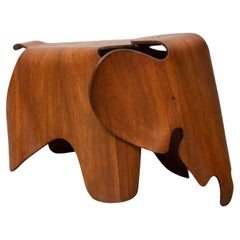
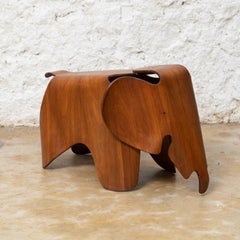
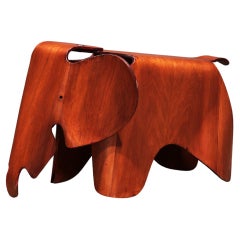
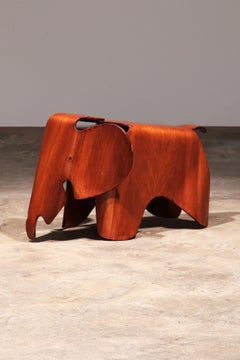
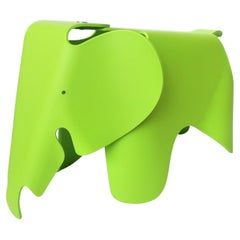
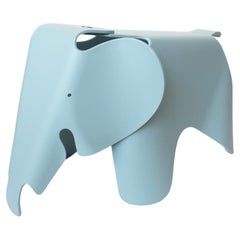
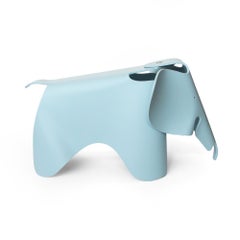
Charles Eames and Ray Eames were the embodiment of the inventiveness, energy and optimism at the heart of mid-century modern American design, and have been recognized as the most influential designers of the 20th century. The Eameses were lovers of folk craft who had a genius for making highly original chairs, tables, case pieces and other furniture using traditional materials and forms.
As furniture designers, filmmakers, artists, textile and graphic designers and even toy and puzzle makers, the Eameses were a visionary and effective force for the notion that design should be an agent of positive change. They are the happy, ever-curious, ever-adventurous faces of modernism.
Charles Eames (1907–78) studied architecture and industrial design. Ray Eames (née Beatrice Alexandra Kaiser, 1912–88) was an artist, who studied under the Abstract Expressionist painter Hans Hofmann. They met in 1940 at the Cranbrook Academy of Art in suburban Detroit (the legendary institution where Charles also met his frequent collaborator Eero Saarinen and the artist and designer Harry Bertoia) and married the next year.
His technical skills and her artistic flair were wonderfully complementary. They moved to Los Angeles in 1941, where Charles worked on set design for MGM. In the evenings at their apartment, they experimented with molded plywood using a handmade heat-and-pressurization device they called the “Kazam!” machine. The next year, they won a contract from the U.S. Navy for lightweight plywood leg splints for wounded servicemen — vintage Eames splints are coveted collectibles today; more so those that Ray used to make sculptures.
The Navy contract allowed Charles to open a professional studio, and the attention-grabbing plywood furniture the firm produced prompted George Nelson, the director of design of the furniture-maker Herman Miller Inc., to enlist Charles and (by association, if not by contract) Ray in 1946. Some of the first Eames items to emerge from Herman Miller are now classics: the Eames chair, the LCW, or Lounge Chair Wood, and the DCM, or Dining Chair Metal, supported by tubular steel.
The Eameses eagerly embraced new technology and materials, and one of their peculiar talents was to imbue their supremely modern design with references to folk traditions.
Their Wire chair group of the 1950s, for example, was inspired by basket weaving techniques. The populist notion of “good design for all” drove their molded fiberglass chair series that same decade, and also produced the organic-form, ever-delightful La Chaise. In 1956 the Eames lounge chair and ottoman appeared — the supremely comfortable plywood-base-and-leather-upholstery creation that will likely live in homes as long as there are people with good taste and sense.
Charles Eames once said, “The role of the designer is that of a very good, thoughtful host anticipating the needs of his guests.” For very good collectors and thoughtful interior designers, a piece of design by the Eameses, the closer produced to original conception the better, is almost de rigueur — for its beauty and comfort, and not least as a tribute to the creative legacy and enduring influence of Charles and Ray Eames.
The original Eames furniture for sale on 1stDibs includes chairs, tables, case pieces and other items.
Stools are versatile and a necessary addition to any living room, kitchen area or elsewhere in your home. A sofa or reliable lounge chair might nab all the credit, comfort-wise, but don’t discount the roles that good antique, new and vintage stools can play.
“Stools are jewels and statements in a space, and they can also be investment pieces,” says New York City designer Amy Lau, who adds that these seats provide an excellent choice for setting an interior’s general tone.
Stools, which are among the oldest forms of wooden furnishings, may also serve as decorative pieces, even if we’re talking about a stool that is far less sculptural than the gracefully curving molded plywood shells that make up Sōri Yanagi’s provocative Butterfly stool.
Fawn Galli, a New York interior designer, uses her stools in the same way you would use a throw pillow. “I normally buy several styles and move them around the home where needed,” she says.
Stools are smaller pieces of seating as compared to armchairs or dining chairs and can add depth as well as functionality to a space that you’ve set aside for entertaining. For a splash of color, consider the Stool 60, a pioneering work of bentwood by Finnish architect and furniture maker Alvar Aalto. It’s manufactured by Artek and comes in a variety of colored seats and finishes.
Barstools that date back to the 1970s are now more ubiquitous in kitchens. Vintage barstools have seen renewed interest, be they a meld of chrome and leather or transparent plastic, such as the Lucite and stainless-steel counter stool variety from Indiana-born furniture designer Charles Hollis Jones, who is renowned for his acrylic works. A cluster of barstools — perhaps a set of four brushed-aluminum counter stools by Emeco or Tubby Tube stools by Faye Toogood — can encourage merriment in the kitchen. If you’ve got the room for family and friends to congregate and enjoy cocktails where the cooking is done, consider matching your stools with a tall table.
Whether you need counter stools, drafting stools or another kind, explore an extensive range of antique, new and vintage stools on 1stDibs.