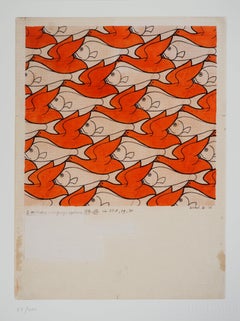
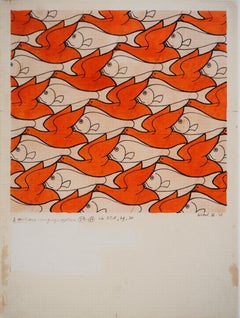
Birds and Fishes - Facsimile Lithograph, Ltd /450
By M.C. Escher
Located in Paris, IDF
M.C. ESCHER (1898-1972) Birds and Fishes, 2008 Facsimile after the original woodcut from 1943
Category
20th Century Modern Landscape Prints
Materials
Color
Birds and Fishes - Facsimile Lithograph, Ltd /450
By M.C. Escher
Located in Paris, IDF
M.C. ESCHER (1898-1972) Birds and Fishes, 2008 Facsimile after the original woodcut from 1943
Color
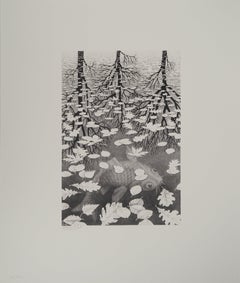
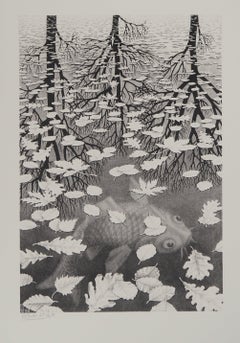
NATURE - Autumn and Carp - Signed Facsimile, Ltd /450
By M.C. Escher
Located in Paris, IDF
M.C. ESCHER (1898-1972) Birds and Fishes, 2008 Facsimile after the original woodcut from 1943
Color
Unavailable
H 20.48 in W 20.48 in D 0.4 in
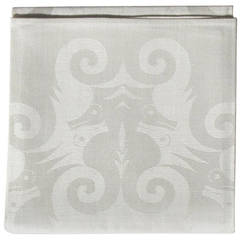
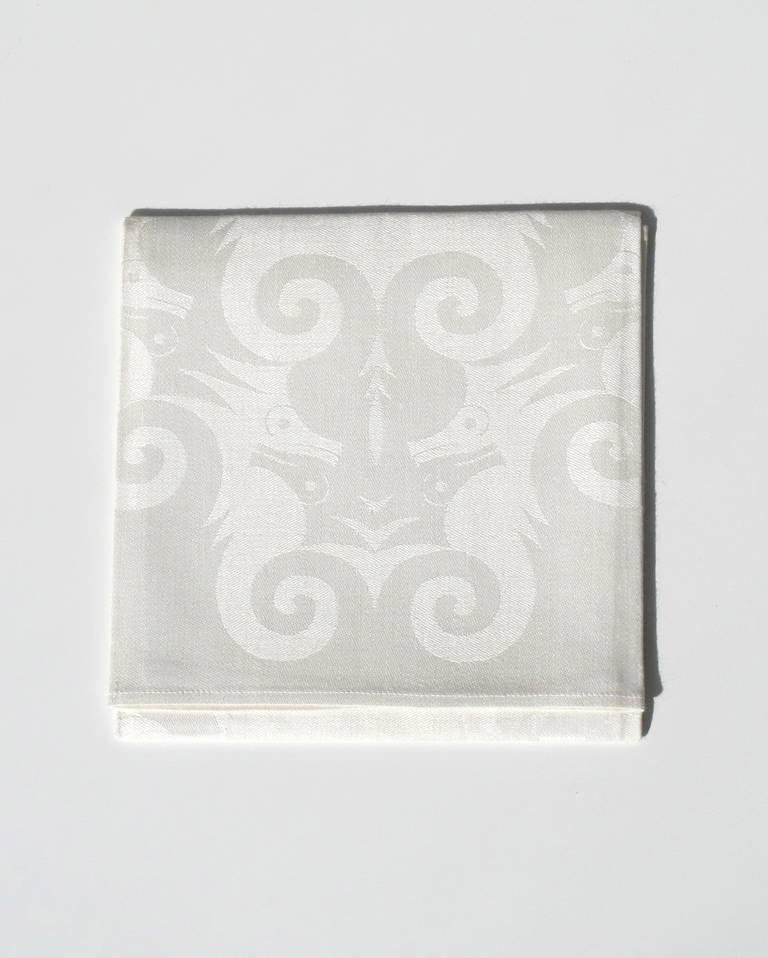
Rare M.C. Escher Damask Napkin with Seahorse and Fish, 1950s
By M.C. Escher
Located in Amstelveen, NL
Damask items by Maurits Cornelis Escher (1898-1972) are extremely rare. In the 1950s world-famous
Damask, Linen
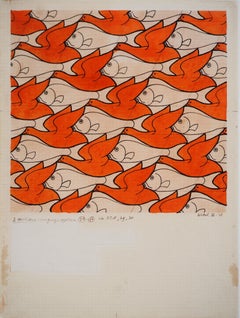
Birds and Fishes - Facsimile, Ltd /450
By M.C. Escher
Located in Paris, IDF
M.C. ESCHER (1898-1972) Birds and Fishes, 2008 Facsimile after the original woodcut from 1943
Color
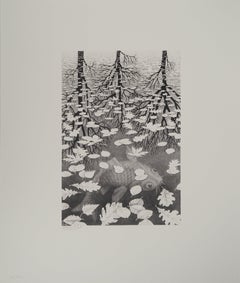
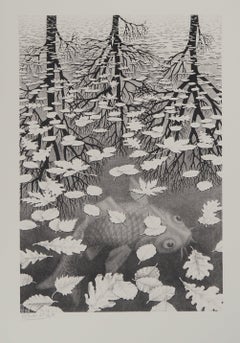
NATURE - Autumn and Carp - Signed Facsimile, Ltd /450
By M.C. Escher
Located in Paris, IDF
M.C. ESCHER (1898-1972) Birds and Fishes, 2008 Facsimile after the original woodcut from 1943
Color
Sold|$1,697
H 10.95 in W 15.91 in D 0.04 in
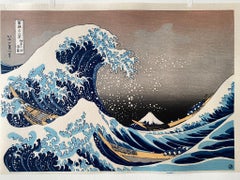
Rare Authentic Hokusai Great Wave-Authentic Seal of Watanabi Publisher-Mint con.
By Katsushika Hokusai
Located in London, GB
This rare authentic woodblock print made by the most prestige Woodblock print maker Suga Kayoko, published by Numabe Mokuhan, this edition is handled by Numabe Shinkichi or his son N...
Washi Paper, Ink
$119Sale Price|20% Off
H 9.5 in W 6 in
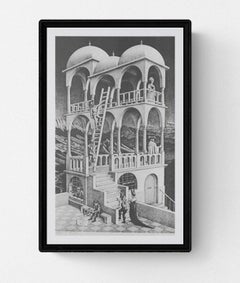
Belvedere Lithograph by M.C. Escher, Offset Print, Framed, 1988
By M.C. Escher
Located in Brooklyn, NY
M.C. Escher’s Belvedere is framed in a shiny black metal frame with a 3/8-inch front profile and a 7/8-inch side profile, lending it a sleek, contemporary appearance. The overall dim...
Offset
$1,036Sale Price|20% Off
H 14 in W 10.25 in
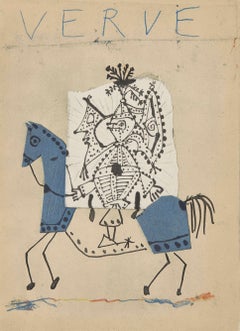
Pablo Picasso, The Blue Rider, from Verve, Revue Artistique, 1951 (after)
By Pablo Picasso
Located in Southampton, NY
This exquisite lithograph after Pablo Picasso (1881–1973), titled Le cavalier bleu (The Blue Rider), from Verve, Revue Artistique et Litteraire, Vol. VII, No. 25–26, originates from ...
Lithograph
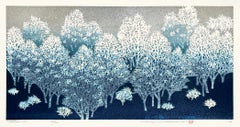
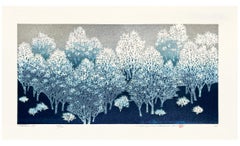
Winter Trees — Sōsaku Hanga Japanese Woodblock Print
Located in Myrtle Beach, SC
Hajime Namiki, 'Tree Scene 159', color woodcut, edition 200, 2022. Signed in pencil and with the artist’s red seal. Titled, numbered '37/200' and dated, in pencil. A very fine impres...
Woodcut
$1,500
H 24 in W 24 in
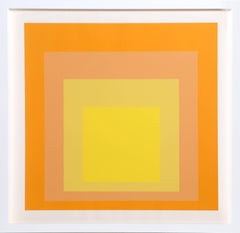
Interaction of Color: Homage to the Square, Abstract Screenprint by Josef Albers
By Josef Albers
Located in Long Island City, NY
This "Homage to the Square" print was created by Albers for the occasion of an exhibition at Grippi Gallery in Manhattan in 1973. It is in an excellent white contemporary frame. Art...
Screen

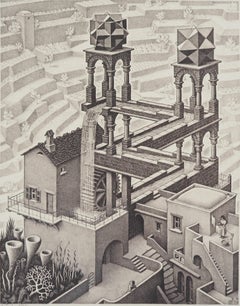
The Waterfall - Signed Facsimile, Ltd /450
By M.C. Escher
Located in Paris, IDF
M.C. ESCHER (1898-1972) The Waterfall, 2008 Facsimile after the original woodcut from 1935 Signed in the plate Numbered / 450 copies (the number you can see can be different) On vel...
Color
$98,695
H 12.6 in W 10.24 in D 0.04 in
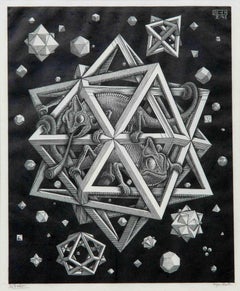
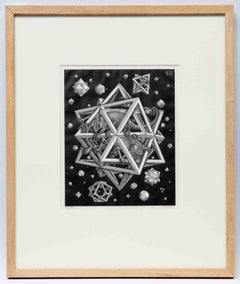
Stars/Sterren - Woodcut by Maurits Cornelis Escher - 1948
Located in Roma, IT
Woodcut print realized by Escher in 1948. Hand signed in pencil and annotated in pencil lower right "eigen druck". Monogrammed and dated in the plate "MCE/X-'48 upper right. One o...
Woodcut
Nothing is quite what it seems in the universe of Maurits Cornelis Escher (widely known as M.C. Escher). The Dutch artist, famed for his graphic prints featuring infinite staircases, twisted perspectives and self-replicating animals, was a master of illusion in more ways than one.
Escher's pictures aren’t simply puzzles designed to play tricks on the brain; they were born of a desire to stretch our powers of perception, to encourage us to cultivate a natural curiosity and playfulness about the world around us. According to New York gallerist Skot Foreman, the artist had a rare gift. “He combined the structure and analytics of the left brain with the artistic creativity of the right brain,” Foreman explains. “Somehow, he turned images into mind-bending universes that were able to stretch the boundaries of our imagination, urging us to rethink the realms of possibility within nature’s laws of order.”
But creating illusionistic illustrations was not Escher’s only talent. He was also a passionate diarist, recording his thoughts and frustrations in written form throughout his life. He often lamented that his pictures could never fully convey his cerebral imaginings. At the same time, he expressed impatience with those who couldn’t see beyond the surface appeal of his shape-shifting patterns. Escher was an artist who sought perfection and felt misunderstood by the mainstream art world.
“The most important thing about Escher is that he was always curious, always researching and exploring. Most people lose this quality as they get older, but Escher maintained a childlike enthusiasm for the world,” says Dutch filmmaker Robin Lutz, whose thoughtful feature-length film, M.C. Escher: Journey to Infinity, marries documentary footage with animation and unfolds at an unhurried pace, allowing Escher’s witty and intelligent prose to gently guide us through his creative evolution.
Escher always carried a magnifying glass in his pocket to “enjoy the tiniest details” at his feet, be it a plant climbing a rock, a butterfly or a grasshopper. He had a real passion for travel and spent more than a decade in Rome with his wife, Jetta, and young family. It was there that he first played with multiple perspectives, sketching the city’s architecture at night to avoid the “excessive baroque frills” he deemed too distracting in the daylight. Another big development was sparked by a 1936 visit to the Alhambra palace in Granada, Spain. Inspired by the Moorish tiles of the 14th-century landmark, Escher started to experiment with repeating patterns, or tessellations, creating his first woodcuts and lithographs of metamorphosing birds, lizards and fish interlocking and filling the entire surface of the paper in jigsaw fashion.
During and directly after World War II, Escher produced many of his most famous works, emotional reactions to a world plunged into chaos. This period marked the start of his fascination with impossible staircases, never-ending waterfalls and cyclical still lifes featuring figures and creatures seemingly caught in a loop, a paradox of entrapment and renewal.
Indeed, the concept of infinity was a major inspiration for him. It informs his fish-eye studies and curvilinear perspectives, which cram in so much dizzying detail it’s impossible to know where one thing ends and another begins. It’s no wonder, then, that Escher’s probing, mind-expanding prints have such enduring appeal.
Find original M.C. Escher art on 1stDibs.
The first decades of the 20th century were a period of artistic upheaval, with modern art movements including Cubism, Surrealism, Futurism and Dadaism questioning centuries of traditional views of what art should be. Using abstraction, experimental forms and interdisciplinary techniques, painters, sculptors, photographers, printmakers and performance artists all pushed the boundaries of creative expression.
Major exhibitions, like the 1913 Armory Show in New York City — also known as the “International Exhibition of Modern Art,” in which works like the radically angular Nude Descending a Staircase by Marcel Duchamp caused a sensation — challenged the perspective of viewers and critics and heralded the arrival of modern art in the United States. But the movement’s revolutionary spirit took shape in the 19th century.
The Industrial Revolution, which ushered in new technology and cultural conditions across the world, transformed art from something mostly commissioned by the wealthy or the church to work that responded to personal experiences. The Impressionist style emerged in 1860s France with artists like Claude Monet, Paul Cézanne and Edgar Degas quickly painting works that captured moments of light and urban life. Around the same time in England, the Pre-Raphaelites, like Edward Burne-Jones and Dante Gabriel Rossetti, borrowed from late medieval and early Renaissance art to imbue their art with symbolism and modern ideas of beauty.
Emerging from this disruption of the artistic status quo, modern art went further in rejecting conventions and embracing innovation. The bold legacy of leading modern artists Georges Braque, Pablo Picasso, Frida Kahlo, Salvador Dalí, Henri Matisse, Joan Miró, Marc Chagall, Piet Mondrian and many others continues to inform visual culture today.
Find a collection of modern paintings, sculptures, prints and other fine art on 1stDibs.
Decorating with fine art prints — whether they’re figurative prints, abstract prints or another variety — has always been a practical way of bringing a space to life as well as bringing works by an artist you love into your home.
Pursued in the 1960s and ’70s, largely by Pop artists drawn to its associations with mass production, advertising, packaging and seriality, as well as those challenging the primacy of the Abstract Expressionist brushstroke, printmaking was embraced in the 1980s by painters and conceptual artists ranging from David Salle and Elizabeth Murray to Adrian Piper and Sherrie Levine.
Printmaking is the transfer of an image from one surface to another. An artist takes a material like stone, metal, wood or wax, carves, incises, draws or otherwise marks it with an image, inks or paints it and then transfers the image to a piece of paper or other material.
Fine art prints are frequently confused with their more commercial counterparts. After all, our closest connection to the printed image is through mass-produced newspapers, magazines and books, and many people don’t realize that even though prints are editions, they start with an original image created by an artist with the intent of reproducing it in a small batch. Fine art prints are created in strictly limited editions — 20 or 30 or maybe 50 — and are always based on an image created specifically to be made into an edition.
Many people think of revered Dutch artist Rembrandt as a painter but may not know that he was a printmaker as well. His prints have been preserved in time along with the work of other celebrated printmakers such as Pablo Picasso, Salvador Dalí and Andy Warhol. These fine art prints are still highly sought after by collectors.
“It’s another tool in the artist’s toolbox, just like painting or sculpture or anything else that an artist uses in the service of mark making or expressing him- or herself,” says International Fine Print Dealers Association (IFPDA) vice president Betsy Senior, of New York’s Betsy Senior Fine Art, Inc.
Because artist’s editions tend to be more affordable and available than his or her unique works, they’re more accessible and can be a great opportunity to bring a variety of colors, textures and shapes into a space.
For tight corners, select small fine art prints as opposed to the oversized bold piece you’ll hang as a focal point in the dining area. But be careful not to choose something that is too big for your space. And feel free to lean into it if need be — not every work needs picture-hanging hooks. Leaning a larger fine art print against the wall behind a bookcase can add a stylish installation-type dynamic to your living room. (Read more about how to arrange wall art here.)
Find fine art prints for sale on 1stDibs today.