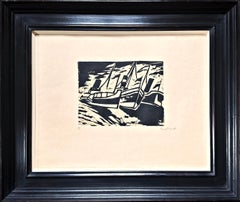
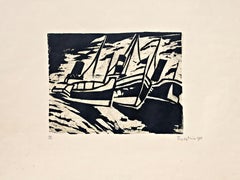
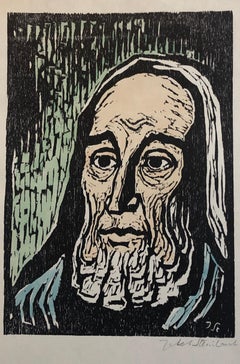
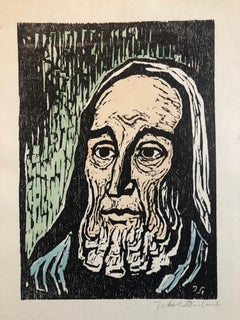
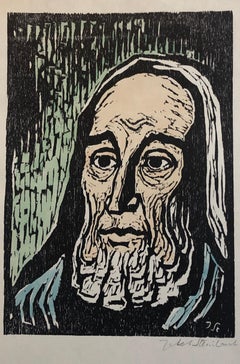
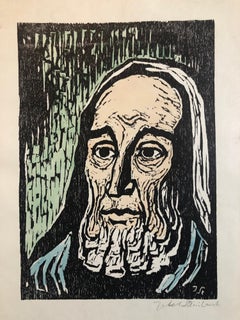
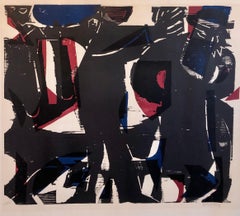
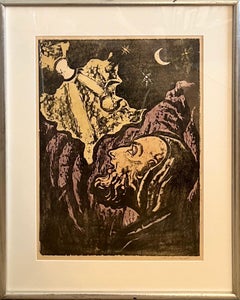
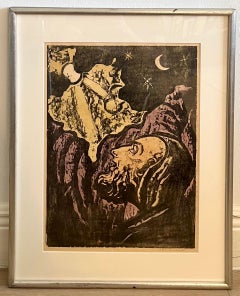
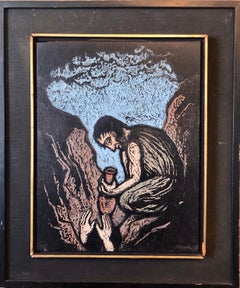
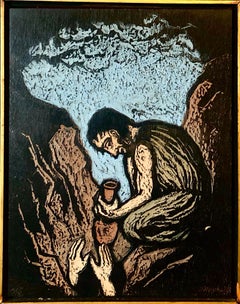
On 1stDibs, you can find the most appropriate german color woodcut for your needs in our varied inventory. You can easily find an example made in the
abstract style, while we also have 58
abstract versions to choose from as well. Finding the perfect german color woodcut may mean sifting through those created during different time periods — you can find an early version that dates to the 18th Century and a newer variation that were made as recently as the 21st Century. If you’re looking to add a german color woodcut to create new energy in an otherwise neutral space in your home, you can find a work on 1stDibs that features elements of
gray,
brown,
beige,
blue and more. There have been many interesting german color woodcut examples over the years, but those made by
(after) Henri Matisse,
Henri Matisse,
Lamar Briggs,
Katya Zvereva and
Jacob Pins are often thought to be among the most thought-provoking. Artworks like these of any era or style can make for thoughtful decor in any space, but a selection from our variety of those made in
woodcut print,
lithograph and
paint can add an especially memorable touch. A large german color woodcut can be an attractive addition to some spaces, while smaller examples are available — approximately spanning 5.75 high and 4 wide — and may be better suited to a more modest living area.
The price for an artwork of this kind can differ depending upon size, time period and other attributes — a german color woodcut in our inventory may begin at $83 and can go as high as $165,000, while the average can fetch as much as $1,428.
While “expressionist” is used to describe any art that avoids naturalism and instead employs a bold use of flattened forms and intense brushwork, Expressionist art formally describes early-20th-century work from Europe that drew on Symbolism and confronted issues such as urbanization and capitalism. Expressionist artists experimented in paintings and prints with skewed perspectives, abstraction and unconventional, bright colors to portray how isolating and anxious the world felt rather than how it appeared.
Between 1905 and 1920, Austrian and German artists, in particular, were inspired by Postimpressionists such as Paul Gauguin and Vincent van Gogh in their efforts to strive for a new authenticity in their work. In its geometric patterns and decorative details, Expressionist art was also marked by eclectic sources like German and Russian folk art as well as tribal art from Africa and Oceania, which the movement’s practitioners witnessed at museums and world’s fairs.
Groups of artists came together to share and promote the themes now associated with Expressionism, such as Die Brücke (The Bridge) in Dresden, which included Erich Heckel, Ernst Ludwig Kirchner and Karl Schmidt-Rottluff and investigated alienation and the dissolution of society in vivid color. In Munich, Der Blaue Reiter (The Blue Rider), a group led by Wassily Kandinsky and Franz Marc, instilled Expressionism with a search for spiritual truths. In his iconic painting The Scream, prolific Norwegian painter Edvard Munch conveyed emotional turmoil through his depiction of environmental elements, such as the threatening sky.
Expressionism shifted around the outbreak of World War I, with artists using more elements of the grotesque in reaction to the escalation of unrest and violence. Printmaking was especially popular, as it allowed artists to widely disseminate works that grappled with social and political issues amid this time of upheaval. Although the art movement ended with the rise of Nazi Germany, where Expressionist creators were labeled “degenerate,” the radical ideas of these artists would influence Neo-Expressionism that emerged in the late 1970s with painters like Jean-Michel Basquiat and Francesco Clemente.
Find a collection of authentic Expressionist paintings, sculptures, prints and more art on 1stDibs.
Decorating with fine art prints — whether they’re figurative prints, abstract prints or another variety — has always been a practical way of bringing a space to life as well as bringing works by an artist you love into your home.
Pursued in the 1960s and ’70s, largely by Pop artists drawn to its associations with mass production, advertising, packaging and seriality, as well as those challenging the primacy of the Abstract Expressionist brushstroke, printmaking was embraced in the 1980s by painters and conceptual artists ranging from David Salle and Elizabeth Murray to Adrian Piper and Sherrie Levine.
Printmaking is the transfer of an image from one surface to another. An artist takes a material like stone, metal, wood or wax, carves, incises, draws or otherwise marks it with an image, inks or paints it and then transfers the image to a piece of paper or other material.
Fine art prints are frequently confused with their more commercial counterparts. After all, our closest connection to the printed image is through mass-produced newspapers, magazines and books, and many people don’t realize that even though prints are editions, they start with an original image created by an artist with the intent of reproducing it in a small batch. Fine art prints are created in strictly limited editions — 20 or 30 or maybe 50 — and are always based on an image created specifically to be made into an edition.
Many people think of revered Dutch artist Rembrandt as a painter but may not know that he was a printmaker as well. His prints have been preserved in time along with the work of other celebrated printmakers such as Pablo Picasso, Salvador Dalí and Andy Warhol. These fine art prints are still highly sought after by collectors.
“It’s another tool in the artist’s toolbox, just like painting or sculpture or anything else that an artist uses in the service of mark making or expressing him- or herself,” says International Fine Print Dealers Association (IFPDA) vice president Betsy Senior, of New York’s Betsy Senior Fine Art, Inc.
Because artist’s editions tend to be more affordable and available than his or her unique works, they’re more accessible and can be a great opportunity to bring a variety of colors, textures and shapes into a space.
For tight corners, select small fine art prints as opposed to the oversized bold piece you’ll hang as a focal point in the dining area. But be careful not to choose something that is too big for your space. And feel free to lean into it if need be — not every work needs picture-hanging hooks. Leaning a larger fine art print against the wall behind a bookcase can add a stylish installation-type dynamic to your living room. (Read more about how to arrange wall art here.)
Find fine art prints for sale on 1stDibs today.