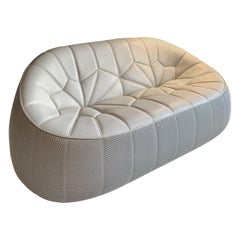
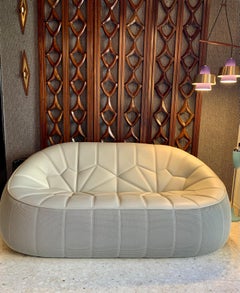
With enduring designs like the immensely plush, Pop art–inspired Togo lounge chair and sofa, Ligne Roset has become synonymous with radical luxury furniture. However, when Antoine Roset (1841–93) started the company in 1860 in the small French town of Oussiat, its focus was on wooden umbrella handles.
In 1892, Ligne Roset’s founder expanded with a property in Montagnieu where he set up a wood-processing factory, eventually expanding into manufacturing chairs. After his death, his wife, Marie-Victorine, took over before his son, Emile Roset, began leading the company in the 1910s.
It wasn’t until after World War II that Antoine’s grandson, Jean Roset, would recognize the need for furniture in settings like schools, hospitals and retirement homes and take inspiration from Scandinavian modern design for functional pieces made primarily from affordable beech.
Under Jean, Ligne Roset supplied quite a few European institutions with beautiful wood furnishings. In the 1970s, he shifted the company’s focus again, this time looking to domestic and residential markets. Around this time, Jean’s two sons, Pierre and Michel, joined the company.
Ligne Roset opened its first store in 1973 with one of the most popular collections being designer Michel Ducaroy’s Togo modular sofa and chairs — classics of contemporary French design that look like oversize bent pillows.
After the success of this initial designer collaboration, Ligne Roset brought on more guest designers over the following decades, including Didier Gomez, Pascal Mourgue, Peter Maly, Pierre Paulin, Inga Sempé and Ronan and Erwan Bouroullec. Paulin’s Elysée sofa and Pumpkin chair — designed in 1971 for Elysée Palace — are among the brand’s most popular pieces. In 1975, the company introduced its Cinna brand, known to collectors for the Sandra sofa designed by Annie Hiéronimus and other alluring seating.
Ligne Roset continues to be run by the Roset family who works on revolutionary furniture in partnership with a variety of collaborators. It has operated in Briord since 1973 where it produces its iconically sleek and innovative pieces.
Find new and vintage Ligne Roset sofas, lounge chairs, tables and other furniture on 1stDibs.
The late 19th and early 20th centuries saw sweeping social change and major scientific advances — both of which contributed to a new aesthetic: modernism. Rejecting the rigidity of Victorian artistic conventions, modernists sought a new means of expression. References to the natural world and ornate classical embellishments gave way to the sleek simplicity of the Machine Age. Architect Philip Johnson characterized the hallmarks of modernism as “machine-like simplicity, smoothness or surface [and] avoidance of ornament.”
Early practitioners of modernist design include the De Stijl (“The Style”) group, founded in the Netherlands in 1917, and the Bauhaus School, founded two years later in Germany.
Followers of both groups produced sleek, spare designs — many of which became icons of daily life in the 20th century. The modernists rejected both natural and historical references and relied primarily on industrial materials such as metal, glass, plywood, and, later, plastics. While Bauhaus principals Marcel Breuer and Ludwig Mies van der Rohe created furniture from mass-produced, chrome-plated steel, American visionaries like Charles and Ray Eames worked in materials as novel as molded plywood and fiberglass. Today, Breuer’s Wassily chair, Mies van der Rohe’s Barcelona chair — crafted with his romantic partner, designer Lilly Reich — and the Eames lounge chair are emblems of progressive design and vintage originals are prized cornerstones of collections.
It’s difficult to overstate the influence that modernism continues to wield over designers and architects — and equally difficult to overstate how revolutionary it was when it first appeared a century ago. But because modernist furniture designs are so simple, they can blend in seamlessly with just about any type of décor. Don’t overlook them.
Antique and vintage loveseats are functional and totally charming furniture in homes large and small these days. They first appeared in the 17th and 18th centuries, though they were not yet known by this endearing term.
These petite, two-seat sofas were originally intended to comfortably sit a woman clad in what were the era’s large and elaborate dresses — ornate hooped garments with copious folds of fabric, embroidery and lace. However, because the original seats featured just enough space for two, they quickly became popular for couples that were courting. Loveseats meant that the couples could engage in close conversation, but furniture makers ensured that there was enough space between sitters to prioritize modesty.
In the early days of loveseats, the furnishings were minimalist in appearance and could often be found in an s-shape, with the two sides facing each other. The spare seating was initially little more than a wooden bench, as loveseats weren’t yet upholstered or cushioned. Design of the seating evolved over time, and this wide chair was eventually padded and tufted for comfort. During the 1800s, loveseats were a luxurious addition to the homes of the wealthy, and even today, antique 19th-century loveseats are still quite alluring. In any lavishly decorated parlor of the Victorian era, you might find a pair of partygoers tucked into a particularly plush iteration of these cozy perches, one boasting arched crests of carved mahogany over its sculpted seats, with front cabriole legs resolving in paw feet.
In modern homes, loveseats — even antique Victorian loveseats — pair well with oversize sofas or are ideal replacements for sofas, particularly if you’re working on organizing and furnishing a smaller space. A loveseat is a stylish addition to a home library or a reading nook and can easily be situated at the foot of the bed in your bedroom. In the living room, you may wish to position your vintage loveseat and couch around a central focal point, such as a distinguishing architectural feature or a fireplace. But be sure to leave some walking room between your seating and any nearby coffee tables or side tables. Allow for around two feet for guests to pass between a couch and chair or loveseat and at least a foot between a loveseat and coffee table.
Find a wide variety of antique, new and vintage loveseats today on 1stDibs.