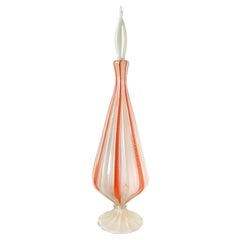
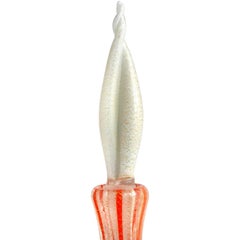
Not only did Salviati support the revival of Venice’s flagging Murano glass industry in the 19th century, but the company also became world-renowned for its innovative glassmaking techniques, revolutionizing the art of mosaics and glassware design.
The story of Salviati glass begins with Vicenza-born lawyer and entrepreneur Antonio Salviati. His love of Murano glass art and mosaics inspired him to establish his own mosaic and glass manufacturing firm, the Salviati Dott. Antonio fu Bartolomeo company, in Venice in 1859. Glassmakers in the region had been weathering a dismal political climate and growing competition in neighboring countries, and Salviati had initially hoped to revive Murano glassmaking in order to restore deteriorating mosaics in local cathedrals.
In 1864, Salviati exhibited a monumental glass mosaic at the “First Glassmakers’ Exhibition,” which won the gold medal. His award-winning mosaic solidified his company’s reputation as a first-rate glassmaker, which soon drew the attention of international investors, particularly investors from Great Britain.
In 1866, Salviati and C. opened in London with the support of historian William Drake and diplomat Sir Austen Henry Layard. Meanwhile, the Salviati company established its headquarters on the Rio dei Vetrai in Murano.
Throughout the late 1800s, Salviati and C. expanded its production to include household glassware and serveware and decorative objects such as cups, glasses, amphoras and vials. Salviati also received commissions to produce mosaics for St Paul’s Cathedral and the Houses of Parliament in London, the Paris Opera House and the Viceroy of Egypt’s Palace in Alexandria.
After Antonio Salviati died in 1890, his sons Giulio and Silvio took over the company. The Barovier family — a dynasty that stretches as far back as 1295 — bought the manufacturer in 1883, and a glass master named Maurizio Camerino, who had honed his skills at Salviati, was appointed to lead the company. Camerino’s children took the reins following the glass master’s death in 1931 and launched a successful lighting line of table lamps and chandeliers after World War II.
Throughout the 20th century, Salviati participated in several Venice Biennale exhibitions from 1958 to 1972. In 1962, the company was awarded the Compasso d’Oro prize for the Marco vase, designed by architect Sergio Asti.
Since its acquisition by the Umana group in 2015, Salviati has collaborated with numerous renowned designers such as Federico Peri, Davide Bruno, Renzo Stellon, Alberto Lago and Anna Gili. Salviati's pieces can be found in the collections of the Museum August Kestner in Hanover, Germany, the Museum of Modern Art and Corning Museum of Glass in New York, the Eretz Museum in Tel Aviv, Israel, and the Murano Glass Museum in Venice.
Find antique Salviati glass that includes bowls, vases, lighting and more.
Vintage Space Age furniture captured post–World War II optimism with swooping shapes, bowed lines and experimentation with new materials including plastic and fiberglass.
From the launch of the Sputnik 1 satellite in 1957 to the landing of Apollo 11 astronauts on the moon in 1969, the space race between the Soviet Union and the United States propelled advancements in technology that transformed culture. Space Age design encompassed fashion, architecture, cars, furniture and objects for the home, bringing wonder and hope for the future into everyday life.
Coinciding with Pop art, Space Age style featured bold colors and forms. Eero Aarnio’s Ball chair, which debuted in 1966, used molded fiberglass for a capsule-like space while Verner Panton’s 1959 Panton chair was a single piece of molded plastic for a gravity-defying S shape. Red versions of Olivier Mourgue’s 1964 Djinn chair were futuristic enough to appear on the space station in Stanley Kubrick’s 1968 film 2001: A Space Odyssey. Today, Joe Colombo is revered as a master of modern Italian design thanks to the provocative modular furniture pieces he created, such as the Tube chair and the Elda armchair, both of which embody the future-forward spirit of the Space Age.
The Space Age spirit extended to home building too. The futuristic Case Study Houses, which were designed by the likes of Pierre Koenig, Charles and Ray Eames, Richard Neutra and Whitney R. Smith, are considered a high point of modernism and the Southern California lifestyle.
Sometimes the nods to space exploration were more literal, like moon and star motifs or the 1965 Eclisse lamp by Vico Magistretti that saw the mid-century Italian designer integrating a movable inner shade to “eclipse” the light source. Alongside the pioneering moon missions, JVC manufactured the Videosphere portable television reminiscent of the Apollo 11 space helmets.
Although the style faded in the 1970s — with the 1975 joining of the Apollo and Soyuz spacecrafts signaling a new era of cooperation and the global oil crisis impacting the availability of plastics — the era’s innovations influenced designers into the 21st century such as Zaha Hadid and Djivan Schapira.
Find a collection of vintage Space Age seating, tables, lighting and other furniture on 1stDibs.
Over time, many different styles of vintage, new and antique bottles have found second lives as coveted decorative objects in pristine display cases all over the world. Originally, these bottles may have been decanters and flasks for spirits and liqueurs, medicine and perfume bottles or functional vases for fresh floral arrangements.
We know that glass can be a radical art form. So your vintage art glass or Art Deco pieces will stand on their own to be admired by all alongside your other treasured collectibles in your living room or dining room. But maybe you’re thinking about decorating elsewhere in your home with the other types of glass bottles that you’ve picked up over the years.
There are many corners of your space that can be brightened by an arrangement of bottles of various sizes, shapes and colors. Spruce up your kitchen, bedroom, craft room or art studio by lining the window sill with an array of glass bottles. In this case, you’ll want to use glass bottles instead of ceramic or metal, as transparent material in the sunlight — particularly colored bottles — will introduce energy and pops of color to adjacent walls and surfaces.
Grouping short, tall, thin and wide bottles — some with flowers, some without — on a tabletop, buffet or desk in your home office can bring a much-needed dynamic as a centerpiece or merely dress up a workspace.
On 1stDibs, find a collection of vintage, new and antique glass bottles that includes mid-century modern bottles, Murano glass and more.