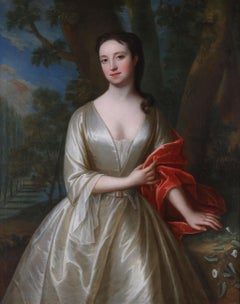
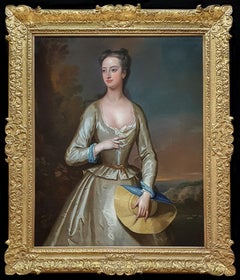
Charles Jervas Art

Irish, 1670-1739
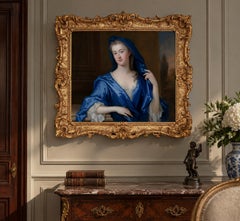
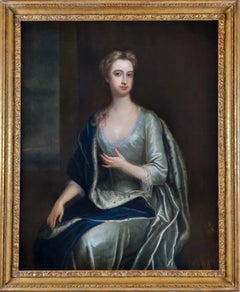
Charles Jervas was born in Dublin in 1675 who later lived in England. After moving to England, Jervas became an apprentice to the painter Sir Godfrey Kneller. He later studied drawing in Rome and then returned (c. 1709) to England. Succeeding Kneller, he became court painter to the English kings George I and George II. His home became a centre for literary figures, among them Alexander Pope and Jonathan Swift, whose portraits Jervas painted, in addition to that of George II (1728). He produced a translation of Miguel de Cervantes’s Don Quixote (published posthumously, with his surname spelled Jarvis, in 1742).
to
1
Overall Width
to
Overall Height
to
1
1
1
1
1
1
1
1
1
1
1
1
10,908
2,844
2,494
1,423
1
1
Artist: Charles Jervas
Related Items
Madonna and child, Italian school, 18th century

Madonna and child, Italian school, 18th century

Located in DEVENTER, NL

Italian School, 18th century Depicted are the Madonna and Child Jesus, the virgin Mary is holding the Child Jesus lovingly in her arms. The child, lying on a bundle of cloth and with...

Category

18th Century Charles Jervas Art

Materials

Canvas, Oil

Pair of 19th C. American Oval Portraits

Pair of 19th C. American Oval Portraits

$2,450

H 21.5 in Dm 26.5 in

Pair of 19th C. American Oval Portraits

Located in San Francisco, CA

Pair of 19th century American oval portraits of a couple, possibly husband & wife Oil on canvas 21.5 x 26.5

Category

19th Century Charles Jervas Art

Materials

Canvas, Oil

Fine 17th Century English Old Master Oil Painting Portrait Aristocratic Lady

Fine 17th Century English Old Master Oil Painting Portrait Aristocratic Lady

Located in Cirencester, Gloucestershire

Portrait of a Young English Aristocratic Lady English, circa 1670's period, unsigned oil on canvas laid on board, unframed canvas: 30 x 25 inches Provenance: private collection, UK C...

Category

Mid-17th Century Old Masters Charles Jervas Art

Materials

Oil, Canvas

Portrait of marquise de Flavacourt, mistress of Louis XV of France, 18th c. 1740

Portrait of marquise de Flavacourt, mistress of Louis XV of France, 18th c. 1740

By Jean-Marc Nattier

Located in PARIS, FR

Portrait of Hortense-Félicité de Mailly-Nesle, Marquise de Flavacourt (1715-1799) Studio of Jean-Marc Nattier (Paris, 1685 - 1766), no visible signature Mid-18th century French Schoo...

Category

Mid-18th Century Old Masters Charles Jervas Art

Materials

Canvas, Oil

Portrait of a Boy - Oil on Canvas by Anastasia Kurakina - 2010s

Portrait of a Boy - Oil on Canvas by Anastasia Kurakina - 2010s

By Anastasia Kurakina

Located in Roma, IT

Portrait of a boy is an original contemporary artwork, realized in 2010s by the emerging artist Anastasia Kurakina. Mixed colored oil painting on canvas. Good conditions Not signed.

Category

2010s Contemporary Charles Jervas Art

Materials

Canvas, Oil

Rabbi with Torah, Framed Oil Painting Portrait by Abraham Straski

Rabbi with Torah, Framed Oil Painting Portrait by Abraham Straski

By Abraham Straski

Located in Long Island City, NY

Artist: Abraham Straski, Polish (1903 - 1987) Title: Rabbi with Torah (15-F) Year: circa 1957 Medium: Oil on Canvas, signed l.r. Image Size: 16 x 12 inches Frame Size: 26 x 20 inches

Category

1950s Post-War Charles Jervas Art

Materials

Canvas, Oil

“The Horse Race" #50 A Pierre Bosco (Italy/France, 1909-1993) circa 1950s

“The Horse Race" #50 A Pierre Bosco (Italy/France, 1909-1993) circa 1950s

By Pierre Bosco

Located in SANTA FE, NM

“The Horse Race" #50 A Pierre Bosco, (1909-1993) Oil n canvas Signed lower right 12 x 15 inches “The savage art of Bosco bears its rudeness and its mystery. It is an art of pure ex...

Category

1960s Expressionist Charles Jervas Art

Materials

Canvas, Oil

Rock Me Baby  Oil 14 x 20 Framed  Water Movement  Figurative Portraiture

Rock Me Baby Oil 14 x 20 Framed Water Movement Figurative Portraiture

Located in Houston, TX

LOOK FOR FREE SHIPPING AT CHECKOUT Rock Me is a 14 x 20 figurative oil painting by E. Melinda Morrison. It was painted in 2019. Rock Me shows the movement of the water rocking the ...

Category

2010s Impressionist Charles Jervas Art

Materials

Canvas, Oil, Egg Tempera, Panel

Portrait of a Young Man Oil Painting Celebrated 20th Century Artist

Portrait of a Young Man Oil Painting Celebrated 20th Century Artist

By Oliver Messel

Located in London, GB

Oliver Messel 1904 - 1978 Portrait of a Young Man Oil on canvas, signed and dated 'Oliver Messel 1930' (on the stretcher) Image size: 30 x 25 inches (76.2 x 63.4 cm) Original frame Oliver Messel was born to Leonard and Maud Messel, née Sambourne, on the 13 January 1904 and was the youngest of three children. The family moved to Nymans, the Messel family home in Sussex, from nearby Balcombe in 1915. The house remained in the family until 1953 when it was bequeathed to the National Trust, following a fire in 1947 which destroyed a large portion of the house. The Messels originated from a line of German Jewish bankers on Leonard’s side, however, both family lines boast a number of artistic influences, including Maud’s father. Maud was brought up at 18 Stafford Terrace, Kensington (now known as the Linley Sambourne House Museum), amongst collections of antique porcelain and eighteenth-century furniture, and with a host of artistic visitors such as Henry Irving and Oscar Wilde. Oliver’s own upbringing appears to be influenced by his mother's, as the Messel family were also affiliated with artists and writers and were keen collectors of art, filling their home with textiles, paintings and collections of European and Asian fans from travels abroad. It was amongst such treasures that Oliver, Anne and Linley spent their childhood, in addition to the beauty of Nyman’s extensive gardens. Oliver was schooled at Eton but rather than going up to university was encouraged by family friends, gallery owner Archie Propert and painter and sculptor Glyn Philpot, to attend art school. In 1922 he enrolled at the Slade School of Fine Art in London, where he studied under Henry Tonks. Here, he met the artist Rex Whistler with whom he remained firm friends until Whistler’s death in WW2. Upon leaving the Slade in 1924 Oliver was apprenticed to the studio of portrait artist John Wells, where he learnt various Old Master painting techniques, and met artists such as Jacob Epstein, Augustus John and William Orpen. Whilst at the Slade Oliver developed his interest in Papier Mâché masks, a pastime popular amongst many art students at the time. Whilst apprenticed to artist John Wells several of Oliver’s masks were exhibited at the Claridge Gallery, London, alongside pieces by Whistler and other young artists. These were seen by Serge Diaghilev, director of the Ballet Russes, and Charles B. Cochran, a theatrical producer, both of whom made Oliver offers of work. His first job in the theatre was creating masks for the Ballets Russes’ Zéphyr et Flore, 1925, designed by the French artist Georges Braque, followed by numerous musical revues for Cochran, including Wake Up and Dream!, 1929, with music by Cole Porter. It was during these revues, working with Porter and Noel Coward, that Oliver also began to design headdresses and costumes. In 1932 he was rewarded with his first full commission to design both costume and sets for Helen!, directed by Max Reinhardt. The production design is still celebrated today for its innovative approach and ground-breaking ‘white on white’ aesthetic, which referenced ‘Greek temples, Rococo drapes, Baroque colonnades and Louis XIV carousels’. The success of Helen! led to further offers within the theatre including Reinhardt’s version of A Midsummer Night’s Dream at the Old Vic in 1937, starring Vivien Leigh as Titania and Robert Helpmann as Oberon, the Jean Cocteau play The Infernal Machine in 1940, and Christopher Fry’s translation of Jean Anouilh’s Ring Round the Moon, 1950. One of Oliver’s best-known productions during this period was the Russian ballet The Sleeping Beauty, performed by Sadler’s Wells Ballet in 1946 at the Royal Opera House, Covent Garden. Encompassing over 200 costumes and four set changes, Oliver’s romantic designs were celebrated for bringing colour back to post-war London, and variations on his designs are still used today. Additional designs for the ballet included Comus in 1940, for which he was released from war duties, and Homage to the Queen, choreographed by Frederick Ashton and performed in 1953 for the Queen’s coronation. His first opera was in 1940 for Mozart’s Die Zauberflöte at the Royal Opera House, followed by a series of productions at the newly founded Glyndebourne Opera House in Sussex, for which Oliver also designed the proscenium arch. He triumphed in 1956 designing a season of four different productions for their Mozart bicentennial, also providing illustrations for the programme covers. His popularity also spread beyond theatre to film, were he worked on over eight different feature films including Romeo and Juliet, 1936, directed by George Cukor. During a three-month research trip to Italy Oliver collected over 3,000 reference images including postcards of artwork by Piero della Francesca, Giovanni Bellini and Leonardo da Vinci, along with prints and photographs of textiles and architectural features. A production of Gabriel Pascal’s Caesar and Cleopatra, 1946, starring Vivien Leigh and Claude Rains, was celebrated for Oliver’s ability to recreate the opulence and luxury of ancient Egypt under the constraints of wartime rationing. Such was his skill that Vivien Leigh in a letter to Oliver declared that “I have of course told Pascal that nobody in the world must do the costumes except you.” He was later nominated for an Academy Award for his work on his final film Suddenly, Last Summer, 1959; an adaptation of Tennessee Williams’ American Southern Gothic mystery. Having started his artistic career as a portrait apprentice, capturing the faces of family and friends, Oliver continued to develop this practice until the end of his life.  His style is said to have been influenced by Glyn Philpot, the Messel’s family friend who encouraged Oliver from an early age in his pursuit of art and design. His most prolific period came in the 1950s during which he produced over 50 portraits, which were shown in exhibitions in New York, London and Barbados. The exhibitions included both well-known faces and anonymous sitters captured on Oliver’s travels, and a number of these works have entered private collections. He continued to paint after moving to the Caribbean in 1966, capturing society figures and the rich and famous including fashion designer Carolina Herrera and Bianca Jagger. His style remained unchanged throughout his career, using the same soft painterly strokes and subtle palette as in his theatre designs. By far his greatest contribution in addition to theatre and film was Oliver’s interior and architectural designs. Another, much celebrated commission included Rayne shoe shop in Old Bond Street, where he created jewel-like interiors using the same practice of scaled models as his set designs. Other notable interior designs include those for Norwich and Bath Assembly Rooms, Flaxley Abbey in Gloucestershire, Rosehill Theatre in Cumbria and the Reader’s Digest offices in Paris. However, upon moving to Barbados in 1966, Oliver embraced a new career envisioning architectural concepts for private houses, hotels and public buildings, utilising his experience with interior design to furnish them with bespoke items of furniture and textiles. His first project was Maddox, the deserted eighteenth-century plantation house bought by himself and his partner Vagn Riis-Hansen in 1964. The existing building and gardens were remodelled to Oliver’s designs embracing an inherent theatricality with views out to sea. These were framed by terraces and verandas which extended out from the living rooms creating what is often referred to as a Caribbean style of ‘indoor-outdoor’ living. For the woodwork he used a shade of green that is now known as ‘Messel green’ and often associated with the island of Barbados. Oliver was born into a wealthy family; he travelled extensively and was exposed to art and culture from a young age. A privileged youth, his name is often mentioned amongst the ‘Bright Young Things’, for whom costume parties at country houses and jaunts to Europe on a whim became a thing of fable. This informal group included people such as Cecil Beaton (a life-long friend whom Oliver first met at Eton), Lord Berners, Noel Coward, John Betjeman, Harold Acton, Nancy Mitford, Edith Sitwell, Stephen Tennant...

Category

20th Century Modern Charles Jervas Art

Materials

Canvas, Oil

Fine 1840's Portrait of a Bearded Man in a Fez Hat large Oil Painting on Canvas

Fine 1840's Portrait of a Bearded Man in a Fez Hat large Oil Painting on Canvas

Located in Cirencester, Gloucestershire

Circle of William James Muller (British, 1812-1845) Portrait of a Bearded man in a Fez Oil on canvas, unframed unsigned Dimensions: (Unframed) 31.5 in. (H) x 21.75 in. (W) Conditio...

Category

Early 19th Century Old Masters Charles Jervas Art

Materials

Canvas, Oil

Portrait of a Lady, Early 20th Century Oil

Portrait of a Lady, Early 20th Century Oil

By Arthur Ambrose McEvoy

Located in London, GB

Follower of Ambrose McEvoy (unsigned) Circa 1910 Portrait of a Lady Oil on canvas Image size: 20 x 16 inches (51 x 40.5 cm) Original ebonised Frame A stunning portrait of a lady ...

Category

Early 20th Century Charles Jervas Art

Materials

Canvas, Oil

"Lady in the mirror"

"Lady in the mirror"

Located in Edinburgh, GB

Luigi Sorio (1835-1909) – "Lady in the Mirror" Medium: Oil on canvas Dimensions (Framed): 109 x 84 cm Dimensions (Flat): 84 x 60 cm Signature: Lower left corner Frame: Ornate gil...

Category

19th Century Realist Charles Jervas Art

Materials

Canvas, Oil

Previously Available Items
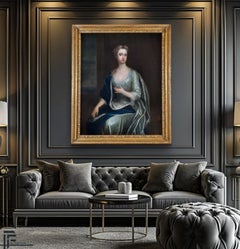
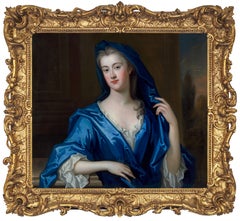
Portrait of Frances, Viscountess Scudamore in a Silver Dress & Blue Cloak

Portrait of Frances, Viscountess Scudamore in a Silver Dress & Blue Cloak

By Charles Jervas

Located in London, GB

Portrait of Frances, Viscountess Scudamore in a Silver Dress and Blue Cloak c.1709-1719 By Charles Jervas (1675-1739) This elegant and graceful portrait, presented by Titan Fine Ar...

Category

18th Century Old Masters Charles Jervas Art

Materials

Canvas, Oil

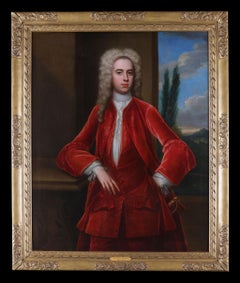
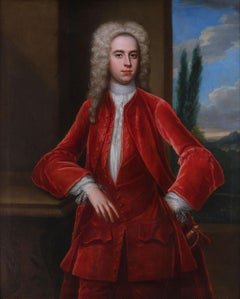
Portrait of a Man possibly Arthur Viscount Irwin, Temple Newsam Oil on canvas

Portrait of a Man possibly Arthur Viscount Irwin, Temple Newsam Oil on canvas

By Charles Jervas

Located in St. Albans, GB

Charles Jervas Possibly Arthur, 6th Viscount Irwin (Temple Newsam) Oil on Canvas Picture Size: 50 x 40" Outside Frame Size: 58 x 48" 1675 – 1739 Charles Jervas, who was born in Cl...

Category

Early 1700s English School Charles Jervas Art

Materials

Oil

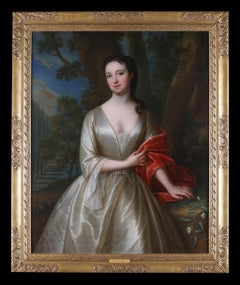
Portrait of a Lady possibly Frances Thynne, Lady Worsley 1673-1750 Oil on canvas

Portrait of a Lady possibly Frances Thynne, Lady Worsley 1673-1750 Oil on canvas

By Charles Jervas

Located in St. Albans, GB

Charles Jervas Possibly Frances Thynne, Lady Worsley 1673-1750 Oil on Canvas Picture Size: 50 x 40" Outside Frame Size: 58 x 48" 1675 – 1739 Charles Jervas, who was born in Clonli...

Category

Early 1700s English School Charles Jervas Art

Materials

Oil

Portrait of Hannah Clements as a Shepherdess c.1730; by Charles Jervas

Portrait of Hannah Clements as a Shepherdess c.1730; by Charles Jervas

By Charles Jervas

Located in London, GB

This elegant and graceful portrait is said to represent Hannah Clements (1710-1781) nee Gore. Painted by Charles Jervas - who was in 1723 appointed to the post of King’s Painter by George I and in 1725 to George II - it is one of his finest and most impressive examples. Jervas was considered the supreme practitioner of female portraiture in the 1720s and 1730s, and was the foremost successor to Sir Godfrey Kneller after the latter's death in 1723. Presented in an outstanding carved and gilded antique frame, a remarkable work of art in itself. The sitter is captured in a moment of relaxation in a country landscape. Jervas continued the idiom of Sir Godfrey Kneller, his master, whilst introducing a new ease and suggestion of informality into his portraits. By depicting the sitter within the landscape with sheep Arcadian simplicity is being suggested. This draws from the tradition of pastoral literature and by the early 17th century was already popular in art; all educated individuals were familiar with Latin and Greek pastoral poetry. The mythological world of Arcady was an idyll that the ladies and gentlemen of the Court could inhabit in the guise of shepherds and shepherdesses. The pastoral tradition in literature and plays had been embraced by an aristocratic class since classical times. Life in the country was perceived as peaceful, contemplative and free of worry of hardships, a time to pursue pleasure. To be painted in such a manner created a tangible expression of power and wealth. When the portrait was painted the pastoral was so ingrained that the mere inclusion of such elements suggested Arcadia to the viewer. And this is further emphasised by painting the light to reflect sunset and the suggestion of tranquillity. Of course, the sitter did not live in such a place and this masterful painting was a flight from chaos to a tranquil world. Hannah Catherine Clements (nee Gore) (1710-1781) was the daughter of Rev. William Gore (and granddaughter of Sir William Gore, 3rd Baronet), and Honora Prittie. She married Nathaniel Clements (1705-1777), an important Irish politician and financial figure, in January 1730. Nathaniel became the main financial manager of the British and Irish Government in Ireland during the period, and was de facto Minister for Finance from 1740 to 1777. He had an extensive property portfolio, including Abbotstown, County Dublin, estates in County Leitrim and County Cavan and was developer of property in Dublin, including part of Henrietta Street where he lived at No. 7 from 1734 to 1757 in what was described as “Parisian luxury”. The couple had six children. Charles Jervas was born in Clonliske in Kings Country, Ireland in 1675. He received his artistic training in Kneller’s studio and was later, by the 1690’s, Kneller’s assistant. According to Vertue Jervas made small copies of the Raphael cartoons, then at Hampton Court, in about 1698 and sold them to Dr George Clarke of All Souls, Oxford who lent him £50 to embark on the then essential ‘grand tour’ in 1699. Taking in Paris and settling in Rome by 1703, he furthered his artistic training and became a voracious copyist of the old masters. George Vertue noted that he was known as “Carlo Jervasi” and was a “good, engenious painter”. On his return to London in 1709 Tatler (15th April 1709) remarked that he was 'the last great painter Italy has sent us' and noted that he “painted many ladies as shepherdesses and country girls”. The style that he cultivated made him Kneller's natural successor when that artist died in 1723. In 1727 he married a widow, Penelope Hume, a lady of considerable means (£20,000). In September 1738 he travelled to Italy seeking some reprieve from his asthma, returning in May 1739. He died in November that year and bequeathed £1000 to his friend, Pope, should he outlive his widow: this did not happen as she survived until 1747. The following spring his considerable art collection was sold in 2265 lots in a sale lasting 9 days. Apart from royalty Jervas gained the patronage of many of the ruling and intellectual elite. He moved in the highest circles of the literary and social world and became an intimate of Sir Robert Walpole and the poet Alexander Pope, to whom he gave drawing lessons. Jervas’ portrait of Elizabeth Felton, of Playford, Later Countess of Bristol (1677-1741) realised £45,410 at Christies London 11th June 2002, lot 13. His portrait of Lady Barbara North realised £42,050 at Christies London 11th July 2008, lot 55. Titan Fine Art are pleased to offer this work, which is representative of the artist’s best work. Provenance: Private collection, Beal House...

Category

18th Century Old Masters Charles Jervas Art
Materials

Canvas, Oil

Charles Jervas art for sale on 1stDibs.

Find a wide variety of authentic Charles Jervas art available for sale on 1stDibs. You can also browse by medium to find art by Charles Jervas in canvas, fabric, oil paint and more. Much of the original work by this artist or collective was created during the 18th century and is mostly associated with the Old Masters style. Not every interior allows for large Charles Jervas art, so small editions measuring 41 inches across are available. Customers who are interested in this artist might also find the work of Studio of Sir Peter Lely, Flemish School, 17th Century, and Sir Godfrey Kneller. Charles Jervas art prices can differ depending upon medium, time period and other attributes. On 1stDibs, the price for these items starts at $19,172 and tops out at $19,172, while the average work can sell for $19,172.

Artists Similar to Charles Jervas