Leonard Wells Volk Art

American, 1828-1895

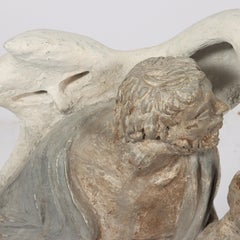
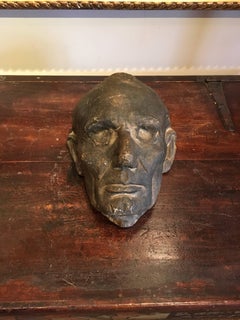
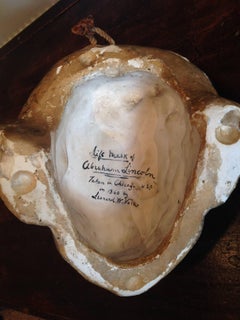
Leonard Wells Volk was a famous American sculptor. He made several large monumental sculptures, including the tomb of the politician Stephen A. Douglas, and statues of American Civil War figures. From 1855–57, Stephen A. Douglas, his wife's cousin, supported the family's travel to Rome so that Volk could pursue additional study. Returning to the United States in 1857, Volk and his family settled in the booming city of Chicago, where he helped to establish the Chicago Academy of Design in 1867 and served as its president until 1878. The Chicago Academy of Design was a precursor to the School of the Art Institute of Chicago. For eight years, he served as its director and taught numerous students, including Elbridge Ayer Burbank, who became noted for his more than 1200 portraits of Native Americans. In 1860, Volk made one of the only two life masks of the United States President, Abraham Lincoln after which, he went to posterity. In the early part of spring 1860, during Lincoln's visit to Chicago, Volk asked him to sit for a bust. He decided to start by doing a life mask to eliminate the need for several sittings. Lincoln found the process of letting wet plaster dry on his face, followed by a skin-stretching removal process, anything but agreeable. But he maintained good humor and was pleased with the final bust. He declared it the animal himself. Volk later used the life mask and bust of 1860 as the basis for other versions of Lincoln, including a full-size statue. The life mask was also studied by other artists, such as Daniel Chester French.

to
1
Overall Width
to
Overall Height
to
1
1
1
1
1
1
1
1
10,138
2,779
1,375
1,368
1
Artist: Leonard Wells Volk
Life Mask of Abraham Lincoln
By Leonard Wells Volk
Located in London, GB
Leonard Wells Volk was a famous American sculptor. He went to posterity after making one of only two life masks of United States President Abraham Lincoln. I...
Category

1860s Victorian Leonard Wells Volk Art

Materials

Plaster
Related Items
FREN AND CHIE: The Badass Gangstar Couple Of South Of France.
By Mauro Oliveira
Located in LOS ANGELES, CA
**STORE CLOSURE - UP TO 80% OFF - TAKE ADVANTAGE OF IT** ***EVERYTHING MUST GO BY DECEMBER 31ST!*** ***The artist is moving on to a new full time venture in 2026**...
Category

21st Century and Contemporary Pop Art Leonard Wells Volk Art

Materials

Metal

"Pioneer Family" WPA American Modernism Plaster Maquette Realism 20th Century
By William Zorach
Located in New York, NY
"Pioneer Family," 23 1/2 x 16 1/4 x 10 3/4 inPlaster. c. 1927. Unsigned. Realism The Smithsonian has a cast of this sculpture in its collection. Pictured on the cover of “The Sculpt...
Category

1920s American Modern Leonard Wells Volk Art

Materials

Plaster
Finely rendered Equestrian Model Sculpture
Located in Greenwich, CT
a very fine Model Sculpture of a standing horse , finely rendered in patinated plaster, signed ‘MMM’ and dated 30 , w. rich burnished patina. Its quality and elegance are reminiscent...
Category

Early 20th Century Leonard Wells Volk Art

Materials

Plaster
Finely rendered Equestrian Model Sculpture
$3,400
H 8.25 in W 11.25 in D 3 in
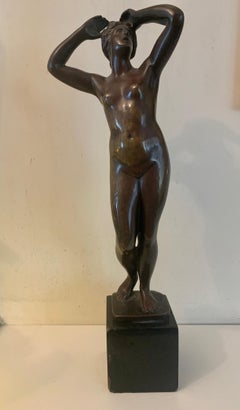
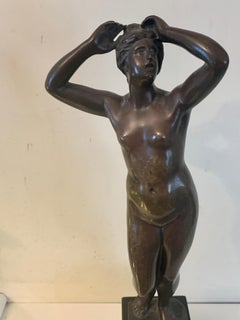
19th century French Bronze of a naked woman standing up.
Located in Woodbury, CT
Well modeled 19th century French bronze of a standing naked woman. Signed Cartinet, this piece is a wonderful example of the skill of a Sculptor. The piece retains all its origina...
Category

1890s Victorian Leonard Wells Volk Art

Materials

Bronze

Relining Nude (WG6)
By Waylande Gregory
Located in Wilton Manors, FL
Waylande Gregory (1905-1971). Nude Reclining, ca. 1950's. Painted composite cast from original sculpted in 1930's. Casting sanctioned and approved by the artist during his lifetime in partnership with MPI, Museum Pieces Incorporated. Very few examples were produced and even fewer survive. Waylande Gregory was considered a major American sculptor during the 1930's, although he worked in ceramics, rather than in the more traditional bronze or marble. Exhibiting his ceramic works at such significant American venues for sculpture as the Whitney Museum of American Art in New York City and at the venerable Pennsylvania Academy of the Fine Arts in Philadelphia, he also showed his ceramic sculptures at leading New York City galleries. Gregory was the first modern ceramist to create large scale ceramic sculptures, some measuring more than 70 inches in height. Similar to the technique developed by the ancient Etruscans, he fired his monumental ceramic sculptures only once. Gregory was born in 1905 in Baxter Springs, Kansas and was something of a prodigy. Growing up on a ranch near a Cherokee reservation, Gregory first became interested in ceramics as a child during a native American burial that he had witnessed. He was also musically inclined. In fact, his mother had been a concert pianist and had given her son lessons. At eleven, he was enrolled as a student at the Kansas State Teacher's College, where he studied carpentry and crafts, including ceramics. Gregory's early development as a sculptor was shaped by the encouragement and instruction of Lorado Taft, who was considered both a major American sculptor as well as a leading American sculpture instructor. In fact, Taft's earlier students included such significant sculptors as Bessie Potter Vonnoh and Janet Scudder. But, Taft and his students had primarily worked in bronze or stone, not in clay; and, Gregory's earliest sculptural works were also not in ceramics. In 1924, Gregory moved to Chicago where he caught the attention of Taft. Gregory was invited by Taft to study with him privately for 18 months and to live and work with him at his famed "Midway Studios." The elegant studio was a complex of 13 rooms that overlooked a courtyard. Taft may have been responsible for getting the young man interested in creating large scale sculpture. However, by the 1920's, Taft's brand of academic sculpture was no longer considered progressive. Instead, Gregory was attracted to the latest trends appearing in the United States and Europe. In 1928 he visited Europe with Taft and other students. "Kid Gregory," as he was called, was soon hired by Guy Cowan, the founder of the Cowan Pottery in Cleveland, Ohio, to become the company's only full time employee. From 1928 to 1932, Gregory served as the chief designer and sculptor at the Cowan Pottery. Just as Gregory learned about the process of creating sculpture from Taft, he literally learned about ceramics from Cowan. Cowan was one of the first graduates of Alfred, the New York School of Clayworking and Ceramics. Alfred had one of the first programs in production pottery. Cowan may have known about pottery production, but he had limited sculptural skills, as he was lacking training in sculpture. The focus of the Cowan Pottery would be on limited edition, table top or mantle sculptures. Two of the most successful of these were Gregory's Nautch Dancer, and his Burlesque Dancer. He based both sculptures on the dancing of Gilda Gray, a Ziegfield Follies girl. Gilda Gray was of Polish origin and came to the United States as a child. By 1922, she would become one of the most popular stars in the Follies. After losing her assets in the stock market crash of 1929, she accepted other bookings outside of New York, including Cleveland, which was where Gregory first saw her onstage. She allowed Gregory to make sketches of her performances from the wings of the theatre. She explained to Gregory, "I'm too restless to pose." Gray became noted for her nautch dance, an East Indian folk dance. A nautch is a tight, fitted dress that would curl at the bottom and act like a hoop. This sculpture does not focus on Gray's face at all, but is more of a portrait of her nautch dance. It is very curvilinear, really made of a series of arches that connect in a most feminine way. Gregory created his Burlesque Dancer at about the same time as Nautch Dancer. As with the Nautch Dancer, he focused on the movements of the body rather than on a facial portrait of Gray. Although Gregory never revealed the identity of his model for Burlesque Dancer, a clue to her identity is revealed in the sculpture's earlier title, Shimmy Dance. The dancer who was credited for creating the shimmy dance was also Gilda Gray. According to dance legend, Gray introduced the shimmy when she sang the Star Spangled Banner and forgot some of the lyrics, so, in her embarrassment, started shaking her shoulders and hips but she did not move her legs. Such movement seems to relate to the Burlesque Dancer sculpture, where repeated triangular forms extend from the upper torso and hips. This rapid movement suggests the influence of Italian Futurism, as well as the planar motion of Alexander Archipenko, a sculptor whom Gregory much admired. The Cowan Pottery was a victim of the great depression, and in 1932, Gregory changed careers as a sculptor in the ceramics industry to that of an instructor at the Cranbrook Academy in Bloomfield Hills, Michigan. Cranbrook was perhaps the most prestigious place to study modern design in America. Its faculty included the architect Eliel Saarinen and sculptor Carl Milles. Although Gregory was only at Cranbrook for one and one half years, he created some of his finest works there, including his Kansas Madonna. But, after arriving at Cranbrook, the Gregory's had to face emerging financial pressures. Although Gregory and his wife were provided with complimentary lodgings, all other income had to stem from the sale of artworks and tuition from students that he, himself, had to solicit. Gregory had many people assisting him with production methods at the Cowan Pottery, but now worked largely by himself. And although he still used molds, especially in creating porcelain works, many of his major new sculptures would be unique and sculpted by hand, as is true of Kansas Madonna. The scale of Gregory's works were getting notably larger at Cranbrook than at Cowan. Gregory left the surface of Kansas Madonna totally unglazed. Although some might object to using a religious title to depict a horse nursing its colt, it was considered one of Gregory's most successful works. In fact, it had a whole color page illustration in an article about ceramic sculpture titled, "The Art with the Inferiority Complex," Fortune Magazine, December, 1937. The article notes the sculpture was romantic and expressive and the sculpture was priced at $1,500.00; the most expensive sculpture...
Category

1950s Art Deco Leonard Wells Volk Art

Materials

Plaster
Relining Nude (WG6)
Relining Nude (WG6)
$2,000
H 12 in W 14 in D 8.5 in
Takashi Murakami Jellyfish Eyes art toy (Takashi Murakami Luxor and Kurage-bo)
By Takashi Murakami
Located in NEW YORK, NY
Takashi Murakami Luxor and Kurage-bo (from Jellyfish Eyes) 2014: Rare limited edition Takashi Murakami art toy. This work was produced by Murakami in 2014 and features the playful, highly decorative Luxor and Kurage-bo characters from Jellyfish Eyes (a 2013 fantasy film directed by Takashi Murakami). Medium: 3D plaster...
Category

21st Century and Contemporary Pop Art Leonard Wells Volk Art

Materials

Plaster
Vintage Moth II (Hand-Painted, Gold Luster, Vintage Imagery)
By Melanie Sherman
Located in Kansas City, MO
Melanie Sherman Vintage Moth II (Hand-Painted, Gold Luster, Vintage Imagery) Porcelain, Glaze, Overglaze, Chinapaints, 24k German Gold Luster Year: 2025 Size: 4.5 x 6 x 0.5 inches Si...
Category

18th Century Victorian Leonard Wells Volk Art

Materials

Luster, Porcelain, Paint, Glaze

Bust of Albert Einstein, Plaster Sculpture 1964
Located in Long Island City, NY
A fine patinated plaster sculpture Albert Einstein mounted to a painted wooden base. The sculpture is signed illegibly and dated on the re...
Category

1960s American Realist Leonard Wells Volk Art

Materials

Plaster
Vintage Moth I (Made-to-order, Hand-Painted, Gold Luster, Vintage Imagery)
By Melanie Sherman
Located in Kansas City, MO
Melanie Sherman Vintage Moth I (Hand-Painted, Gold Luster, Vintage Imagery) Porcelain, Glaze, Overglaze, Chinapaints, 24k German Gold Luster Year: 2025 Size: 4.5 x 6 x 0.5 inches Sig...
Category

18th Century Victorian Leonard Wells Volk Art

Materials

Luster, Porcelain, Paint, Glaze

Sculpture of the Virgin Mary Immaculate Conception, Olot School, Catalonia Spain
Located in Valladolid, ES
Outstanding image of the Virgin Mary Immaculate, made of wood pulp. This sculpture originated from the Olot School, created at the beginning of the 20th century in the Spanish town o...
Category

Early 1900s Baroque Leonard Wells Volk Art

Materials

Plaster, Wood

'I Like When You Call Me Senhorita' III (Orig. Female Bust With Real Seashells)
By Mauro Oliveira
Located in LOS ANGELES, CA
**BLACK FRIDAY, CYBER MONDAY AND CHRISTMAS BEST FINAL PRICE** **STORE CLOSURE - UP TO 80% OFF - TAKE AN OPPORTUNITY OF IT** ***EVERYTHING MUST GO BY DECEMBER 31ST!...
Category

21st Century and Contemporary Contemporary Leonard Wells Volk Art

Materials

Resin, Plaster, Wood, Glue, Acrylic

Large Antique Turtle Shell
Located in Palm Beach, FL
Large lofty wall hanging 19th century turtle shell with its iconic form and alluring organic variegated color scheme.
Category

19th Century Victorian Leonard Wells Volk Art

Materials

Organic Material

Large Antique Turtle Shell
$10,700
H 29.5 in W 24 in D 7 in

Leonard Wells Volk art for sale on 1stDibs.

Find a wide variety of authentic Leonard Wells Volk art available for sale on 1stDibs. You can also browse by medium to find art by Leonard Wells Volk in plaster and more. Not every interior allows for large Leonard Wells Volk art, so small editions measuring 8 inches across are available. Customers who are interested in this artist might also find the work of and Louis Auguste Moreau. Leonard Wells Volk art prices can differ depending upon medium, time period and other attributes. On 1stDibs, the price for these items starts at $8,568 and tops out at $8,568, while the average work can sell for $8,568.

Still Thinking About These?

All Recently Viewed