Want more images or videos?
Request additional images or videos from the seller
1 of 2
Joseph NewmanModel with Still Life1925
1925
$6,500List Price
About the Item
- Creator:Joseph Newman (1890-1979, American)
- Creation Year:1925
- Medium:
- Movement & Style:
- Period:
- Condition:
- Gallery Location:Los Angeles, CA
- Reference Number:1stDibs: LU39341162
About the Seller
5.0
Vetted Professional Seller
Every seller passes strict standards for authenticity and reliability
Established in 1972
1stDibs seller since 2011
410 sales on 1stDibs
Typical response time: 13 hours
Authenticity Guarantee
In the unlikely event there’s an issue with an item’s authenticity, contact us within 1 year for a full refund. DetailsMoney-Back Guarantee
If your item is not as described, is damaged in transit, or does not arrive, contact us within 7 days for a full refund. Details24-Hour Cancellation
You have a 24-hour grace period in which to reconsider your purchase, with no questions asked.Vetted Professional Sellers
Our world-class sellers must adhere to strict standards for service and quality, maintaining the integrity of our listings.Price-Match Guarantee
If you find that a seller listed the same item for a lower price elsewhere, we’ll match it.Trusted Global Delivery
Our best-in-class carrier network provides specialized shipping options worldwide, including custom delivery.You May Also Like
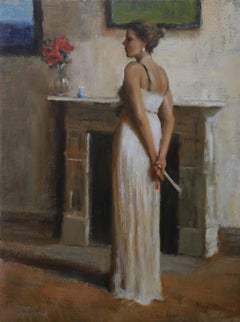
The Evening Gown American Impressionism Oil on Canvas 24" x 18" Figure Interior
Located in Houston, TX
Look for Free Shipping at Checkout
The Evening Gown is an American Impressionistic painting by Stuart Fullerton. The artist is know ...
Category
2010s American Impressionist Figurative Paintings
Materials
Oil, Canvas
$2,200
H 24 in W 18 in D 1 in
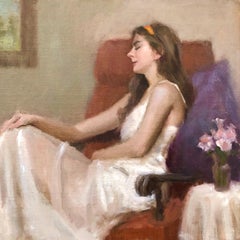
Kit Impressionism Reclining Figure in Chair Interior Oil on Canvas 14" x 14"
Located in Houston, TX
Look for Free Shipping at Checkout
Kit is an American Impressionist figurative painting by Stuart Fullerton. The artist is known for his landscape, still-life, portraits and citys...
Category
2010s American Impressionist Figurative Paintings
Materials
Oil, Canvas
$2,200
H 14 in W 14 in D 1.5 in
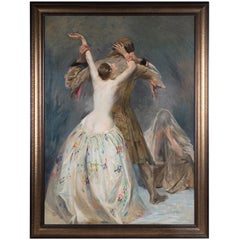
Oil on Canvas Depicting William Shakespeare's Characters "Othello & Desdemona"
By Hamilton Hamilton
Located in LA, CA
Hamilton Hamilton (American, 1847-1928) A large and impressive oil on canvas "Othello and Desdemona" after the William Shakespeare's play "Othello", depicting a young Desdemona pleading with an enraged Othello, and perhaps Iago is the seated figure, within a giltwood craquelure finished frame. Signed (l/r): H. Hamilton, 1921 .
Canvas Height: 67 inches (170.2 cm)
Canvas Width: 48 inches (121.9 cm)
Frame Height: 75 inches (190.5 cm)
Frame Width: 57 inches (144.8 cm)
Frame Depth: 2 inches (5.1 cm)
Hamilton Hamilton (1 April 1847 – 4 January 1928) was a painter and etcher, known mostly for his landscapes of the American West. Born in Oxford, England, he lived most of his life in the Eastern United States. He painted landscapes in New York, Connecticut, the American West, England, and France. He also painted portraits and drew illustrations.
Artistic career
Hamilton Hamilton was born in Oxford, England, on 1 April 1847. While young, he was a protégé of John Ruskin. In 1872, he began his mostly self-taught career as a portrait artist in Buffalo, New York. He created 47 landscape paintings during an 1873 expedition to Colorado which were chosen to be part of the 1876 Centennial Exposition in Philadelphia. He spent 1878 and 1879 painting in Pont-Aven, Brittany, alongside Barbizon School painters.
He moved to New York City in 1881 and shortly after began to practice genre painting and etching.[6] He became an associate member of the National Academy of Design in 1886 and a National Academician in 1889. Until the end of the century, he and his family resided alternately in upstate New York, Long Island, Colorado, and England.[6] In 1907 and 1908, Hamilton spent two years painting landscapes in Southern California. In 1912 he and his family permanently moved to Norwalk, Connecticut. There he became involved with the Silvermine group of artists led by Solon Borglum...
Category
Early 20th Century American Impressionist Figurative Paintings
Materials
Canvas, Wood, Oil
$34,500
H 75 in W 57 in D 2 in
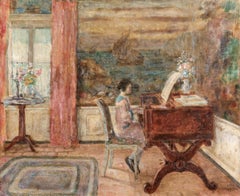
The Piano Recital - Impressionist Figurative Interior Oil by Frederick Frieseke
By Frederick Carl Frieseke
Located in Marlow, Buckinghamshire
Signed and dated oil on canvas figure in interior painting by American impressionist painter Frederick Carl Frieseke. The piece depicts a young girl in a pink dress seated at a piano...
Category
1920s American Impressionist Figurative Paintings
Materials
Oil, Canvas
Price Upon Request
H 27 in W 31 in
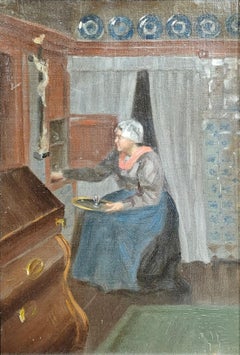
"Lady in a Interior" Addison Thomas Millar, 19th Century American Genre Painting
By Addison Thomas Millar
Located in New York, NY
Addison Thomas Millar
Lady in a Interior
Oil on canvas board
14 x 10 inches
Millar's father emigrated to the United States from Scotland in 1845. He grew up in Warren, Ohio. During his primary education, he took some painting lessons from John Bell, a local landscape painter.
In his late teens, he won three consecutive awards from The Youth's Companion, in their annual art contests. This prompted his parents to allow him to go to Cincinnati to take formal lessons from the genre painter, De Scott...
Category
19th Century American Impressionist Figurative Paintings
Materials
Canvas, Oil, Board
$3,500
H 17.375 in W 13.875 in
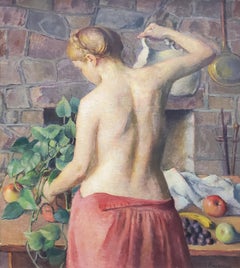
In a Early Light
By Robert Brackman
Located in Saratoga Springs, NY
Signed lower right.
A beautiful painting of a woman with her back to the viewer, watering a plant in front of an old brick wall. She is wearing a red skirt. A fruit arrangement sits...
Category
Mid-20th Century American Impressionist Figurative Paintings
Materials
Canvas, Oil
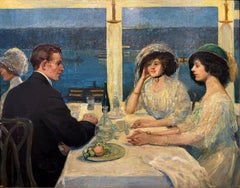
At the Claremont (View of the Hudson River and Palisades), Ida Sedgwick Proper
Located in New York, NY
Ida Sedgwick Proper
At the Claremont (View of the Hudson River and Palisades)
circa 1912
Signed lower right
Oil on canvas
45 1/4 x 57 1/2 inches
Exhibited
New York, Heterodoxy, Malv...
Category
1910s American Impressionist Figurative Paintings
Materials
Canvas, Oil
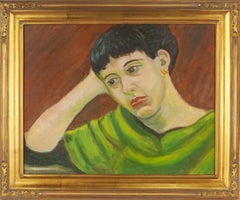
Mid Century Modern Portrait of Woman in Green Dress Original Oil Painting
By Genevieve Rogers
Located in Soquel, CA
Mid Century Modern Portrait of Woman in Green Dress Original Oil Painting
Evocative mid century modern portrait of woman in green dress by California artist Genevieve Rogers (America...
Category
1960s American Impressionist Figurative Paintings
Materials
Canvas, Oil, Illustration Board
$760 Sale Price
20% Off
H 21.5 in W 24.5 in D 1 in
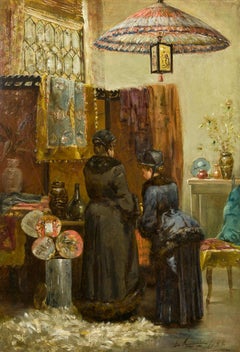
The Japanese Corner
By Elliott Daingerfield
Located in New York, NY
A child of the American South, Elliott Daingerfield was born in Harper’s Ferry, Virginia, and raised in Fayetteville, North Carolina, where his father, C...
Category
19th Century American Impressionist Interior Paintings
Materials
Canvas, Oil
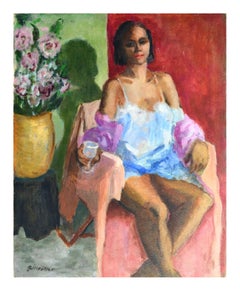
Seated Figure In Boudoir
By Patricia Gillfillan
Located in Soquel, CA
Beautiful figurative oil on canvas of a woman seated in her boudoir by Monterey California-area artist Patricia Gillfillan (American, 1924-2016). Signed "Gillfillan" lower left. Unfr...
Category
1980s American Impressionist Figurative Paintings
Materials
Canvas, Oil
More From This Seller
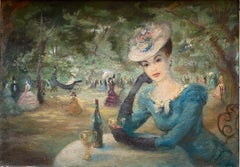
View AllLady in the Paris Park
Located in Los Angeles, CA
Beautiful young lady in a Paris Park, signed, Original Frame, listed size includes the frame.
Category
1950s Impressionist Figurative Paintings
Materials
Oil, Panel
$788 Sale Price
49% Off
Anita
Located in Los Angeles, CA
Attached is “Anita” (1916), by William Cahill (1878-1924), oil on artist board, 14 x 14 inches, signed & dated l/r. Exhibited at the Salmagundi Club, 1...
Category
1910s Impressionist Figurative Paintings
Materials
Oil, Panel
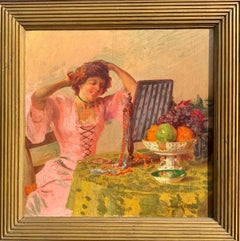
BLONDE WITH ART DECO NECKLACE
Located in Los Angeles, CA
Biography from the niece of the artist from during his lifetime. Paintings acquired from the artist.s estate.
Max Turner
1925 - 2019
Max Lamar Turner Painter, Sculptor, Teacher and Author.
Max Turner was born in Omaha, Nebraska on July 28, 1925. His father was Lance Howard Turner and his mother Mary Irene Turner. In 1927, his family moved to Bingham Canyon, Utah where Max's father extracted copper from a creek that he had diverted to pass through his garage. The town was located in a narrow canyon on the eastern face of the Oquirrh Mountains. In 1938, when Max was 13, his family moved to Midvale, Utah. After completing high school, Max went to work laying rail until he was inducted into the U.S. Navy to serve during W.W. II.
There he took an aptitude test and was initially assigned to the medical corp., later transferring to the dental unit. Max was stationed at Port Hueneme, Ventura County, California through the end of the war. When he was discharged in 1946, he remained in Southern California, living in the Los Angeles area. He met a man named Larry Torres and they formed a partnership to do silk screen work primarily for the Colby Poster Printing Company. This lasted about 10 years until the Colby building caught fire and burned down. In 1958, Max began working for Slade Novelty company that made doll parts using a product called plastisol. A year later, Max began producing plastic parts through his own business. One day, a couple of kids brought in a shrunken skull they had made and asked Max if he could reproduce it. Max said he could and he looked around for a business to work with for this task. He ultimately decided he could create his own machine shop to make molds. As a result, Max purchased a lathe, drill press, grinder and other tools to create his own machine shop and went into business making molds. He built a clientele and in 1973, he moved his machine shop to Glendale, California.
Painter, Sculptor, Teacher and Author:
Max recalls the day when his interest in art took a new direction. He happened to be in a paint store to purchase some supplies when he saw a card posted on a wall that read, "Come paint with Connie Marlo". Max had been interested in art since his youth and he was frequently impressed with paintings displayed by local artists at various community events.
Consequently, he decided to go to Connie's Saturday morning art class at a studio on North La Brea Avenue (between Sunset and Hollywood) in Los Angeles. But, as fate would have it, he immediately took a detour from this class when he found a piece of paper on the floor of the studio referencing another art class dealing with compositions, patterns, rhythms and color harmony. The instructor's name was Hal Reed, a former art student of the Russian/American Master, Nicolai Fechin. Hal owned the building (previously the Will Foster Studio) and had founded the Art League of Los Angeles. When Max found Hal, he asked Hal if he could join his class. Hal said "No, the class was full" but he said Max could monitor the class in the back of the classroom. Max took him up on the offer and began observing the weekly class.
During the class, Hal told his students that they should practice what they were learning by going to "live model" classes. Max began attending these classes where he learned how to draw figures. After a few months, Hal and Max became good friends. Hal was so impressed with Max's work that he offered Max the opportunity to teach at another location that Hal was opening in the San Fernando Valley. Max accepted the offer and began teaching his own art class. For Max, it was a quick jump from learning to teaching. Max then found that several of his students had to commute to his art class from the west end of the "Valley". To better serve this group of students, Max decided to relocate to another studio in Calabasas.
Max continued teaching, and at this time he was producing very impressive portraits, both oil paintings and charcoal drawings from live models (Max never worked from photos). Max demonstrated real talent, and the style of his drawings and paintings were being compared to those of Nicolai Fechin. And, like Fechin, Max also had an interest in sculpting. One day, Max decided to design and cast a bronze owl sculpture to put in his Calabasas Fine Art Gallery. Later, someone approached Max when he was at the foundry and asked him about his success selling the owl sculpture. The individual who asked this question was convinced that there was a broader market for these sculptures and he ordered a dozen of the owl sculptures from Max. This encouraged Max to do more castings. Some of the new castings were antique sculptures he found and reproduced. As this new business grew, he decided to establish his own foundry, employing up to 15 workers. The business continued for many years, up until the late 1990's when Max got tired of the foundry business and sold it.
Max, who was now in his 70's, decided to move on to his next venture as an artist, dedicating himself to doing the actual sculpting of original art. He loved the creativity of sculpting and he had his sculptures cast at local foundries, ironically the same ones that used to be his competition. Max was now fully engaged in his new artistic direction and, over time, he produced a large body of work. He created very impressive sculptures, including about 100 full-size sculptures. He sold some of these to high-end clientele, the Foundry at SLS Las Vegas, and to Hollywood studios.
Even though Max now seemed to be totally in his element, he somehow also found time to continue to teach painting classes at the California Art Institute in Westlake Village in Los Angeles. At the institute, he specialized in figure work. Max continued to draw, paint and teach, but he says he stopped sculpting when he turned 90.
Max produced four books showcasing his drawings and paintings. The first is "Faces, The Drawings of Max Turner", copyright 2000, that showcases nearly 100 of his portrait drawings. Within the "Acknowledgements" section, he lists Hal Reed and Joseph Nordmann, two former students of Nicolai Fechin.
In 2006, Max produced his second book titled "Figures and Faces", reflecting not only portraits but also figure drawings and paintings. It is a wonderful book of Max's work, but it is currently difficult to find. The third book is titled "Faces 2, The Paintings and Drawings of Max Turner", copyright 2009, which includes 75 portrait paintings and drawings. In the "Preface" of this book, Max describes growing up in a small and isolated mining town during the Great Depression. He states that as a kid, he had little exposure of any culture or view of what the rest of the world was like. His neighbor was the trash collector and Max would sometimes go through his truck looking for anything of value. Among other things, he found magazines like Cosmopolitan, Good Housekeeping and Red Book, with covers that frequently showed drawings or paintings of faces. Max states that these images were the very first source of inspiration for him. He says that he began looking more carefully at people's faces and if they had character, he would draw them. By drawing them, Max says that he was making them part of his world, his world of "Faces".
In 2018, Max published his newest book showcasing his drawings and paintings. It is titled "Max Turner's Figure Sketches". This softbound book includes 76 pages and over 120 drawings and paintings. In the Introduction, Max explains "I have found that when approaching the figure, one should begin with the gesture. After having captured the essence or feeling of the pose, one can then proceed to build on it." The figure sketches in this wonderful book reflect a Master's work that consistently captures the "gesture"-showing the emotion, movement and expression.
Two more books are on the horizon for Max, both dealing with his passion for sculpting. His first, "The Sculpture of Max Turner" is a compilation of his commercial and noncommercial pieces throughout his career. The second, "Terra Cotta Sculpture by Max Turner" is a complete collection of figures done at the California Art Institute. These much anticipated books should be out later in 2018.
Max now considers himself primarily a sculptor. But others in the art world are more than impressed with his drawings and paintings as well. His portraits are often described as having a Fechin-esque appearance, referring to the style of Nicolai Fechin. When Max observed those first art classes given by Hal Reed, it should be noted that Hal had previously been a student of the Russian/American Master Nicolai Fechin in the early to mid-1950's. In fact, Hal was a student in the last art class that Fechin taught before he unexpectedly died in 1955. Hal was so strongly influenced by Fechin that he later produced two 30-minute art instruction videos as part his Art Video Productions wherein he specifically described Fechin techniques that he learned in Fechin's class. The Fechin style and techniques were in play when Max later met Hal. Over the years, many of Max's art students, art collectors, gallery owners, as well as the Director of the Monterey Museum of Art have commented on the Fechin-esque qualities of Max's wonderful charcoal drawings and paintings. So, while Max may consider himself primarily a sculptor, his drawings and paintings are also impressive and very much sought after.
When Nicolai Fechin died in 1955, three of the nine students in his last art class became life-long friends. Max subsequently became friends with not only Hal Reed, but also with prior Fechin students Joseph Nordmann and Albert Londraville...
Category
1990s Modern Figurative Paintings
Materials
Canvas, Oil

$650 Sale Price
48% Off
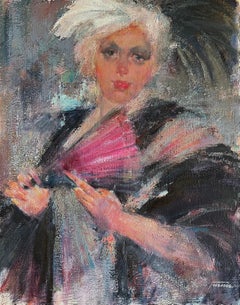
LADY WITH PICK FAN
Located in Los Angeles, CA
Biography from the niece of the artist from during his lifetime. Paintings acquired from the artist.s estate.
Max Turner
1925 - 2019
Max Lamar Turner Painter, Sculptor, Teacher and Author.
Max Turner was born in Omaha, Nebraska on July 28, 1925. His father was Lance Howard Turner and his mother Mary Irene Turner. In 1927, his family moved to Bingham Canyon, Utah where Max's father extracted copper from a creek that he had diverted to pass through his garage. The town was located in a narrow canyon on the eastern face of the Oquirrh Mountains. In 1938, when Max was 13, his family moved to Midvale, Utah. After completing high school, Max went to work laying rail until he was inducted into the U.S. Navy to serve during W.W. II.
There he took an aptitude test and was initially assigned to the medical corp., later transferring to the dental unit. Max was stationed at Port Hueneme, Ventura County, California through the end of the war. When he was discharged in 1946, he remained in Southern California, living in the Los Angeles area. He met a man named Larry Torres and they formed a partnership to do silk screen work primarily for the Colby Poster Printing Company. This lasted about 10 years until the Colby building caught fire and burned down. In 1958, Max began working for Slade Novelty company that made doll parts using a product called plastisol. A year later, Max began producing plastic parts through his own business. One day, a couple of kids brought in a shrunken skull they had made and asked Max if he could reproduce it. Max said he could and he looked around for a business to work with for this task. He ultimately decided he could create his own machine shop to make molds. As a result, Max purchased a lathe, drill press, grinder and other tools to create his own machine shop and went into business making molds. He built a clientele and in 1973, he moved his machine shop to Glendale, California.
Painter, Sculptor, Teacher and Author:
Max recalls the day when his interest in art took a new direction. He happened to be in a paint store to purchase some supplies when he saw a card posted on a wall that read, "Come paint with Connie Marlo". Max had been interested in art since his youth and he was frequently impressed with paintings displayed by local artists at various community events.
Consequently, he decided to go to Connie's Saturday morning art class at a studio on North La Brea Avenue (between Sunset and Hollywood) in Los Angeles. But, as fate would have it, he immediately took a detour from this class when he found a piece of paper on the floor of the studio referencing another art class dealing with compositions, patterns, rhythms and color harmony. The instructor's name was Hal Reed, a former art student of the Russian/American Master, Nicolai Fechin. Hal owned the building (previously the Will Foster Studio) and had founded the Art League of Los Angeles. When Max found Hal, he asked Hal if he could join his class. Hal said "No, the class was full" but he said Max could monitor the class in the back of the classroom. Max took him up on the offer and began observing the weekly class.
During the class, Hal told his students that they should practice what they were learning by going to "live model" classes. Max began attending these classes where he learned how to draw figures. After a few months, Hal and Max became good friends. Hal was so impressed with Max's work that he offered Max the opportunity to teach at another location that Hal was opening in the San Fernando Valley. Max accepted the offer and began teaching his own art class. For Max, it was a quick jump from learning to teaching. Max then found that several of his students had to commute to his art class from the west end of the "Valley". To better serve this group of students, Max decided to relocate to another studio in Calabasas.
Max continued teaching, and at this time he was producing very impressive portraits, both oil paintings and charcoal drawings from live models (Max never worked from photos). Max demonstrated real talent, and the style of his drawings and paintings were being compared to those of Nicolai Fechin. And, like Fechin, Max also had an interest in sculpting. One day, Max decided to design and cast a bronze owl sculpture to put in his Calabasas Fine Art Gallery. Later, someone approached Max when he was at the foundry and asked him about his success selling the owl sculpture. The individual who asked this question was convinced that there was a broader market for these sculptures and he ordered a dozen of the owl sculptures from Max. This encouraged Max to do more castings. Some of the new castings were antique sculptures he found and reproduced. As this new business grew, he decided to establish his own foundry, employing up to 15 workers. The business continued for many years, up until the late 1990's when Max got tired of the foundry business and sold it.
Max, who was now in his 70's, decided to move on to his next venture as an artist, dedicating himself to doing the actual sculpting of original art. He loved the creativity of sculpting and he had his sculptures cast at local foundries, ironically the same ones that used to be his competition. Max was now fully engaged in his new artistic direction and, over time, he produced a large body of work. He created very impressive sculptures, including about 100 full-size sculptures. He sold some of these to high-end clientele, the Foundry at SLS Las Vegas, and to Hollywood studios.
Even though Max now seemed to be totally in his element, he somehow also found time to continue to teach painting classes at the California Art Institute in Westlake Village in Los Angeles. At the institute, he specialized in figure work. Max continued to draw, paint and teach, but he says he stopped sculpting when he turned 90.
Max produced four books showcasing his drawings and paintings. The first is "Faces, The Drawings of Max Turner", copyright 2000, that showcases nearly 100 of his portrait drawings. Within the "Acknowledgements" section, he lists Hal Reed and Joseph Nordmann, two former students of Nicolai Fechin.
In 2006, Max produced his second book titled "Figures and Faces", reflecting not only portraits but also figure drawings and paintings. It is a wonderful book of Max's work, but it is currently difficult to find. The third book is titled "Faces 2, The Paintings and Drawings of Max Turner", copyright 2009, which includes 75 portrait paintings and drawings. In the "Preface" of this book, Max describes growing up in a small and isolated mining town during the Great Depression. He states that as a kid, he had little exposure of any culture or view of what the rest of the world was like. His neighbor was the trash collector and Max would sometimes go through his truck looking for anything of value. Among other things, he found magazines like Cosmopolitan, Good Housekeeping and Red Book, with covers that frequently showed drawings or paintings of faces. Max states that these images were the very first source of inspiration for him. He says that he began looking more carefully at people's faces and if they had character, he would draw them. By drawing them, Max says that he was making them part of his world, his world of "Faces".
In 2018, Max published his newest book showcasing his drawings and paintings. It is titled "Max Turner's Figure Sketches". This softbound book includes 76 pages and over 120 drawings and paintings. In the Introduction, Max explains "I have found that when approaching the figure, one should begin with the gesture. After having captured the essence or feeling of the pose, one can then proceed to build on it." The figure sketches in this wonderful book reflect a Master's work that consistently captures the "gesture"-showing the emotion, movement and expression.
Two more books are on the horizon for Max, both dealing with his passion for sculpting. His first, "The Sculpture of Max Turner" is a compilation of his commercial and noncommercial pieces throughout his career. The second, "Terra Cotta Sculpture by Max Turner" is a complete collection of figures done at the California Art Institute. These much anticipated books should be out later in 2018.
Max now considers himself primarily a sculptor. But others in the art world are more than impressed with his drawings and paintings as well. His portraits are often described as having a Fechin-esque appearance, referring to the style of Nicolai Fechin. When Max observed those first art classes given by Hal Reed, it should be noted that Hal had previously been a student of the Russian/American Master Nicolai Fechin in the early to mid-1950's. In fact, Hal was a student in the last art class that Fechin taught before he unexpectedly died in 1955. Hal was so strongly influenced by Fechin that he later produced two 30-minute art instruction videos as part his Art Video Productions wherein he specifically described Fechin techniques that he learned in Fechin's class. The Fechin style and techniques were in play when Max later met Hal. Over the years, many of Max's art students, art collectors, gallery owners, as well as the Director of the Monterey Museum of Art have commented on the Fechin-esque qualities of Max's wonderful charcoal drawings and paintings. So, while Max may consider himself primarily a sculptor, his drawings and paintings are also impressive and very much sought after.
When Nicolai Fechin died in 1955, three of the nine students in his last art class became life-long friends. Max subsequently became friends with not only Hal Reed, but also with prior Fechin students Joseph Nordmann and Albert Londraville...
Category
1990s Modern Figurative Paintings
Materials
Canvas, Oil
$450 Sale Price
64% Off
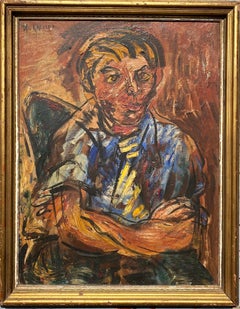
Man with Yellow Tie
Located in Los Angeles, CA
ALEXANDER KREISEL
"MAN WITH YELLOW TIE"
OIL ON CANVAS BOARD, SIGNED
RUSSIAN-AMERICAN, C.1935
26 X 19.5 INCHES
FRAMED 29.5 X 23.5 INCHES
Alexander Krei...
Category
1930s Expressionist Figurative Paintings
Materials
Canvas, Oil
$1,688 Sale Price
24% Off
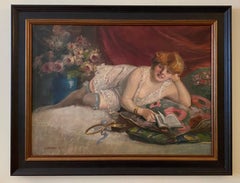
Relaxing
By Richard Geiger
Located in Los Angeles, CA
RICHARD GEIGER
"RELAXING"
OIL ON CANVAS, SIGNED
HUNGARIAN, C.1930
28 X 39 INCHES
FRAMED 36.5 X 46 INCHES
Richard Geiger
1870-1945
Richard Geiger was born in Vienna and first studied at the Vienna Art Institute with the academic painter Christian Ludwig Von Griepenkerl and, subsequently, in Paris with Francois Flameng...
Category
1930s Art Deco Portrait Paintings
Materials
Canvas, Oil
$1,625 Sale Price
50% Off