1930s Art

5,898 Results
to
792
3,345
1,260
919
529
345
Overall Width
to
Overall Height
to
7,700
21,601
166,909
237,062
2,159
2,352
4,713
6,441
5,971
15,973
21,387
26,801
19,394
14,213
5,499
2,452
456
410
252
111
111
108
73
9
9
5
2
2
3,563
2,384
314
3,943
1,789
1,636
1,168
1,123
712
463
454
431
332
329
293
292
288
284
235
224
218
208
184
2,057
1,644
1,380
1,141
907
261
155
139
88
59
1,880
1,179
3,380
2,984
Period: 1930s
Original "Campionato del Mondo, Tiro al Piccione" vintage sports poster

Original "Campionato del Mondo, Tiro al Piccione" vintage sports poster

Located in Spokane, WA

Original poster Italian lithograph. Tira Al Piccion - Roma. Skeet Shooting. VII World Championship “Tiro a Piccione” pre-World War II Olympic style poster. Powerful pre-world War II poster. This shows the American flag flying next to the Nazi flag for the skeet shooting championship in Italy. Note that the year 1935 corresponds with the fascist year date of XIV-XV. Museum linen backed. The USA flag is sitting right next to the German Nazi...

Category

Art Deco 1930s Art

Materials

Lithograph

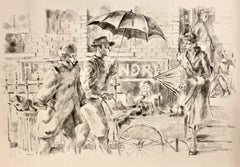
Cincinnati Ohio cityscape drawing WPA era Eden Parks Drive

Cincinnati Ohio cityscape drawing WPA era Eden Parks Drive

Located in Wilton Manors, FL

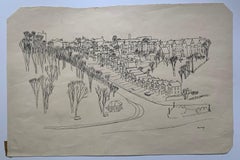
Beautiful original drawing by American artist, Albert Sway (b.1913). Cincinnati Cityscape, ca. 1935. Ink on paper measures 8.5 x 11 inches. Signed lower right. Good condition with no...

Category

American Realist 1930s Art

Materials

Paper, Ink

"Sur la rivière (Marne)" - On the River Marne - Hand Colored Lithograph

"Sur la rivière (Marne)" - On the River Marne - Hand Colored Lithograph

Located in Soquel, CA

"Sur la rivière (Marne)" - On the River Marne - Hand Colored Lithograph Serene depiction of a house along the Marne River by unknown artist "Charlot." This piece was commissioned and printed by Camilla Lucas Publishing in New York. A two-story house with a red roof sits on the bank of the river. Lush trees line the banks, some of which are depicted with orange-brown leaves, indicating that autumn has arrived. The color in this piece was added by hand. Titled "Sur la riviere (Marne)" in the lower left corner. Signed "Charlot" in the lower right corner. Presented in a wood frame with a double mat. Frame size: 20"W x 16"W Image size: 11.5"H x 9"W In 1928, Hungarian-born Sidney Zoltan Lucas founded "Camilla Lucas Publishing" which encompassed a wholesale art publishing house and a retail art gallery. This business was both wholesale and retail and dealt in reproductions of antique, modern, and contemporary prints. It also sold original art including etchings, lithographs, and paintings. Starting in the 1930's and continuing into the 1950's, Sydney Lucas traveled to Europe periodically and contracted with French and Flemish artists to publish their work under the banner of the "Paris Etching Society." During his career, Sydney published many thousands of images. He brought art into the homes of people at all levels of income through his etchings, serigraphs, woodblock prints, restrikes and reproductions. The various subjects included Redouté and Prevost Flowers, Barraband and Gould Birds, Piranesi, French Landscapes, Urban Scenes, Women, Children, Animals, Hunting and much more. Later on in the 1950s, Sydney and his wife Phyllis Lucas became the first North American publishers of original signed, limited edition lithographs by the famous surrealist artist Salvador Dali. They worked directly with Mr. Dali over several years and the three created such fine images that in 1985 the Lucas’ Collection of limited edition lithographs from Salvador Dali’s paintings were displayed alongside his original paintings at the Salvador Dali Museum...

Category

Impressionist 1930s Art

Materials

Paper, Ink, Watercolor

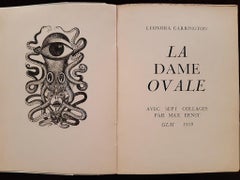
La Dame Ovale - Vintage Rare Book Illustrated by Max Ernst - 1934

La Dame Ovale - Vintage Rare Book Illustrated by Max Ernst - 1934

By Max Ernst

Located in Roma, IT

La Dame Ovale is an original modern rare book written by Mary Leonora Carrington (Chorley, Lancashire 1917 – Mexico City, 2011) and illustrated by Max Ernst (1891 - 1976) in 1934. Original edition. Published by GLM, Paris. 535 numbered copies. Format: small 8°. Seven full page collages. Unnumbered pages. Good conditions. Max Ernst in 1934. Originally a Dada activist in Germany, Max Ernst (1891 - 1976) became one of the early adherents of the Surrealist circle. As a child living in a small community near Cologne, Ernst had considered his existence incredible and full of wonders. In autobiographical transcripts, written mostly in the third person, he said of his birth: “Max Ernst had his first contact with the world of sense on the 2nd April 1891 at 9:45 a.m., when he emerged from the egg which his mother had laid in an eagle’s nest and which the bird had incubated for seven years”. Ernst’s service in the German army during World War I swept away his early success as an Expressionist. In his own words: “Max Ernst died on 1st August 1914. He returned to life on 11th November 1918, a young man who wanted to become a magician and find the central myth of his age. From time to time he consulted the eagle which had guarded the egg of his prenatal existence. The bird’s advice can be detected in his work”. Mary Leonora Carrington (Chorley, Lancashire 1917 – Mexico City, 2011). Carrington was a British-born Mexican artist, surrealist painter, and novelist. She lived most of her adult life in Mexico City and was one of the last surviving participants in the Surrealist movement of the 1930s. Carrington was also a founding member of the women's liberation movement in Mexico during the 1970s. In 1936 Leonora saw the work of the German surrealist...

Category

Surrealist 1930s Art

Materials

Paper, Photogravure

Paysage de Franche-Comté

Paysage de Franche-Comté

Located in LE HAVRE, FR

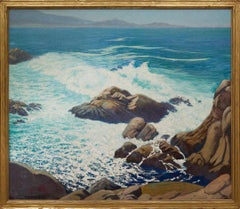
Jules Emile ZINGG (1882–1942) Landscape of Franche-Comté Oil on canvas Dimensions: 54 x 74 cm Signed lower left Circa: 1930 / 1935 Provenance: Private collection, Paris ...

Category

Post-Impressionist 1930s Art

Materials

Canvas, Oil

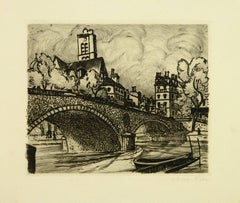
Edinburgh Town View from Bridge Circa 1930, Impressionist Oil Painting, Framed

Edinburgh Town View from Bridge Circa 1930, Impressionist Oil Painting, Framed

By Charles Eddowes Turner

Located in Hillsborough, NC

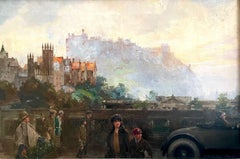
Famous Edinburgh view of the Castle Mount from bustling North Bridge in Impressionist style, dating to mid 1920s/1930s, presenting a glimpse of Scottish society of the time. Dunlop C...

Category

Impressionist 1930s Art

Materials

Canvas, Oil

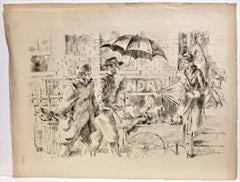
Cincinnati Ohio cityscape drawing WPA era

Cincinnati Ohio cityscape drawing WPA era

Located in Wilton Manors, FL

Beautiful original drawing by American artist, Albert Sway (b.1913). Cincinnati Cityscape, ca. 1935. Ink on paper measures 10 x 15 inches. Signed lower left. Good condition with no d...

Category

American Realist 1930s Art

Materials

Paper, Ink

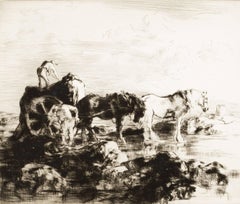
The Vraic Season (No 1).

The Vraic Season (No 1).

By Edmund Blampied

Located in Plano, TX

The Vraic Season (No 1). 1936. Etching. Appleby 181. 12 x 14 1/4 (sheet 15 1/4 x 20). Edition 125 for The American College Society of Print Collectors (alternatively titled Seaweed H...

Category

Modern 1930s Art

Materials

Drypoint, Etching

Greylag Goose, French antique bird duck art illustration print

Greylag Goose, French antique bird duck art illustration print

By P. Mahler

Located in Melbourne, Victoria

'Oie Cendree - Oie des Moissons' (Greylag Goose) French chromolithograph, published in 1931. Printed title lower right of sheet. Plate number top right. From a French series of ill...

Category

Art Deco 1930s Art

Materials

Lithograph

Large French Post-Impressionist Signed Oil Woodland Lake Moody Pastel Colors

Large French Post-Impressionist Signed Oil Woodland Lake Moody Pastel Colors

By Marcel Guillard 1

Located in Cirencester, Gloucestershire

The Banks of the Lake by Marc Guillard (French b.1896) signed oil on board, framed Framed: 22 x 28 inches Board: 21 x 27 inches Inscribed Verso Provenance: Private collection, Loire ...

Category

Impressionist 1930s Art

Materials

Oil

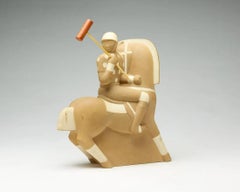
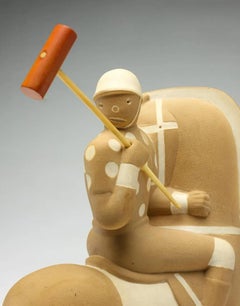
Early 20th Century Ceramic Sculpture of a Polo Player and Horse

Early 20th Century Ceramic Sculpture of a Polo Player and Horse

By Waylande Gregory

Located in Beachwood, OH

Waylande Gregory (American, 1905-1971) Polo Player, c. 1930s Ceramic Inscribed signature on bottom 11 x 8.5 inches Waylande Gregory was considered a major American sculptor during the 1930's, although he worked in ceramics, rather than in the more traditional bronze or marble. Exhibiting his ceramic works at such significant American venues for sculpture as the Whitney Museum of American Art in New York City and at the venerable Pennsylvania Academy of the Fine Arts in Philadelphia, he also showed his ceramic sculptures at leading New York City galleries. Gregory was the first modern ceramist to create large scale ceramic sculptures, some measuring more than 70 inches in height. Similar to the technique developed by the ancient Etruscans, he fired his monumental ceramic sculptures only once. Gregory was born in 1905 in Baxter Springs, Kansas and was something of a prodigy. Growing up on a ranch near a Cherokee reservation, Gregory first became interested in ceramics as a child during a native American burial that he had witnessed. He was also musically inclined. In fact, his mother had been a concert pianist and had given her son lessons. At eleven, he was enrolled as a student at the Kansas State Teacher's College, where he studied carpentry and crafts, including ceramics. Gregory's early development as a sculptor was shaped by the encouragement and instruction of Lorado Taft, who was considered both a major American sculptor as well as a leading American sculpture instructor. In fact, Taft's earlier students included such significant sculptors as Bessie Potter Vonnoh and Janet Scudder. But, Taft and his students had primarily worked in bronze or stone, not in clay; and, Gregory's earliest sculptural works were also not in ceramics. In 1924, Gregory moved to Chicago where he caught the attention of Taft. Gregory was invited by Taft to study with him privately for 18 months and to live and work with him at his famed "Midway Studios." The elegant studio was a complex of 13 rooms that overlooked a courtyard. Taft may have been responsible for getting the young man interested in creating large scale sculpture. However, by the 1920's, Taft's brand of academic sculpture was no longer considered progressive. Instead, Gregory was attracted to the latest trends appearing in the United States and Europe. In 1928 he visited Europe with Taft and other students. "Kid Gregory," as he was called, was soon hired by Guy Cowan, the founder of the Cowan Pottery in Cleveland, Ohio, to become the company's only full time employee. From 1928 to 1932, Gregory served as the chief designer and sculptor at the Cowan Pottery. Just as Gregory learned about the process of creating sculpture from Taft, he literally learned about ceramics from Cowan. Cowan was one of the first graduates of Alfred, the New York School of Clayworking and Ceramics. Alfred had one of the first programs in production pottery. Cowan may have known about pottery production, but he had limited sculptural skills, as he was lacking training in sculpture. The focus of the Cowan Pottery would be on limited edition, table top or mantle sculptures. Two of the most successful of these were Gregory's "Nautch Dancer," (fig. 1) and his "Burlesque Dancer," (fig. 2). He based both sculptures on the dancing of Gilda Gray, a Ziegfield Follies girl. Gilda Gray was of Polish origin and came to the United States as a child. By 1922, she would become one of the most popular stars in the Follies. After losing her assets in the stock market crash of 1929, she accepted other bookings outside of New York, including Cleveland, which was where Gregory first saw her onstage. She allowed Gregory to make sketches of her performances from the wings of the theatre. She explained to Gregory, "I'm too restless to pose." Gray became noted for her nautch dance, an East Indian folk dance. A nautch is a tight, fitted dress that would curl at the bottom and act like a hoop. This sculpture does not focus on Gray's face at all, but is more of a portrait of her nautch dance. It is very curvilinear, really made of a series of arches that connect in a most feminine way. Gregory created his "Burlesque Dancer" at about the same time as "Nautch Dancer." As with the "Nautch Dancer," he focused on the movements of the body rather than on a facial portrait of Gray. Although Gregory never revealed the identity of his model for "Burlesque Dancer," a clue to her identity is revealed in the sculpture's earlier title, "Shimmy Dance." The dancer who was credited for creating the shimmy dance was also Gilda Gray. According to dance legend, Gray introduced the shimmy when she sang the "Star Spangled Banner" and forgot some of the lyrics, so, in her embarrassment, started shaking her shoulders and hips but she did not move her legs. Such movement seems to relate to the "Burlesque Dancer" sculpture, where repeated triangular forms extend from the upper torso and hips. This rapid movement suggests the influence of Italian Futurism, as well as the planar motion of Alexander Archipenko, a sculptor whom Gregory much admired. The Cowan Pottery was a victim of the great depression, and in 1932, Gregory changed careers as a sculptor in the ceramics industry to that of an instructor at the Cranbrook Academy in Bloomfield Hills, Michigan. Cranbrook was perhaps the most prestigious place to study modern design in America. Its faculty included the architect Eliel Saarinen and sculptor Carl Milles. Although Gregory was only at Cranbrook for one and one half years, he created some of his finest works there, including his "Kansas Madonna" (fig. 3). But, after arriving at Cranbrook, the Gregory's had to face emerging financial pressures. Although Gregory and his wife were provided with complimentary lodgings, all other income had to stem from the sale of artworks and tuition from students that he, himself, had to solicit. Gregory had many people assisting him with production methods at the Cowan Pottery, but now worked largely by himself. And although he still used molds, especially in creating porcelain works, many of his major new sculptures would be unique and sculpted by hand, as is true of "Kansas Madonna." The scale of Gregory's works were getting notably larger at Cranbrook than at Cowan. Gregory left the surface of "Kansas Madonna" totally unglazed. Although some might object to using a religious title to depict a horse nursing its colt, it was considered one of Gregory's most successful works. In fact, it had a whole color page illustration in an article about ceramic sculpture titled, "The Art with the Inferiority Complex," Fortune Magazine, December, 1937. The article notes the sculpture was romantic and expressive and the sculpture was priced at $1,500.00; the most expensive sculpture in the article. Gregory was from Kansas, and "Kansas Madonna" should be considered a major sculptural document of Regionalism. Gregory and his wife Yolande moved to New Jersey in the summer of 1933. And the artist began construction on his new home in the Watchung Mountains of Bound Brook (Warren today) in 1938. His enormous, custom kiln was probably constructed at the start of 1938. Gregory's new sculptures were the largest ceramic sculptures in western art, in modern times. To create these works of ceramic virtuosity, the artist developed a "honeycomb" technique, in which an infrastructure of compartments was covered by a ceramic "skin." Science and atomic energy were a theme in Gregory's most significant work, the "Fountain of the Atom" (fig. 4), at the 1939 New York's World Fair. This major work included twelve monumental ceramic figures at the fairground entrance from the newly constructed railway entrance, giving the work great visibility and prominence. The framework of the fountain itself was of steel and glass bricks. It consisted of a bluish green pool which was sixty five feet in diameter. Above it were two concentric circular tiers, or terraces, as Gregory called them; the first wider than the second. On the first terrace were eight "Electrons," comprised of four male and four female terra cotta figures, each approximately 48 inches high. These relate to the valance shell of the atom. Above them on a narrower terrace, were the much larger and heavier terra cotta figures depicting the four elements, each averaging about 78 inches in height and weighing about a ton and a half. Of the four, "Water" and "Air" were male, while "Earth" and "Fire" were female. This terrace represents the nucleus of the atom. In the center of the fountain, above the "Elements," was a central shaft comprised of sixteen glass tubes from which water tumbled down from tier to tier. At the top, a colorful flame burned constantly. The glass block tiers were lit from within, the whole creating a glowing and gurgling effect. Since the fair was temporary, the figures could be removed after its closing. But the credit for the design of the structure of the fountain belongs to collaborator Nembhard Culin, who was responsible for several other structures on the fair grounds as well. Although Gregory created a figure of "Fire" for the "Fountain of the Atom," he also executed a second, slightly smaller but more defined version which he exhibited at various locations (including Cranbrook, Baltimore Museum, etc.) in 1940-1941, during the second year of the fair (fig.5). Measuring 61 inches in height, "Fire" may be a metaphor for sexual energy, as well as atomic energy. Gregory stated, "Fire is represented by an aquiline female figure being consumed in endless arabesques of flame." Portraiture was also a significant focus of Gregory's sculpture. Gregory produced many commissioned portraits of local people as well as celebrities. He created Albert Einstein's portrait from life (fig. 6, ca. 1940) after Einstein had seen Gregory's "Fountain of the Atom." He also sculpted some of the leading figures in entertainment, including 2 sculptures of Henry Fonda, who became a personal friend. Gregory also sculpted a series of idealized female heads, both in terra cotta and in porcelain. These include "Girl with Olive" (ca. 1932) and "Cretan Girl;"(ca. 1937) both are very reductive and almost abstract works that call to mind Constantine Brancusi's "Mademoiselle Pogany" (1912, Philadelphia Museum of Art). But perhaps one of his most original female heads is "Head of a Child" (fig. 7, ca. 1933), a sensitive white glazed terra cotta portrayal with elaborately crafted braded hair, was originally created as one of a pair. Gregory also produced sculptural works for the Works Progress Administration. The WPA was a work relief project that greatly helped artists during the great depression. Founded by the Federal Government in 1935, an estimated 2500 murals were produced. Among these public works were the iconic post office murals. But, among the painted murals were also sculptural relief murals including Gregory's "R.F.D.," 1938, for the Columbus, Kansas Post Office. But, Gregory's largest WPA relief...

Category

1930s Art
Materials

Ceramic

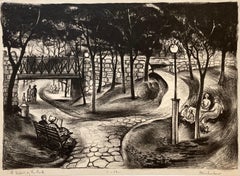
Ann Michalov, A View of the Park

Ann Michalov, A View of the Park

Located in New York, NY

Originally from Illinois, Ann Michalov worked in Spokane, Seattle and Portland, where she finally settled. This lithograph however really looks very like ...

Category

Ashcan School 1930s Art

Materials

Lithograph

Joan Crawford (1933) Silver Gelatin Fibre Print

Joan Crawford (1933) Silver Gelatin Fibre Print

Located in London, GB

Joan Crawford (1933) Silver Gelatin Fibre Print - Oversized (Photo by Pictorial Press / Alamy Archives) 1933 Joan Crawford (1905-1977) US film actress. Additional Information: U...

Category

Modern 1930s Art

Materials

Black and White, Archival Pigment

Byron Browne, (Abstraction)

Byron Browne, (Abstraction)

By Byron Browne

Located in New York, NY

This print was made for the American Abstract Artists Portfolio, 1937. All the images were lithographs made on zinc plates. Usually they were signed in the image -- on the plate, as ...

Category

Abstract 1930s Art

Materials

Lithograph

German Spaniel, French hound dog chromolithograph print, 1931

German Spaniel, French hound dog chromolithograph print, 1931

By P. Mahler

Located in Melbourne, Victoria

French chromolithograph, published in 1931. Signed by artist in the plate. Printed title lower right of sheet. Plate number top right. From a French series of illustrations of sporti...

Category

Art Deco 1930s Art

Materials

Lithograph

Original I regret I have only one Life, Nathan Hale, vintage psoter

Original I regret I have only one Life, Nathan Hale, vintage psoter

Located in Spokane, WA

Original poster, lithograph, linen-backed, Nathan Hale poster reading," I only regret that I have but one life to lose for my country." Step into history with this 1939 Kelly Read & Co. Rochester (NY) poster, a testament to the principles our patriots died for. This very rare original poster is the only documented copy remaining. Archival linen-backed and ready to frame. The poster features a stylized image of Nathan Hale, an American Revolutionary War soldier...

Category

American Impressionist 1930s Art

Materials

Lithograph

Joan Crawford - Silver Gelatin Fibre Print

Joan Crawford - Silver Gelatin Fibre Print

Located in London, GB

Joan Crawford - Silver Gelatin Fibre Print - Oversized (Photo by Pictorial Press / Alamy Archives) Joan Crawford (1905-1977) US film actress. Additional Information: Unframed Pa...

Category

Modern 1930s Art

Materials

Black and White, Silver Gelatin

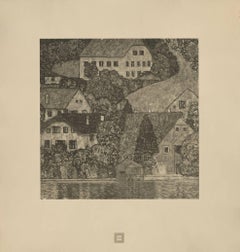
Max Eisler Eine Nachlese folio "Houses in Unterach on Lake Attersee" collotype

Max Eisler Eine Nachlese folio "Houses in Unterach on Lake Attersee" collotype

By (after) Gustav Klimt

Located in Palm Beach, FL

After Gustav Klimt, Max Eisler Plate #29, Am Attersee; brown-toned monochrome collotype after the 1915-16 painting in oil on canvas. GUSTAV KLIMT EINE NACHLESE (GUSTAV KLIMT AN AFTERMATH), a portfolio of 30 collotypes prints, 15 are multi-color and 15 are monochrome, on chine colle paper laid down on heavy cream-wove paper with deckled edges; Max Eisler, Editor-Publisher; Osterreichischer Staatsdruckerei (Austrian State Printing Office), Printer; in a limited edition of 500 numbered examples of which: 200 were printed in German, 150 were printed in French and 150 were printed in English; Vienna, 1931. 2018 marks the 100th anniversary of Gustav Klimt’s death. It is a fitting time to reflect upon the enduring legacy and deep impact of his art. Recognizing this need for posterity with uncanny foresight, the publication of Gustav Klimt: An Aftermath (Eine Nachlese) provides a rare collection of work after Klimt which has proven to be an indispensable tool for Klimt scholarship as well as a source for pure visual delight. Approximately 25 percent of the original works featured in the Aftermath portfolio have since been lost. Of those 30, six were destroyed by fire on 8 May 1945. On that fateful final day of WWII, the retreating Feldherrnhalle, a tank division of the German Army, set fire to the Schloss Immendorf which was a 16th century castle in Lower Austria used between 1942-1945 to store objects of art. All three of Klimt’s Faculty Paintings: Philosophy, Medicine and Jurisprudence (1900-1907), originally created for the University of Vienna, were on premises at that time. Also among the inventory of Klimt paintings in storage there was art which had been confiscated by the Nazis. One of the most significant confiscated collections was the Lederer collection which featured many works by Gustav Klimt such as Girlfriends II and Garden Path with Chickens. In many instances, Aftermath is our only link to these lost treasures. Max Eisler (1881-1937), the publisher of the 1931 Aftermath portfolio, was an art historian at Vienna University specializing in modern and contemporary arts and crafts whose 1920 book on Klimt was the first Klimt monograph. He saw An Aftermath as filling-in important gaps left by the earlier print portfolios which had only featured Klimt up to 1913 and which had glossed over major art projects such as the Tree of Life frieze for the Palais Stoclet. And whereas only 10 of the 50 prints from the earlier portfolios published by H.O. Miethke were made in intricate multi-color images, Eisler augmented the earlier format by featuring half of the 30 images in stunning multi-colored collotypes. Understanding the fragile nature of the collotype printing process also reinforces this project’s distinctive and exceptional characteristics. Fragile collotype plates can not be reused. As such, this necessitates the completion of a run on the first go and also dictates a limited production number. Printed by hand, the collotypes required deft handling by the printer, Osterreichische Staatsdruckerei. A complicated and lengthy process involving gelatin colloids mixed with dichromates, the creation of 16 color separation thin glass filters to achieve the light-sensitive internegative images which could faithfully capture all of the painting’s tonal gradations and colors, exposure to actinic light, and delicate chine collie papers which allowed for greater color saturation, the printer’s collaborative role in capturing and transmitting Klimt’s nuanced paint strokes is nothing short of remarkable. The Österreichische Staatsdruckerei (Austrian State Printing Office), was the successor to the KK Hof -und Staatsdruckerei which was founded by Emperor Franz I in 1804 and whose collotype printing innovations of Klimt’s art...

Category

Vienna Secession 1930s Art

Materials

Archival Paper

Still Life with Roses and Pitcher (PA Impressionist woman artist)

Still Life with Roses and Pitcher (PA Impressionist woman artist)

Located in Wilton Manors, FL

Alice B. Doughten (1880-1969). Still Life with Roses, ca. 1930. Oil on masonite panel, 12 x 16 inches. Measures 18 x 22 inches framed. Signed lower right. Original label affixed on verso with Moorestown NJ identified as artist's address. Born in Camden, New Jersey, Alice Doughten became noted for her still life and landscape paintings with figures, usually watercolors and sometimes abstract in style. She studied art at the Pennsylvania Academy of the Fine Arts with Henry McCarter, Earl Horter, Ralph Pearson...

Category

Impressionist 1930s Art

Materials

Masonite, Oil

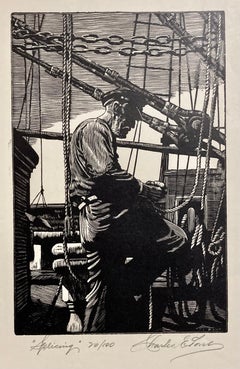
Charles Pont, Splicing

Charles Pont, Splicing

Located in New York, NY

An old sailor is shown at work on a what must be a huge sailing vessel. He's splicing, or joining ropes together -- probably still a useful skill in the mi...

Category

Ashcan School 1930s Art

Materials

Woodcut

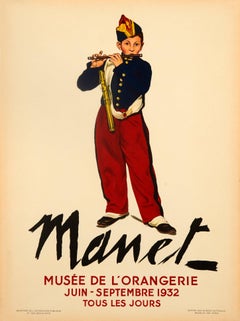
Le Fifre - Musée De L'Orangerie (after) Edouard Manet, 1932

Le Fifre - Musée De L'Orangerie (after) Edouard Manet, 1932

By Édouard Manet

Located in New York, NY

Artist: Edouard Manet Medium: Lithographic Poster, 1932 Dimensions: 29.5 x 22 in, 75 x 55.9 cm Classic Poster Paper - Excellent Condition A This 1932 very rare lithographic poster reproduces an amazing painting by Edouard Manet entitled "Le Fifre" (the fifer), from 1866. It was displayed at the Louvre from 1914 until 1947, when it was relocated to the Musée du Jeu de Paume. In 1986, it was moved to its current home in the Musée d'Orsay, the national museum of 19th-century art. (it is now on loan to the Louvre in Abu Dhabi.) On a trip to Spain in 1865, Édouard Manet visited the Prado, where the art of Diego Velasquez...

Category

1930s Art
Materials

Lithograph

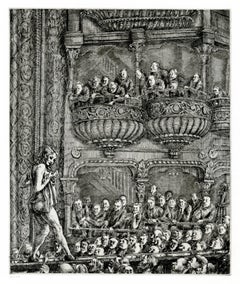
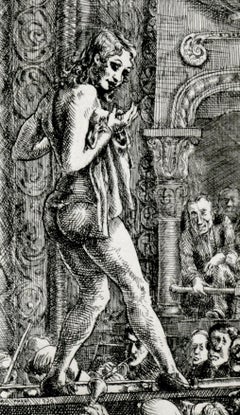
Gaiety Burlesk
Gaiety Burlesk

Gaiety Burlesk

By Reginald Marsh

Located in Fairlawn, OH

Gaiety Burlesque Etching, 1930 Unsigned (as usual for the Whitney edition); Numbered in pencil lower left; Blind stamp of the Whitney Museum (WM) lower right Edition: 114, regular ed...

Category

American Modern 1930s Art

Materials

Etching