Want more images or videos?
Request additional images or videos from the seller
1 of 6

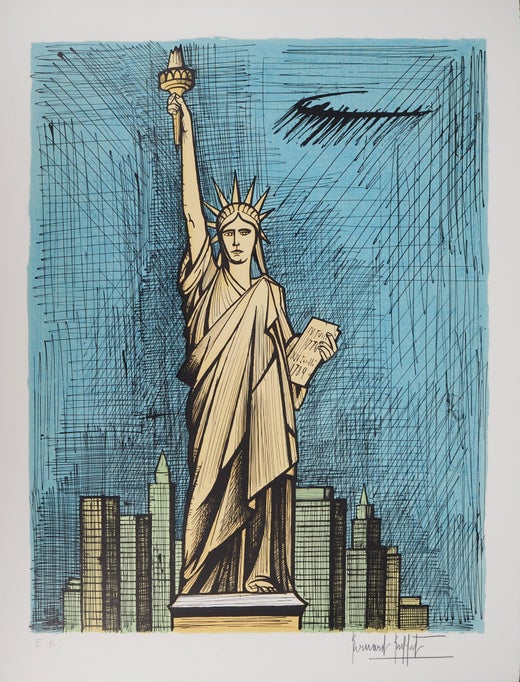
Bernard Buffet
Le Clown Pointu

1968

You May Also Like

Giorgio de Chirico 1960s Original Signed Lithography
By Giorgio De Chirico
Located in Roma, IT
Giorgio de Chirico 1960s Original Signed Lithography Lithograph with golden yellow background Signed in pencil lower left ‘P d A’ Artist's proof Signed in pencil lower right ‘G. De ...
Category

1950s Modern Animal Prints

Materials

Paper, Lithograph

British Post Office Greetings Telegrams (1935-1978), after various artists
Located in London, GB
British Post Office Greetings Telegrams (1935-1978), after various artists photolithograph dimensions, including frames: 33 x Telegram 9 ¾ x 11 ⅞ in. (24.8 x 30.1 cm.) 31 x Telegram 10 ½ x 12 in. (26.8 x 30.5 cm.) 12 x Telegram 11 ½ x 18 in. (29.2 x 45.7 cm.) and similar 12 x Telegram 9 x 11 ½ in. (22.9 x 29.2 cm.) 1 x Telegram 11 ¾ x 12 ¾ in. (29.8 x 32.4 cm.) 1 x Telegram 9 x 10 ⅜ in. (22.9 x 26.3 cm.) 1 x Telegram 8 x 10 ½ in. (20.3 x 26.7 cm.) A set of ninety-one (91) The historical equivalent of a text or WhatsApp message, the first telegram was sent in code in 1844 from Washington to Baltimore by Samuel Morse, asking “What hath God wrought?” By 1870 (the year that the British General...
Category

20th Century Modern Figurative Prints

Materials

Lithograph
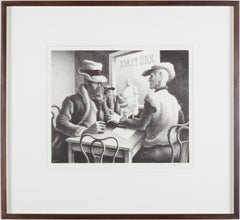
Descente aux enfers
By Georges Braque
Located in Paris, FR
Lithograph on Japan Paper, 1961 handsigned by the artist in pencil 23 x 19 cm (image) - 32 x 25 cm (sheet) very good condition LCD2804
Category

1960s Modern Figurative Prints

Materials

Lithograph
Descente aux enfers
$4,514
H 12.6 in Dm 9.85 in
Memnon - after Georges Braque - Lithograph - 1988 - Figurative Print
By (after) Georges Braque
Located in Sint-Truiden, BE
Color lithograph after a gouache by Georges Braque from the edition of 398 published by Armand & Georges Israel in 1988. Printed signature. Artwork entirely made in France: from th...
Category

1980s Modern Figurative Prints

Materials

Lithograph
Hébé - after Georges Braque - Lithograph - 1988 - Figurative Print
By (after) Georges Braque
Located in Sint-Truiden, BE
Color lithograph after a gouache by Georges Braque from the edition of 398 published by Armand & Georges Israel in 1988. Printed signature. Artwork en...
Category

1980s Modern Figurative Prints

Materials

Lithograph
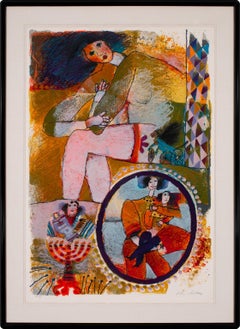
"Mother"
By Raphael Soyer
Located in Southampton, NY
Signed in pencil lower right AP (artist proof)lower left Sight size 18 x 12 in Overall size in museum quality matted frame 30 x 23 in Same lithograph is in permanent collection of th...
Category

Mid-20th Century Modern Figurative Prints

Materials

Lithograph
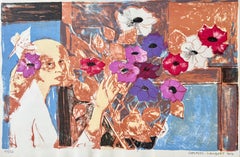
"Mother"
$1,250 Sale Price
43% Off
H 30 in W 23 in D 1 in
Marc Chagall - Bateau Mouche au bouquet - Original Lithograph
By Marc Chagall
Located in Collonge Bellerive, Geneve, CH
Marc Chagall Original Lithograph Title: Bateau Mouche au bouquet 1963 Dimensions: 39 x 30 cm Edition: 180 Unsigned as issued. From Regards sur Paris Published by André Sauret Condit...
Category

1960s Modern Figurative Prints

Materials

Lithograph
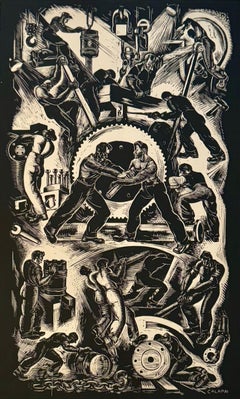
Marc Chagall - Moses with Tablets of Stone - Original Lithograph
By Marc Chagall
Located in Collonge Bellerive, Geneve, CH
Marc Chagall, Original Lithograph depicting an instant of the Bible. Technique: Original lithograph in colours Year: 1956 Sizes: 35,5 x 26 cm / 14" x 10.2" (sheet) Published by: Éditions de la Revue Verve, Tériade, Paris Printed by: Atelier Mourlot, Paris Documentation / References: Mourlot, F., Chagall Lithograph [II] 1957-1962, A. Sauret, Monte Carlo 1963, nos. 234 and 257 Marc Chagall (born in 1887) Marc Chagall was born in Belarus in 1887 and developed an early interest in art. After studying painting, in 1907 he left Russia for Paris, where he lived in an artist colony on the city’s outskirts. Fusing his own personal, dreamlike imagery with hints of the fauvism and cubism popular in France at the time, Chagall created his most lasting work—including I and the Village (1911)—some of which would be featured in the Salon des Indépendants exhibitions. After returning to Vitebsk for a visit in 1914, the outbreak of WWI trapped Chagall in Russia. He returned to France in 1923 but was forced to flee the country and Nazi persecution during WWII. Finding asylum in the U.S., Chagall became involved in set and costume design before returning to France in 1948. In his later years, he experimented with new art forms and was commissioned to produce numerous large-scale works. Chagall died in St.-Paul-de-Vence in 1985. The Village Marc Chagall was born in a small Hassidic community on the outskirts of Vitebsk, Belarus, on July 7, 1887. His father was a fishmonger, and his mother ran a small sundries shop in the village. As a child, Chagall attended the Jewish elementary school, where he studied Hebrew and the Bible, before later attending the Russian public school. He began to learn the fundamentals of drawing during this time, but perhaps more importantly, he absorbed the world around him, storing away the imagery and themes that would feature largely in most of his later work. At age 19 Chagall enrolled at a private, all-Jewish art school and began his formal education in painting, studying briefly with portrait artist Yehuda Pen. However, he left the school after several months, moving to St. Petersburg in 1907 to study at the Imperial Society for the Protection of Fine Arts. The following year, he enrolled at the Svanseva School, studying with set designer Léon Bakst, whose work had been featured in Sergei Diaghilev's Ballets Russes. This early experience would prove important to Chagall’s later career as well. Despite this formal instruction, and the widespread popularity of realism in Russia at the time, Chagall was already establishing his own personal style, which featured a more dreamlike unreality and the people, places and imagery that were close to his heart. Some examples from this period are his Window Vitebsk (1908) and My Fianceé with Black Gloves (1909), which pictured Bella Rosenfeld, to whom he had recently become engaged. The Beehive Despite his romance with Bella, in 1911 an allowance from Russian parliament member and art patron Maxim Binaver enabled Chagall to move to Paris, France. After settling briefly in the Montparnasse neighborhood, Chagall moved further afield to an artist colony known as La Ruche (“The Beehive”), where he began to work side by side with abstract painters such as Amedeo Modigliani and Fernand Léger as well as the avant-garde poet Guillaume Apollinaire. At their urging, and under the influence of the wildly popular fauvism and cubism, Chagall lightened his palette and pushed his style ever further from reality. I and the Village (1911) and Homage to Apollinaire (1912) are among his early Parisian works, widely considered to be his most successful and representative period. Though his work stood stylistically apart from his cubist contemporaries, from 1912 to 1914 Chagall exhibited several paintings at the annual Salon des Indépendants exhibition, where works by the likes of Juan Gris, Marcel Duchamp and Robert Delaunay were causing a stir in the Paris art world. Chagall’s popularity began to spread beyond La Ruche, and in May 1914 he traveled to Berlin to help organize his first solo exhibition, at Der Sturm Gallery. Chagall remained in the city until the highly acclaimed show opened that June. He then returned to Vitebsk, unaware of the fateful events to come. War, Peace and Revolution In August 1914 the outbreak of World War I precluded Chagall’s plans to return to Paris. The conflict did little to stem the flow of his creative output, however, instead merely giving him direct access to the childhood scenes so essential to his work, as seen in paintings such as Jew in Green (1914) and Over Vitebsk (1914). His paintings from this period also occasionally featured images of the war’s impact on the region, as with Wounded Soldier (1914) and Marching (1915). But despite the hardships of life during wartime, this would also prove to be a joyful period for Chagall. In July 1915 he married Bella, and she gave birth to a daughter, Ida, the following year. Their appearance in works such as Birthday (1915), Bella and Ida by the Window (1917) and several of his “Lovers” paintings give a glimpse of the island of domestic bliss that was Chagall’s amidst the chaos. To avoid military service and stay with his new family, Chagall took a position as a clerk in the Ministry of War Economy in St. Petersburg. While there he began work on his autobiography and also immersed himself in the local art scene, befriending novelist Boris Pasternak, among others. He also exhibited his work in the city and soon gained considerable recognition. That notoriety would prove important in the aftermath of the 1917 Russian Revolution when he was appointed as the Commissar of Fine Arts in Vitebsk. In his new post, Chagall undertook various projects in the region, including the 1919 founding of the Academy of the Arts. Despite these endeavors, differences among his colleagues eventually disillusioned Chagall. In 1920 he relinquished his position and moved his family to Moscow, the post-revolution capital of Russia. In Moscow, Chagall was soon commissioned to create sets and costumes for various productions at the Moscow State Yiddish...
Category

1950s Modern Figurative Prints

Materials

Lithograph
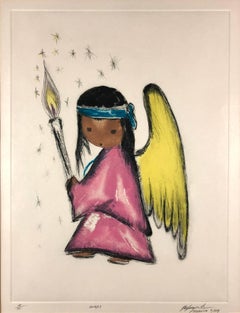
Marc Chagall - Moses - Original Lithograph
By Marc Chagall
Located in Collonge Bellerive, Geneve, CH
Marc Chagall, Original Lithograph depicting an instant of the Bible. Technique: Original lithograph in colours Year: 1956 Sizes: 35,5 x 26 cm / 14" x 10.2" (sheet) Published by: Éditions de la Revue Verve, Tériade, Paris Printed by: Atelier Mourlot, Paris Documentation / References: Mourlot, F., Chagall Lithograph [II] 1957-1962, A. Sauret, Monte Carlo 1963, nos. 234 and 257 Marc Chagall (born in 1887) Marc Chagall was born in Belarus in 1887 and developed an early interest in art. After studying painting, in 1907 he left Russia for Paris, where he lived in an artist colony on the city’s outskirts. Fusing his own personal, dreamlike imagery with hints of the fauvism and cubism popular in France at the time, Chagall created his most lasting work—including I and the Village (1911)—some of which would be featured in the Salon des Indépendants exhibitions. After returning to Vitebsk for a visit in 1914, the outbreak of WWI trapped Chagall in Russia. He returned to France in 1923 but was forced to flee the country and Nazi persecution during WWII. Finding asylum in the U.S., Chagall became involved in set and costume design before returning to France in 1948. In his later years, he experimented with new art forms and was commissioned to produce numerous large-scale works. Chagall died in St.-Paul-de-Vence in 1985. The Village Marc Chagall was born in a small Hassidic community on the outskirts of Vitebsk, Belarus, on July 7, 1887. His father was a fishmonger, and his mother ran a small sundries shop in the village. As a child, Chagall attended the Jewish elementary school, where he studied Hebrew and the Bible, before later attending the Russian public school. He began to learn the fundamentals of drawing during this time, but perhaps more importantly, he absorbed the world around him, storing away the imagery and themes that would feature largely in most of his later work. At age 19 Chagall enrolled at a private, all-Jewish art school and began his formal education in painting, studying briefly with portrait artist Yehuda Pen. However, he left the school after several months, moving to St. Petersburg in 1907 to study at the Imperial Society for the Protection of Fine Arts. The following year, he enrolled at the Svanseva School, studying with set designer Léon Bakst, whose work had been featured in Sergei Diaghilev's Ballets Russes. This early experience would prove important to Chagall’s later career as well. Despite this formal instruction, and the widespread popularity of realism in Russia at the time, Chagall was already establishing his own personal style, which featured a more dreamlike unreality and the people, places and imagery that were close to his heart. Some examples from this period are his Window Vitebsk (1908) and My Fianceé with Black Gloves (1909), which pictured Bella Rosenfeld, to whom he had recently become engaged. The Beehive Despite his romance with Bella, in 1911 an allowance from Russian parliament member and art patron Maxim Binaver enabled Chagall to move to Paris, France. After settling briefly in the Montparnasse neighborhood, Chagall moved further afield to an artist colony known as La Ruche (“The Beehive”), where he began to work side by side with abstract painters such as Amedeo Modigliani and Fernand Léger as well as the avant-garde poet Guillaume Apollinaire. At their urging, and under the influence of the wildly popular fauvism and cubism, Chagall lightened his palette and pushed his style ever further from reality. I and the Village (1911) and Homage to Apollinaire (1912) are among his early Parisian works, widely considered to be his most successful and representative period. Though his work stood stylistically apart from his cubist contemporaries, from 1912 to 1914 Chagall exhibited several paintings at the annual Salon des Indépendants exhibition, where works by the likes of Juan Gris, Marcel Duchamp and Robert Delaunay were causing a stir in the Paris art world. Chagall’s popularity began to spread beyond La Ruche, and in May 1914 he traveled to Berlin to help organize his first solo exhibition, at Der Sturm Gallery. Chagall remained in the city until the highly acclaimed show opened that June. He then returned to Vitebsk, unaware of the fateful events to come. War, Peace and Revolution In August 1914 the outbreak of World War I precluded Chagall’s plans to return to Paris. The conflict did little to stem the flow of his creative output, however, instead merely giving him direct access to the childhood scenes so essential to his work, as seen in paintings such as Jew in Green (1914) and Over Vitebsk (1914). His paintings from this period also occasionally featured images of the war’s impact on the region, as with Wounded Soldier (1914) and Marching (1915). But despite the hardships of life during wartime, this would also prove to be a joyful period for Chagall. In July 1915 he married Bella, and she gave birth to a daughter, Ida, the following year. Their appearance in works such as Birthday (1915), Bella and Ida by the Window (1917) and several of his “Lovers” paintings give a glimpse of the island of domestic bliss that was Chagall’s amidst the chaos. To avoid military service and stay with his new family, Chagall took a position as a clerk in the Ministry of War Economy in St. Petersburg. While there he began work on his autobiography and also immersed himself in the local art scene, befriending novelist Boris Pasternak, among others. He also exhibited his work in the city and soon gained considerable recognition. That notoriety would prove important in the aftermath of the 1917 Russian Revolution when he was appointed as the Commissar of Fine Arts in Vitebsk. In his new post, Chagall undertook various projects in the region, including the 1919 founding of the Academy of the Arts. Despite these endeavors, differences among his colleagues eventually disillusioned Chagall. In 1920 he relinquished his position and moved his family to Moscow, the post-revolution capital of Russia. In Moscow, Chagall was soon commissioned to create sets and costumes for various productions at the Moscow State Yiddish...
Category

1950s Modern Figurative Prints

Materials

Lithograph

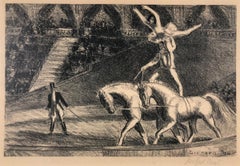
Pablo Picasso - Les Banderillas - Original Lithograph
By Pablo Picasso
Located in Collonge Bellerive, Geneve, CH
Original Lithograph by Picasso Atelier Mourlot. Paper: Vélin. Dimensions : 9 5/8 x 12 7/16 inches Bloch 1017; Cramer 113; Mourlot 350
Category

1960s Modern Animal Prints

Materials

Lithograph
More From This Seller

View All
Cove at Vintage
By LeRoy Neiman
Located in Missouri, MO
Cove at Vintage Leroy Neiman (American, 1921-2012) Signed in pencil lower right Edition 237/375 lower left 34 x 36.5 inches 43 x 45.5 inches with frame Known for his bright, colorful paintings and screen prints of famous sports stars...
Category

20th Century American Modern Landscape Prints

Materials

Color, Lithograph
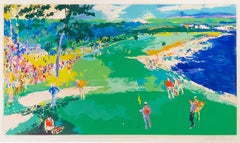
The 18th at Pebble Beach
By LeRoy Neiman
Located in Missouri, MO
The 18th at Pebble Beach Leroy Neiman (American, 1921-2012) Signed in pencil lower right Edition 176/400 lower left 26 x 43 inches 37.25 x 54.5 inches with frame Known for his bright, colorful paintings and screen prints of famous sports stars...
Category

20th Century American Modern Landscape Prints

Materials

Color, Lithograph

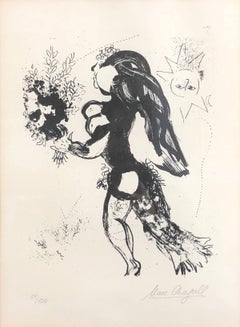
L'Offrande (Signed and Numbered)
By Marc Chagall
Located in Missouri, MO
Lithograph on Arches Paper Pencil Signed Lower Right, "Marc Chagall" Numbered Lower Left Ed. 51/100 Published by CH. SORLIER SIte Size: 19 x 12.5 Framed Size: approx 27.5 x 22.5
Category

1960s Modern Figurative Prints

Materials

Lithograph
Personnages De Sacre Printemps V
By Marino Marini
Located in Missouri, MO
Color Lithograph Signed and Numbered Ed. 75 Marino Marini (February 27, 1901 — August 6, 1980) was an Italian sculptor. Born in Pistoia, Marini is particularly famous for his serie...
Category

1970s Modern Figurative Prints

Materials

Lithograph

Devant le Tableau (Signed and Numbered)
By Marc Chagall
Located in Missouri, MO
Lithograph on Arches Paper Pencil Signed Lower Right, "Marc Chagall" Numbered Lower Left Ed. 9/40, one of 40 impressions reserved for the artist aside from the standard signed editio...
Category

1960s Modern Figurative Prints

Materials

Lithograph

Le Christ a l'Horloge, Paris (Christ in the Clock)
By Marc Chagall
Located in Missouri, MO
Marc Chagall "Le Christ a l'Horloge, Paris" (Christ in the Clock) 1957 (M. 196) Color Lithograph on Arches Wove Paper Signed in Pencil "Marc Chagall" Lower Right Initialed "H.C." (Hors Commerce) Lower Left, aside from numbered edition of 90 *Floated in Gold Frame with Linen Matting, UV Plexiglass Sheet Size: 18 3/4 x 14 3/4 inches (47.5 cm x 38 cm) Image Size: 9 3/4 x 8 1/2 inches Framed Size: 28.5 x 24.25 inches Marc Chagall was a man of keen intelligence, a shrewd observer of the contemporary scene, with a great sympathy for human suffering. He was born on July 7, 1887 in Vitebsk, Russia; his original name was Moishe Shagal (Segal), but when he became a foremost member of the Ecole de Paris, he adopted French citizenship and the French spelling of his name. Vitebsk was a good-sized Russian town of over 60,000, not a shtetl. His father supported a wife and eight children as a worker in a herring-pickling plant. Sheltered by the Jewish commandment against graven images, the young Chagall never saw so much as a drawing until, one day, he watched a schoolmate copying a magazine illustration. He was ridiculed for his astonishment, but he began copying and improvising from magazines. Both Chagall's parents reluctantly agreed to let him study with Yehuda Pen, a Jewish artist in Vitebsk. Later, in 1906, they allowed their son to study in St. Petersburg, where he was exposed to Russian Iconography and folk art. At that time, Jews could leave the Pale only for business and employment and were required to carry a permit. Chagall, who was in St. Petersburg without a permit, was imprisoned briefly. His first wife, Bella Rosenfeld, was a product of a rich cultivated and intellectual group of Jews in Vitebsk. Chagall was made commissar for the arts for the area, charged with directing its cultural life and establishing an art school. Russian folklore, peasant life and landscapes persisted in his work all his life. In 1910 a rich patron, a lawyer named Vinaver, staked him to a crucial trip to Paris, where young artists were revolutionizing art. He also sent him a handsome allowance of 125 francs (in those days about $24) each month. Chagall rejected cubism, fauvism and futurism, but remained in Paris. He found a studio near Montparnasse in a famous twelve-sided wooden structure divided into wedge-shaped rooms. Chaim Soutine, a fellow Russian Jew, and Modigliani lived on the same floor. To Chagall's astonishment, he found himself heralded as one of the fathers of surrealism. In 1923, a delegation of Max Ernst, Paul Eluard and Gala (later Salvador Dali's wife) actually knelt before Chagall, begging him to join their ranks. He refused. To understand Chagall's work, it is necessary to know that he was born a Hasidic Jew, heir to mysticism and a world of the spirit, steeped in Jewish lore and reared in the Yiddish language. The Hasidim had a special feeling for animals, which they tried not to overburden. In the mysterious world of Kabbala and fantastic ancient legends of Chagall's youth, the imaginary was as important as the real. His extraordinary use of color also grew out of his dream world; he did not use color realistically, but for emotional effect and to serve the needs of his design. Most of his favorite themes, though superficially light and trivial, mask dark and somber thoughts. The circus he views as a mirror of life; the crucifixion as a tragic theme, used as a parallel to the historic Jewish condition, but he is perhaps best known for the rapturous lovers he painted all his life. His love of music is a theme that runs through his paintings. After a brief period in Berlin, Chagall, Bella and their young daughter, Ida, moved to Paris and in 1937 they assumed French citizenship. When France fell, Chagall accepted an invitation from the Museum of Modern Art to immigrate to the United States. He was arrested and imprisoned in Marseilles for a short time, but was still able to immigrate with his family. The Nazi onslaught caught Chagall in Vichy, France, preoccupied with his work. He was loath to leave; his friend Varian Fry rescued him from a police roundup of Jews in Marseille, and packed him, his family and 3500 lbs. of his art works on board a transatlantic ship. The day before he arrived in New York City, June 23, 1941, the Nazis attacked Russia. The United States provided a wartime haven and a climate of liberty for Chagall. In America he spent the war years designing large backdrops for the Ballet. Bella died suddenly in the United States of a viral infection in September 1944 while summering in upstate New York. He rushed her to a hospital in the Adirondacks, where, hampered by his fragmentary English, they were turned away with the excuse that the hour was too late. The next day she died. He waited for three years after the war before returning to France. With him went a slender married English girl, Virginia Haggard MacNeil; Chagall fell in love with her and they had a son, David. After seven years she ran off with an indigent photographer. It was an immense blow to Chagall's ego, but soon after, he met Valentine Brodsky, a Russian divorcee designing millinery in London (he called her Fava). She cared for him during the days of his immense fame and glory. They returned to France, to a home and studio in rustic Vence. Chagall loved the country and every day walked through the orchards, terraces, etc. before he went to work. Chagall died on March 28, 1985 in the south of France. His heirs negotiated an arrangement with the French state allowing them to pay most of their inheritance taxes in works of art. The heirs owed about $30 million to the French government; roughly $23 million of that amount was deemed payable in artworks. Chagall's daughter, Ida and his widow approved the arrangement. Written and submitted by Jean Ershler Schatz, artist and researcher from Laguna Woods, California. Sources: Hannah Grad Goodman in Homage to Chagall in Hadassah Magazine, June 1985 Jack Kroll in Newsweek, April 8, 1985 Andrea Jolles in National Jewish Monthly Magazine, May 1985 Michael Gibson...
Category

1950s Modern Figurative Prints

Materials

Lithograph

Recently Viewed

View All