Want more images or videos?
Request additional images or videos from the seller
1 of 6

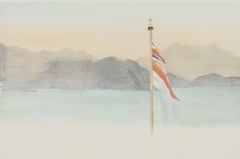
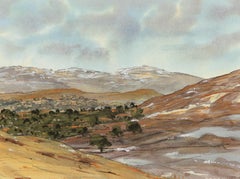
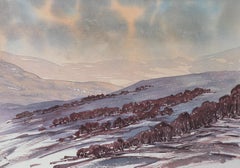
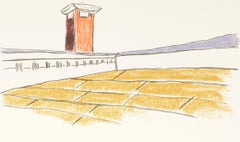
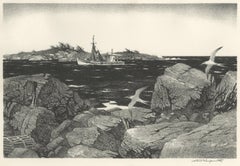
James Allen
The Bridge

c. 1936-7

$1,250List Price

You May Also Like

Red-breasted Flycatcher Birds: A 19th C. Hand-colored Lithograph by John Gould
By John Gould and Henry Constantine Richter
Located in Alamo, CA
This is a striking hand-colored folio sized lithograph entitled "Erythrosterna Parva" (Red-breasted Flycatcher) by John Gould from his monograph "The Birds of Great Britain", publish...
Category

Mid-19th Century Naturalistic Animal Prints

Materials

Lithograph

Original Boyriven Aviation Navigation Chemin de Fer art deco vintage poster 1933
Located in Spokane, WA
An authentic, original Boyriven vintage poster designed by O.K. Gerand, professionally linen-backed for durability and display. A striking composition with bold graphics and clean ty...
Category

1930s Art Deco Portrait Prints

Materials

Lithograph

Original "Food Will Win The War" vintage World War 1 poster
By Charles E. Chambers
Located in Spokane, WA
Original World War 1 vintage poster: Food Will Wn the War. Arhival linen backed. PRINTER: Rusling Wood Litho., New York Bright and in good condition. There is some marks down the left side of the poster, possible ink from when the poster was printed. This poster calls on immigrants to do their part in the war effort. It depicts recent immigrants standing near a sailing ship with the Statue of Liberty and a rainbow stretched across the New York City skyline in the background. The text reads: You came here seeking Freedom. You must now help preserve it. Wheat is needed by the allies. Waste nothing. The generosity and compassion of the American people and the great agricultural resources of the North American continent would be called upon... Twenty million Americans signed pledges of membership in the Food Administration...
Category

1910s American Realist Figurative Prints

Materials

Lithograph

Original Passion Play Oberammergau Tercentenary 1634 - 1934 vintage poster
By Jupp Wiertz
Located in Spokane, WA
Original Passion Play Tercentenary Oberammergau, 300th-year anniversary poster (1634 - 1934). "Germany Invites You!" This archivally linen-backed poster is the English version. It fe...
Category

1930s Art Deco Landscape Prints

Materials

Lithograph

Urban Landscapes Oct 83 Exhibit
By Richard Estes
Located in Rochester Hills, MI
Artist Name: Richard Estes Year: 1983 Size-Width Size-Height: 22¾" x 20"  Natalie Knight Gallery David Krut Fine Art 8 Oct 83 Unframed in Very Good Condition. Richard Estes is an ...
Category

1980s Abstract Landscape Prints

Materials

Lithograph

John Rogers Cox Original AAA Lithograph. “Wheat Shocks”
By John Rogers Cox
Located in Phoenix, AZ
Original pencil signed stone lithograph by AAA artist John Rogers Cox (1915-1990) This wonderful Regionalist image measures 8 3/4"h x 11 3/4"w. Paper size is 12 x 16. The work presen...
Category

1950s Landscape Prints

Materials

Lithograph

Original "Sint-Truiden Carnaval!" vintage festival poster
Located in Spokane, WA
Original 1959 “Sint-Truiden Carnaval!” vintage lithograph poster. Archivally linen backed in very good condition, ready to frame. No paper loss, no tears, no stains. Excellent gr...
Category

1950s Modern Figurative Prints

Materials

Lithograph

Original "Sint-Truiden Carnaval!"  vintage festival poster
$1,196 Sale Price
20% Off
H 39 in W 24.5 in D 0.05 in
Normandy : La Frette sur Seine - Lithograph, Ltd /200
By Albert Marquet
Located in Paris, IDF
Albert MARQUET Normandy : La Frette sur Seine Original lithograph Signed with the artist stamp Numbered / 200 On Arches vellum 45 x 57 cm (c. 18 x 23 in) Excellent condition
Category

Early 20th Century Post-Impressionist Landscape Prints

Materials

Lithograph

Realist Skyscape Triptych in Blue Tones of Serene Cloudy Sky, Handmade Cyanotype
By Kind of Cyan
Located in Barcelona, ES
This series of cyanotype triptychs showcases the beauty of nature scenes, including stunning beaches and oceans, as well as the intricate textures of water, forests, and skies. These...
Category

2010s Realist Landscape Paintings

Materials

Paper, Emulsion, Lithograph

Whitefish Point
Located in Chesterfield, MI
Whitefish Point is a famous lighthouse located in Paradise, Michigan at the southeastern end of Lake Superior. Leo Kuschel's paintings and prints are hig...
Category

Late 20th Century Realist Landscape Prints

Materials

Lithograph

Whitefish Point
$180 Sale Price
53% Off
H 25 in W 30 in

More From This Seller

View All
Poplar Tree B
By Shiko Munakata
Located in Fairlawn, OH
Poplar Tree B Lithograph, c. 1959 Signed and numbered in pencil by the artist (see photo) Artist's red stamp lower left margin (see photo) Edition: 50 (20/50) Printed by Arthur Flory...
Category

1950s Modern Landscape Prints

Materials

Lithograph

Snow Mountain (or Lake in the Mountains)
By Adolf Arthur Dehn
Located in Fairlawn, OH
Signed lower right Edition: Undetermined, plus an artist's edition of 10 Edition: Undetermined, plus an artist's edition of 10 Published by the Associated American Artist ...
Category

1960s Landscape Prints

Materials

Lithograph

City Park, Winter
By Aaron Bohrod
Located in Fairlawn, OH
City Park, Winter Lithograph, c. 1947 Signed in pencil lower right (see photo) Published by Associated American Artists Printed by George C. Miller, New York Edition: c. 250 In the Bohrod papers at Syracuse University, the artist states that it is a view of Pittsburgh. It depicts the George Washington Monument in Allegheny Commons Park, dedicated in 1891. The sculptor f the monument is Edward Ludwig Albert Pausch (1856-1931). Condition: Excellent Image size: 9 1/4 x 13 7/16 inches Frame size: 19 x 23 inches Provenance: Estate of Adolf Dehn Reference: AAA Index No. 848 Aaron Bohrod (21 November 1907 – 3 April 1992) was an American artist best known for his trompe-l'œil still-life paintings. Education Bohrod was born in Chicago in 1907, the son of an emigree Bessarabian-Jewish grocer. Bohrod studied at the School of the Art Institute of Chicago and the Art Students League of New York between 1926 and 1930. While at the Art Students League, Bohrod was influenced by John Sloan and chose themes that involved his own surroundings. Career He returned to Chicago in 1930 where he painted views of the city and its working class. He eventually earned Guggenheim Fellowships which permitted him to travel throughout the country, painting and recording the American scene. His early work won him widespread praise as an important social realist and regional painter and printmaker and his work was marketed through Associated American Artists in New York. Bohrod completed three commissioned murals for the Treasury Departments Section of Fine Arts in Illinois; Vandalia in 1935, Galesburg in 1938 and Clinton in 1939. During World War II, Bohrod worked as an artist; first in the Pacific for the United States Army Corps of Engineers' Army War Art Unit...
Category

1940s American Realist Landscape Prints

Materials

Lithograph

The Columns of Herakles
By Ossip Zadkine
Located in Fairlawn, OH
The Columns of Herakles Lithograph in Grey printed Zerkall-Vellum paper, 1960 Signed in pencil by the artist 'O. Zadkine' at the lower right corner (see photo) Numbered in pencil 102...
Category

1960s Surrealist Landscape Prints

Materials

Lithograph

The Golden Gate
By Adolf Arthur Dehn
Located in Fairlawn, OH
The Golden Gate Lithograph on wove paper watermarked GC, 1940 Signed in pencil by the artist (see photo) Publisher: Associated American Artists Edition: 189, unnumbered The image depicts The Golden Gate Bridge which connects San Francisco and Marin County, California References And Exhibitions: Illustrated: Adams, The Sensuous Life of Adolf Dehn, Fig. 13.17, page 324 Reference: L & O 325 AAA Index 391 Adolf Dehn, American Watercolorist and Printmaker, 1895-1968 Adolf Dehn was an artist who achieved extraordinary artistic heights, but in a very particular artistic sphere—not so much in oil painting as in watercolor and lithography. Long recognized as a master by serious print collectors, he is gradually gaining recognition as a notable and influential figure in the overall history of American art. In the 19th century, with the invention of the rotary press, which made possible enormous print runs, and the development of the popular, mass-market magazines, newspaper and magazine illustration developed into an artistic realm of its own, often surprisingly divorced from the world of museums and art exhibitions, and today remains surprisingly overlooked by most art historians. Dehn in many regards was an outgrowth of this world, although in an unusual way, since as a young man he produced most of his illustrative work not for popular magazines, such as The Saturday Evening Post, but rather for radical journals, such as The Masses or The Liberator, or artistic “little magazines” such as The Dial. This background established the foundation of his outlook, and led later to his unique and distinctive contribution to American graphic art. If there’s a distinctive quality to his work, it was his skill in introducing unusual tonal and textural effects into his work, particularly in printmaking but also in watercolor. Jackson Pollock seems to have been one of many notable artists who were influenced by his techniques. Early Years, 1895-1922 For an artist largely remembered for scenes of Vienna and Paris, Adolf Dehn’s background was a surprising one. Born in Waterville, Minnesota, on November 22, 1895, Dehn was the descendent of farmers who had emigrated from Germany and homesteaded in the region, initially in a one-room log cabin with a dirt floor. Adolf’s father, Arthur Clark Dehn, was a hunter and trapper who took pride that he had no boss but himself, and who had little use for art. Indeed, during Adolf’s boyhood the walls of his bedroom and the space under his bed were filled with the pelts of mink, muskrats and skunks that his father had killed, skinned and stretched on drying boards. It was Adolf’s mother, Emilie Haas Dehn, a faithful member of the German Lutheran Evangelical Church, who encouraged his interest in art, which became apparent early in childhood. Both parents were ardent socialists, and supporters of Eugene Debs. In many ways Dehn’s later artistic achievement was clearly a reaction against the grinding rural poverty of his childhood. After graduating from high school in 1914 at the age of 19—an age not unusual in farming communities at the time, where school attendance was often irregular—Dehn attended the Minneapolis School of Art from 1914 to 1917, whose character followed strongly reflected that of its director, Munich-trained Robert Kohler, an artistic conservative but a social radical. There Dehn joined a group of students who went on to nationally significant careers, including Wanda Gag (later author of best-selling children’s books); John Flanagan (a sculptor notable for his use of direct carving) Harry Gottlieb (a notable social realist and member of the Woodstock Art Colony), Elizabeth Olds (a printmaker and administrator for the WPA), Arnold Blanch (landscape, still-life and figure painter, and member of the Woodstock group), Lucille Lunquist, later Lucille Blanch (also a gifted painter and founder of the Woodstock art colony), and Johan Egilrud (who stayed in Minneapolis and became a journalist and poet). Adolf became particularly close to Wanda Gag (1893-1946), with whom he established an intense but platonic relationship. Two years older than he, Gag was the daughter of a Bohemian artist and decorator, Anton Gag, who had died in 1908. After her husband died, Wanda’s mother, Lizzi Gag, became a helpless invalid, so Wanda was entrusted with the task of raising and financially supporting her six younger siblings. This endowed her with toughness and an independent streak, but nonetheless, when she met Dehn, Wanda was Victorian and conventional in her artistic taste and social values. Dehn was more socially radical, and introduced her to radical ideas about politics and free love, as well as to socialist publications such as The Masses and The Appeal to Reason. Never very interested in oil painting, in Minneapolis Dehn focused on caricature and illustration--often of a humorous or politically radical character. In 1917 both Dehn and Wanda won scholarships to attend the Art Students League, and consequently, in the fall of that year both moved to New York. Dehn’s art education, however, ended in the summer of 1918, shortly after the United States entered World War I, when he was drafted to serve in the U. S. Army. Unwilling to fight, he applied for status as a conscientious objector, but was first imprisoned, then segregated in semi-imprisonment with other Pacifists, until the war ended. The abuse he suffered at this time may well explain his later withdrawal from taking political stands or making art of an overtly political nature. After his release from the army, Dehn returned to New York where he fell under the spell of the radical cartoonist Boardman Robinson and produced his first lithographs. He also finally consummated his sexual relationship with Wanda Gag. The Years in Europe: 1922-1929 In September of 1921, however, he abruptly departed for Europe, arriving in Paris and then moving on to Vienna. There in the winter of 1922 he fell in love with a Russian dancer, Mura Zipperovitch, ending his seven-year relationship with Wanda Gag. He and Mura were married in 1926. It was also in Vienna that he produced his first notable artistic work. Influenced by European artists such as Jules Pascin and Georg Grosz, Dehn began producing drawings of people in cafes, streets, and parks, which while mostly executed in his studio, were based on spontaneous life studies and have an expressive, sometimes almost childishly wandering quality of line. The mixture of sophistication and naiveté in these drawings was new to American audiences, as was the raciness of their subject matter, which often featured pleasure-seekers, prostitutes or scenes of sexual dalliance, presented with a strong element of caricature. Some of these drawings contain an element of social criticism, reminiscent of that found in the work of George Grosz, although Dehn’s work tended to focus on humorous commentary rather than savagely attacking his subjects or making a partisan political statement. Many Americans, including some who had originally been supporters of Dehn such as Boardman Robinson, were shocked by these European drawings, although George Grocz (who became a friend of the artist in this period) admired them, and recognized that Dehn could also bring a new vision to America subject matter. As he told Dehn: “You will do things in America which haven’t been done, which need to be done, which only you can do—as far at least as I know America.” A key factor in Dehn’s artistic evolution at this time was his association with Scofield Thayer...
Category

1940s American Realist Landscape Prints

Materials

Lithograph

Les Jardin des Tuileries
By Edouard Vuillard
Located in Fairlawn, OH
Signed by the artist in pencil upper right; Annotated in pencil by the artist below signature: "no 58" Edition: Intended edition of 100 for Vollard's "Album des Peintres-Gravures" o...
Category

Late 19th Century Landscape Prints

Materials

Lithograph
Still Thinking About These?

All Recently Viewed