Want more images or videos?
Request additional images or videos from the seller
1 of 5
Pieter Bruegel the ElderArmed Four Master Putting Out to Sea1561
1561
$12,500List Price
About the Item
- Creator:Pieter Bruegel the Elder (1525 - 1569, Dutch)
- Creation Year:1561
- Dimensions:Height: 10 in (25.4 cm)Width: 12 in (30.48 cm)Depth: 2 in (5.08 cm)
- Medium:
- Movement & Style:
- Period:
- Condition:
- Gallery Location:New York, NY
- Reference Number:1stDibs: LU51531453373

About the Seller
4.9
Recognized Seller
These prestigious sellers are industry leaders and represent the highest echelon for item quality and design.
Established in 2000
1stDibs seller since 2016
108 sales on 1stDibs
Typical response time: 18 hours
Associations
International Fine Print Dealers Association
Authenticity Guarantee
In the unlikely event there’s an issue with an item’s authenticity, contact us within 1 year for a full refund. DetailsMoney-Back Guarantee
If your item is not as described, is damaged in transit, or does not arrive, contact us within 7 days for a full refund. Details24-Hour Cancellation
You have a 24-hour grace period in which to reconsider your purchase, with no questions asked.Vetted Professional Sellers
Our world-class sellers must adhere to strict standards for service and quality, maintaining the integrity of our listings.Price-Match Guarantee
If you find that a seller listed the same item for a lower price elsewhere, we’ll match it.Trusted Global Delivery
Our best-in-class carrier network provides specialized shipping options worldwide, including custom delivery.You May Also Like
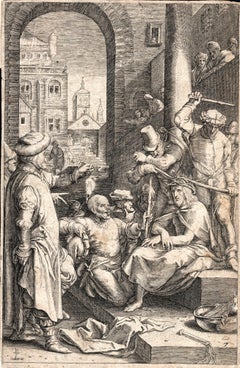
Christ Crowned with Thorns, from The Passion of Christ
By Hendrick Goltzius
Located in Middletown, NY
Engraving on cream wove paper, 8 x 5 3/8 inches (203 x 137 mm), narrow to thread margins. First state (of 2). A fine impression with archival paper adhered at left top and bottom cor...
Category
Early 17th Century Old Masters Figurative Prints
Materials
Engraving
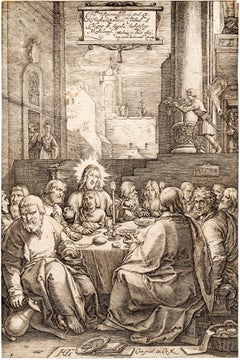
The Last Supper, from The Passion of Christ
By Hendrick Goltzius
Located in Middletown, NY
Engraving on cream laid paper, 8 x 5 3/8 inches (203 x 137 mm), trimmed at the platemark. A fine impression with a Coat of Arms watermark. Second state, after the addition of the Frederick de Witt...
Category
16th Century Old Masters Figurative Prints
Materials
Laid Paper, Engraving
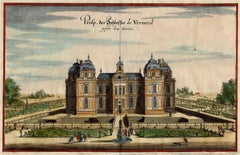
Chateau de Verneuil
By Matthäus Merian the Elder
Located in Middletown, NY
Engraving with hand coloring and heightening in watercolor on two leaves of expertly conjoined handmade laid paper, one leaf with a large watermark a feathered dragon, 7 1/4 x 11 1/4...
Category
Mid-17th Century Old Masters Landscape Prints
Materials
Watercolor, Handmade Paper, Engraving
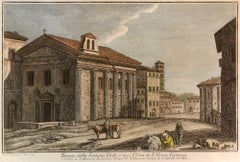
Veduta del Tempio della Fortuna Virile, from Raccolta delle più belle Vedute ...
By Giuseppe Vasi
Located in Middletown, NY
By Giuseppe Vasi after Giovanni Piranesi: Etching and engraving with hand coloring in watercolor on laid paper with an E and R watermark, full margins. Minor...
Category
Late 18th Century Old Masters Landscape Prints
Materials
Watercolor, Laid Paper, Engraving, Etching
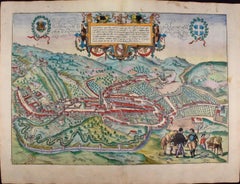
View of Seravalle, Italy: A 16th Century Hand-colored Map by Braun & Hogenberg
By Franz Hogenberg
Located in Alamo, CA
This is an original 16th century copperplate originally hand-colored engraved map of View of Seravalle, Italy entitled "Seravallum Celeberrimum Marchiae Tarvisiniae in Agro Foro Juliensi Opp. - Seravalli, quam vides, Spectator, iconem, operi huic nostro suis sumptib. . . ." by Georg Braun & Franz Hogenberg, from their famous city atlas "Civitates Orbis Terrarum", published in Augsberg, Germany in 1575.
The map depicts a view of Seravalle, now Vittorio Veneto, in San Marino, Italy, north of Venice, in a topographically accurate bird's-eye view from the south. A water-filled moat is seen to the south of the city walls and farmland to the east. Two men are depicted standing on a hill in the lower right in conversation next to grain sacks and a grazing horse, while a younger man behind them to the right herds a mule carrying presumably pigs. A very colorful and ornate title cartouche is in the upper center and coat-of-arms are in the right and left upper corners. Serravalle lies in an idyllic setting in the foothills and surrounded by orchards. St Mary's Cathedral with its tall bell tower is prominent in the center of the town. The marketplace and town hall with a bell tower in the square are depicted. Houses and shops are around the main square. Serravalle's importance as an agricultural centre is emphasized by the figures in the foreground. In 1337 Serravalle was conquered by the Republic of Venice. In 1866 the town was united with neighbouring Ceneda to form the town of Vittorio Veneto.
The following is an English translation of an excerpt from the French description of the city on the back of the map: "Serravalle, a market town renowned for cloth, wine and grain, is in such a beautiful situation that the number of its inhabitants, attracted by the loveliness of the place, has grown so much at times that the wall encircling it has had to be enlarged for the third time. The city with the surrounding town once belonged to the Church in Ceneda as an imperial fief. It subsequently became the seat of the Da Camino family (a princely house that at that time was one of the five most noble in all Italy). Now the city is under the sway of the Venetians but is prudently governed by them. For they send only one city councillor with instructions to ensure that justice prevails and to collect duties. In all else, power lies in the hands of the noble families."
This is a translation of the Latin in the title cartouche on the front: "The picture of the town of Serravalle, which you see, viewer, has been contributed to our work entirely at his own expense by Minutius, son of Hieronymus Minutius, a noble gentleman and one renowned for the far-reaching competence of his jurisdiction. We saw him sojourning in Cologne, where he was on business for Gregory XIII; while our good wishes accompany him, we should also like to accompany him on his way with this remembrance, even though it might be against his will, so that even those who have not seen him may learn of his excellence. However, those who do not yet know him will also see his excellence if God the Almighthy does not summon erring souls too soon back to the eternal seat of the Blessed."
References: Van der Krogt 4, 4728, State 1; Taschen, Braun and Hogenberg, p.331; Fauser, #14960
This striking hand-colored city view is printed on laid, chain-linked paper with wide margins. The sheet measures 16" high by 21" wide. There is a central vertical fold as issued and French text on the verso, with Latin on the front. There is some discoloration in the upper and right margins which may represent some watercolor paint from the time of the original hand-coloring of the map. There is a small hole to the right of the upper portion of the vertical fold, which is only visible when held up to light and an area of reinforcement on the verso of the lower vertical fold. The map is otherwise in very good to excellent condition.
Braun and Hogenberg's 'The Civitates Orbis Terrarum' was the second atlas of maps ever published and the first atlas of cities and towns of the world. It is one of the most important books published in the 16th century. Most of the maps in the atlas were engraved by Franz Hogenberg and the text, with its descriptions of the history and additional factual information of the cities, was written by a team of writers and edited by Georg Braun. The work contained 546 bird-eye views and map views of cities and towns from all over the world. It gave graphic representation of the main features of the illustrated cities and towns, including the buildings and streets. Although the ordinary buildings are stylized, the principal buildings are reproduced from actual drawings created on location. The principal landmarks and streets can still be recognized today. In addition, the maps often include the heraldic arms of the city, the nature of the surrounding countryside, the important rivers, streams and harbors, even depicting stone bridges, wooden pontoons, flat-bottomed ferries, ships and working boats, wharves and jetties, as well as land-based activities, including horsemen, pedestrians, wagons, coaches, and palanquins. Small vignettes are often included which illustrate the trade, occupations and habits of the local inhabitants, such as agriculture, paper-making and textiles, as well as local forms of punishment, such as gibbets, wheels, floggings etc. Large figures dressed in their local costume are often presented out of proportion in the foreground. The aim of the authors was to give as much information as possible in a pleasing visual form. They succeeded in creating maps that were both informative and decorative works of art. The atlas is a wonderful glimpse of life in medieval Europe.
Georg Braun (1541-1622) was German Catholic...
Category
16th Century Old Masters Landscape Prints
Materials
Engraving
$780 Sale Price
20% Off
H 16 in W 21 in
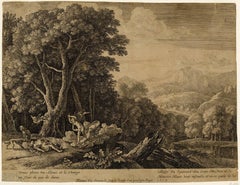
Venus Lamenting over the Death of Adonis
By Herman van Swanevelt
Located in Middletown, NY
c. 1654. Etching with engraving on thin laid paper with an early and large unidentified watermark with a sundial and a many-pointed star, and an unidentified collector's stamp in the...
Category
Mid-17th Century Old Masters Landscape Prints
Materials
Handmade Paper, Engraving, Etching
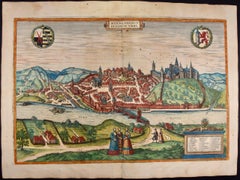
View of Meissen, Germany: A 16th Century Hand-colored Map by Braun & Hogenberg
By Franz Hogenberg
Located in Alamo, CA
This is a 16th century original hand-colored copperplate engraved map of View of View of Meissen, Germany entitled "Misena Hermun Duvorum Urbs" by Georg Braun & Franz Hogenberg, from their famous city atlas "Civitates Orbis Terrarum", published in Cologne, Germany in 1575.
The map depicts a side view and bird's-eye view, looking across the Elbe River (labelled Albis Fluvius on the map; White River in Latin) from the northeast. In the foreground are three women in conversation on a hill above the city, along with a man and a woman in conversation by a road, all dressed in contemporary costumes of the upper class. A coat-of-arms is present in each upper corner. A great castle sits atop a hill in the background on the left. Meissen grew up around Albrechtsburg castle, built by Emperor Henry I around AD 929, and was granted a municipal charter at the end of the 12th century. From 1471 onwards, the castle complex was reconstructed as the residence of the Saxon electors on the northeast corner of the Domberg (Cathedral Hill). Meissen cathedral is a Gothic hall church begun c. 1270; in 1413 a bolt of lightning destroyed its west towers, which were replaced only in the 20th century. Meissen lies to the northwest of Dresden, Germany in Saxony. Meissen is famous for its Meissen porcelain and the Albrechtsburg castle
The following is an English translation of an excerpt from Braun's description of the city: "This city is surrounded by very many rivers, to the east flows the Elbe, to the south the Triebisch, to the west are the mountains, to the north the Meisse, after which the city is said to be named. The city is well-situated in its surroundings, the navigable rivers, the mountains and the healthy air. Around the city there is a good land to grow grain, fertile vineyards on the hillsides and without doubt the mountains are not without ore, for one mile away, up the Elbe, is Scharfenberg, where silver and lead ore are mined.."
References: Van der Krogt 4, 2684; Taschen, Braun and Hogenberg...
Category
16th Century Old Masters Landscape Prints
Materials
Engraving
$780 Sale Price
20% Off
H 15.75 in W 21.25 in
View of Emden, Germany: A 16th Century Hand-colored Map by Braun & Hogenberg
By Franz Hogenberg
Located in Alamo, CA
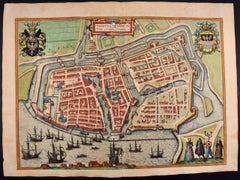
This is a 16th century original hand-colored copperplate engraved map of a bird's-eye View of Embden, Germany entitled " Emuda, vulgo Embden vrbs Frisia orientalis primaria" by Georg Braun & Franz Hogenberg, in volume II of their famous city atlas "Civitates Orbis Terrarum", published in Cologne, Germany in 1575.
This is a beautifully colored and detailed map of Emden, a seaport in northwestern Germany, along the Ems River and perhaps portions of over Dollart Bay, near the border with the Netherland. The map depicts a bird's-eye view of the city from the southwest, as well as a view of the harbor and an extensive system of canals. Numerous ships of various sizes, as well as two rowboats containing numerous occupants are seen in the main waterway in the foreground and additional boats line two canals in the center of the city. Two men and two women are shown on a hill in the foreground on the right, dressed in the 16th century style of nobility. Two ornate crests are included in each corner. A title strap-work cartouche is in the upper center with the title in Latin. The crest on the right including Engelke up de Muer (The Little Angel on the Wall) was granted by Emperor Maximilian I in 1495.
This is an English translation of an excerpt of Braun's description of Embden: "In Emden, the capital of East Frisia, rich merchants live in very fine houses. The city has a broad and well-situated harbour, which in my opinion is unique in Holland. Frisia and the whole of the Netherlands, for the ships can anchor here right under the city walls. They have also extended the harbour as far as the New Town, so that up to 400 ships can now find shelter here when the sea is rough."
The emphasis on the harbor and waterways within the city highlights the importance of Emden's place as a seaport at this time. Embden developed from a Dutch/Flemish trading settlement in the 7th-8th centuries into a city as late as late 14th century. In 1494 it was granted staple rights, and in 1536 the harbour was extended. In the mid-16th century Emden's port was thought to have the most ships in Europe. Its population then was about 5,000, rising to 15,000 by the end of the 16th century. The Ems River flowed directly under the city walls, but its course was changed in the 17th century by the construction of a canal. Emden has canals within its city limits, a typical feature of Dutch towns, which also enabled the extension of the harbor. In 1744 Emden was annexed by Prussia and is now part of Germany. It was captured by French forces in 1757 during the Seven Years' War, but recaptured by Anglo-German forces in 1758. During the Napoleonic French era, Emden and the surrounding lands of East Frisia were part of the short-lived Kingdom of Holland.
References:Van der Krogt 4, 1230, State 2; Taschen, Braun and Hogenberg...
Category
16th Century Old Masters Landscape Prints
Materials
Engraving
$940 Sale Price
20% Off
H 15.63 in W 21.25 in
Tournai (Tournay), Belgium: A 16th Century Hand-colored Map by Braun & Hogenberg
By Franz Hogenberg
Located in Alamo, CA
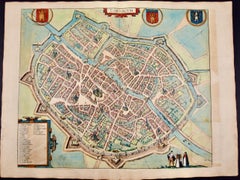
This is a 16th century original hand-colored copperplate engraved map of Tournai, Belgium, entitled "Tornacum" by Georg Braun & Franz Hogenberg, in volume IV of their famous city atlas "Civitates Orbis Terrarum", published in Cologne or Augsberg, Germany in 1575. The map provides a bird's-eye view of the walled city of Tournai, the second oldest city in Belgium. It lies approximately one hour by car southwest of Brussels or from Ghent. The names of thirty of its streets, prominent buildings, churches and squares are listed in a key within a strap-work cartouche in the lower left. These locations are numbered in the key corresponding to their locations on the map.
This colorful map of Tournai (Tornacum or Tournay as it was called in the 16th century) includes the title in Latin in a cartouche in the upper center. Three crests are present across the upper map. A man and two woman are standing on a hill in the foreground in the lower right dressed in the style of 16th century upper class residents of the town.
This is an English translation of an excerpt of Braun's description of Tornai: “Tornacum or Turnacum is a city in Gallia Belgica, situated on the Schelde in the territory of the Nervii, called Tournai by its French inhabitants, but Dorneck by the Germans. Tournai has always been a large and powerful city, with an abundance of goods and commercial activities and wonderfully resourceful craftsmen, who invent new articles every day, and although some of these go out of use they constantly conceive of other new things, both useful and delightful, so that they have at all times something that provides work and a means of livelihood for the poor."
ReferencesVan der Krogt 4, 4435, State 1; Taschen, Braun and Hogenberg...
Category
16th Century Old Masters Landscape Prints
Materials
Engraving
$620 Sale Price
20% Off
H 15.88 in W 20.75 in
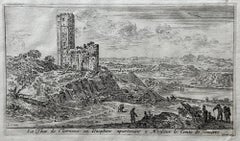
Le Tour de Clermont en Dauphine apartenant a Monsieur de Tonnerre
By Israel Silvestre
Located in Middletown, NY
Etching and engraving on handmade cream laid paper, 3 7/8 x 6 7/8 inches (97 x 173 mm), full margins. In good condition, consistent with age. Several small notations in pencil in t...
Category
18th Century Old Masters Landscape Prints
Materials
Handmade Paper, Laid Paper, Engraving, Etching
$400
H 7.88 in W 6.88 in
More From This Seller
View AllThe Anglers
By Adriaen van Ostade
Located in New York, NY
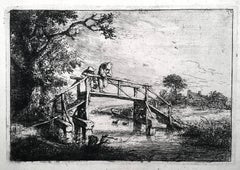
Adriaen Van Ostade (1610-1685) etching The Anglers, circa 1647, Godefry 26, Bartsch 26. Very good condition, with small (1/2 inch) margins, on cream laid paper, archival mounting. 4 ...
Category
1640s Old Masters Landscape Prints
Materials
Etching
Suite of 12 Views of Italy
By Franz Weirotter
Located in New York, NY
Franz Weirotter (1730-1771), Suite of 12 Views of Italy, etchings, 1759 [most signed in the plate by Weirotter]. Reference: Nagel 5. 10 printed in pairs on one sheet; one on a small...
Category
1750s Old Masters Landscape Prints
Materials
Etching
The Bridge, Santa Maria
By James Abbott McNeill Whistler
Located in New York, NY
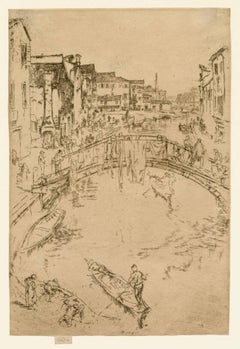
James Whistler (1834-1903), The Bridge, Santa Marta, 1879-80, etching with drypoint, printed in sepia on fine laid paper. Signed with the butterfly and inscribed imp on the tab (also with an exceedingly light butterfly lower right in the plate). Kennedy 204, probably eighth (final) state; Glasgow 201, probably state 9 (of 9) (cf. Margaret F. MacDonald, Grischka Petri, Meg Hausberg, and Joanna Meacock, James McNeill Whistler: The Etchings, a catalogue raisonné, University of Glasgow, 2011), Lochnan 199. Trimmed to the platemark by the artist, h: 11.8 x w: 7.9 in / h: 30 x w: 20.1 cm.
A fine impression, printed with subtle tone.
The bridge theme occurs repeatedly in Whistler’s vistas. It is also the main focus of more than one of the Venetian prints. While some bridges are seen from below, from where one would see it if approaching in a gondola (for example Ponte del Piovan, Kennedy 209), The Bridge depicts the scene from a high perspective, opening up the view into the far distance. The small boat approaching the arch in the foreground is again, as in the earlier Thames prints, a stock motif that is probably ultimately derived from the Japanese woodcuts of Hokusai and Hiroshige. The bridge here is the Ponte de le Terese over the Rio de l’Arzere in the Santa Marta quarter.
The early biography of Whistler by Elizabeth and Joseph Pennell is essential for its “immense quantity of information” but also notorious for “the inherent hyperbole and misinformation” (Eric Denker, Annotated Bibliography, in Fine, p. 184). Still, it is worth quoting from the Pennels’ appraisal of The Bridge: “Simplicity of expression has never been carried further. Probably the finest plate, in its simplicity and directness, is The Bridge. Whistler now obtained the quality of richness by suggesting detail, and also by printing. In The Traghetto...
Category
1870s Impressionist Landscape Prints
Materials
Drypoint, Etching
The Mill, Amsterdam, 1889
By James Abbott McNeill Whistler
Located in New York, NY
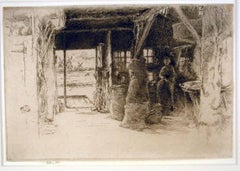
James Whistler (1834-1903), The Mill, 1889, etching and drypoint, signed in pencil with the butterfly on the tab and inscribed “imp”, and inscribed “first state” (twice) and annotated “Wunderlich” and signed again with the butterfly verso. Reference: Kennedy 413, first state (of 5). Glasgow 457, second state (of 6; see discussion below) (cf. Margaret F. MacDonald, Grischka Petri, Meg Hausberg, and Joanna Meacock, James McNeill Whistler: The Etchings, a catalogue raisonné, University of Glasgow, 2011)
On laid paper, in very good condition, trimmed just outside of the platemark all around except for the tab by the artist, 6 1/4 x 9 3/8 inches.
A very fine impression of this great rarity, printed in black/brown ink with a slight veil of plate tone.
provenance:
H. Wunderlich & Co., New York
Louis B. Dailey, New York (Lugt 4500)
sale, Sotheby’s, New York, October 31, 2003, lot 69
literature;
Neue Lagerliste 122: James McNeill Whistler – Etchings...
Category
1880s Impressionist Landscape Prints
Materials
Drypoint, Etching
Lagoon: Noon
By James Abbott McNeill Whistler
Located in New York, NY
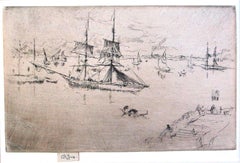
James McNeill Whistler (1830-1903), Lagoon: Noon, etching and drypoint, 1879-1880, signed with the butterfly and inscribed “imp” on the tab [also signed with the butterfly in the plate lower left]. Reference: Glasgow 209, third state (of 3), Kennedy 216, third state (of 3); Lochnan 231, 4 7/8 x 7 7/8 inches.
A fine impression with very little plate tone, and printed with extraordinary attention to the etching and drypoint details. The printed butterfly, usually only barely visible, is clearly defined in this impression (see detail below). Kennedy mades special note that an impression like this, with the clearly visible butterfly, was in the collection of John H. Wrenn.
On a commission from the Fine Arts Society, Whistler created the plates of his Venice series...
Category
1870s Impressionist Landscape Prints
Materials
Drypoint, Etching
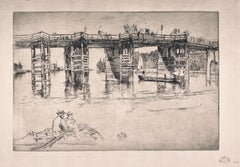
Old Putney Bridge
By James Abbott McNeill Whistler
Located in New York, NY
James Whistler (1834-1903), Old Putney Bridge, 1879, etching and drypoint, signed in pencil with a large, elaborate shaded butterfly, lower right and inscribed imp (also signed with the butterfly in the plate), printed in dark-brown/black ink on laid paper, watermark ProPatria, an impression in Glasgow’s seventh (final) state, published by The Fine Art Society, probably printed in 1881, 8x 11 3/4 inches, sheet 12 1/8 x 16 1/8 inches. Reference: Kennedy 178; Glasgow 185.
Provenance: Kraushaar Gallery, New York
A fine impression, with wide margins.
The Fine Art Societys relationship with Whistler began with the new etchings of the Thames he made in 1879, following a visit from Ernest Brown who had joined the staff of the gallery. The plate is on a large scale and shows the change in the artists approach to the Thames since the etchings he had made in Wapping and the docks in the summer of 1859. The central motif is the old bridge, by this stage somewhat dilapidated. It was shortly to be demolished and replaced by the new bridge of Cornish granite...
Category
Late 19th Century Impressionist Landscape Prints
Materials
Drypoint, Etching