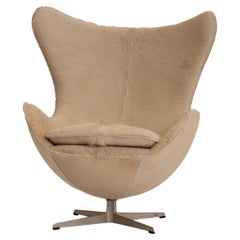
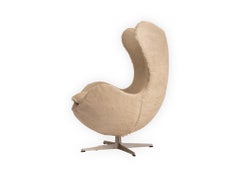
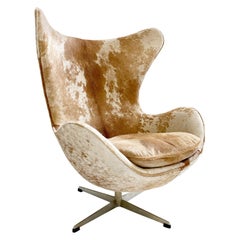
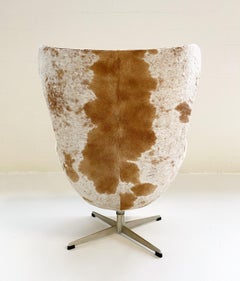
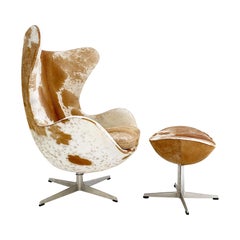
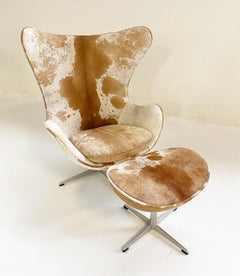
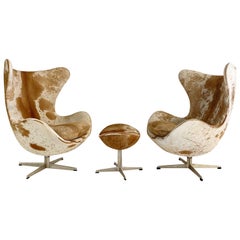
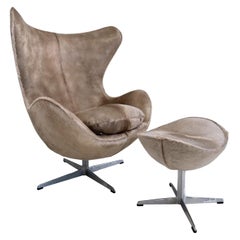
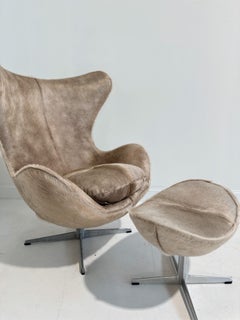
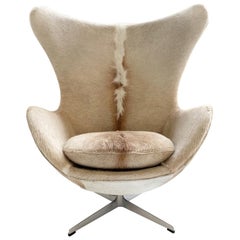
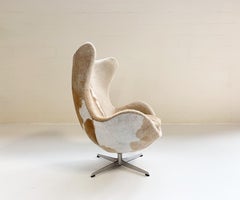
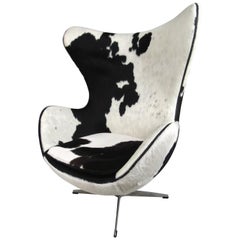
The eye-catching work of the Danish architect and designer Arne Jacobsen often introduces new collectors to mid-20th century furniture. With their fluid lines and sculptural presence, Jacobsen’s signature pieces — the elegant Swan chair and the cozy-yet-cutting edge Egg chair, both first presented in 1958 — are iconic representations of both the striking aesthetic of the designers of the era and their concomitant attention to practicality and comfort. Jacobsen designed furniture that had both gravitas and groove.
Though Jacobsen is a paragon of Danish modernism, his approach to design was the least “Danish” of those who are counted as his peers. The designs of Hans Wegner, Finn Juhl, Børge Mogensen and others grew out of their studies as cabinetmakers. They prized skilled craftsmanship and their primary material was carved, turned and joined wood. Jacobsen was first and foremost an architect, and while he shared his colleagues’ devotion to quality of construction, he was far more open to other materials such as metal and fiberglass.
Many of Jacobsen’s best-known pieces had their origin in architectural commissions. His molded-plywood, three-legged Ant chair (1952) was first designed for the cafeteria of a pharmaceutical company headquarters. The tall-backed Oxford chair was made for the use of dons at St. Catherine’s College, Oxford, whose Jacobsen-designed campus opened in 1962 (while still under construction). The Swan, Egg and Drop chairs and the AJ desk lamp were all created as part of Jacobsen’s plan for the SAS Royal Copenhagen Hotel, which opened in 1960. (The hotel has since been redecorated, but one guest room has been preserved with all-Jacobsen accoutrements.)
To Jacobsen’s mind, the chief merit of any design was practicality. He designed the first stainless-steel cutlery set made by the Danish silver company Georg Jensen; Jacobsen’s best-selling chair — the plywood Series 7 — was created to provide lightweight, stackable seating for modern eat-in kitchens. But as you will see from the objects on 1stDibs, style never took a backseat to function in Arne Jacobsen’s work. His work merits a place in any modern design collection.
Find authentic Arne Jacobsen chairs, tables, sofas and other furniture on 1stDibs.
While this specific seating is known to all for its comfort and familiar form, the history of how your favorite antique or vintage lounge chair came to be is slightly more ambiguous.
Although there are rare armchairs dating back as far as the 17th century, some believe that the origins of the first official “lounge chair” are tied to Hungarian modernist designer-architect Marcel Breuer. Sure, Breuer wasn’t exactly reinventing the wheel when he introduced the Wassily lounge chair in 1925, but his seat was indeed revolutionary for its integration of bent tubular steel.
Officially, a lounge chair is simply defined as a “comfortable armchair,” which allows for the shape and material of the furnishings to be extremely diverse. Whether or not chaise longues make the cut for this category is a matter of frequent debate.
The Eames lounge chair, on the other hand, has come to define somewhat of a universal perception of what a lounge chair can be. Introduced in 1956, the Eames lounger (and its partner in cozy, the ottoman) quickly became staples in television shows, prestigious office buildings and sumptuous living rooms. Venerable American mid-century modern designers Charles and Ray Eames intended for it to be the peak of luxury, which they knew meant taking furniture to the next level of style and comfort. Their chair inspired many modern interpretations of the lounge — as well as numerous copies.
On 1stDibs, find a broad range of unique lounge chairs that includes everything from antique Victorian-era seating to vintage mid-century modern lounge chairs by craftspersons such as Hans Wegner to contemporary choices from today’s innovative designers.