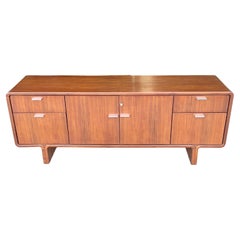
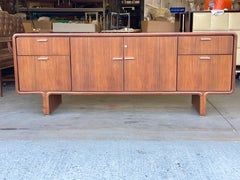
1960’ File Credenza by Elite Interiors of Canada Ltd.
Located in Hanover, MA
float in the room and be viewed from all angles. Produced by Elite Interiors of Canada Ltd. around the
Category
Vintage 1960s Space Age Credenzas
Materials
Chrome
1960’ File Credenza by Elite Interiors of Canada Ltd.
Located in Hanover, MA
float in the room and be viewed from all angles. Produced by Elite Interiors of Canada Ltd. around the
Chrome
Vintage Space Age furniture captured post–World War II optimism with swooping shapes, bowed lines and experimentation with new materials including plastic and fiberglass.
From the launch of the Sputnik 1 satellite in 1957 to the landing of Apollo 11 astronauts on the moon in 1969, the space race between the Soviet Union and the United States propelled advancements in technology that transformed culture. Space Age design encompassed fashion, architecture, cars, furniture and objects for the home, bringing wonder and hope for the future into everyday life.
Coinciding with Pop art, Space Age style featured bold colors and forms. Eero Aarnio’s Ball chair, which debuted in 1966, used molded fiberglass for a capsule-like space while Verner Panton’s 1959 Panton chair was a single piece of molded plastic for a gravity-defying S shape. Red versions of Olivier Mourgue’s 1964 Djinn chair were futuristic enough to appear on the space station in Stanley Kubrick’s 1968 film 2001: A Space Odyssey. Today, Joe Colombo is revered as a master of modern Italian design thanks to the provocative modular furniture pieces he created, such as the Tube chair and the Elda armchair, both of which embody the future-forward spirit of the Space Age.
The Space Age spirit extended to home building too. The futuristic Case Study Houses, which were designed by the likes of Pierre Koenig, Charles and Ray Eames, Richard Neutra and Whitney R. Smith, are considered a high point of modernism and the Southern California lifestyle.
Sometimes the nods to space exploration were more literal, like moon and star motifs or the 1965 Eclisse lamp by Vico Magistretti that saw the mid-century Italian designer integrating a movable inner shade to “eclipse” the light source. Alongside the pioneering moon missions, JVC manufactured the Videosphere portable television reminiscent of the Apollo 11 space helmets.
Although the style faded in the 1970s — with the 1975 joining of the Apollo and Soyuz spacecrafts signaling a new era of cooperation and the global oil crisis impacting the availability of plastics — the era’s innovations influenced designers into the 21st century such as Zaha Hadid and Djivan Schapira.
Find a collection of vintage Space Age seating, tables, lighting and other furniture on 1stDibs.
Antique and vintage credenzas can add an understated touch of grace to your home. These long and sophisticated cabinet-style pieces of furniture can serve a variety of purposes, and they look great too.
In Italy, the credenza was originally a small side table used in religious services. Appropriately, credere in Italian means “to believe.” Credenzas were a place to not only set the food ready for meals, they were also a place to test and taste prepared food for poison before a dish was served to a member of the ruling class. Later, credenza was used to describe a type of versatile narrow side table, typically used for serving food in the home. In form, a credenza has much in common with a sideboard — in fact, the terms credenza and sideboard are used almost interchangeably today.
Credenzas usually have short legs or no legs at all, and can feature drawers and cabinets. And all kinds of iterations of the credenza have seen the light of day over the years, from ornately carved walnut credenzas originating in 16th-century Tuscany to the wealth of Art Deco credenzas — with their polished surfaces and geometric patterns — to the array of innovative modernist interpretations that American furniture maker Milo Baughman created for Directional and Thayer Coggin.
The credenza’s blend of style and functionality led to its widespread use in the 20th century. Mid-century modern credenzas are particularly popular — take a look at Danish furniture designer Arne Vodder’s classic Model 29, for instance, with its reversible sliding doors and elegant drawer pulls. Hans Wegner, another Danish modernist, produced strikingly minimalist credenzas in the 1950s and ’60s, as did influential American designer Florence Knoll. Designers continue to explore new and exciting ways to update this long-loved furnishing.
Owing to its versatility and familiar low-profile form, the credenza remains popular in contemporary homes. Unlike many larger case pieces, credenzas can be placed under windows and in irregularly shaped rooms, such as foyers and entryways. This renders it a useful storage solution. In living rooms, for example, a credenza can be a sleek media console topped with plants and the rare art monographs you’ve been planning to show off. In homes with open floor plans, a credenza can help define multiple living spaces, making it ideal for loft apartments.
Browse a variety of antique and vintage credenzas for sale on 1stDibs to find the perfect fit for your home today.