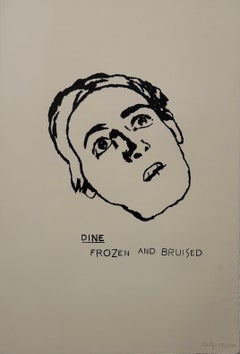
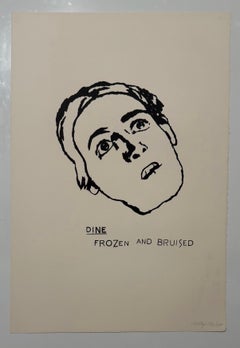
Jim Dine Art Book For Sale on 1stDibs
You are likely to find exactly the jim dine art book you’re looking for on 1stDibs, as there is a broad range for sale. Find
modern versions now, or shop for
modern creations for a more modern example of these cherished works. Finding the perfect jim dine art book may mean sifting through those created during different time periods — you can find an early version that dates to the 20th Century and a newer variation that were made as recently as the 21st Century. If you’re looking to add a jim dine art book to create new energy in an otherwise neutral space in your home, you can find a work on 1stDibs that features elements of
beige,
black,
gray,
blue and more. There have been many interesting jim dine art book examples over the years, but those made by
Jim Dine,
Donald Saff,
Les Levine,
Fred McDarrah and
Mel Ramos are often thought to be among the most thought-provoking. These artworks were handmade with extraordinary care, with artists most often working in
etching,
lithograph and
silver gelatin print.
How Much is a Jim Dine Art Book?
The average selling price for a jim dine art book we offer is $1,000, while they’re typically $75 on the low end and $5,995 for the highest priced.
Ronald Brooks Kitaj for sale on 1stDibs
Born in Cleveland, Ohio in 1932, R.B. (Ronald Brooks) Kitaj is considered a key figure in European and American contemporary painting. While his work has been considered controversial, he is regarded as a master draftsman with a commitment to figurative art. His highly personal paintings and drawings reflect his deep interest in history; cultural, social and political ideologies; and issues of identity.
Among his various honors are election to the American Academy of Arts and Letters in 1982, and election to the Royal Academy in 1985 (the first American since John Singer Sargent to receive this honor.)
Numerous retrospective exhibitions of his work include shows at the Hirshhorn Museum in Washington, D.C.; The Jewish Museum, Berlin; The Jewish Museum, London; and the Hamburger Kunsthalle in Germany.
Raised in Cleveland, Ohio, and Troy, New York, Kitaj joined the Merchant Marines in 1949.
In 1950, between sailings, he attended classes at the Cooper Union for the Advancement of Science and Art in New York. He went on to study drawing at the Academy of Fine Art in Vienna, Austria.
Kitaj moved to Oxford, England in 1957, and enrolled at The Ruskin School of Drawing and Fine Art, University of Oxford.
In 1959, Kitaj was accepted into Royal College of Art, London, where he befriended classmate David Hockney. Upon graduation from the RCA, Kitaj signed with Marlborough Fine Art, London, where he had his first solo exhibition in 1963. His art career began in earnest, and he found critical acclaim alongside commercial success.
A second solo show followed at Marlborough Gallery, New York, in 1965, and he sold “The Ohio Gang” to The Museum of Modern Art.
In 1969, Kitaj taught for a year at the University of California, Los Angeles.
In 1976, he coined the term “School of London” in an essay he wrote as curator of the polemical exhibition, “The Human Clay,” at the Hayward Gallery, London. The term, though loose, continues to define a group of stylistically diverse artists, including Kitaj, who were working in London at that time focusing on figural representation.
In 1981, he spent a year in Paris, France, where he focused on drawing and use of pastel.
In 1994, the Tate Gallery, London, organized a major retrospective of Kitaj’s work. Hostile and personal attacks from some critics led to what Kitaj referred to as the “Tate War.” The exhibition subsequently traveled to the Los Angeles County Museum of Art and the Metropolitan Museum of Art, New York.
Kitaj moved to Los Angeles, California, and continued to exhibit with Marlborough Fine Art and the Marlborough Gallery, New York.
In 2001 the National Gallery London organized a solo exhibition of paintings: “R.B. Kitaj In the Aura of Cezanne and Other Masters.” Kitaj focused on his “late style” in his Yellow Studio in Westwood and died in 2007.
His gift of his archive to the UCLA Library Special Collections was celebrated with exhibitions at the Skirball Cultural Center and UCLA’s Young Research Library.
A Close Look at Pop-art Art
Perhaps one of the most influential contemporary art movements, Pop art emerged in the 1950s. In stark contrast to traditional artistic practice, its practitioners drew on imagery from popular culture — comic books, advertising, product packaging and other commercial media — to create original Pop art paintings, prints and sculptures that celebrated ordinary life in the most literal way.
ORIGINS OF POP ART
CHARACTERISTICS OF POP ART
- Bold imagery
- Bright, vivid colors
- Straightforward concepts
- Engagement with popular culture
- Incorporation of everyday objects from advertisements, cartoons, comic books and other popular mass media
POP ARTISTS TO KNOW
ORIGINAL POP ART ON 1STDIBS
The Pop art movement started in the United Kingdom as a reaction, both positive and critical, to the period’s consumerism. Its goal was to put popular culture on the same level as so-called high culture.
Richard Hamilton’s 1956 collage Just what is it that makes today’s homes so different, so appealing? is widely believed to have kickstarted this unconventional new style.
Pop art works are distinguished by their bold imagery, bright colors and seemingly commonplace subject matter. Practitioners sought to challenge the status quo, breaking with the perceived elitism of the previously dominant Abstract Expressionism and making statements about current events. Other key characteristics of Pop art include appropriation of imagery and techniques from popular and commercial culture; use of different media and formats; repetition in imagery and iconography; incorporation of mundane objects from advertisements, cartoons and other popular media; hard edges; and ironic and witty treatment of subject matter.
Although British artists launched the movement, they were soon overshadowed by their American counterparts. Pop art is perhaps most closely identified with American Pop artist Andy Warhol, whose clever appropriation of motifs and images helped to transform the artistic style into a lifestyle. Most of the best-known American artists associated with Pop art started in commercial art (Warhol made whimsical drawings as a hobby during his early years as a commercial illustrator), a background that helped them in merging high and popular culture.
Roy Lichtenstein was another prominent Pop artist that was active in the United States. Much like Warhol, Lichtenstein drew his subjects from print media, particularly comic strips, producing paintings and sculptures characterized by primary colors, bold outlines and halftone dots, elements appropriated from commercial printing. Recontextualizing a lowbrow image by importing it into a fine-art context was a trademark of his style. Neo-Pop artists like Jeff Koons and Takashi Murakami further blurred the line between art and popular culture.
Pop art rose to prominence largely through the work of a handful of men creating works that were unemotional and distanced — in other words, stereotypically masculine. However, there were many important female Pop artists, such as Rosalyn Drexler, whose significant contributions to the movement are recognized today. Best known for her work as a playwright and novelist, Drexler also created paintings and collages embodying Pop art themes and stylistic features.
Read more about the history of Pop art and the style’s famous artists, and browse the collection of original Pop art paintings, prints, photography and other works for sale on 1stDibs.
Finding the Right Abstract-prints-works-on-paper for You
Explore a vast range of abstract prints on 1stDibs to find a piece to enhance your existing collection or transform a space.
Unlike figurative paintings and other figurative art, which focuses on realism and representational perspectives, abstract art concentrates on visual interpretation. An artist may use a single color or simple geometric forms to create a world of depth. Printmaking has a rich history of abstraction. Through materials like stone, metal, wood and wax, an image can be transferred from one surface to another.
During the 19th century, iconic artists, including Edvard Munch, Paul Cézanne, Georgiana Houghton and others, began exploring works based on shapes and colors. This was a departure from the academic conventions of European painting and would influence the rise of 20th-century abstraction and its pioneers, like Pablo Picasso and Piet Mondrian.
Some leaders of European abstraction, including Franz Kline, were influenced by the gestural shapes of East Asian calligraphy. Calligraphy interprets poetry, songs, symbols or other means of storytelling into art, from works on paper in Japan to elements of Islamic architecture.
Bold, daring and expressive, abstract art is constantly evolving and dazzling viewers. And entire genres have blossomed from it, such as Color Field painting and Minimalism.
The collection of abstract art prints on 1stDibs includes etchings, lithographs, screen-prints and other works, and you can find prints by artists such as Joan Miró, Alexander Calder and more.