Pablo Picasso Genevieve Laporte
Recent Sales
Vintage 1950s French Modern Prints
Paper
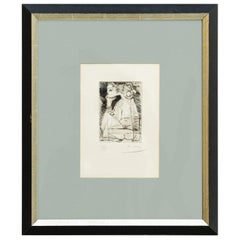

Pablo Picasso Genevieve Laporte For Sale on 1stDibs
How Much is a Pablo Picasso Genevieve Laporte?
Pablo Picasso for sale on 1stDibs
One of the most prolific and revolutionary artists the world has ever seen, Pablo Picasso had a tremendous impact on the development of 20th-century modern art. Although he is best known for his association with the Cubist movement, which he founded with Georges Braque, Picasso’s influence extends to Surrealism, neoclassicism and Expressionism.
“Every act of creation is, first of all, an act of destruction,” the Spanish artist proclaimed. In Picasso's Cubist paintings, he emphasizes the two-dimensionality of the canvas, breaking with conventions regarding perspective, foreshortening and proportion. Picasso was inspired by Iberian and African tribal art. One of his most famous pre-Cubist works is Les Demoiselles d’Avignon (1907), a painting considered immoral and shocking at the time for its depiction of nude women whose faces resemble Iberian tribal masks.
Picasso made many portraits in this style, most often of the women in his life, their expressively colored faces composed of geometric shards of surface planes. In Woman in a Hat (Olga), 1935, he painted his first wife as an assemblage of abstract forms, leaving the viewer to decipher the subject through the contrasting colors and shapes. Picasso was a tireless artist, creating more than 20,000 paintings, drawings, prints, ceramics and sculptures. Tracing his life’s work reveals the progression of modern art, on which he had an unparalleled influence.
Browse an expansive collection of Pablo Picasso's art on 1stDibs.
A Close Look at Modern Furniture
The late 19th and early 20th centuries saw sweeping social change and major scientific advances — both of which contributed to a new aesthetic: modernism. Rejecting the rigidity of Victorian artistic conventions, modernists sought a new means of expression. References to the natural world and ornate classical embellishments gave way to the sleek simplicity of the Machine Age. Architect Philip Johnson characterized the hallmarks of modernism as “machine-like simplicity, smoothness or surface [and] avoidance of ornament.”
Early practitioners of modernist design include the De Stijl (“The Style”) group, founded in the Netherlands in 1917, and the Bauhaus School, founded two years later in Germany.
Followers of both groups produced sleek, spare designs — many of which became icons of daily life in the 20th century. The modernists rejected both natural and historical references and relied primarily on industrial materials such as metal, glass, plywood, and, later, plastics. While Bauhaus principals Marcel Breuer and Ludwig Mies van der Rohe created furniture from mass-produced, chrome-plated steel, American visionaries like Charles and Ray Eames worked in materials as novel as molded plywood and fiberglass. Today, Breuer’s Wassily chair, Mies van der Rohe’s Barcelona chair — crafted with his romantic partner, designer Lilly Reich — and the Eames lounge chair are emblems of progressive design and vintage originals are prized cornerstones of collections.
It’s difficult to overstate the influence that modernism continues to wield over designers and architects — and equally difficult to overstate how revolutionary it was when it first appeared a century ago. But because modernist furniture designs are so simple, they can blend in seamlessly with just about any type of décor. Don’t overlook them.
Finding the Right Prints for You
Prints are works of art produced in multiple editions. Though several copies of a specific artwork can exist, collectors consider antique and vintage prints originals when they have been manually created by the artist or are “impressions” that are part of the artist’s intent for the work.
Modern artists use a range of printmaking techniques to produce different types of prints such as relief, intaglio and planographic. Relief prints are created by cutting away a printing surface to leave only a design. Ink or paint is applied to the raised parts of the surface, and it is used to stamp or press the design onto paper or another surface. Relief prints include woodcuts, linocuts and engravings.
Intaglio prints are the opposite of relief prints in that they are incised into the printing surface. The artist cuts the design into a block, plate or other material and then coats it with ink before wiping off the surface and transferring the design to paper through tremendous pressure. Intaglio prints have plate marks showing the impression of the original block or plate as it was pressed onto the paper.
Artists create planographic prints by drawing a design on a stone or metal plate using a grease crayon. The plate is washed with water, then ink is spread over the plate and it adheres to the grease markings. The image is then stamped on paper to make prints.
All of these printmaking methods have an intricate process, although each can usually transfer only one color of ink. Artists use separate plates or blocks for multiple colors, and together these create one finished work of art.
Find prints ranging from the 18th- and 19th-century bird illustrations by J.C. Sepp to mid-century modern prints, as well as numerous other antique and vintage prints at 1stDibs. Browse the collection today and read about how to arrange wall art in your space.