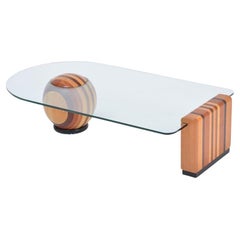
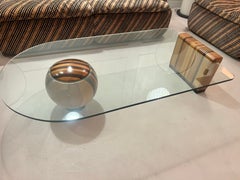
Massimo Vignelli and Lella Vignelli’s legacy can be seen everywhere in the logos of Bloomingdale’s, Ford and American Airlines, among others. In addition to their work in branding, they were prolific creators of modernist home furnishings, products and interiors for the likes of Casigliani and other brands. The duo’s collaborations, which span 50 years, have left a profound mark on design and wider visual culture.
After meeting in Italy, Lella (1934–2016) and Massimo (1931–2014) began working together in 1961 and a decade later formed Vignelli Associates in New York. A self-described “information architect,” Massimo was committed to streamlining complex ideas into clear, visually arresting forms. (Witness the graphic identity that he cocreated with Bob Noorda for the New York City Transit Authority as well as his influential 1972 subway map.) The Vignellis’ most recognizable piece, for example, may be the Handkerchief chair, a stackable office chair made of compression-molded plastic that has the look of a cloth floating in air. It was created for Knoll in 1983 after they designed the brand’s logo.
Evidence of the couple’s influence can also be found in their Saratoga line (1964), the first collection of lacquered furniture, which helped herald in the trendy “glossy” look of the decade (and beyond). When the Vignellis created the Poltrona Frau Interview chair in 1988 for an Italian television station, it became widely sought after, “which goes to show you the power of the TV media,” the couple once said.
Much like the Vignellis' elemental graphic designs, the couple's Kono (1984) and Pisa tables (1985) cull the form of the table down to geometric shapes. Both pieces were created for Casigliani — Lella and Massimo began to collaborate with the Italian brand during the late 1970s. The company’s founder, Maurizio Casigliani, personally visited the couple in New York City and invited them to design a line of furnishings made with Carrara marble for the brand.
Vignelli furniture is often labeled as Massimo Vignelli’s alone, though he fought to have Lella recognized for her work, even throwing away magazines that neglected to give her due credit. As he wrote of their lifelong collaboration in his book Designed By: Lella Vignelli: “It is not holding a pencil with four hands that makes a partnership; it is sharing the creative act and exercising creative criticism which is reflected in the end result.”
Find vintage Massimo and Lella Vignelli tables designed for Casigliani and other furniture today on 1stDibs.
Organically shaped, clean-lined and elegantly simple are three terms that well describe vintage mid-century modern furniture. The style, which emerged primarily in the years following World War II, is characterized by pieces that were conceived and made in an energetic, optimistic spirit by creators who believed that good design was an essential part of good living.
ORIGINS OF MID-CENTURY MODERN FURNITURE DESIGN
CHARACTERISTICS OF MID-CENTURY MODERN FURNITURE DESIGN
MID-CENTURY MODERN FURNITURE DESIGNERS TO KNOW
ICONIC MID-CENTURY MODERN FURNITURE DESIGNS
VINTAGE MID-CENTURY MODERN FURNITURE ON 1STDIBS
The mid-century modern era saw leagues of postwar American architects and designers animated by new ideas and new technology. The lean, functionalist International-style architecture of Le Corbusier and Bauhaus eminences Ludwig Mies van der Rohe and Walter Gropius had been promoted in the United States during the 1930s by Philip Johnson and others. New building techniques, such as “post-and-beam” construction, allowed the International-style schemes to be realized on a small scale in open-plan houses with long walls of glass.
Materials developed for wartime use became available for domestic goods and were incorporated into mid-century modern furniture designs. Charles and Ray Eames and Eero Saarinen, who had experimented extensively with molded plywood, eagerly embraced fiberglass for pieces such as the La Chaise and the Womb chair, respectively.
Architect, writer and designer George Nelson created with his team shades for the Bubble lamp using a new translucent polymer skin and, as design director at Herman Miller, recruited the Eameses, Alexander Girard and others for projects at the legendary Michigan furniture manufacturer.
Harry Bertoia and Isamu Noguchi devised chairs and tables built of wire mesh and wire struts. Materials were repurposed too: The Danish-born designer Jens Risom created a line of chairs using surplus parachute straps for webbed seats and backrests.
The Risom lounge chair was among the first pieces of furniture commissioned and produced by celebrated manufacturer Knoll, a chief influencer in the rise of modern design in the United States, thanks to the work of Florence Knoll, the pioneering architect and designer who made the firm a leader in its field. The seating that Knoll created for office spaces — as well as pieces designed by Florence initially for commercial clients — soon became desirable for the home.
As the demand for casual, uncluttered furnishings grew, more mid-century furniture designers caught the spirit.
Classically oriented creators such as Edward Wormley, house designer for Dunbar Inc., offered such pieces as the sinuous Listen to Me chaise; the British expatriate T.H. Robsjohn-Gibbings switched gears, creating items such as the tiered, biomorphic Mesa table. There were Young Turks such as Paul McCobb, who designed holistic groups of sleek, blond wood furniture, and Milo Baughman, who espoused a West Coast aesthetic in minimalist teak dining tables and lushly upholstered chairs and sofas with angular steel frames.
Generations turn over, and mid-century modern remains arguably the most popular style going. As the collection of vintage mid-century modern chairs, dressers, coffee tables and other furniture for the living room, dining room, bedroom and elsewhere on 1stDibs demonstrates, this period saw one of the most delightful and dramatic flowerings of creativity in design history.
Taller than a coffee table and more elongated and narrow, a sofa table is designed to nestle against the back of a sofa. One-of-a-kind antique, vintage and new sofa tables make a statement while also dividing the room or displaying decorative objects.
Sofa tables are similar to Pembroke tables, which emerged in the 18th century but were positioned in front of the sofa for serving tea or playing cards. The popular furnishing now comes in a range of styles.
Rustic living areas can incorporate natural wood sofa tables that complement the space. Brutalist sofa tables combine organic materials with a distinctly contemporary edge to contrast city and country styles. Scandinavian modern sofa tables offer a sleeker aesthetic. These wooden pieces often have simple designs and few embellishments, with angular lines and experimental structures that enhance any living room.
Notably, minimalist sofa tables frequently feature slightly slimmer profiles. Instead of consisting primarily of wood, these tables are often made of luxurious granite, gleaming brass or lightweight aluminum.
Shop a wide selection of antique, vintage and new sofa tables on 1stDibs today.