John O'Shea Art

American, 1876-1956

John O'Shea was born in Ireland and immigrated to New York at the age of 16, where he studied at the Adelphi Academy and the Art Students League. O’Shea moved to the Monterey Peninsula circa 1917, where he was busy in the local art community, serving as the President of the Carmel Art Association. O'Shea was a versatile artist, painting in oil, watercolor and charcoal; his bold, vibrant paintings of figures, landscapes, fantasies and portraits were avant-garde. O’Shea is remembered for his wide travels in search of subject matter. He painted Hawaii, Tahiti, Mexico and the Southwest as well as the Carmel-Monterey area.

(Biography provided by Robert Azensky Fine Art)

to
1
2
2
1
1
1
1
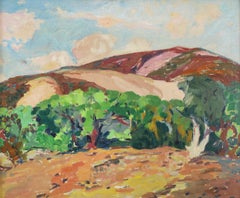
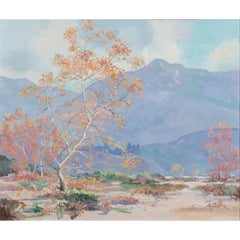
American Impressionist painting of the Monterey, California Hills
By John O'Shea
Located in Colfax, CA
A bright and cheerful depiction of the hills near Monterey, CA by American artist John O'Shea. Born in Ireland in 1913, O'Shea moved to Pasadena, California and began his career as ...
Category

1930s American Impressionist John O'Shea Art

Materials

Oil

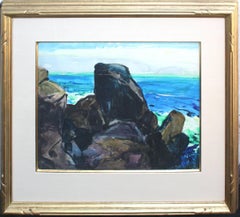
1920s Big Sur "Coastal Scene"- "John O'Shea and Friends" Exhibition, 1993
By John O'Shea
Located in Soquel, CA
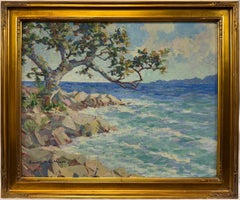
Wonderful mid-century watercolor seascape of the Carmel coast by California artist John O'Shea (American, 1876-1956), c.1940s. Signed "John O'Shea" lower left corner. Exhibition label on verso from 1993 Carmel Art Association Exhibition, John O'Shea and Friends, with artist name and title "Coastal Scene". Displayed in custom giltwood frame. Image, 18.50"L x 24"W. Provenance: John O'Shea estate; Gerry Byrne Collection; Steven Hawk Gallery Collection; Robert Azensky Fine Art Collection. This piece is listed in the 1993 exhibition catalog, "John O'Shea and Friends" (not pictured) and will be included gratis in purchase. (A note about the catalog: there is a typo in the catalog which in error states the size of the piece is 16" x 20"). Artist Bio: John O’Shea was born in Ireland and immigrated to New York at the age of 16 where he studied at the Adelphi Academy and the Art Students League. O’Shea moved to the Monterey Peninsula circa 1917 where he was busy in the local art community, serving as the President of the Carmel Art Association. O'Shea was a versatile artist painting in oil, watercolor and charcoal, his bold, vibrant paintings...
Category

1920s American Impressionist John O'Shea Art

Materials

Paper, Watercolor

Related Items
Old House, Built in 1848
By Gilbert Neumann
Located in Austin, TX
"Old House, Built in 1848" by painter Gilbert F. Neumann Medium: Oil paint on panel Size: 9 x 12 inches Frame Size: 14 x 18.5 inches A nostalgic painting of ...
Category

20th Century American Impressionist John O'Shea Art

Materials

Oil, Panel

Lovely California Landscape Painting by listed artist John Thomas Nolf, ca 1920s
Located in Baltimore, MD
John Thomas Nolf was born in Allentown, Pa. in 1872. He had his academic studies in Chicago at the Art Institute. He exhibited often at the Institute,...
Category

Early 20th Century American Impressionist John O'Shea Art

Materials

Oil

“Bermuda Coast” Henrietta Dunn Mears American Impressionist Oil on Board Signed
By Henrietta Dunn Mears
Located in Yardley, PA
A vibrant Bermuda seascape depicting the rocky shoreline with turquoise waters breaking against sunlit boulders beneath a sweeping tree. Mears uses bold, textured brushstrokes and a ...
Category

20th Century American Impressionist John O'Shea Art

Materials

Oil, Board

American Impressionist Landscape, attributed to Charles Harold Davis ca 1920’s
By Charles Harold Davis
Located in Baltimore, MD
This is a lovely oil on canvas painting that was attributed to Charles Harold Davis when I purchased it about ten years ago. It is unfortunately not signed. The scene is a view throu...
Category

1920s American Impressionist John O'Shea Art

Materials

Oil

“Village Street” by Mary Nicholena MacCord, American Impressionist European Town
By Mary Nicholena MacCord
Located in Yardley, PA
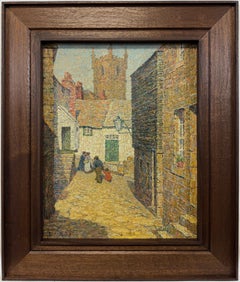
A wonderful view of a charming European town. This work captures the quiet intimacy of a cobbled lane, its golden stones leading the viewer toward a cluster of whitewashed and brick ...
Category

Early 20th Century American Impressionist John O'Shea Art

Materials

Canvas, Oil, Board

Corfe Castle - Dorset, England. Original English Landscape Oil Painting.
Located in Marco Island, FL
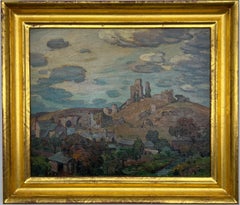
A lovely little Impressionist landscape of Corfe Castle in Dorset, England, painted by William Samuel Horton (1856-1936). From AskArt: A landscape painter, William Horton lived a...
Category

Early 20th Century American Impressionist John O'Shea Art

Materials

Oil, Panel

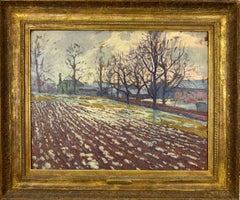
Melting Snow in Ploughed Field. American Impressionist Painting Winter Scene.
Located in Marco Island, FL
A lovely little Impressionist landscape of Melting Snow in a Ploughed Field, painted by William Samuel Horton (1856-1936). William Horton, primarily a landscape painter, lived and...
Category

Early 20th Century American Impressionist John O'Shea Art

Materials

Oil, Canvas

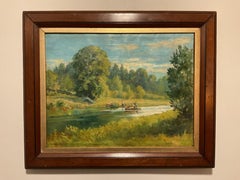
American Impressionist Painting - Boating Party, Sudbury River near Boston, Mass
Located in Baltimore, MD
This bright and cheerful painting is notated as “A Boating Party - Sudbury River”. It is by listed American artist Henry Orne Rider (1860-1943). Born in Salem, Massachusetts, Rider ...
Category

Early 20th Century American Impressionist John O'Shea Art

Materials

Oil

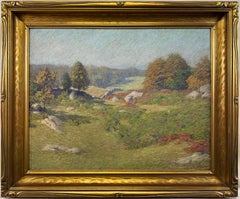
“Autumn Landscape, c. 1910” American Impressionist New England Fall Oil Signed
Located in Yardley, PA
Warm air seems to move through this scene as the eye wanders along a gentle swale dotted with granite boulders, low stone walls and scrubby autumn color. A ribbon of meadow pulls us ...
Category

Early 20th Century American Impressionist John O'Shea Art

Materials

Canvas, Oil

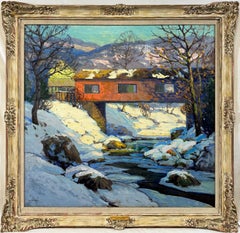
“Covered Bridge, Kingston, NY, 1927” by Walter Koeniger, Snowy Winter Landscape
By Walter Koeniger
Located in Yardley, PA
Known for his evocative, snow-covered landscapes, Koeniger brings this subject to life with his bold, confident brushwork and keen eye for natural light. The composition centers arou...
Category

1920s American Impressionist John O'Shea Art

Materials

Canvas, Oil

"Train Station, " Max Kuehne, Industrial City Scene, American Impressionism
By Max Kuehne
Located in New York, NY
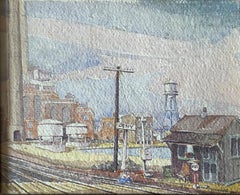
Max Kuehne (1880 - 1968) Train Station, circa 1910 Watercolor on paper 8 1/4 x 10 1/4 inches Signed lower right Provenance: Private Collection, Illinois Max Kuehne was born in Halle, Germany on November 7, 1880. During his adolescence the family immigrated to America and settled in Flushing, New York. As a young man, Max was active in rowing events, bicycle racing, swimming and sailing. After experimenting with various occupations, Kuehne decided to study art, which led him to William Merritt Chase's famous school in New York; he was trained by Chase himself, then by Kenneth Hayes Miller. Chase was at the peak of his career, and his portraits were especially in demand. Kuehne would have profited from Chase's invaluable lessons in technique, as well as his inspirational personality. Miller, only four years older than Kuehne, was another of the many artists to benefit from Chase's teachings. Even though Miller still would have been under the spell of Chase upon Kuehne's arrival, he was already experimenting with an aestheticism that went beyond Chase's realism and virtuosity of the brush. Later Miller developed a style dependent upon volumetric figures that recall Italian Renaissance prototypes. Kuehne moved from Miller to Robert Henri in 1909. Rockwell Kent, who also studied under Chase, Miller, and Henri, expressed what he felt were their respective contributions: "As Chase had taught us to use our eyes, and Henri to enlist our hearts, Miller called on us to use our heads." (Rockwell Kent, It's Me O Lord: The Autobiography of Rockwell Kent. New York: Dodd, Mead and Co., 1955, p. 83). Henri prompted Kuehne to search out the unvarnished realities of urban living; a notable portion of Henri's stylistic formula was incorporated into his work. Having received such a thorough foundation in art, Kuehne spent a year in Europe's major art museums to study techniques of the old masters. His son Richard named Ernest Lawson as one of Max Kuehne's European traveling companions. In 1911 Kuehne moved to New York where he maintained a studio and painted everyday scenes around him, using the rather Manet-like, dark palette of Henri. A trip to Gloucester during the following summer engendered a brighter palette. In the words of Gallatin (1924, p. 60), during that summer Kuehne "executed some of his most successful pictures, paintings full of sunlight . . . revealing the fact that he was becoming a colorist of considerable distinction." Kuehne was away in England the year of the Armory Show (1913), where he worked on powerful, painterly seascapes on the rocky shores of Cornwall. Possibly inspired by Henri - who had discovered Madrid in 1900 then took classes there in 1906, 1908 and 1912 - Kuehne visited Spain in 1914; in all, he would spend three years there, maintaining a studio in Granada. He developed his own impressionism and a greater simplicity while in Spain, under the influence of the brilliant Mediterranean light. George Bellows convinced Kuehne to spend the summer of 1919 in Rockport, Maine (near Camden). The influence of Bellows was more than casual; he would have intensified Kuehne's commitment to paint life "in the raw" around him. After another brief trip to Spain in 1920, Kuehne went to the other Rockport (Cape Ann, Massachusetts) where he was accepted as a member of the vigorous art colony, spearheaded by Aldro T. Hibbard. Rockport's picturesque ambiance fulfilled the needs of an artist-sailor: as a writer in the Gloucester Daily Times explained, "Max Kuehne came to Rockport to paint, but he stayed to sail." The 1920s was a boom decade for Cape Ann, as it was for the rest of the nation. Kuehne's studio in Rockport was formerly occupied by Jonas Lie. Kuehne spent the summer of 1923 in Paris, where in July, André Breton started a brawl as the curtain went up on a play by his rival Tristan Tzara; the event signified the demise of the Dada movement. Kuehne could not relate to this avant-garde art but was apparently influenced by more traditional painters — the Fauves, Nabis, and painters such as Bonnard. Gallatin perceived a looser handling and more brilliant color in the pictures Kuehne brought back to the States in the fall. In 1926, Kuehne won the First Honorable Mention at the Carnegie Institute, and he re-exhibited there, for example, in 1937 (Before the Wind). Besides painting, Kuehne did sculpture, decorative screens, and furniture work with carved and gilded molding. In addition, he designed and carved his own frames, and John Taylor Adams encouraged Kuehne to execute etchings. Through his talents in all these media he was able to survive the Depression, and during the 1940s and 1950s these activities almost eclipsed his easel painting. In later years, Kuehne's landscapes and still-lifes show the influence of Cézanne and Bonnard, and his style changed radically. Max Kuehne died in 1968. He exhibited his work at the National Academy of Design, the Art Institute of Chicago, the Carnegie Institute in Pittsburgh, the Memorial Art Gallery of the University of Rochester, and in various New York City galleries. Kuehne's works are in the following public collections: the Detroit Institute of Arts (Marine Headland), the Whitney Museum (Diamond Hill...
Category

1910s American Impressionist John O'Shea Art

Materials

Paper, Watercolor

Esther Eddy Hasting 'Whispers of Autumn Light' landscape painting
Located in San Rafael, CA
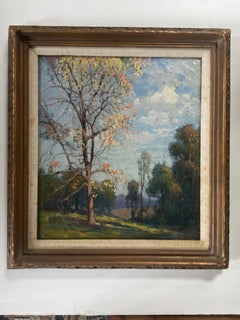
Esther Eddy Hasting (American, 1876-1953) 'Whispers of Autumn Light' Oil on canvas Signed lower right Canvas: 20in H x 24in W In vintage gold gilt frame: 25in H x 29in W In this l...
Category

20th Century American Impressionist John O'Shea Art

Materials

Oil

John O'shea art for sale on 1stDibs.

Find a wide variety of authentic John O'Shea art available for sale on 1stDibs. You can also browse by medium to find art by John O'Shea in paint, paper, watercolor and more. Much of the original work by this artist or collective was created during the 1920s and is mostly associated with the Impressionist style. Not every interior allows for large John O'Shea art, so small editions measuring 36 inches across are available. Customers who are interested in this artist might also find the work of Louis Oscar Griffith, Robert Hallowell, and Reynolds Beal. John O'Shea art prices can differ depending upon medium, time period and other attributes. On 1stDibs, the price for these items starts at $9,200 and tops out at $9,200, while the average work can sell for $9,200.

Artists Similar to John O'Shea

Still Thinking About These?

All Recently Viewed