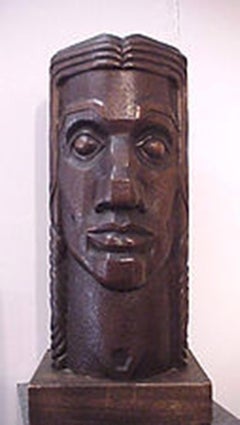
Leo Salazar Art

to
1
Overall Width
to
Overall Height
to
1
1
1
1
1
1
1
1
1
1
1
10,138
2,779
1,375
1,369
1
Artist: Leo Salazar
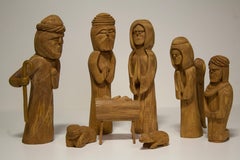
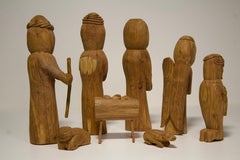
Nativity Scene By Leo Salazar Hand Carved Cedar Wood 1960s
By Leo Salazar
Located in Detroit, MI
Nativity Scene with Blessed Mary, Kneeling Joseph, Angel, One Shepherd, One King, Manger, Baby Jesus, and Two Animals. The figures range in height from 18.5" to 12"; animals are 3" ...
Category

1960s Modern Leo Salazar Art

Materials

Cedar

Related Items
Metropolis
By Maxine Kim Stussy 1
Located in West Hollywood, CA
Presenting a monumental original wood assemblage sculpture by American artist Maxine Kim Stussy(1923 - 2020) "Metropolis", is an original unique wood assemblage using solid wood mac...
Category

1950s Modern Leo Salazar Art

Materials

Wood

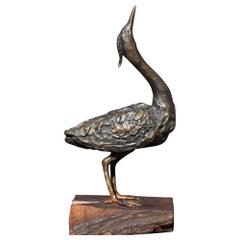
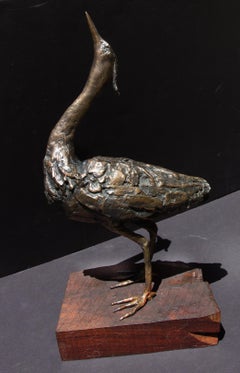
Bronze Heron Sculpture by Wayne F Williams
Located in Rochester, NY
Bronze heron by American sculptor Wayne Williams. Signed and dated 1993. Edition 2/2. Mounted on a walnut base. From Finger Lakes Magazine 2001: Art is everywhere in the Finger Lakes. Inspired by the region’s diverse scenery and lifestyles, artists pursue their creativity outdoors, in studios and in workshops. In the many well-established museums and galleries or at the newer fledgling arts organizations, a wide array of artistic styles and talents are represented. Often the artists, like Wayne Williams, share their artistic skill and passion through teaching at local colleges. Williams, who is retired after a 35-year career at Finger Lakes Community College, found his calling there. “I didn’t want to teach in public schools,” explains Williams of his career choice. “I wanted to be at the college level. CCFL (the Community College of the Finger Lakes, as it was then known) was literally creating a college, right from scratch.” The year was 1968 and Williams was charged with coordinating the new college’s art program. Rand Darrow, a CCFL student in that first year, remembers attending Williams’ art classes in a commercial building on Main Street just south of the railroad tracks in Canandaigua. Darrow appreciated his instructor’s relaxed manner. “He was a great teacher,” recalls Darrow, “cracking jokes all the time.” Darrow graduated with a major in Liberal Arts and continued on to SUNY Oswego where he earned a BA in fine arts. He taught art to elementary and middle school students for 30 years. These days Williams and Darrow typically cross paths at the Wayne County Arts Council in Newark where Williams and his wife, Marleen, are heavily involved. Williams offers classes in figure drawing and sculpture and hangs the gallery’s shows, including his former student’s “Slavic Tales of Novgorod” this past August. “I’d like to take a sculpture class from him,” says Darrow. In 2003 when Williams retired, the college honored him and another retiring art professor, Tom Insalaco, by renaming its art gallery the Williams-Insalaco Art Gallery. It was known formerly as Gallery 34 to recognize its origins at 34 North Main Street in Canandaigua. Williams held professor’s rank from 1976 and served as director of the art gallery beginning with its opening in 1983. Williams, who was born and raised in Newark, New York, says he began doing art at about age 8. By the time he was in junior high school his career direction seemed clear. He received local and national awards for his art and a scholarship to Syracuse University, from which he graduated in 1958 with a Bachelor of Fine Arts in sculpture. He continued with graduate work at Syracuse, receiving an MFA in sculpture in 1962. He worked full time as a sculptor until he began teaching. At one point Williams admits he wanted to be a painter, but didn’t want to adopt the abstract expressionist style in vogue in the 1950s, preferring to pursue the realist tradition. He advises any would-be artist to “do what you do because you love it.” After graduation he traveled abroad, spending time in Belgium, the land of his ancestors. “My family’s name was originally Willems,” explains the 73-year old who still relishes the time spent in the Flemish countryside. Williams speaks excitedly about art, referencing the lives of great artists. He acknowledges that American artists do not have the same stature as those in Europe, where Old Masters like Brueghel and Rembrandt are national heroes. These days the energetic Williams, known primarily as a sculptor, is active at the Phelps Arts Center where he is on the board of directors. In mid-September when a group of visitors on a motor coach tour explored artworks displayed in the beautiful church-turned- gallery, they were treated to a large number of Williams’ bronze and metal sculptures, along with his charcoal drawings. “I’ve always loved his work because he deals with things, people, and animals you understand,” says the center’s Director Emeritus Marion Donnelly, who has known him for many years. Outside the Phelps Community Historical Society, Williams’ life-size figure of a farmer raises his pitchfork above a colorful flower garden on the front lawn. Inspired by the peasants working the fields in Europe, the metal figure is shown with wooden shoes. This is Williams’ largest copper piece, loaned to the Phelps museum in connection with Artistry in Sculpture, a community exhibition in 2009. Williams added a new base using a metal wagon...
Category

20th Century Modern Leo Salazar Art
Materials

Bronze

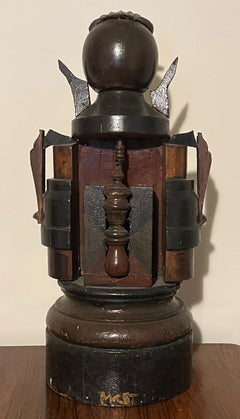
Untitled
By Josep Maria Codina Corona
Located in Barcelona, BARCELONA
Includes a Certificate of Authenticity
Category

1960s Modern Leo Salazar Art

Materials

Wood

Untitled
Untitled
$3,362
H 9.85 in W 11.42 in D 6.7 in
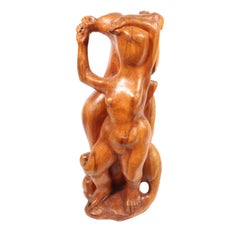
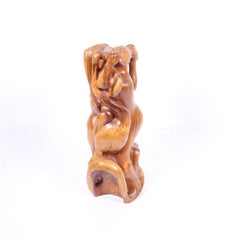
Two Women
By Robert Lohman
Located in Indianapolis, IN
Lohman studied at John Herron Art Institute, and Cranbrook and Yale for graduate work. Assisted Carl Milles at Cranbrook Academy before becoming Director of Fine Arts there from 1947...
Category

1950s Modern Leo Salazar Art

Materials

Wood

Two Women
Two Women
$3,000
H 25 in W 10 in D 10 in
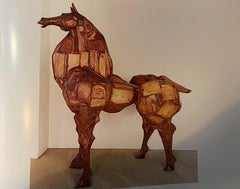
Maximus: Circus Horse
By Maxine Kim Stussy 1
Located in West Hollywood, CA
We are proud to present a lifetime masterpiece by American artist Maxine Kim Stussy. “Maxumus: Circus Horse”, is an original wood assemblage of both ha...
Category

1950s Modern Leo Salazar Art

Materials

Wood

Maximus: Circus Horse
$125,000
H 84 in W 37 in D 72 in
Harlem III
By Robert Cook
Located in New York, NY
Signed, titled, and dated in ink on base verso. Unique sculpture created using the lost wax process. This piece is 7 1/2" high x 12" wide x 3 1/2" deep. Robert Cook was born in Boston in 1921. He studied with George Demetrios...
Category

1990s Modern Leo Salazar Art

Materials

Bronze

Harlem III
Harlem III
$7,200
H 7.5 in W 12 in D 3.5 in
Nude Couple Embracing
Located in Milford, NH
A fine modernist solid wooden sculpture of a nude couple embracing in the manner of Rodin by South African artist Herman Wald (1906-1970). Wald was born...
Category

Mid-20th Century Modern Leo Salazar Art

Materials

Wood, Paint

Nude Couple Embracing
$1,900
H 37 in W 11 in D 9.75 in
Isabella
Located in West Hollywood, CA
Presenting an original carved wood sculpture by American WPA artist Avis Zeidler Nemkoff. "Isabella", is a hand carved wood sculpture measuring 18.5 inches tall, exceptional original condition, originally acquired from the estate of the artist who resided in Northern California. This is a magnificent one of a kind hand carved wood sculpture, c.1938. Please contact the gallery for additional information •Avis Zeidler was born in Madison, Wisconsin, in 1908. •It is not known when Zeidler moved to California. However, in the 1930s she majored in art at the University of California. •Later, she enrolled at the California School of Fine Arts after receiving a scholarship for her studies there. She studied with Ray Boynton, Lucien Labaudt, Karl Eugen Neuhaus, and Ralph Stackpole...
Category

1930s American Modern Leo Salazar Art

Materials

Wood

Isabella
$14,500
H 18.5 in W 10 in
Sydney Kumalo Bronze Minimalist African Modernist Sculpture Figural Female Nude
Located in Surfside, FL
Sydney Kumalo. Features a bronze stylized female figural form sculpture fixed to a marble plinth and wood base. Bears signature on base. Measures 9 1/2" x 4 1/4". There is no edition number on the piece. Sydney Kumalo (1935 - 1988) was born in Sophiatown, Johannesburg, on 13 April 1935. His was one of the families who had to move out of the "white" city to the South Western Townships, or Soweto. Raised in Diepkloof and educated at Madibane High School, he took with him from old Sophiatown the curious and diverse heritage of its heyday. Art classes in the Catholic school, "Sof' town" blues and jazz, the vibrant street culture and growing defiance of its population of various races who were gradually forced out into separate race-group areas. So it was that these various aspects of his early life created for Kumalo a cultural mix of a Zulu family related to the traditional royal house; city schooling, nascent township music and lingo; growing urbanised political defiance and the deep-rooted Zulu pride and respect for the legends and ancient stories of a tribal people. This mix of old and new cultures was reinforced when he began his studies at the Polly Street Art Centre in 1953 where he became a member of Cecil Skotnes group of serious artists who were encouraged to acquire professional skills. Skotnes introduced a basic training programme with modelling as a component, which marked the introduction of sculpting (in brick-clay) at Polly Street. Kumalo was Skotnes’ assistant at Polly Street from 1957 to 1964, and having recognised his great talent as a sculptor, Skotnes encouraged him to become a professional artist. After Kumalo’s very successful assistance with a commission to decorate the St Peter Claver church at Seeisoville near Kroonstad, with painting designs, sculpture and relief panels in 1957, Skotnes arranged for Kumalo to continue his art training by working in Edoardo Villa ’s studio from 1958 to 1960. Working with Villa, he received professional guidance and began to familiarize himself with the technical aspects of sculpting and bronze casting. In 1960 he became an instructor at the Polly Street Art Centre. Kumalo started exhibiting his work with some of the leading commercial Johannesburg galleries in 1958, and had his first solo exhibition with the Egon Guenther Gallery in 1962. He was a leader of the generation who managed to leave behind the forms of African curios, reject the European-held paternalism which encouraged notions of "naive" and "tribal" African art, and yet still hold fast to the core of the old legends and spiritual values of his people. He introduced these subjects into his bronze sculptures and pastel drawings, evolving his own expressive, contemporary African "style". Together with Skotnes, Villa, Cecily Sash and Giuseppe Cattaneo, Kumalo became part of the Amadlozi group in 1963. This was a group of artists promoted by the African art collector and gallery director Egon Guenther, and characterised by their exploration of an African idiom in their art. Elza Miles writes that Cecil Skotnes’ friendship with Egon Guenther had a seminal influence on the aspirant artists of Polly Street: “Guenther broadened their experience by introducing them to German Expressionism as well as the sculptural traditions of West and Central Africa. He familiarised them with the work of Ernst Barlach, Käthe Kollwitz, Gustav Seitz, Willi Baumeister and Rudolf Sharf.” It is therefore not surprising that some of Kumalo’s sculptures show an affinity with Barlach’s powerful expressionist works. Guenther organised for the Amadlozi group to hold exhibitions around Italy, in Rome, Venice, Milan and Florence, in both 1963 and 1964. Kumalo’s career took off in the mid 1960s, with his regular participation in exhibitions in Johannesburg, London, New York and Europe. He also represented South Africa at the Venice Biennale in 1966, and in 1967 participated in the São Paulo Biennale. EJ De Jager (1992) describes Kumalo’s sculpture as retaining much of the “canon and formal aesthetic qualities of classical African sculpture. His work contains the same monumentality and simplicity of form.” His main medium for modelling was terra cotta, which was then cast in bronze, always paying careful attention to the finish of both the model as well as the final cast. He began casting the pieces he modelled in clay or plaster into bronze at the Renzo Vignali Artistic Foundry in Pretoria North. He worked throughout his life with its owners, the Gamberini family, and enjoyed learning the technical aspects of the casting process, refining his surfaces according to what he learned would produce the best results in metal. De Jager further writes that Kumalo’s distinctive texturing of the bronze or terra cotta is reminiscent of traditional carving techniques of various African cultures. “In many respects Kumalo thus innovated a genuine contemporary or modern indigenous South African sculpture”. Kumalo came to admire the works of the Cubists, and of British sculptors Henry Moore and Lynn Chadwick. He became noted for adapting shapes from them into his own figures. The success of his use of the then current monumental simplicity and purely aesthetic abstractions of natural forms has been emulated by many South African sculptors since the 1970s. He was in many ways the doyen of South African Black art. As such he was an important influence especially on younger African sculptors, by whom he is greatly revered. Through his teaching at Polly Street and at the Jubilee Centre, as well as through his personal example of integrity, dedication and ability, he inspired and guided students who in their own right became outstanding artists, for example, Ezrom Legae, Leonard Matsoso and Louis Maqhubela From 1969 onward, he allied himself with Linda Givon, founder of The Goodman Gallery in Johannesburg, where he exhibited regularly until his death in December 1988. Working with Givon also perpetuated his associations with his many friends of strong principles. Skotnes, Villa, Legae and later such peers from the Polly Street era as Leonard Matsoso, Durant Sihlali and David Koloane have all exhibited at The Goodman Gallery. Kumalo, Legae, and later Fikile (Magadlela) and Dumile (Feni) were among the leading exponents of a new Afrocentric art...
Category

20th Century Modern Leo Salazar Art
Materials

Marble, Bronze

Sheeba
By Alfred Van Loen
Located in Indianapolis, IN
Embossed monogram signature. Referenced in "Beyond Time; The Art of Alfred Van Loen" SunStorm c.1993, p. 38. Van Loen was a highly influential modern artist and teacher of German de...
Category

Mid-20th Century Modern Leo Salazar Art

Materials

Plaster, Wood

Sheeba
Sheeba
$2,380
H 28 in W 9 in D 10 in
Modern Brutalist Metal Sculpture of an Abstract Skeletal Figure in a Locker
By Bob Fowler
Located in Houston, TX
Modern abstract brutalist metal sculpture by Houston artist Bob Fowler. The work features a skeletal figure welded in a box or locker. Firmly attached to a white and natural wood bas...
Category

1960s Modern Leo Salazar Art

Materials

Metal

Nude Statue, 20th Century Carved Oak
Located in London, GB
Carved Oak, 20th Century European School Nude Statue Height: 21 3/4 inches
Category

20th Century Modern Leo Salazar Art
Materials

Oak

Leo Salazar art for sale on 1stDibs.

Find a wide variety of authentic Leo Salazar art available for sale on 1stDibs. You can also browse by medium to find art by Leo Salazar in cedar, wood and more. Much of the original work by this artist or collective was created during the 1960s and is mostly associated with the modern style. Not every interior allows for large Leo Salazar art, so small editions measuring 7 inches across are available. Leo Salazar art prices can differ depending upon medium, time period and other attributes. On 1stDibs, the price for these items starts at $6,500 and tops out at $6,500, while the average work can sell for $6,500.

Artists Similar to Leo Salazar

Still Thinking About These?

All Recently Viewed