Maria Sybilla Merian Still-life Prints
Dutch, 1647-1717
Maria Sibylla Merian (1647—1717) was a naturalist and artist. Her contributions to entomology were never appropriately recognized in her lifetime. She is now considered to be a pioneer in the fields of botany and zoology. She made detailed observations of live specimens, which was a departure from previous studies that used preserved specimens. She focused great detail on the processes of metamorphosis, which had not been studied so comprehensively before her work. The engravings for the publication were done by J. Mulder, P. Sluyter and A. Stopendaal, all after paintings on vellum by Merian. The work is considered to be one of the most beautiful, and famous illustrated natural history works of the 18th century. The work was the result of Merian's trip in 1699 with her daughter Dorothea to Surinam, a Dutch colony on the northeastern coast of South America. The pair studied and recorded plants and insects for two years under difficult conditions. They came back to Amsterdam with specimens, notes and drawings and there completed their astounding work. One naturalist proclaimed "Her portrayals of living insects and other animals were imbued with a charm, a minuteness of observation and an artistic sensibility that had not previously been seen in a natural history book; if Gould and Audubon have 'a spiritual ancestor, then it is difficult to think of a more worthy claimant to the title than Maria Sibylla Merian." On the day Maria Sibylla Merian died, Tsar Peter the Great purchased a two-volume collection of her unbound paintings, as well as her journal.
Born in Frankfurt am Main, Maria Sibylla Merian was the daughter of Matthaus Merian the Elder (1593—1650), a famous German-Swiss painter, engraver and publisher. Her father died when she was three and her mother remarried Jacob Marrel (1614-1681), who was a still-life painter. From the time she was eleven, Marrel schooled Maria Sibylla Merian in the tradition of northern European still life painting, working directly from life. As her interests evolved toward the study of insects, she employed these artistic skills to create her outstanding scientific and esthetically beautiful works. She was truly at the crossroads of art and science.to
3
6
Overall Width
to
Overall Height
to
35
94
72
64
58
9
9
9
8
5
5
4
4
4
3
2
2
1
1
1
1
1
1
9
9
9
9
Artist: Maria Sybilla Merian
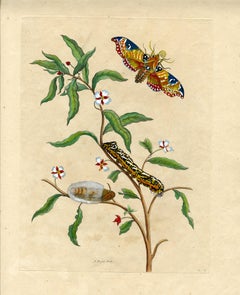
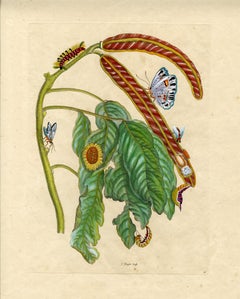
Tree with moth, caterpillar..., Plate 39, Metamorphosis Insectorum Surinamensium
By Maria Sibylla Merian
Located in Middletown, NY
Metamorphosis Insectorum Surinamensium, Plate No. 39; Unidentified tree with moth, caterpillar and pupa.
The Netherlands: 1705....
Category
Early 18th Century Naturalistic Maria Sybilla Merian Still-life Prints
Materials
Watercolor, Engraving
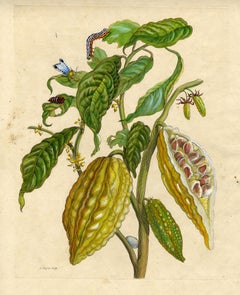
Cocoa plant, caterpillar, ..., Plate 26, Metamorphosis Insectorum Surinamensium
By Maria Sibylla Merian
Located in Middletown, NY
Metamorphosis Insectorum Surinamensium, Plate No. 26; Cocoa plant, caterpillar, pupa, and butterflies. The Netherlands: 1705. En...
Category
Early 18th Century Naturalistic Maria Sybilla Merian Still-life Prints
Materials
Watercolor, Engraving
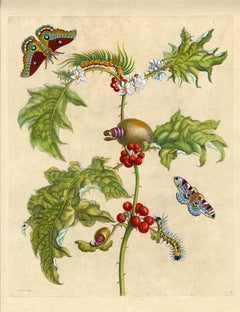
Thistle and Moths, plate no. 6, Metamorphosis Insectorum Surinamensium
By Maria Sibylla Merian
Located in Middletown, NY
Metamorphosis Insectorum Surinamensium, Plate No. 6; Thistle and Moths. The Netherlands: 1705. Engraving with hand coloring in w...
Category
Early 18th Century Naturalistic Maria Sybilla Merian Still-life Prints
Materials
Watercolor, Engraving
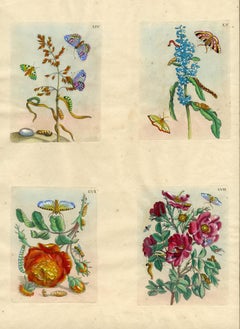
4 plates from The Wondrous Transformation of Caterpillars & their Strange Diet..
By Maria Sibylla Merian
Located in Middletown, NY
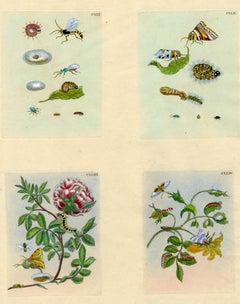
Four plates from The Wondrous Transformation of Caterpillars and their Strange Diet of Flowers. “Wolfsmelk Rupsen;" “Wolfsmilch, Raupe und Schmetterling" Amsterdam: J F Bernard, 1730. Each an engraving with hand coloring in watercolor and gouache printed on one sheet of watermarked Honig cream laid paper, each measures 6 1/4 x 5 inches (157 x 121 mm), sheet measures 20 5/8 x 14 inches (522 x 355 mm), full margins. With handling creases in the lower right sheet quadrant, as well as minor, loose cockling, otherwise in very good condition. The colors are superb with exceptionally fresh and bright saturation. Engraved between 1679 and 1683, printed 1730. Plates included: LIV, LV, LVI, & LVII.
MARIA SIBYLLA MERIAN was one of the most highly respected entomologists of the 17th century, and remains today one of the field's most significant figures. A German-born naturalist and scientific illustrator, she reared herself on the study of caterpillars, and made tremendous contributions to the knowledge of the life cycles of numerous species. Until her detailed and careful study of the process of metamorphosis it was thought that insects were "born of mud," through spontaneous generation.
Trained as a miniature painter by her stepfather, she published her first book of illustrations in 1675, at the age of 28. In 1679, Merian published the first volume of the two-volume series on caterpillars, The Wondrous Transformation of Caterpillars and their Strange Diet of Flowers; the second volume followed in 1683. Each volume contained 50 plates that she engraved and etched. In 1699, Merian traveled to Dutch Guiana...
Category
Early 18th Century Naturalistic Maria Sybilla Merian Still-life Prints
Materials
Watercolor, Engraving
4 plates from The Wondrous Transformation of Caterpillars & their Strange Diet..
By Maria Sibylla Merian
Located in Middletown, NY
Four plates from The Wondrous Transformation of Caterpillars and their Strange Diet of Flowers. “Wolfsmelk Rupsen;" “Wolfsmilch, Raupe und Schmetterling" Amsterdam: J F Bernard, 1730. Each an engraving with hand coloring in watercolor and gouache printed on one sheet of watermarked Honig cream laid paper, each measures 6 1/4 x 5 inches (157 x 121 mm), sheet measures 20 5/8 x 14 inches (522 x 355 mm), full margins. With handling creases in the lower right sheet quadrant, as well as minor, loose cockling, otherwise in very good condition. The colors are superb with exceptionally fresh and bright saturation. Engraved between 1679 and 1683, printed 1730. Plates included: No.1:I; No. 2:1; II & III.
MARIA SIBYLLA MERIAN was one of the most highly respected entomologists of the 17th century, and remains today one of the field's most significant figures. A German-born naturalist and scientific illustrator, she reared herself on the study of caterpillars, and made tremendous contributions to the knowledge of the life cycles of numerous species. Until her detailed and careful study of the process of metamorphosis it was thought that insects were "born of mud," through spontaneous generation.
Trained as a miniature painter by her stepfather, she published her first book of illustrations in 1675, at the age of 28. In 1679, Merian published the first volume of the two-volume series on caterpillars, The Wondrous Transformation of Caterpillars and their Strange Diet of Flowers; the second volume followed in 1683. Each volume contained 50 plates that she engraved and etched. In 1699, Merian traveled to Dutch Guiana...
Category
Early 18th Century Naturalistic Maria Sybilla Merian Still-life Prints
Materials
Watercolor, Engraving
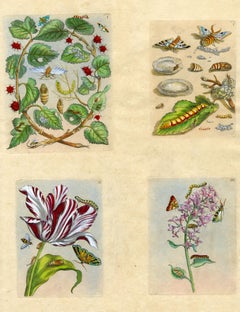
4 plates from The Wondrous Transformation of Caterpillars & their Strange Diet..
By Maria Sibylla Merian
Located in Middletown, NY
Four plates from The Wondrous Transformation of Caterpillars and their Strange Diet of Flowers. “Wolfsmelk Rupsen;" “Wolfsmilch, Raupe und Schmetterling" Amsterdam: J F Bernard, 1730. Each an engraving with hand coloring in watercolor and gouache printed on one sheet of watermarked Honig cream laid paper, each measures 6 1/4 x 5 inches (157 x 121 mm), sheet measures 20 5/8 x 14 inches (522 x 355 mm), full margins. With one 1.5 inch inch tear across the area of the top-left corner, well outside of image area. Handling creases in the lower right sheet quadrant, as well as minor, loose cockling, otherwise in very good condition. The colors are superb with exceptionally fresh and bright saturation. Engraved between 1679 and 1683, printed 1730. Plates included: CXXI, CXXII, CXXIII, & CXXIV.
MARIA SIBYLLA MERIAN was one of the most highly respected entomologists of the 17th century, and remains today one of the field's most significant figures. A German-born naturalist and scientific illustrator, she reared herself on the study of caterpillars, and made tremendous contributions to the knowledge of the life cycles of numerous species. Until her detailed and careful study of the process of metamorphosis it was thought that insects were "born of mud," through spontaneous generation.
Trained as a miniature painter by her stepfather, she published her first book of illustrations in 1675, at the age of 28. In 1679, Merian published the first volume of the two-volume series on caterpillars, The Wondrous Transformation of Caterpillars and their Strange Diet of Flowers; the second volume followed in 1683. Each volume contained 50 plates that she engraved and etched. In 1699, Merian traveled to Dutch Guiana...
Category
Early 18th Century Naturalistic Maria Sybilla Merian Still-life Prints
Materials
Watercolor, Engraving
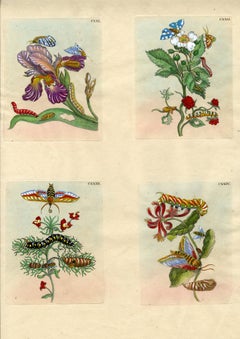
4 plates from The Wondrous Transformation of Caterpillars & their Strange Diet..
By Maria Sibylla Merian
Located in Middletown, NY
Four plates from The Wondrous Transformation of Caterpillars and their Strange Diet of Flowers. “Wolfsmelk Rupsen;" “Wolfsmilch, Raupe und Schmetterling" Amsterdam: J F Bernard, 1730. Each an engraving with hand coloring in watercolor and gouache printed on one sheet of watermarked Honig cream laid paper, each measures 6 1/4 x 5 inches (157 x 121 mm), sheet measures 20 5/8 x 14 inches (522 x 355 mm), full margins. With handling creases in the lower right sheet quadrant, as well as minor, loose cockling, otherwise in very good condition. The colors are superb with exceptionally fresh and bright saturation. Engraved between 1679 and 1683, printed 1730. Plates included: CI; CII; CIII & CIV.
MARIA SIBYLLA MERIAN was one of the most highly respected entomologists of the 17th century, and remains today one of the field's most significant figures. A German-born naturalist and scientific illustrator, she reared herself on the study of caterpillars, and made tremendous contributions to the knowledge of the life cycles of numerous species. Until her detailed and careful study of the process of metamorphosis it was thought that insects were "born of mud," through spontaneous generation.
Trained as a miniature painter by her stepfather, she published her first book of illustrations in 1675, at the age of 28. In 1679, Merian published the first volume of the two-volume series on caterpillars, The Wondrous Transformation of Caterpillars and their Strange Diet of Flowers; the second volume followed in 1683. Each volume contained 50 plates that she engraved and etched. In 1699, Merian traveled to Dutch Guiana...
Category
Early 18th Century Naturalistic Maria Sybilla Merian Still-life Prints
Materials
Watercolor, Engraving
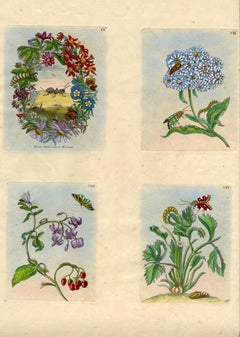
3 plates from The Wondrous Transformation of Caterpillars & their Strange Diet..
By Maria Sibylla Merian
Located in Middletown, NY
Three plates from The Wondrous Transformation of Caterpillars and their Strange Diet of Flowers. “Wolfsmelk Rupsen;" “Wolfsmilch, Raupe und Schmetterling" Amsterdam: J F Bernard, 1730. Each an engraving with hand coloring in watercolor and gouache printed on one sheet of watermarked Honig cream laid paper, each measures 6 1/4 x 5 inches (157 x 121 mm), sheet measures 20 5/8 x 14 inches (522 x 355 mm), full margins. With handling creases in the lower right sheet quadrant, as well as minor, loose cockling, otherwise in very good condition. The colors are superb with exceptionally fresh and bright saturation. Engraved between 1679 and 1683, printed 1730. Plates included: XLVIII; XLIX & L.
MARIA SIBYLLA MERIAN was one of the most highly respected entomologists of the 17th century, and remains today one of the field's most significant figures. A German-born naturalist and scientific illustrator, she reared herself on the study of caterpillars, and made tremendous contributions to the knowledge of the life cycles of numerous species. Until her detailed and careful study of the process of metamorphosis it was thought that insects were "born of mud," through spontaneous generation.
Trained as a miniature painter by her stepfather, she published her first book of illustrations in 1675, at the age of 28. In 1679, Merian published the first volume of the two-volume series on caterpillars, The Wondrous Transformation of Caterpillars and their Strange Diet of Flowers; the second volume followed in 1683. Each volume contained 50 plates that she engraved and etched. In 1699, Merian traveled to Dutch Guiana...
Category
Early 18th Century Naturalistic Maria Sybilla Merian Still-life Prints
Materials
Watercolor, Engraving
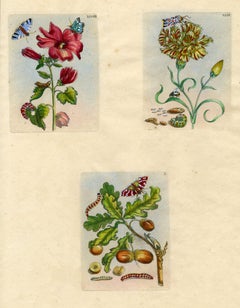
4 plates from The Wondrous Transformation of Caterpillars & their Strange Diet..
By Maria Sibylla Merian
Located in Middletown, NY
Four plates from The Wondrous Transformation of Caterpillars and their Strange Diet of Flowers. “Wolfsmelk Rupsen;" “Wolfsmilch, Raupe und Schmetterling" Amsterdam: JF Bernard, 1730. Each an engraving with hand coloring in watercolor and gouache printed on one sheet of watermarked Honig cream laid paper, each measures 6 1/4 x 5 inches (157 x 121 mm), sheet measures 20 5/8 x 14 inches (522 x 355 mm), full margins. With handling creases in the lower right sheet quadrant, as well as minor, loose cockling, otherwise in very good condition. The colors are superb with exceptionally fresh and bright saturation. Engraved between 1679 and 1683, printed 1730. Plates included: CXLI, CXLII, CXIII & CXLIV.
MARIA SIBYLLA MERIAN was one of the most highly respected entomologists of the 17th century, and remains today one of the field's most significant figures. A German-born naturalist and scientific illustrator, she reared herself on the study of caterpillars, and made tremendous contributions to the knowledge of the life cycles of numerous species. Until her detailed and careful study of the process of metamorphosis it was thought that insects were "born of mud," through spontaneous generation.
Trained as a miniature painter by her stepfather, she published her first book of illustrations in 1675, at the age of 28. In 1679, Merian published the first volume of the two-volume series on caterpillars, The Wondrous Transformation of Caterpillars and their Strange Diet of Flowers; the second volume followed in 1683. Each volume contained 50 plates that she engraved and etched. In 1699, Merian traveled to Dutch Guiana...
Category
Early 18th Century Naturalistic Maria Sybilla Merian Still-life Prints
Materials
Watercolor, Engraving
Related Items
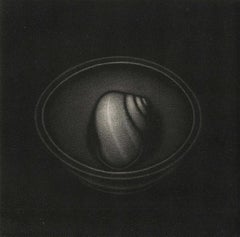
Snail in a Bowl (Artist Proof inscribed to Fritz Eichenberg)
Located in New Orleans, LA
Leonard Merchant's mezzotint, "Snail in Cup" is inscribed for fellow artist, Fritz Eichenberg.
While a student at the Central School for Arts and Crafts in London, a young Leonard Marchant found an engraving rocker in a cupboard and proceeded to turn himself into a master of the painstaking art of mezzotinting.
Marchant, who has died in Shrewsbury aged 70, grew up in Simonstown, the Royal Navy's enclave in South Africa. Though his first job was as a parliamentary messenger, he taught himself to paint and, aged 19, was given a one-man show in Cape Town. Fired by this success, he left for England to study painting and, he claimed, to escape the stifling home atmosphere created by his Catholic mother and aunts. (His father was killed in the second world war.) Without contacts in London, he phoned Jacob Epstein, whose recommendation resulted in a grant to study briefly at the Central School. It was later, when studying full-time at the Central, that he saw the mezzotints of the Japanese master, Yozo Hamaguchi, in a London gallery. He was hooked.
Creating a mezzotint is tedious in the extreme. The copper plate must first be prepared with a "rocker" which roughens the surface. A plate may be "rocked" 30 or 40 times. The rough texture is then reduced with a burnisher and a scraper, allowing the print a range of tones from velvety black through the greys to white. Marchant's plates could be months in the making. But the technical demands were the least of his worries. In its 18th- and 19th-century heyday, mezzotint was solely a reproductive medium, for copying masters such as Reynolds and Turner. The development of photography rendered it unfashionable, and by the 1960s the technique, known as la manière anglaise, was a bygone medium.
Marchant, by now a teacher in printmaking at the Central, began to create original mezzotints with a colleague, Radavan Kraguly. A perfectionist, he seemed to revel in the straitjacket procedure. Perhaps it was the metaphor of bringing darkness out of light that appealed to this straight-talking, sometimes sombre, man, who would suddenly relax and light up like a gleaming hue on one of his prints. His work was of squares and triangles with the occasional cat, black and ominous, and carefully arranged still lifes, featuring plants, a seed pod, a pot he might have bought at auction to celebrate the sale of a print.
There were one-man shows, notably at the Bankside Gallery. He sold well at the Royal Academy summer exhibition, was a Florence Biennale prizewinner, spent a fellowship year at the British School in Rome, and was elected a Fellow of the Royal Society of Painter-Printmakers.
But making mezzotints was not a paying job. Marchant and his South African wife...
Category
1980s Modern Maria Sybilla Merian Still-life Prints
Materials
Mezzotint

$138 Sale Price
25% Off
H 5.88 in W 5.88 in
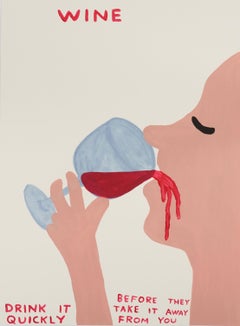
Wine
By David Shrigley
Located in Manchester, GB
David Shrigley, Wine, 2021
Hand-signed and dated on the reverse
Edition 29 of 125
75 x 56 cm
Screenprint in colours
Private Collection UK
Category
2010s Contemporary Maria Sybilla Merian Still-life Prints
Materials
Screen
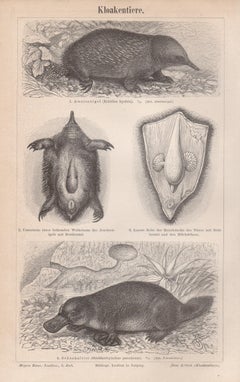
Echidna and Platypus, Australian animal monotreme antique engraving print
Located in Melbourne, Victoria
'Kloakentiere'
(Monotremes - echidna and platypus))
German wood-engraving, circa 1895.
240mm by 155mm (sheet)
Category
Late 19th Century Naturalistic Maria Sybilla Merian Still-life Prints
Materials
Engraving
$65
H 9.45 in W 6.11 in
The Celestial Hippocampus (Ed. 88/140)
Located in Dallas, TX
"The Scar by China Miéville is a novel which has been a part of my life for many years, and has travelled as my companion through since adolescence. I've attempted to depict the Avan...
Category
21st Century and Contemporary Surrealist Maria Sybilla Merian Still-life Prints
Materials
Screen
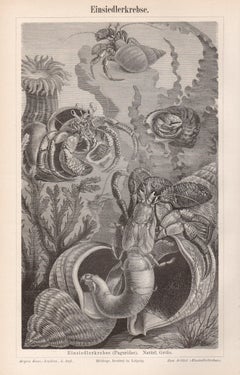
Hermit Crabs, German animal antique underwater crustacean engraving print
Located in Melbourne, Victoria
'Einsiedlerkrebse'
(Hermit crabs)
German wood-engraving, circa 1895.
240mm by 155mm (sheet)
Category
Late 19th Century Naturalistic Maria Sybilla Merian Still-life Prints
Materials
Engraving
$50
H 9.45 in W 6.11 in
[ Bird of Paradise] La Pie de paradise, vue par derriere, No.21
By Jacques Barraband
Located in Paonia, CO
[ Bird of Paradise] La Pie de paradise, vue par derriere , No.21, Paris 1801-1806 [Astrapia nigra]. Color-printed engraving with hand-coloring. French botanical and zoological illustrator Jacques Barraband (1767-1809) was known as one of the finest ornithological artists of his time .He is best known for his watercolors and engravings that were commissioned by François LeVaillant, French explorer, naturalist, zoological collector , noted ornithologist and author. Levaillant’s Histoire naturelle des perroquets (1801-05) and his Histoire naturelle des oiseaux de paradis (Birds of Paradise, 1801-06), both of which Barraband contributed to, are still considered some of the most beautiful bird books of all times because of their exceptional scientific accuracy, rich color and detail. The Astrapia nigra is a Bird of Paradise that inhabits the Vogelkop Peninsula of West Papua...
Category
Early 18th Century Other Art Style Maria Sybilla Merian Still-life Prints
Materials
Engraving
![[ Bird of Paradise] La Pie de paradise, vue par derriere, No.21](https://a.1stdibscdn.com/jacques-barraband-prints-works-on-paper--bird-of-paradise-la-pie-de-paradise-vue-par-derriere-no21-for-sale/a_7803/1543778408303/Bird_of_Paradise_master.jpg?width=240 "jacques bird")
$5,200 Sale Price
20% Off
H 21 in W 28.5 in
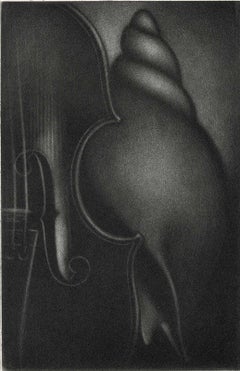
Violin et Coquille (violin and shell / inscribed Happy New Year 2000)
By Laurent Schkolnyk
Located in New Orleans, LA
This black and white mezzotint of a shell next to a violin is an artist proof that was inscribed Happy New Year 2000 and signed by the artist. The regular e...
Category
1990s American Modern Maria Sybilla Merian Still-life Prints
Materials
Mezzotint
$131 Sale Price
25% Off
H 5.75 in W 3.75 in
Lily Scent
By Robert Rauschenberg
Located in New York, NY
Robert Rauschenberg
Lily Scent, 1981
Lithograph
32 x 24 inches
SPIII
Signed
Category
1980s Abstract Expressionist Maria Sybilla Merian Still-life Prints
Materials
Lithograph
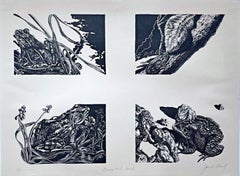
Frogs and Toad, Signed lithograph (AP), from Conspiracy: The Artist as Witness
By Jack Beal
Located in New York, NY
Jack Beal
Frogs and Toad, 1971
Hand signed in pencil by Jack Beal, annotated AP
One-color lithograph proofed by hand and pulled by machine from a zinc plate on Arches buff paper with deckled edges at the Shorewood Bank Street Atelier
Stamped, hand numbered AP, aside from the regular edition of 150 Stamped on reverse: COPYRIGHT © 1971 BY JACK BEAL, bears blind stamp
18 × 24 inches
Unframed
18 x 24 inches
Stamped on reverse: COPYRIGHT © 1971 BY JACK BEAL, bears distinctive blind stamp of publisher (shown) Publisher: David Godine, Center for Constitutional Rights, Washington, D.C.
Jack Beal's "Frogs and Toads" is a classic example of protest art from the early 1970s - the most influential era until today. This historic graphic was created for the legendary portfolio "CONSPIRACY: the Artist as Witness", to raise money for the legal defense of the Chicago 8 - a group of anti-Vietnam War activists indicted by President Nixon's Attorney General John Mitchell for conspiring to riot during the 1968 Democratic National Convention. (1968 was also the year Bobby Kennedy was killed and American casualties in Vietnam exceeded 30,000.) The eight demonstrators included Abbie Hoffman, Jerry Rubin, David Dellinger, Tom Hayden, Rennie Davis, John Froines, Lee Weiner, and Bobby Seale. (The eighth activist, Bobby Seale, was severed from the case and sentenced to four years for contempt after being handcuffed, shackled to a chair and gagged.) Although Abbie Hoffman would later joke that these radicals couldn't even agree on lunch, the jury convicted them of conspiracy, with one juror proclaiming the demonstrators "should have been shot down by the police." All of the convictions were ultimately overturned by the 7th Circuit Court of Appeals.
This lithograph has fine provenance: it comes directly from the original Portfolio: "Conspiracy The Artist as Witness" which also featured works by Alexander Calder, Nancy Spero and Leon Golub, Romare Bearden Sol Lewitt, Robert Morris, Claes Oldenburg, Larry Poons, Peter Saul, Raphael Soyer and Frank Stella - as well as this one by Jack Beal. It was originally housed in an elegant cloth case, accompanied by a colophon page. This is the first time since 1971 that this important work has been removed from the original portfolio case for sale. It is becoming increasingly scarce because so many from this edition are in the permanent collections of major museums and institutions worldwide.
Jack Beal wrote a special message about this work on the Portfolio's colophon page. It says, "In 1956, shortly after Sondra and I moved to New York, two friends were arrested and jailed for protesting air-raid drills. From them and their friends came our education. This work is dedicated to them and their families. "In Memory of Patricia McClure Daw and AL Uhrie" - This print was made for their children.
Jack Beal Biography:
Early in his career Walter Henry “Jack” Beal Jr. painted abstract expressionist canvases, because he believed it was “the only valid way to paint.” By the early 1960s he totally altered his approach and fully repudiated abstraction. Turning to representation, he painted narrative and figurative subjects, often enhanced by bright colors and dramatic perspectives.
Beal was born in Richmond, Virginia, and from 1950 to 1953 he attended the Norfolk Division of William and Mary College Polytechnic Institute, (now Old Dominion University) where he studied biology and anatomy. Shifting gears, he sought art training at the School of the Art Institute of Chicago where he focused on drawing, and met his wife, artist Sondra Freckelton. His art history instructor encouraged her students to paint in the manner of established artists, and to that end he frequented the Institute’s galleries. For Beal this was significant: “Until I saw pictures of real quality I had tended to think of painting as just so much self-indulgent smearing around, but when I saw masterpieces by Cézanne and Matisse, and other painters of similar stature, I was bowled over; suddenly I realized the force of art.”
After spending three years (1953–1956) at the Art Institute, Beal concluded his studies there without getting a terminal degree, thinking it was only useful if he wanted to teach, which, at the time, he did not. He also took courses at the University of Chicago in 1955 and 1956. During this period he married Freckelton, a fellow student and sculptor who began her career working in wood and plastic. Together they moved to New York’s SoHo District before its transformation from a wasteland of sweatshops and small factories into an arts district. They were active with the Artist Tenants Association which was instrumental in getting zoning laws changed so that artists could live and work in the well-lit lofts.
Embracing what came to be called “New Realism,” Beal initially painted an occasional landscape as well as earthy-toned still lifes which consisted of jumbled collections filled with personal objects. His signature style started with a series of female nudes—all modeled by Freckelton—based on Greek mythology. These were large canvases with flat paint surfaces, dramatic foreshortening, and unusual perspectives. He further enlivened them with vivid colors, stark lighting, and dynamic patterns derived from textiles and overstuffed furniture. He stopped painting nudes after two episodes. The first came as he was loading a canvas of his naked wife onto a truck in lower Manhattan; several laborers walked by and started to fondle and kiss the painting. On the one hand he felt his wife had been violated, while on the other he was pleased that his realism was so convincing. The second occurred after a solo exhibition in Chicago at which the reception had been sponsored by Playboy magazine. A few days later he was approached by a publicist and asked if Playboy bunnies could be photographed in front of his paintings. He refused.
Some portrait commissions came Beal’s way, but he preferred only portraying friends. More significant were four large murals on the History of Labor in America, the 20th Century: Technology (1975), which he undertook for the headquarters of the United States Department of Labor in Washington. Following a historical timeline, the themes were: colonization, settlement, nineteenth century industry, and twentieth century technology. The unveiling ceremony was attended by government officials and Joan Mondale, an arts advocate and wife of the vice-president. The reviewer for the Washington Post wrote enthusiastically: “They’re heartfelt and they’re big (each is 12 feet square). Their many costumed actors (the Indian, the trapper, the scientist, the hardhat, the capitalist in striped pants, the union maid, etc.) strike dramatic poses in dramatic settings (a seaside wood at dawn, an outdoor blacksmith’s forge, a 19th-century mill, a 20th-century lab). The lighting is theatrical. Beal’s compositions, with their swooping curves and bunched diagonals, are as complicated as his interwoven plots.” To accomplish the murals Beal assembled a team of assistants and models, much in the manner of Renaissance masters, which included artist friends and Freckelton. who by then was painting brightly colorful still lifes.
A second mural commission ensued from New York City’s Metropolitan Transit Authority for two twenty-foot long installations for the Times Square Interborough Rapid Transit Company subway station. Beal’s designs for The Return of Spring (installed in 2001, three days after the terrorist attacks in New York, Washington, DC and Philadelphia) and The Onset of Winter (installed in 2005), Beal captured the appearance of his models in an oil painting made to the scale of the intended mosaic. A collaboration with Miotto Mosaics, the canvases were shipped to the Travisanutto Workshop, in Spilimbergo, Italy, where craftsmen fabricated the design to glass mosaics. The Return of Spring depicted construction workers and other New Yorkers in front of a subway kiosk and an outdoor produce market and in The Onset of Winter, a crowd watches a film crew recording a woman entering the subway as snow falls against the city’s skyline. Harkening back to some of his early nudes based on Greek myth, Persephone, goddess of fertility and wife of Hades, appears in both. The symbolism is pertinent, since she spent six months each year below ground.
Although he disparaged teaching early on, Beal and Freckelton offered four summertime workshops on their farm in Oneonta, New York. He was an instructor at the New York Academy of Art, a graduate art school he helped to establish in 1982. Returning to Virginia, he taught at Hollins College...
Category
1970s Realist Maria Sybilla Merian Still-life Prints
Materials
Lithograph
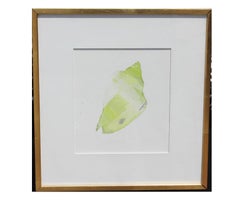
Green Painted Sea Shell Lithograph Edition 33 of 34
By Frances Nail
Located in Houston, TX
Green shell lithograph of a cone shell. Print is edition 33 of 34. Signed and dated by the artist along with titled. Print is framed in a golden frame...
Category
1970s Naturalistic Maria Sybilla Merian Still-life Prints
Materials
Lithograph
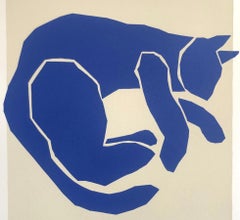
Matisse's Cat, Matisse Style Artwork, Contemporary Animal Print, Blue Art
By Mychael Barratt
Located in Deddington, GB
Matisse's Cat is a limited edition hand made print by artist Mychael Barratt which takes inspiration from the paper cutting work of Matisse in the 1940s....
Category
21st Century and Contemporary Minimalist Maria Sybilla Merian Still-life Prints
Materials
Paper, Screen
$382
H 15.75 in W 14.97 in D 0.04 in
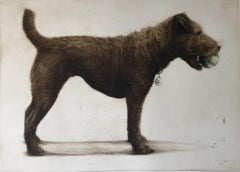
Izzy with her Ball, Dog Art, Affordable Art, Contemporary Animal Art Print
Located in Deddington, GB
Izzy, a charming characterful terrier stands alert, holding her ball in her mouth. Colour etching hand made and printed by the artist.
Helen Fay's art for sale online and in our gall...
Category
2010s Contemporary Maria Sybilla Merian Still-life Prints
Materials
Paper, Drypoint, Etching
$546
H 25.2 in W 32.29 in D 0.06 in
Previously Available Items
Icecream Bean plant..., plate no. 58, Metamorphosis Insectorum Surinamensium
By Maria Sibylla Merian
Located in Middletown, NY
Metamorphosis Insectorum Surinamensium, Plate No. 58; Ice Cream Bean Plant, Cloudless Sulphur Butterfly and Caterpillar with Mot...
Category
Early 18th Century Naturalistic Maria Sybilla Merian Still-life Prints
Materials
Engraving, Watercolor
3 plates from The Wondrous Transformation of Caterpillars & their Strange Diet..
By Maria Sibylla Merian
Located in Middletown, NY
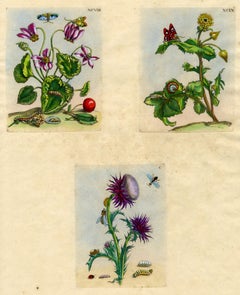
Three plates from The Wondrous Transformation of Caterpillars and their Strange Diet of Flowers. “Wolfsmelk Rupsen;" “Wolfsmilch, Raupe und Schmetterling" Amsterdam: J F Bernard, 173...
Category
Early 18th Century Naturalistic Maria Sybilla Merian Still-life Prints
Materials
Watercolor, Engraving
4 plates from The Wondrous Transformation of Caterpillars & their Strange Diet..
By Maria Sibylla Merian
Located in Middletown, NY
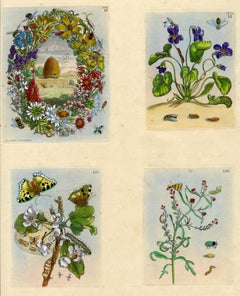
Merian, Maria Sibylla. Four plates from The Wondrous Transformation of Caterpillars and their Strange Diet of Flowers. “Wolfsmelk Rupsen;" “Wolfsmilch, Raupe und Schmetterling" Amste...
Category
Early 18th Century Naturalistic Maria Sybilla Merian Still-life Prints
Materials
Watercolor, Engraving
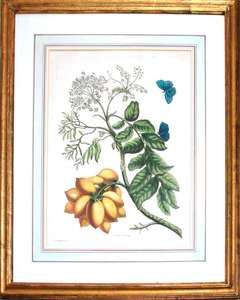
Prunier d'Amerique.
By Maria Sibylla Merian
Located in London, GB
Engraving with FINE CONTEMPORARY HAND-COLOUR. Dimensions: 460 by 310mm. (18 by 12.25 inches). [Paris, chez Huguier, c.1745].
Hunt 524.
For 'Recueil de[s] plantes des Indes'. Mar...
Category
18th Century and Earlier Maria Sybilla Merian Still-life Prints
Maria Sybilla Merian still-life prints for sale on 1stDibs.
Find a wide variety of authentic Maria Sybilla Merian still-life prints available for sale on 1stDibs. You can also browse by medium to find art by Maria Sybilla Merian in engraving, paint, watercolor and more. Not every interior allows for large Maria Sybilla Merian still-life prints, so small editions measuring 10 inches across are available. Customers who are interested in this artist might also find the work of Johann Wilhelm Weinmann, Georges-Louis Leclerc, Comte de Buffon, and george brookshaw. Maria Sybilla Merian still-life prints prices can differ depending upon medium, time period and other attributes. On 1stDibs, the price for these items starts at $4,300 and tops out at $5,300, while the average work can sell for $4,500.