Want more images or videos?
Request additional images or videos from the seller
1 of 5
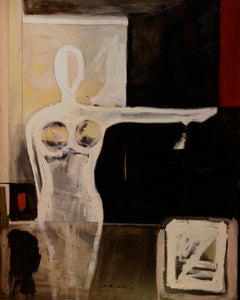
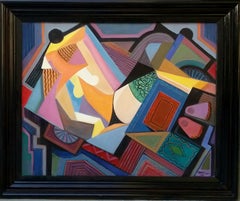
Albert PelsWaitingc.1940
c.1940
$1,800List Price
About the Item
About the Seller
5.0
Vetted Professional Seller
Every seller passes strict standards for authenticity and reliability
Established in 1972
1stDibs seller since 2011
409 sales on 1stDibs
Authenticity Guarantee
In the unlikely event there’s an issue with an item’s authenticity, contact us within 1 year for a full refund. DetailsMoney-Back Guarantee
If your item is not as described, is damaged in transit, or does not arrive, contact us within 7 days for a full refund. Details24-Hour Cancellation
You have a 24-hour grace period in which to reconsider your purchase, with no questions asked.Vetted Professional Sellers
Our world-class sellers must adhere to strict standards for service and quality, maintaining the integrity of our listings.Price-Match Guarantee
If you find that a seller listed the same item for a lower price elsewhere, we’ll match it.Trusted Global Delivery
Our best-in-class carrier network provides specialized shipping options worldwide, including custom delivery.You May Also Like
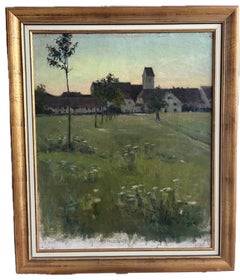
Wilfred Gabriel de Glehn, British Impressionist plein air oil landscape
By Wilfred Gabriel de Glehn
Located in Harkstead, GB
A very early, seminal work by this highly important British artist dating to 1893. The artist was a good friend of John Singer Sargent and they painted together around Europe.
The...
Category
Late 19th Century Impressionist Landscape Paintings
Materials
Oil, Canvas
$4,353 Sale Price
20% Off
H 24 in W 20 in D 1.5 in
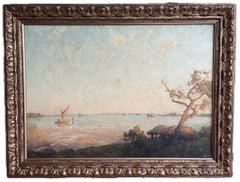
Frederick George Cotman Impressionist oil painting Suffolk river landscape
By Frederick George Cotman
Located in Harkstead, GB
An impressive, panoramic view of the River Stour looking towards Harwich and Felixstowe in Suffolk. It is very much a snapshot of times gone by with the hay barge loaded with hay.
F...
Category
19th Century Impressionist Landscape Paintings
Materials
Oil, Canvas
$1,761 Sale Price
30% Off
H 21.5 in W 30 in D 2 in
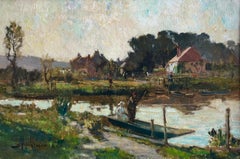
Bertram Priestman British Impressionist oil painting punting scene
By Bertram Priestman
Located in Harkstead, GB
An idyllic scene of figures punting on an East Anglian river. Dating to 1919, the image has an added poignancy as it is in sharp contrast to the tragedies of the First World War whic...
Category
Early 20th Century Impressionist Landscape Paintings
Materials
Oil, Canvas
$3,400
H 16 in W 24 in D 2 in
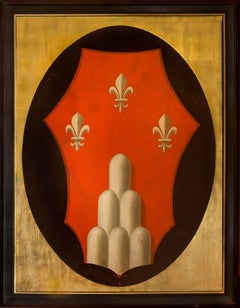
Italian Oil on Canvas Painting Coat of Arms in Gold Leaves Panel and Black Frame
Located in Firenze, IT
This huge Italian 19th century armorial painting features the coat of arms of Montini, a noble Italian family that
has among its ancestors the Archbishop of Milan, later known as Pope Paul VI.
The large oval canvas has a brown and red background, the latter shaped like a shield, in which six mountains
(from the etymology of the surname) and three white fleur de lis are painted.
This big scale palatial oil painting...
Category
Late 19th Century Italian School Figurative Paintings
Materials
Oil, Canvas, Wood
$5,943
H 67.33 in W 53.55 in D 2.37 in
Oil on Canvas “BS Trust”
By Frank Arnold
Located in Fresno, CA
“BS Trust” is 36” x 36”. Frank Arnold’s paintings exhibit the highest quality materials for a truly archival piece, created to last generations. Much of Frank Arnold’s work is sourc...
Category
2010s Abstract Abstract Paintings
Materials
Canvas, Oil
Last Dance
By Frank Arnold
Located in Fresno, CA
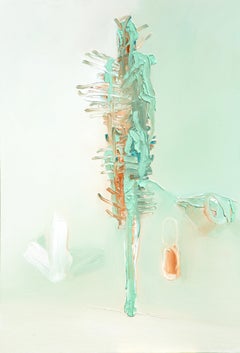
Last Dance is an Oil on Canvas painting in soft, light aqua tones with red/brown accents. Frank Arnold is thought by many to be one of the foremost abstract...
Category
2010s Abstract Abstract Paintings
Materials
Canvas, Oil
My Other Side
By Frank Arnold
Located in Fresno, CA
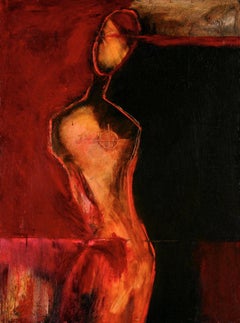
“My Other Side” is 48”x 36”. This is an earlier piece by Arnold from the estate of a late collector of his work. This piece is predominantly shades of red from light to almost black....
Category
Early 2000s Abstract Abstract Paintings
Materials
Canvas, Oil
New Move
By Frank Arnold
Located in Fresno, CA
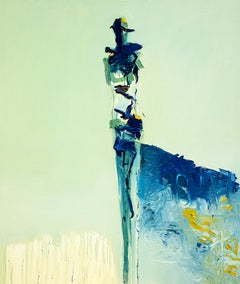
"New Move 8" Oil on Canvas is a mix of blues and greens with chrome yellow accents. Frank Arnold is thought by many to be one of the foremost abstract figurative painters and sculpto...
Category
2010s Abstract Abstract Paintings
Materials
Canvas, Oil
Oil on Canvas “Blake’s Wish”
By Frank Arnold
Located in Fresno, CA
"Blake’s Wish" is 60” x 48”. Solo female figure Dominant colors are black, white and deep crimson red.. Frank Arnold’s paintings exhibit the highest quality materials for a truly arc...
Category
2010s Abstract Abstract Paintings
Materials
Canvas, Oil
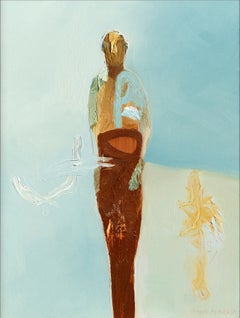
Teller 3
By Frank Arnold
Located in Fresno, CA
"Teller 3" Oil on Canvas presents a singular form and background in varying shades of green, blue, yellow and white and eart tones.
Frank Arnold is viewed as one of the foremost abstract figurative painters and sculptors of our time. He is a living master guided by a personal mission to “turn on a light in the human soul,” through his passionate creation of “Messengers” from his deeper mind connection with Carl Jung's archetypal images, the collective unconscious, and Jungian Synchronicity. These unconscious forms from his deeper mind resonate as personal messages of universal acceptance, reaching out to the viewer.
Arnold has been honored as IAD Artist of the year 2018 by International Artist Day, and 2013 FAC Horizon Artist Award. He has exhibited his artwork in numerous galleries and museums and is in collections worldwide. Arnold divides his working days between oil painting in San Jose del Cabo, Baja Sur...
Category
2010s Abstract Abstract Paintings
Materials
Canvas, Oil
More From This Seller
View AllLADY WITH PICK FAN
Located in Los Angeles, CA
Biography from the niece of the artist from during his lifetime. Paintings acquired from the artist.s estate.
Max Turner
1925 - 2019
Max Lamar Turner Painter, Sculptor, Teacher and Author.
Max Turner was born in Omaha, Nebraska on July 28, 1925. His father was Lance Howard Turner and his mother Mary Irene Turner. In 1927, his family moved to Bingham Canyon, Utah where Max's father extracted copper from a creek that he had diverted to pass through his garage. The town was located in a narrow canyon on the eastern face of the Oquirrh Mountains. In 1938, when Max was 13, his family moved to Midvale, Utah. After completing high school, Max went to work laying rail until he was inducted into the U.S. Navy to serve during W.W. II.
There he took an aptitude test and was initially assigned to the medical corp., later transferring to the dental unit. Max was stationed at Port Hueneme, Ventura County, California through the end of the war. When he was discharged in 1946, he remained in Southern California, living in the Los Angeles area. He met a man named Larry Torres and they formed a partnership to do silk screen work primarily for the Colby Poster Printing Company. This lasted about 10 years until the Colby building caught fire and burned down. In 1958, Max began working for Slade Novelty company that made doll parts using a product called plastisol. A year later, Max began producing plastic parts through his own business. One day, a couple of kids brought in a shrunken skull they had made and asked Max if he could reproduce it. Max said he could and he looked around for a business to work with for this task. He ultimately decided he could create his own machine shop to make molds. As a result, Max purchased a lathe, drill press, grinder and other tools to create his own machine shop and went into business making molds. He built a clientele and in 1973, he moved his machine shop to Glendale, California.
Painter, Sculptor, Teacher and Author:
Max recalls the day when his interest in art took a new direction. He happened to be in a paint store to purchase some supplies when he saw a card posted on a wall that read, "Come paint with Connie Marlo". Max had been interested in art since his youth and he was frequently impressed with paintings displayed by local artists at various community events.
Consequently, he decided to go to Connie's Saturday morning art class at a studio on North La Brea Avenue (between Sunset and Hollywood) in Los Angeles. But, as fate would have it, he immediately took a detour from this class when he found a piece of paper on the floor of the studio referencing another art class dealing with compositions, patterns, rhythms and color harmony. The instructor's name was Hal Reed, a former art student of the Russian/American Master, Nicolai Fechin. Hal owned the building (previously the Will Foster Studio) and had founded the Art League of Los Angeles. When Max found Hal, he asked Hal if he could join his class. Hal said "No, the class was full" but he said Max could monitor the class in the back of the classroom. Max took him up on the offer and began observing the weekly class.
During the class, Hal told his students that they should practice what they were learning by going to "live model" classes. Max began attending these classes where he learned how to draw figures. After a few months, Hal and Max became good friends. Hal was so impressed with Max's work that he offered Max the opportunity to teach at another location that Hal was opening in the San Fernando Valley. Max accepted the offer and began teaching his own art class. For Max, it was a quick jump from learning to teaching. Max then found that several of his students had to commute to his art class from the west end of the "Valley". To better serve this group of students, Max decided to relocate to another studio in Calabasas.
Max continued teaching, and at this time he was producing very impressive portraits, both oil paintings and charcoal drawings from live models (Max never worked from photos). Max demonstrated real talent, and the style of his drawings and paintings were being compared to those of Nicolai Fechin. And, like Fechin, Max also had an interest in sculpting. One day, Max decided to design and cast a bronze owl sculpture to put in his Calabasas Fine Art Gallery. Later, someone approached Max when he was at the foundry and asked him about his success selling the owl sculpture. The individual who asked this question was convinced that there was a broader market for these sculptures and he ordered a dozen of the owl sculptures from Max. This encouraged Max to do more castings. Some of the new castings were antique sculptures he found and reproduced. As this new business grew, he decided to establish his own foundry, employing up to 15 workers. The business continued for many years, up until the late 1990's when Max got tired of the foundry business and sold it.
Max, who was now in his 70's, decided to move on to his next venture as an artist, dedicating himself to doing the actual sculpting of original art. He loved the creativity of sculpting and he had his sculptures cast at local foundries, ironically the same ones that used to be his competition. Max was now fully engaged in his new artistic direction and, over time, he produced a large body of work. He created very impressive sculptures, including about 100 full-size sculptures. He sold some of these to high-end clientele, the Foundry at SLS Las Vegas, and to Hollywood studios.
Even though Max now seemed to be totally in his element, he somehow also found time to continue to teach painting classes at the California Art Institute in Westlake Village in Los Angeles. At the institute, he specialized in figure work. Max continued to draw, paint and teach, but he says he stopped sculpting when he turned 90.
Max produced four books showcasing his drawings and paintings. The first is "Faces, The Drawings of Max Turner", copyright 2000, that showcases nearly 100 of his portrait drawings. Within the "Acknowledgements" section, he lists Hal Reed and Joseph Nordmann, two former students of Nicolai Fechin.
In 2006, Max produced his second book titled "Figures and Faces", reflecting not only portraits but also figure drawings and paintings. It is a wonderful book of Max's work, but it is currently difficult to find. The third book is titled "Faces 2, The Paintings and Drawings of Max Turner", copyright 2009, which includes 75 portrait paintings and drawings. In the "Preface" of this book, Max describes growing up in a small and isolated mining town during the Great Depression. He states that as a kid, he had little exposure of any culture or view of what the rest of the world was like. His neighbor was the trash collector and Max would sometimes go through his truck looking for anything of value. Among other things, he found magazines like Cosmopolitan, Good Housekeeping and Red Book, with covers that frequently showed drawings or paintings of faces. Max states that these images were the very first source of inspiration for him. He says that he began looking more carefully at people's faces and if they had character, he would draw them. By drawing them, Max says that he was making them part of his world, his world of "Faces".
In 2018, Max published his newest book showcasing his drawings and paintings. It is titled "Max Turner's Figure Sketches". This softbound book includes 76 pages and over 120 drawings and paintings. In the Introduction, Max explains "I have found that when approaching the figure, one should begin with the gesture. After having captured the essence or feeling of the pose, one can then proceed to build on it." The figure sketches in this wonderful book reflect a Master's work that consistently captures the "gesture"-showing the emotion, movement and expression.
Two more books are on the horizon for Max, both dealing with his passion for sculpting. His first, "The Sculpture of Max Turner" is a compilation of his commercial and noncommercial pieces throughout his career. The second, "Terra Cotta Sculpture by Max Turner" is a complete collection of figures done at the California Art Institute. These much anticipated books should be out later in 2018.
Max now considers himself primarily a sculptor. But others in the art world are more than impressed with his drawings and paintings as well. His portraits are often described as having a Fechin-esque appearance, referring to the style of Nicolai Fechin. When Max observed those first art classes given by Hal Reed, it should be noted that Hal had previously been a student of the Russian/American Master Nicolai Fechin in the early to mid-1950's. In fact, Hal was a student in the last art class that Fechin taught before he unexpectedly died in 1955. Hal was so strongly influenced by Fechin that he later produced two 30-minute art instruction videos as part his Art Video Productions wherein he specifically described Fechin techniques that he learned in Fechin's class. The Fechin style and techniques were in play when Max later met Hal. Over the years, many of Max's art students, art collectors, gallery owners, as well as the Director of the Monterey Museum of Art have commented on the Fechin-esque qualities of Max's wonderful charcoal drawings and paintings. So, while Max may consider himself primarily a sculptor, his drawings and paintings are also impressive and very much sought after.
When Nicolai Fechin died in 1955, three of the nine students in his last art class became life-long friends. Max subsequently became friends with not only Hal Reed, but also with prior Fechin students Joseph Nordmann and Albert Londraville...
Category
1990s Modern Figurative Paintings
Materials
Canvas, Oil
$450 Sale Price
64% Off
Lounging Nude
By Reza Afrookhteh
Located in Los Angeles, CA
Reza begun studying art seriously at age 15 and was studying at the institute of art in Iran where he graduated with highest honors.
He also studied privately with one of Persia’s m...
Category
2010s Cubist Figurative Paintings
Materials
Canvas, Oil
Price Upon Request
BLONDE WITH ART DECO NECKLACE
Located in Los Angeles, CA
Biography from the niece of the artist from during his lifetime. Paintings acquired from the artist.s estate.
Max Turner
1925 - 2019
Max Lamar Turner Painter, Sculptor, Teacher and Author.
Max Turner was born in Omaha, Nebraska on July 28, 1925. His father was Lance Howard Turner and his mother Mary Irene Turner. In 1927, his family moved to Bingham Canyon, Utah where Max's father extracted copper from a creek that he had diverted to pass through his garage. The town was located in a narrow canyon on the eastern face of the Oquirrh Mountains. In 1938, when Max was 13, his family moved to Midvale, Utah. After completing high school, Max went to work laying rail until he was inducted into the U.S. Navy to serve during W.W. II.
There he took an aptitude test and was initially assigned to the medical corp., later transferring to the dental unit. Max was stationed at Port Hueneme, Ventura County, California through the end of the war. When he was discharged in 1946, he remained in Southern California, living in the Los Angeles area. He met a man named Larry Torres and they formed a partnership to do silk screen work primarily for the Colby Poster Printing Company. This lasted about 10 years until the Colby building caught fire and burned down. In 1958, Max began working for Slade Novelty company that made doll parts using a product called plastisol. A year later, Max began producing plastic parts through his own business. One day, a couple of kids brought in a shrunken skull they had made and asked Max if he could reproduce it. Max said he could and he looked around for a business to work with for this task. He ultimately decided he could create his own machine shop to make molds. As a result, Max purchased a lathe, drill press, grinder and other tools to create his own machine shop and went into business making molds. He built a clientele and in 1973, he moved his machine shop to Glendale, California.
Painter, Sculptor, Teacher and Author:
Max recalls the day when his interest in art took a new direction. He happened to be in a paint store to purchase some supplies when he saw a card posted on a wall that read, "Come paint with Connie Marlo". Max had been interested in art since his youth and he was frequently impressed with paintings displayed by local artists at various community events.
Consequently, he decided to go to Connie's Saturday morning art class at a studio on North La Brea Avenue (between Sunset and Hollywood) in Los Angeles. But, as fate would have it, he immediately took a detour from this class when he found a piece of paper on the floor of the studio referencing another art class dealing with compositions, patterns, rhythms and color harmony. The instructor's name was Hal Reed, a former art student of the Russian/American Master, Nicolai Fechin. Hal owned the building (previously the Will Foster Studio) and had founded the Art League of Los Angeles. When Max found Hal, he asked Hal if he could join his class. Hal said "No, the class was full" but he said Max could monitor the class in the back of the classroom. Max took him up on the offer and began observing the weekly class.
During the class, Hal told his students that they should practice what they were learning by going to "live model" classes. Max began attending these classes where he learned how to draw figures. After a few months, Hal and Max became good friends. Hal was so impressed with Max's work that he offered Max the opportunity to teach at another location that Hal was opening in the San Fernando Valley. Max accepted the offer and began teaching his own art class. For Max, it was a quick jump from learning to teaching. Max then found that several of his students had to commute to his art class from the west end of the "Valley". To better serve this group of students, Max decided to relocate to another studio in Calabasas.
Max continued teaching, and at this time he was producing very impressive portraits, both oil paintings and charcoal drawings from live models (Max never worked from photos). Max demonstrated real talent, and the style of his drawings and paintings were being compared to those of Nicolai Fechin. And, like Fechin, Max also had an interest in sculpting. One day, Max decided to design and cast a bronze owl sculpture to put in his Calabasas Fine Art Gallery. Later, someone approached Max when he was at the foundry and asked him about his success selling the owl sculpture. The individual who asked this question was convinced that there was a broader market for these sculptures and he ordered a dozen of the owl sculptures from Max. This encouraged Max to do more castings. Some of the new castings were antique sculptures he found and reproduced. As this new business grew, he decided to establish his own foundry, employing up to 15 workers. The business continued for many years, up until the late 1990's when Max got tired of the foundry business and sold it.
Max, who was now in his 70's, decided to move on to his next venture as an artist, dedicating himself to doing the actual sculpting of original art. He loved the creativity of sculpting and he had his sculptures cast at local foundries, ironically the same ones that used to be his competition. Max was now fully engaged in his new artistic direction and, over time, he produced a large body of work. He created very impressive sculptures, including about 100 full-size sculptures. He sold some of these to high-end clientele, the Foundry at SLS Las Vegas, and to Hollywood studios.
Even though Max now seemed to be totally in his element, he somehow also found time to continue to teach painting classes at the California Art Institute in Westlake Village in Los Angeles. At the institute, he specialized in figure work. Max continued to draw, paint and teach, but he says he stopped sculpting when he turned 90.
Max produced four books showcasing his drawings and paintings. The first is "Faces, The Drawings of Max Turner", copyright 2000, that showcases nearly 100 of his portrait drawings. Within the "Acknowledgements" section, he lists Hal Reed and Joseph Nordmann, two former students of Nicolai Fechin.
In 2006, Max produced his second book titled "Figures and Faces", reflecting not only portraits but also figure drawings and paintings. It is a wonderful book of Max's work, but it is currently difficult to find. The third book is titled "Faces 2, The Paintings and Drawings of Max Turner", copyright 2009, which includes 75 portrait paintings and drawings. In the "Preface" of this book, Max describes growing up in a small and isolated mining town during the Great Depression. He states that as a kid, he had little exposure of any culture or view of what the rest of the world was like. His neighbor was the trash collector and Max would sometimes go through his truck looking for anything of value. Among other things, he found magazines like Cosmopolitan, Good Housekeeping and Red Book, with covers that frequently showed drawings or paintings of faces. Max states that these images were the very first source of inspiration for him. He says that he began looking more carefully at people's faces and if they had character, he would draw them. By drawing them, Max says that he was making them part of his world, his world of "Faces".
In 2018, Max published his newest book showcasing his drawings and paintings. It is titled "Max Turner's Figure Sketches". This softbound book includes 76 pages and over 120 drawings and paintings. In the Introduction, Max explains "I have found that when approaching the figure, one should begin with the gesture. After having captured the essence or feeling of the pose, one can then proceed to build on it." The figure sketches in this wonderful book reflect a Master's work that consistently captures the "gesture"-showing the emotion, movement and expression.
Two more books are on the horizon for Max, both dealing with his passion for sculpting. His first, "The Sculpture of Max Turner" is a compilation of his commercial and noncommercial pieces throughout his career. The second, "Terra Cotta Sculpture by Max Turner" is a complete collection of figures done at the California Art Institute. These much anticipated books should be out later in 2018.
Max now considers himself primarily a sculptor. But others in the art world are more than impressed with his drawings and paintings as well. His portraits are often described as having a Fechin-esque appearance, referring to the style of Nicolai Fechin. When Max observed those first art classes given by Hal Reed, it should be noted that Hal had previously been a student of the Russian/American Master Nicolai Fechin in the early to mid-1950's. In fact, Hal was a student in the last art class that Fechin taught before he unexpectedly died in 1955. Hal was so strongly influenced by Fechin that he later produced two 30-minute art instruction videos as part his Art Video Productions wherein he specifically described Fechin techniques that he learned in Fechin's class. The Fechin style and techniques were in play when Max later met Hal. Over the years, many of Max's art students, art collectors, gallery owners, as well as the Director of the Monterey Museum of Art have commented on the Fechin-esque qualities of Max's wonderful charcoal drawings and paintings. So, while Max may consider himself primarily a sculptor, his drawings and paintings are also impressive and very much sought after.
When Nicolai Fechin died in 1955, three of the nine students in his last art class became life-long friends. Max subsequently became friends with not only Hal Reed, but also with prior Fechin students Joseph Nordmann and Albert Londraville...
Category
1990s Modern Figurative Paintings
Materials
Canvas, Oil

$650 Sale Price
48% Off
Cubist Nude
By Reza Afrookhteh
Located in Los Angeles, CA
Reza begun studying art seriously at age 15 and was studying at the institute of art in Iran where he graduated with highest honors.
He also studied privately with one of Persia’s ...
Category
2010s Cubist Figurative Paintings
Materials
Canvas, Oil
Price Upon Request
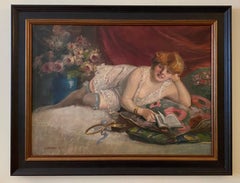
Relaxing
By Richard Geiger
Located in Los Angeles, CA
RICHARD GEIGER
"RELAXING"
OIL ON CANVAS, SIGNED
HUNGARIAN, C.1930
28 X 39 INCHES
FRAMED 36.5 X 46 INCHES
Richard Geiger
1870-1945
Richard Geiger was born in Vienna and first studied at the Vienna Art Institute with the academic painter Christian Ludwig Von Griepenkerl and, subsequently, in Paris with Francois Flameng...
Category
1930s Art Deco Portrait Paintings
Materials
Canvas, Oil
$1,625 Sale Price
50% Off
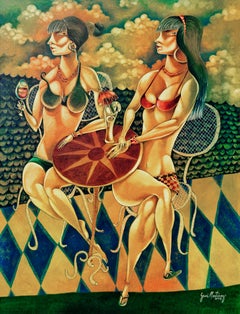
"TOAST TO THE SEA"
By Yuri Martinez Ramos
Located in Los Angeles, CA
YURI MARTINEZ RAMOS
"TOAST TO THE SEA"
OIL ON CANVAS, SIGNED, TITLED
CUBAN-AMERICAN, DATED 2008
40 X 30 INCHES
Toast to the sea is a depiction of the beautiful women at Miami beaches, sunny days, drinks, and having a good moment feeling.
Yuri Martinez Ramos was born in Havana, Cuba on November 24, 1964.
He studied at the Elemental School of Plastic Arts from 1975 – 1979 and the National School of the Arts from 1979 – 1983.
Martinez’ figurative paintings have been compared to Botero because of his satirical social commentary. His style, however, is uniquely his own with typically vibrant Latin colors and use of expressive magical realism. His paintings tell his story and the story of the Cuban dilemma.
Martinez was granted permission by the US Justice Department after much effort with Cuban authorities to come to the US with his family and pursue his career outside Cuba. He now lives and works in Texas.
Papillon Gallery...
Category
Early 2000s Surrealist Figurative Paintings
Materials
Canvas, Oil
$6,375 Sale Price
25% Off