1920s Art

to
983
2,833
858
588
324
334
Overall Width
to
Overall Height
to
7,752
21,920
164,723
231,685
2,035
2,306
4,982
6,545
5,880
15,067
20,694
26,008
18,762
14,138
5,531
1,157
477
414
400
362
123
52
36
26
6
3
2
3,099
1,633
58
3,031
1,589
1,182
1,162
1,013
694
492
338
295
246
201
189
186
185
179
176
157
154
115
109
1,637
1,111
987
926
723
169
131
65
41
40
1,588
778
2,890
1,887
Period: 1920s
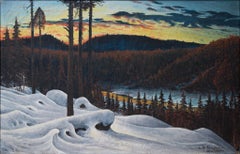
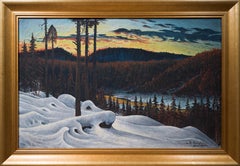
Mountain Landscape in Moonlight, Oil on Canvas, Signed, 1926, 74 cm

Mountain Landscape in Moonlight, Oil on Canvas, Signed, 1926, 74 cm

Located in Stockholm, SE

Anders Loman (1879–1953) Sweden Mountain Landscape in Moonlight, 1926 signed and dated lower right 26 oil on canvas unframed 64 × 68.5 cm (25.2 × 27 in) framed 74 × 79 cm (29.1 × 3...

Category

Post-Impressionist 1920s Art

Materials

Canvas, Oil

“How beautiful it is!”

“How beautiful it is!”

By Dean Cornwell

Located in Fort Washington, PA

Story illustration for “The Torrent: A Romance of the Orange Groves of Valencia” by Vicente Blasco Ibanez for Hearst’s International, published June 1921, page 6. The full caption reads: “‘How beautiful it is!…How I have longed to see it again!’ the lovely stranger mused half aloud to herself - quietly ignoring Rafael’s advances.” Masters of the Golden Age: Harvey Dunn and His StudentsSouth Dakota Art...

Category

1920s Art

Materials

Canvas, Oil

Stillness

Stillness

By John Pierce Barnes

Located in Bryn Mawr, PA

A native of Philadelphia, John Pierce Barnes began his artistic training at the Philadelphia School of Industrial Design. He then attended the Pennsylvania Academy of the Fine Arts, ...

Category

Post-Impressionist 1920s Art

Materials

Oil, Board

JACK SNIPE

Roland ClarkJACK SNIPE, 1928

$680Sale Price|20% Off

JACK SNIPE

By Roland Clark

Located in Portland, ME

Clark, Roland (American 1874-1957). JACK SNIPE. Etching, 1928. Edition of 70. Signed in pencil. 8 1/2 x 12 inches. In excellent condition.

Category

American Realist 1920s Art

Materials

Etching

"Welldiggers from Titusville"

"Welldiggers from Titusville"

By Mary Elizabeth Price

Located in Lambertville, NJ

Jim’s of Lambertville is proud to offer this artwork. Signed lower right. Complemented by a hand carved and gilt frame. Illustrated in "New Hope for American Art" by James Alterman, and "Blue Chips" published by Jim's of Lambertville. M. Elizabeth Price (1877 - 1965) Mary Elizabeth Price was born in West Virginia and raised on a farm in Solebury, Pennsylvania, on the outskirts of New Hope. She studied at the Pennsylvania School of Industrial Arts and the Pennsylvania Academy of the Fine Arts under Hugh Breckenridge. Additionally, she studied in New Hope with William Lathrop. Following her art studies, Price went to New York. While there, she conducted the “Baby Art...

Category

American Impressionist 1920s Art

Materials

Canvas, Oil

Photo of Ben Turpin and Thelma Hill, probably from "A Prodigal Bridegroom" 1926

Photo of Ben Turpin and Thelma Hill, probably from "A Prodigal Bridegroom" 1926

Located in Roma, IT

Rare photo of Ben Turpin and Thelma Hill, probably on the set of "A Prodigal Bridegroom" 1926 circa. Gel-bromide print (Velox). Stamp of former collection on the back. In the pictur...

Category

1920s Art

Materials

Photographic Paper

Portrait of a French Bulldog, oil painting on canvas early 20th c.

Portrait of a French Bulldog, oil painting on canvas early 20th c.

Located in Gavere, BE

Description Title: Portrait of a French Bulldog Materials: oil on canvas Signature: signed lower right Provenance: private collection Germany Dimensions canvas: 40 cm x 50 cm Framed...

Category

Other Art Style 1920s Art

Materials

Canvas, Oil

American Impressionist Nude Woman Playing Hide & Seek

American Impressionist Nude Woman Playing Hide & Seek

By Louis Frederick Bernecker

Located in New York, NY

Wonderful Louis Berneker (1876-1936) American Impressionist painting of Nude Woman playing Hide and Seek. Great Light Pastel Colors of Greens and Blues. Louis Berneker was famous S...

Category

Impressionist 1920s Art

Materials

Acrylic

Rebecca Couchée by JULES PASCIN - School of Paris, Nude Painting, Figurative Art

Rebecca Couchée by JULES PASCIN - School of Paris, Nude Painting, Figurative Art

By Jules Pascin

Located in London, GB

*UK BUYERS WILL PAY AN ADDITIONAL 5% IMPORT DUTY ON TOP OF THE ABOVE PRICE Rebecca Couchée by JULES PASCIN (1885-1930) Oil over pencil on canvas 73.1 x 91.8 cm (28 ¾ x 36 ⅛ inches) Signed lower right, Pascin Executed in 1927, Boulevard de Clichy, Paris Provenance Collection Marcel Bernheim, Palais des Beaux-Arts de Bruxelles, acquired from the artist, 1928 Pierre Blum, Paris, acquired from the above, 1952 Perls Galleries, New York, no. 13565 Private collection, Osaka Sotheby’s, New York, 14th May 1998 Peter Findlay Gallery Inc., New York Private collection, USA, acquired from the above, June 2011 Literature Luis Seoane...

Category

Post-Impressionist 1920s Art

Materials

Canvas, Oil, Pencil

'Elisabeth'  — German Expressionism

'Elisabeth' — German Expressionism

By Karl Michel

Located in Myrtle Beach, SC

Karl Michel, 'Elisabeth', woodcut, edition 20, 1923. Signed, dated, and numbered 'op.142b' and '12/20' in pencil. Signed in the block, lower left. Annotated 'Vorgesdruck' [artist’s proof] in pencil. A fine impression, on heavy fibrous Japan paper, with full margins (1 3/16 to 3 1/2 inches), in good condition. Printed by the artist, With the artist’s blindstamp in the bottom center margin. Scarce. Matted to museum standards, unframed. Image size 4 15/16 x 6 inches (131 x 152 mm); sheet size 10 x 6 inches (254 x 152 mm). ABOUT THE ARTIST Karl Michel (1889-1984) was a noted graphic designer and expressionist printmaker during Germany's pre-Nazi Weimar Republic (1919-1933). Michel’s work was the subject of a feature article in the influential German graphic design magazine Das Plakat (The Poster) in 1920. An anti-war advocate, Michel created a suite of 12 wood engravings depicting his impressions of the humanitarian toll of WWII entitled ‘Humanitas’ (Humanity). The German publishing house Greifenverlag published the series in a reduced folio of unsigned prints. Michel’s graphic work is held in the permanent collections of the Auckland War Memorial Museum (New Zealand), Frederikshavn Kunstmuseum & Exlibrissamling (Denmark), Museum of Applied Arts (Budapest), The Robert Gore Rifkind Center for German Expressionist Studies at the Los Angeles County Museum of Art, and the German Expressionism...

Category

Expressionist 1920s Art

Materials

Woodcut

Nu couché de dos

Henri MatisseNu couché de dos, 1929

$15,000Sale Price|25% Off

Nu couché de dos

By Henri Matisse

Located in London, GB

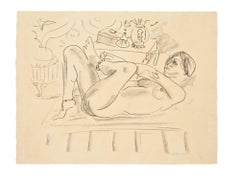
Henri Matisse Nu couché de dos 1929 Lithograph on Arches Velin paper, Edition of 50 Paper size: 50.5 x 66 cms (20 x 26 ins) Image size: 46 x 56 cms (18 x 22 ins) HM16567

Category

Modern 1920s Art

Materials

Lithograph

DESERT VISTA (Death Valley)

DESERT VISTA (Death Valley)

By Frances H. Gearhart

Located in Santa Monica, CA

FRANCES H. GEARHART (1869 – 1958) DESERT VISTA (Death Valley) c. 1930 Color linocut signed and titled in pencil. Image 8 3/8 x 8 7/8”. On fibrous japon paper. Sheet 11 ¾ x 8 ¼”. Gen...

Category

American Modern 1920s Art

Materials

Woodcut, Linocut, Color

Set Design, Theater and Stage

Set Design, Theater and Stage

By Simka Simkhovitch

Located in New York, NY

This gem of a set design or theatre design was possibly done prior to the artist coming to the United States from Russia. Born in Kiev, this artist was talented and given the distin...

Category

Other Art Style 1920s Art

Materials

Paper, Gouache

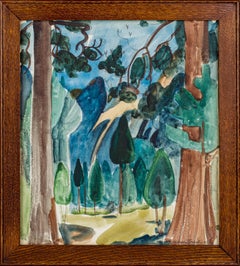
Watercolor Painting by William Zorach, Titled "Redwoods, Yosemite Valley", 1920

Watercolor Painting by William Zorach, Titled "Redwoods, Yosemite Valley", 1920

By William Zorach

Located in New York, NY

William Zorach, 1887-1966 Redwoods, Yosemite Valley, 1920 Watercolor and pencil 15 ¾ x 13 ⅜ inches Signed (at lower right): William Zorach WZorach-7 Provenance: Estate of William Zorach Exhibited: William Zorach, 1887-1996, Sculpture, Drawings and Watercolors, Zabriskie Gallery, New York; Feb. 10 – March 14, 1998. William Zorach was born in Lithuania in 1889, and immigrated to the United States with his family in 1893. Settling in Cleveland with his parents, he worked as a lithographer from 1902- 1908, making enough money to study painting with Henry G. Keller at the School of Art. In 1910, Zorach traveled to Paris to study in La Palette, where he was encouraged to develop his own unique style rather than adhere to traditional teachings. Zorach once said, “I began to be conscious of the various modern influences that were invading the art world…I was disturbed and confused, and yet I felt that I was a very young man entering a new age. The forces creating modern art seemed more alive to me than anything I had known or anything being done in America.” 1 Together with his wife Marguerite, William Zorach produced a number of Cubist- style paintings for the American Armory Show of 1913, and the Forum Exhibition in New York in 1916. Around 1917, Zorach followed the lead of cubist artist Pablo Picasso and began experimenting with wood and stone carvings. By 1922, he devoted himself entirely to sculpture, and like Picasso, became fascinated in “primitive art”—the ritual objects and sculpture pieces of Oceanic, Native American and African tribes. Zorach’s work developed in its use of block-like forms with progressive suppression of detail—drawing elements from sources as disparate as the contemporary cubist and modernist movements, and combining them with forms seen in early African sculpture. Though the forms of his sculpture were often abstract, Zorach primarily focused upon a traditional subject matter, producing such well-known sculptures as Young Girl, now in the Whitney Museum of American Art, and Mother and Child, in the collection of the Metropolitan Museum of Art. Today, William Zorach is known as one of the earliest and most influential American artists dedicated to direct carving. Zorach also made an impression as a teacher and writer, facilitating a major change in the aesthetic philosophy and technique of sculpture in the United States. During the summers from 1913 to 1922, Zorach and his wife Marguerite painted...

Category

1920s Art

Materials

Watercolor, Pencil
Untitled
Untitled

Untitled

By Leon Kelly

Located in Fairlawn, OH

Untitled Pastel on paper, 1922 Signed with the artist's initials in pencil Provenance: Estate of the artist Francis M. Nauman (label) Private collection, NY A very early abstract/cubist work by Kelly. Created while the artist was studying with Arthur Carles in Philadelphia. Leon Kelly (October 21, 1901 – June 28, 1982) was an American artist born in Philadelphia, PA. He is most well known for his contributions to American Surrealism, but his work also encompassed styles such as Cubism, Social Realism, and Abstraction. Reclusive by nature, a character trait that became more exaggerated in the 1940s and later, Kelly's work reflects his determination not to be limited by the trends of his time. His large output of paintings is complemented by a prolific number of drawings that span his career of 50 years. Some of the collections where his work is represented are: The Metropolitan Museum in New York, The Whitney Museum of American Art, the Museum of Modern Art, the Philadelphia Museum of Art, and Boston Public Library. Biography Kelly was born in 1901 at home at 1533 Newkirk Street, Philadelphia, PA. He was the only child of Elizabeth (née Stevenson) and Pantaleon L. Kelly. The family resided in Philadelphia where Pantaleon and two of his cousins owned Kelly Brothers, a successful tailoring business. The prosperity of the firm enabled his father to purchase a 144-acre farm in Bucks County PA in 1902, which he named "Rural Retreat" It was here that Pantaleon took Leon to spend every weekend away from the pressures of business and from the disappointments in his failing marriage. Idyllic and peaceful memories of the farm stayed with Leon and embued his work with a love of nature that emerged later in the Lunar Series, in Return and Departure, and in the insect imagery of his Surrealist work. "If anything," he once said,"I am a Pantheist and see a spirit in everything, the grass, the rocks, everything." At thirteen, Leon left school and began private painting lessons with Albert Jean Adolphe, a teacher at the School of Industrial Art (now the University of the Arts) in Philadelphia. He learned technique by copying the works of the old masters and visiting the Philadelphia Zoo, where he would draw animals. Drawings done in 1916 and 1917 of elephants, snakes and antelope, as well as copies of old master paintings by Holbein and Michelangelo, heralded an impressive emerging talent. In 1917, he studied sculpture with Alexander Portnoff but his studies came to an abrupt halt with the start of World War I. Being too young to enlist, he joined the Quartermaster Corp at the Army Depot in Philadelphia, where he served for more than a year loading ships with supplies and, along with other artists, working on drawings for camouflage. By 1920, the family's fortunes drastically changed. His father's business had failed due to the introduction of ready made clothing and his marriage, unhappy from the beginning, dissolved. Broken by circumstance Pantaleon left Philadelphia to begin a wandering existence looking for work leaving Leon to support his mother and grandmother. He found a job in 1920 at the Freihofer Baking Company where he worked nights for the next four years. Under these circumstances Leon continued to develop his skills in drawing and painting and learned of the revolutionary developments in art that were taking place in Paris. During the day he was granted permission to study anatomy at the Philadelphia School of Osteopathy where he dissected a cadaver and perfected his knowledge of the human figure. He also met and studied etching with Earl Horter, a well known illustrator, who had amassed a significant collection of modern art which included work by Brancusi, Matisse, and Cubist works by Picasso and Braque. Among the artists around Horter was Arthur Carles, a charismatic and controversial painter who taught at the Pennsylvania Academy of Fine Arts. Leon enrolled in the Academy in 1922, becoming what Carles described as, "his best student". In the next three years Leon work ranged from academic studies of plaster casts, to pointillism, to landscapes of Fairmount Park in Philadelphia, as well as a series of pastels showing influences from Matisse to Picasso. Clearly influenced by Earl Horter's collection and Arthur Carles he mastered analytical cubism in works such as The Three Pears, 1923 and 1925 experimented with Purism in Moon Behind the Italian House. In 1925 Kelly was awarded a Cresson Scholarship and on June 14 he left for Europe. Paris The first trip to Europe lasted for approximately three and a half months and introduced Kelly to a culture and place where he felt he belonged. Though he returned to the Academy in the Fall, he left for Europe again a few months later to begin a four-year stay in Paris. He moved into an apartment at 19 rue Daguerre in Paris and began an existence intellectually rich but in creature comforts, very poor. "I kept a cinderblock over the drain in the kitchen sink to keep the rats out of the apartment" he once explained. He frequented the cafes making acquaintances with Henry Miller, James Joyce and the critic Félix Fénéon as well as others. His days were split between copying old master paintings in the Louvre and pursuing modernist ideas that were swirling through the work of all the artists around him. The Lake, 1926 and Interior of the Studio, 1927, now in the Newark Museum. Patrons during this time were the police official Leon Zamaran, a collector of Courbets, Lautrecs and others, who began collecting Kelly's work. Another was Alfred Barnes of the Barnes Collection in Philadelphia. In 1929 Kelly married a young French woman, Henriette D'Erfurth. She appears frequently in paintings and drawings done between 1928 and the early 1930s. Philadelphia The stock market crash of 1929 made it impossible to continue living in Paris and Kelly and Henriette returned to Philadelphia in 1930. He rented a studio on Thompson Street and began working and participating in shows in the city's galleries. Work from 1930 to 1940 showed continuing influences and experimentation with the themes and techniques acquired in Paris as well as a brief foray into Social Realism. The Little Gallery of Contemporary Art purchased the Absinthe Drinker...
Category

Abstract 1920s Art

Materials

Pastel

Siesta by Lon Megargee 1929, Archival Pigmrnt Print

Siesta by Lon Megargee 1929, Archival Pigmrnt Print

Located in Phoenix, AZ

Tequila Siesta Lon Megargee Archival Pigment Print 100% 300 gram cotton rag paper Size: 22.5 x 27 inches Paper size: 24 x 28.5 inches Creator of the iconic logo for the Stetson Hat Company, " Last Drop From his Stetson", still in use today. Fine Art Estate of Lon Megargee At age 13, Lon Megargee came to Phoenix in 1896 following the death of his father in Philadelphia. For several years he resided with relatives while working at an uncle’s dairy farm and at odd jobs. He returned to Philadelphia in 1898 – 1899 in order to attend drawing classes at the Pennsylvania Academy of the Fine Arts. Back in Phoenix in 1899, he decided at the age of 16 to try to make his living as a cowboy. Lon moved to the cow country of Wickenburg where he was hired by Tex Singleton’s Bull Ranch. He later joined the Three Bar Ranch . . . and, after a few years, was offered a job by Billy Cook...

Category

1920s Art

Materials

Archival Pigment

Tennis (Tennis Tournament)

Tennis (Tennis Tournament)

By George Wesley Bellows

Located in Palm Desert, CA

A lithograph by George Bellows. “Tennis (Tennis Tournament)” is a realistic lithograph on paper in black and white by American Realist, George Bellows. Bellows’ depictions of sportin...

Category

American Realist 1920s Art

Materials

Lithograph

L V Guirand de Scevola (1871-1950) A young naked woman standing , Signed pastel

L V Guirand de Scevola (1871-1950) A young naked woman standing , Signed pastel

By Lucien-Victor Guirand de Scévola

Located in Paris, FR

Lucien-Victor Guirand de Scevola (1871-1950) A young naked woman standing Pastel on paper Signed lower right and dedicated, "à JM Fournol (?)" 63 x 40 cm In fairly good condition:...

Category

Art Deco 1920s Art

Materials

Pastel

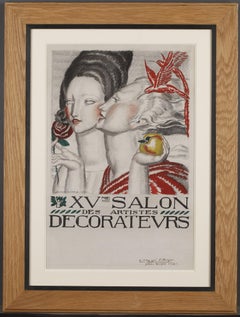
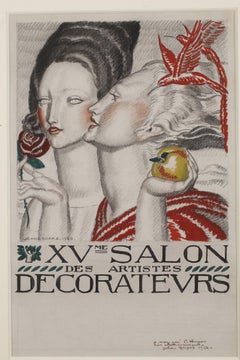
Poster project for the "XVe Salon des Artistes Décorateurs"

Poster project for the "XVe Salon des Artistes Décorateurs"

By Jean Dupas

Located in PARIS, FR

Poster project for the "XVe Salon des Artistes Décorateurs" by Jean DUPAS (1882-1964) Original drawing Pencil, with highlights of gouache Signed "Jean Dupas" Dated "1924" Dedicated ...

Category

Art Deco 1920s Art

Materials

Paper

Bogota's Glory
Bogota's Glory

Bogota's Glory

By Henri Bouchard

Located in PARIS, FR

Bogota's Glory by Henri Bouchard (1875-1960) Sculpture in bronze with a nuanced yellow-brown patina Signed "H. Bouchard" on the base Cast by "Siot" (stamp) France circa 1927 height...

Category

Art Deco 1920s Art

Materials

Bronze

"Sandy"
"Sandy"

"Sandy"

By Robert Henri

Located in Lambertville, NJ

Jim's of Lambertville Fine Art Gallery is proud to present this piece by Robert Henri (1865 - 1929). Robert Henri was born Robert Henry Cozad in Cincinnati, Ohio in 1865. At the ...

Category

Other Art Style 1920s Art

Materials

Canvas, Oil

Claude-Levy Cast Iron Sculpture of Flora, Dated 1925

Claude-Levy Cast Iron Sculpture of Flora, Dated 1925

Located in New York, NY

Claude-Lévy, 1895 – 1942 Alice Nikitina in the role of Flora, from the Dukelsky/Braque production of the ballet Zephyr & Flore at the Ballets Russes, 1925 Cast Stone Signed and dated: Claude-Levy 1925 on rear face of self-base. The present sculpture is as rare as it is delightful. Mademoiselle Claude-Levy, as the catalogues of the period list her, was one of the truly original talents of the Art Deco period. Painter, architect, decorator, and sculptor, she was a friend of the Parisian, Modernist sculptors, Chana Orloff, Henri Laurens and the Martel brothers, to whom her work was often compared. The ingenuity of her models brought her great critical acclaim, but she seems to have stopped producing in the early 1930s. Her output, although fine, is rare. Claude-Levy’s gentle Cubism might be better described as Purism in sculpture. It is characterized by simplified surfaces, rounded (as opposed to angular) forms, and smooth, lustrous surfaces. The Purist movement included the painters Léger, Ozenfant and Le Corbusier in its ranks. Claude-Lévy, along with other artists of the avant- garde living in the Gallic capital (Czaky, Zadkine, Archipenko, Lipchitz, Lambert Rucki Miklos, Nadelman, Vörös, Orloff) helped to develop a collective twentieth century figurative sculptural idiom that exploited the daring and rich possibilities of geometric abstraction. The present work is Claude-Lévy’s Commedia dell’Arte figures inspired by the Stravinsky/Picasso Ballet...

Category

1920s Art

Materials

Cast Stone

Chiens Cup
Chiens Cup

Chiens Cup

By René Lalique

Located in Miami, FL

Rene Lalique (1860-1945) Chiens Cup, also called Grayhound Opalescent molded-pressed white glass 4 x 10 in Literature: Appears in the 1928 catalog. Deleted from the catalog in 1932 ...

Category

Art Deco 1920s Art

Materials

Glass

Arts and Crafts wallpaper design by Glasgow School of Art artists

Arts and Crafts wallpaper design by Glasgow School of Art artists

Located in London, GB

To see more, scroll down to "More from this Seller" and below it click on "See all from this Seller." Glasgow School of Art Wallpaper design Gouache 33 x 48 cm An Arts and Crafts ...

Category

1920s Art

Materials

Gouache

Human face gargoyle/grotesque snarling man; Gothic Limestone Carving

Human face gargoyle/grotesque snarling man; Gothic Limestone Carving

Located in Indianapolis, IN

This gothic style architectural segment of a building facade located ion Harlem, NYC, was carved 1924-1926 by William Bradley & Son Cut Stone Contractors. In 2020, each limestone scu...

Category

Gothic 1920s Art

Materials

Limestone

Sea Gull
Sea Gull

Sea Gull

By Henrietta Shore

Located in Santa Monica, CA

HENRIETTA SHORE (1880 -1963) SEA GULL c 1928 Lithograph, signed and titled in pencil and with the pencil cypher of printer Lynton Kistler (K). Image 7 x 6 1/8 full margins, sheet 12...
Category

American Modern 1920s Art

Materials

Lithograph

Ballet und Pantomime "Walzer", plate #21.

Ballet und Pantomime "Walzer", plate #21.

By Walter Schnackenberg

Located in Palm Beach, FL

Walter Schnackenberg’s style changed several times during his long and successful career. Having studied in Munich, the artist traveled often to Paris where he fell under the spell of the Henri de Toulouse-Lautrec’s colorful and sensuous posters depicting theatrical and decadent subjects. Schnackenberg became a regular contributor of similar compositions to the German magazines Jugend and Simplicissimus before devoting himself to the design of stage scenery and costumes. In the artist’s theatrical work, his mastery of form, ornamentation, and Orientalism became increasingly evident. He excelled at combining fluid Art Nouveau outlines, with spiky Expressionist passages, and the postures and patterns of the mysterious East. In his later years, Schnackenberg explored the unconscious, using surreal subject matter and paler colors that plainly portrayed dreams and visions, some imbued with political connotations. His drawings, illustrations, folio prints, and posters are highly sought today for their exceedingly imaginative qualities, enchanting subject matter, and arresting use of color. SCHNACKENBERG BALLET UND PANTOMIME...
Category

Art Deco 1920s Art

Materials

Paper