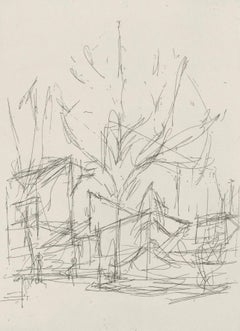
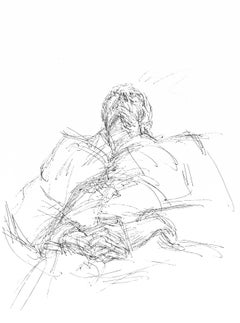
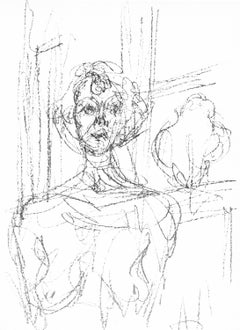
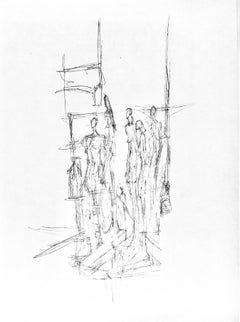
Want more images or videos?
Request additional images or videos from the seller
1 of 10

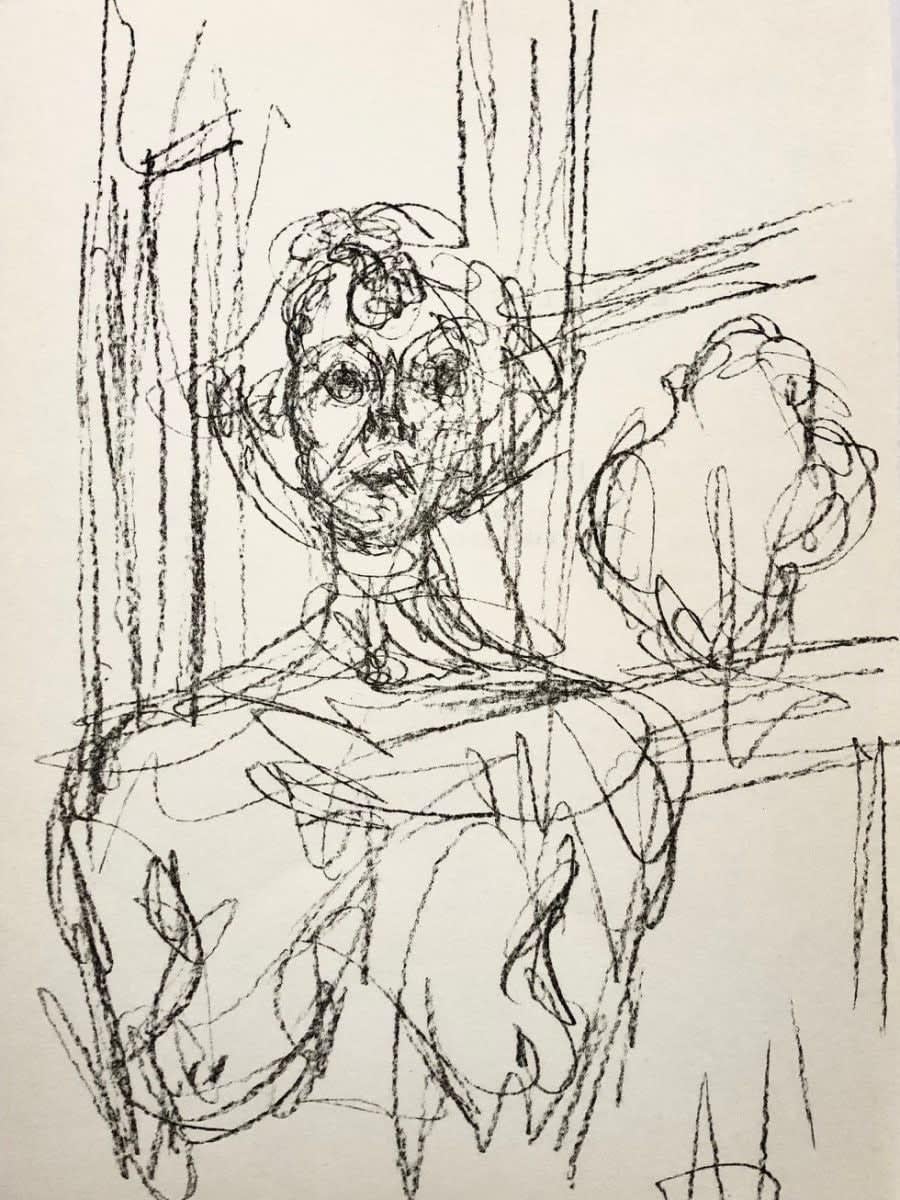
Alberto Giacometti
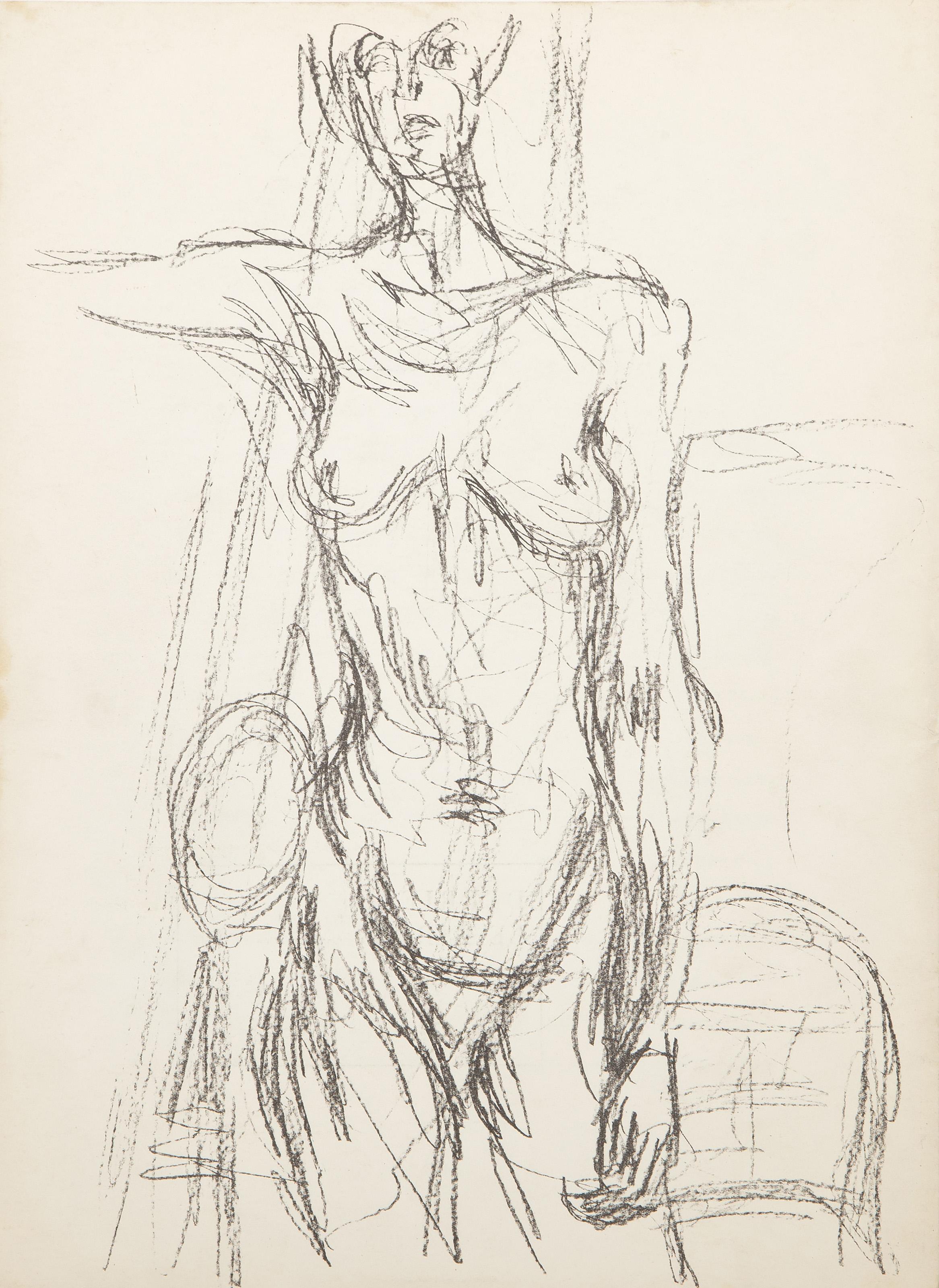
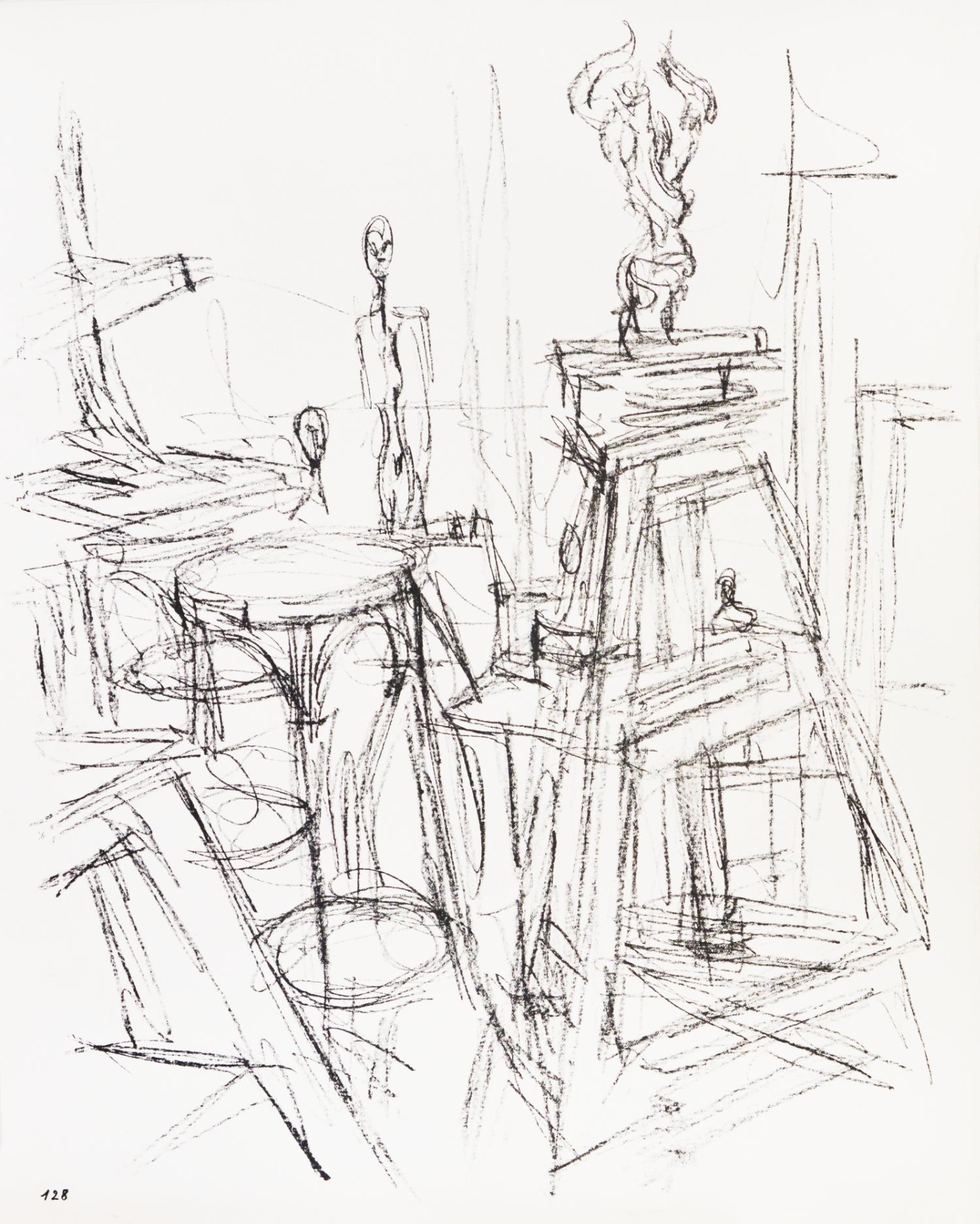
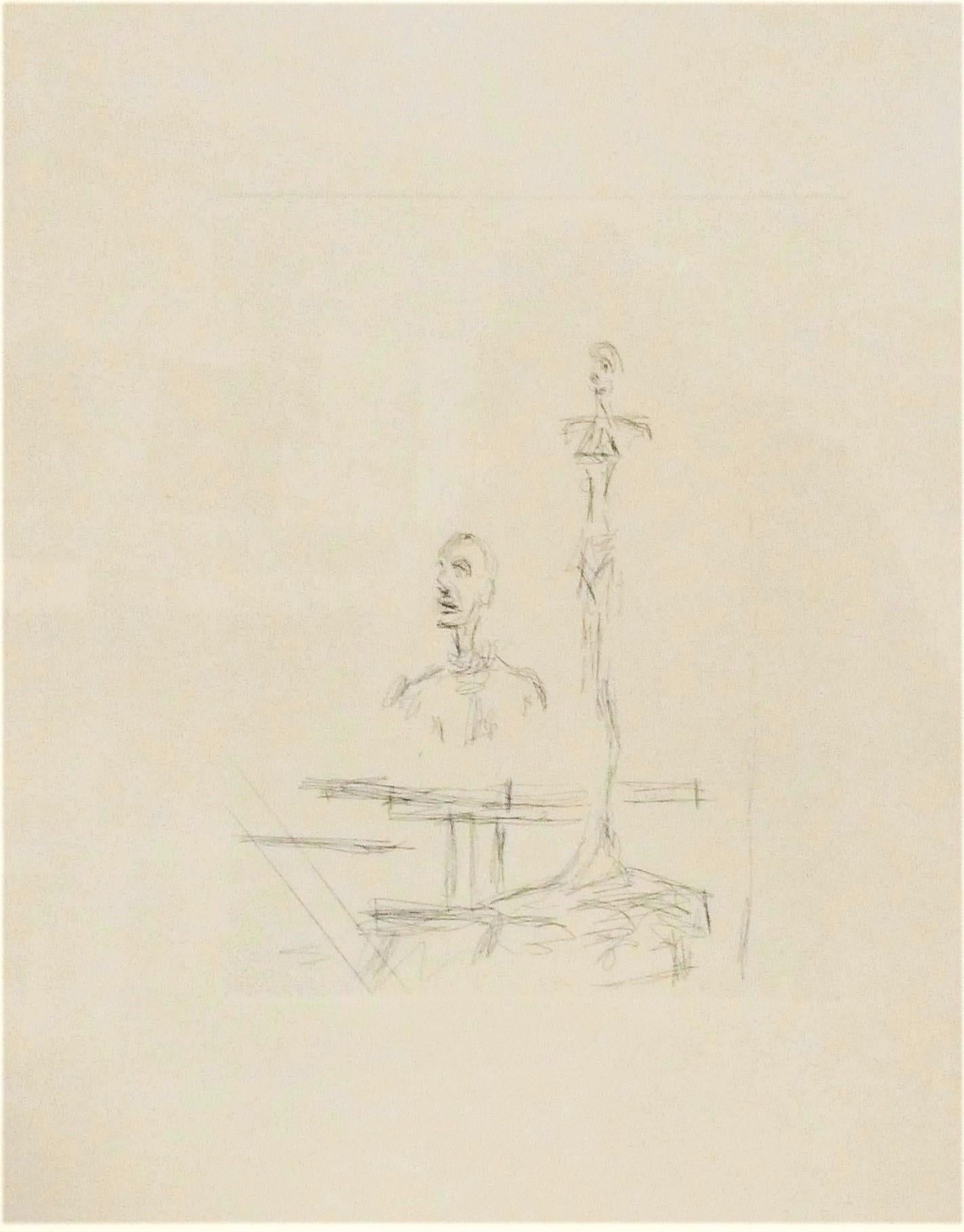
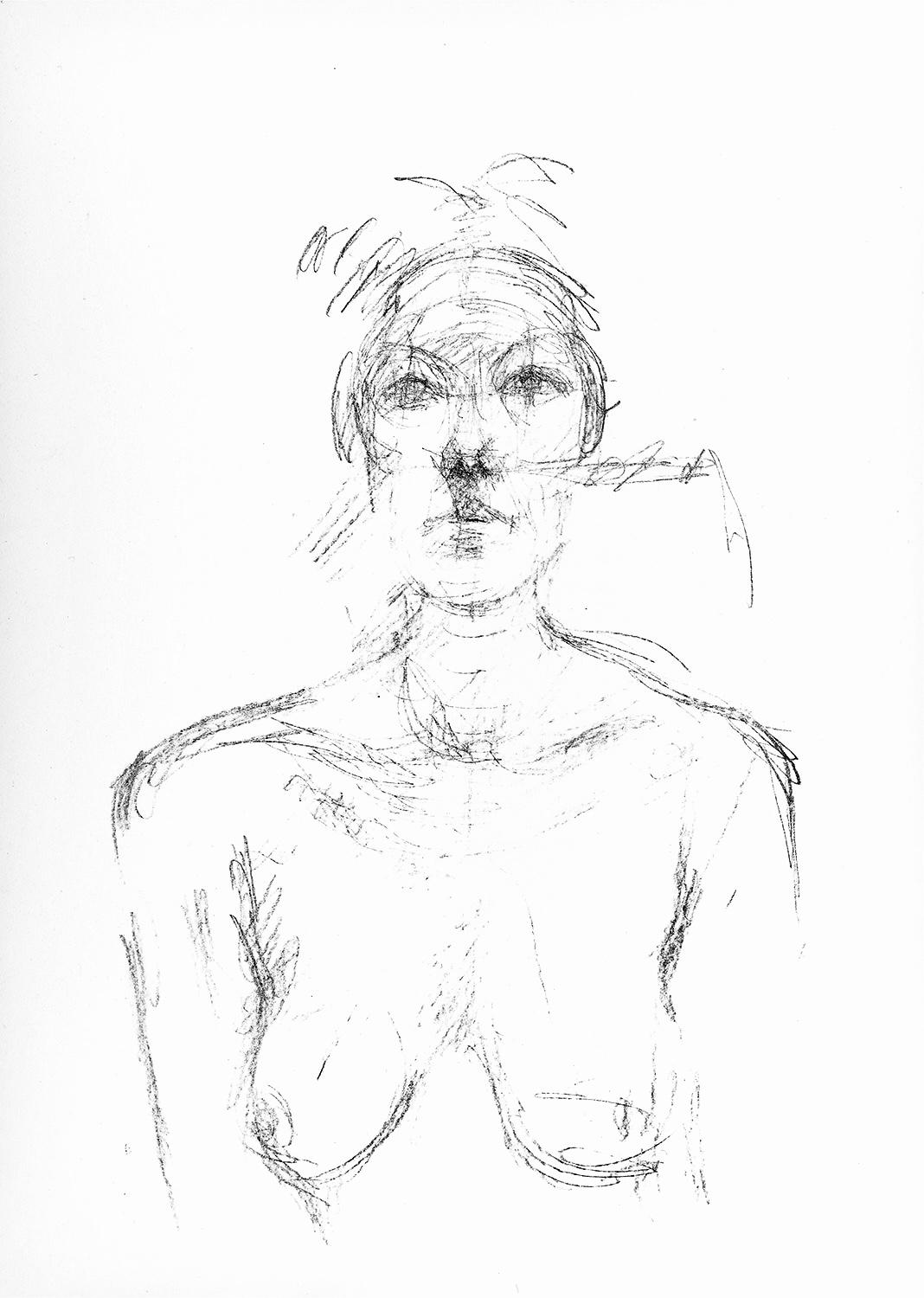
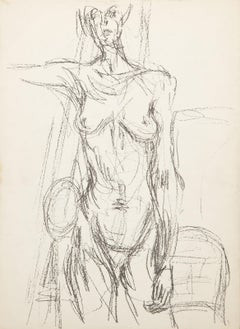
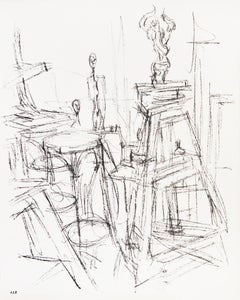
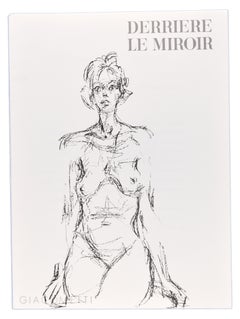
Alberto Giacometti, Figures in an Interior, Derriere le miroir, 1954

1954

$716
$89520% Off
£546.33
£682.9120% Off
€621.49
€776.8620% Off
CA$1,005.50
CA$1,256.8720% Off
A$1,100.39
A$1,375.4920% Off
CHF 581.46
CHF 726.8320% Off
MX$13,133.93
MX$16,417.4220% Off
NOK 7,420.18
NOK 9,275.2220% Off
SEK 6,786.36
SEK 8,482.9520% Off
DKK 4,642.20
DKK 5,802.7420% Off

About the Item

This exquisite lithograph by Alberto Giacometti (1901–1966), titled Figures dans un interieur (Figures in an Interior), from the folio Derriere le miroir, No. 65, originates from the 1954 edition published by Maeght Editeur, Paris, and printed by Mourlot Freres, Paris, 1954. This work encapsulates Giacometti’s fascination with the tension between space and the human presence, its expressive linework and spatial ambiguity evoking the psychological depth that defines his artistic vision. Executed as a lithograph on velin paper, this work measures 15 x 11 inches. Signed in the plate and unnumbered as issued. The edition exemplifies the superb craftsmanship of Mourlot Freres, Paris. Artwork Details: Artist: Alberto Giacometti (1901–1966) Title: Figures dans un interieur (Figures in an Interior), from the folio Derriere le miroir, No. 65 Medium: Lithograph on velin paper Dimensions: 15 x 11 inches (38.1 x 27.9 cm) Inscription: Signed in the plate and unnumbered as issued Date: 1954 Publisher: Maeght Editeur, Paris Printer: Mourlot Freres, Paris Condition: Well preserved, consistent with age and medium Provenance: From the folio Derriere le miroir, No. 65, published by Maeght Editeur, Paris; printed by Mourlot Freres, Paris, 1954 About the Publication: Derriere le miroir (Behind the Mirror) was one of the most important art publications of the 20th century, created and published by Maeght Editeur in Paris from 1946 to 1982. Founded by the visionary art dealer and publisher Aime Maeght, the series served as both an exhibition catalogue and a work of art in its own right, uniting original lithographs by leading modern and contemporary artists with critical essays, poetry, and design of the highest quality. Printed by master lithographers such as Mourlot Freres and Arte, Derriere le miroir became synonymous with the artistic vanguard of postwar Europe. Each issue was devoted to a single artist or theme and published to accompany exhibitions at the Galerie Maeght in Paris, featuring works by Pablo Picasso, Henri Matisse, Georges Braque, Joan Miro, Marc Chagall, Alexander Calder, Fernand Leger, and Alberto Giacometti, among others. The publication reflected Maeght’s belief that art should be both accessible and elevated—an ideal realized through its luxurious production values, meticulous printing, and collaboration with the greatest creative minds of its time. About the Artist: Alberto Giacometti (1901–1966) was a Swiss sculptor, painter, and draughtsman whose hauntingly elongated figures and existential vision redefined modern art and made him one of the most influential artists of the 20th century. Born in Borgonovo, Switzerland, into an artistic family—his father, Giovanni Giacometti, was a noted Post-Impressionist—he was immersed in art from an early age before studying in Geneva and moving to Paris in 1922, where he became part of the city’s avant-garde alongside Pablo Picasso, Alexander Calder, Salvador Dali, Joan Miro, Wassily Kandinsky, Marcel Duchamp, and Man Ray. In the 1920s and 1930s, Giacometti explored Cubism and Surrealism, creating symbolic and dreamlike sculptures such as Suspended Ball (1930–31) and The Palace at 4 A.M. (1932), which reflected the influence of Dali, Duchamp, and Man Ray. By the 1940s, he abandoned Surrealism to pursue a deeply personal exploration of the human condition, developing his iconic attenuated figures that embodied both fragility and resilience. His signature sculptures—L’Homme qui marche I (Walking Man I), Femme debout, and Le Chariot—expressed the isolation, endurance, and vulnerability of modern existence, echoing the existential philosophy of Jean-Paul Sartre and Simone de Beauvoir. Giacometti’s figures, stripped of mass yet monumental in spirit, symbolized humanity’s search for meaning in a postwar world, while his paintings and drawings—portraits of his brother Diego, his wife Annette, and his friends—captured the psychological depth of perception with trembling, repetitive lines that blurred the boundary between body and soul. His friendships with Picasso, Calder, Miro, and Kandinsky shaped his understanding of form, motion, and space, while his philosophical engagement with Duchamp and Man Ray deepened his inquiry into the nature of reality and perception. Working obsessively in his modest Montparnasse studio, Giacometti pursued art as an existential act—destroying and rebuilding his figures in an endless search for truth. His influence on postwar art was immense, shaping the work of Henry Moore, Francis Bacon, Louise Bourgeois, Lucian Freud, and later contemporary sculptors such as Antony Gormley and Anselm Kiefer. His aesthetic also resonated beyond sculpture, influencing fashion, photography, and architecture through his vision of form, isolation, and proportion. Giacometti’s work is represented in major museum collections including MoMA, the Tate Modern, and the Centre Pompidou, and continues to inspire artists, collectors, and thinkers worldwide. Standing alongside Pablo Picasso, Alexander Calder, Salvador Dali, Joan Miro, Wassily Kandinsky, Marcel Duchamp, and Man Ray, Giacometti remains a towering figure in modern art—a sculptor-philosopher who transformed the human form into a universal symbol of resilience and reflection. His highest auction record was achieved by L’Homme qui marche I (Walking Man I), which sold for $141.3 million at Sotheby’s, London, on February 3, 2010, reaffirming Alberto Giacometti’s enduring legacy as one of the most visionary, profound, and collectible artists in the history of modern art. Alberto Giacometti Figures dans un interieur Derriere le miroir No. 65, Giacometti Mourlot Freres, Giacometti Maeght Editeur, Giacometti velin paper, Giacometti collectible lithograph.
  • Creator:
    Alberto Giacometti (1901 - 1966, Swiss)
  • Creation Year:
    1954
  • Dimensions:
    Height: 15 in (38.1 cm)Width: 11 in (27.94 cm)
  • Medium:
  • Movement & Style:
  • Period:
  • Condition:
  • Gallery Location:
    Southampton, NY
  • Reference Number:
    1stDibs: LU1465216420762

More From This Seller

View All
Alberto Giacometti, Landscape, from Derriere le miroir, 1954 (after)
By Alberto Giacometti
Located in Southampton, NY
This exquisite lithograph after Alberto Giacometti (1901–1966), titled Paysage (Landscape), from the folio Derriere le miroir, No. 65, originates from the 1954 edition published by M...
Category

1950s Modern Abstract Prints

Materials

Lithograph

Alberto Giacometti, Bust II, from Derriere le Miroir, 1960
By Alberto Giacometti
Located in Southampton, NY
This exquisite lithograph by Alberto Giacometti (1901–1966), titled Buste II (Bust II), originates from the 1960 folio Derriere le Miroir, No. 119, Poetes, peintres, sculpteurs (Poet...
Category

1960s Modern Abstract Prints

Materials

Lithograph

Composition, Feuilles éparses, Alberto Giacometti
By Alberto Giacometti
Located in Southampton, NY
Etching on vélin cuve de Rives paper. Inscription: Unsigned and unnumbered, as issued. Good condition. Notes: From the folio, Feuilles éparses, 1965. Published and printed by Louis B...
Category

1960s Surrealist Figurative Prints

Materials

Etching

Alberto Giacometti, Georges Braque, August 31, 1963, from Derriere le Miroir
By Alberto Giacometti
Located in Southampton, NY
This exquisite lithograph by Alberto Giacometti (1901–1966), titled Georges Braque le 31 aout 1963 (Georges Braque, August 31, 1963), originates from the 1964 folio Derriere le Miroi...
Category

1960s Modern Abstract Prints

Materials

Lithograph

Alberto Giacometti, Annette, from Prints from the Mourlot Press, 1964
By Alberto Giacometti
Located in Southampton, NY
This exquisite lithograph by Alberto Giacometti (1901–1966), titled Annette, from the album Prints from the Mourlot Press, exhibition sponsored by the French Embassy, circulated by the Traveling Exhibition Service of the National Collection of Fine Arts, Smithsonian Institution 1964–1965, originates from the 1964 edition published by Fernand Mourlot, Paris, in collaboration with the Embassy of France, Washington, D.C., and the Smithsonian Institution, Washington D.C., and printed by Mourlot Freres, Paris, October 27, 1964. This lithograph captures Giacometti’s distinct approach to portraiture, defined by trembling lines and psychological depth that distill the essence of human presence into a study of perception and being. Annette, his wife and muse, appears as both intimate subject and universal archetype, embodying the fragility and endurance that pervade Giacometti’s entire oeuvre. Executed as a lithograph on velin d'Arches paper, this work measures 10 x 7.5 inches. Unsigned and unnumbered as issued. The edition exemplifies the refined craftsmanship of Mourlot Freres and highlights Giacometti’s mastery of line and form within the existential context of postwar modernism. Artwork Details: Artist: Alberto Giacometti (1901–1966) Title: Annette, from the album Prints from the Mourlot Press Medium: Lithograph on velin d'Arches paper Dimensions: 10 x 7.5 inches (25.4 x 19.05 cm) Inscription: Unsigned and unnumbered as issued Date: 1964 Publisher: Fernand Mourlot, Paris, in collaboration with the Embassy of France, Washington, D.C., and the Smithsonian Institution, Washington D.C. Printer: Mourlot Freres, Paris Condition: Well preserved, consistent with age and medium Provenance: From the album Prints from the Mourlot Press, published by Fernand Mourlot, Paris, 1964 Notes: Excerpted from the album, This exhibition is a manifestation of Franco-American friendship and we would be very happy if it is of interest to all those who visit it. I wish to thank Mrs. Annemarie Pope for proposing and organizing this exhibition of the work of the artists who have used our press. We are honored that Mr. Herve Alphand, Ambassador of France to the United States, and Mr. Edouard Morot-Sir, Cultural Counsellor at the French Embassy in New York, will sponsor this exhibition. I express to them my thanks and appreciation. As for the artists themselves, who executed the originals contained in this catalogue, I can only say simply, "Thank you." They are all friends. We would have liked to include not just the twenty-four illustrations in this small book, but many more. During the year 1963, we lost three great artists who were faithful friends of our press. Thanks to Mrs. Georges Braque, Mr. Louis Carre, and Mr. Edouard Dermit, who have been able to pay our respects to Georges Braque, Jacques Villon and Jean Cocteau. The great Henri Matisse is also with us, since Mrs. Du-thuit-Matisse and her brothers have allowed us to use an unpublished original lithograph. Thanks to them all for their generosity. —Fernand Mourlot. The lithography at Mourlot printing press by Jean Adhemar, Curator of prints at the Bibliotheque nationale. Acknowledgments, Fernand Mourlot has long been the acknowledged master printer of France in every field, from lithographs to fine books to posters. The unfailing quality of his work commands the respect of museums, collectors, and most important of all, the artists themselves. Every product of his workshop bears the mark of Mourlot's discipline and craft and can truly be called an ideal collaboration between artist and artisan. The result of years of thoughtful planning, this special exhibition presents an accurate portrait of the Mourlot Press. We are greatly indebted to Fernand Mourlot, who made the selection, supervised the production of the catalogue, and gave endless time and energy to the details of preparation. This album was finished in Paris on 27th October 1964. The original lithographs and the reproductions were printed on the presses of Mourlot. The Imprimerie Nationale, Director Andre Brignole, was responsible for the typography. The edition has been limited to MM examples on Velin d'Arches and CC on Velin de Rives, reserved for the artists, the staff and the friends of the Imprimerie Mourlot. About the Publication: Prints from the Mourlot Press, published in Paris by Fernand Mourlot in 1964 in collaboration with the Embassy of France and the Smithsonian Institution, celebrated the profound artistic partnerships that defined 20th-century printmaking. The portfolio accompanied a traveling exhibition organized by the Smithsonian’s National Collection of Fine Arts and presented at major institutions across the United States between 1964 and 1965. Containing twenty-four original lithographs by leading modern artists—including Pablo Picasso, Henri Matisse, Georges Braque, Joan Miro, Marc Chagall, Alexander Calder, Fernand Leger, Alberto Giacometti, and Jean Cocteau—the publication chronicled the collaborative artistry of Mourlot Freres, whose Paris workshop elevated lithography to a fine art. Each plate demonstrated the mastery of color, composition, and craftsmanship that defined postwar printmaking, while the edition itself stood as a symbol of Franco-American cultural exchange. About the Artist: Alberto Giacometti (1901–1966) was a Swiss sculptor, painter, and draughtsman whose hauntingly elongated figures and existential vision redefined modern art and made him one of the most influential artists of the 20th century. Born in Borgonovo, Switzerland, into an artistic family—his father, Giovanni Giacometti, was a noted Post-Impressionist—he was immersed in art from an early age before studying in Geneva and moving to Paris in 1922, where he became part of the city’s avant-garde alongside Pablo Picasso, Alexander Calder, Salvador Dali, Joan Miro, Wassily Kandinsky, Marcel Duchamp, and Man Ray. In the 1920s and 1930s, Giacometti explored Cubism and Surrealism, creating symbolic and dreamlike sculptures such as Suspended Ball (1930–31) and The Palace at 4 A.M. (1932), which reflected the influence of Dali, Duchamp, and Man Ray. By the 1940s, he abandoned Surrealism to pursue a deeply personal exploration of the human condition, developing his iconic attenuated figures that embodied both fragility and resilience. His signature sculptures—L’Homme qui marche I (Walking Man I), Femme debout, and Le Chariot—expressed the isolation, endurance, and vulnerability of modern existence, echoing the existential philosophy of Jean-Paul Sartre and Simone de Beauvoir. Giacometti’s figures, stripped of mass yet monumental in spirit, symbolized humanity’s search for meaning in a postwar world, while his paintings and drawings—portraits of his brother Diego, his wife Annette, and his friends—captured the psychological depth of perception with trembling, repetitive lines that blurred the boundary between body and soul. His friendships with Picasso, Calder, Miro, and Kandinsky shaped his understanding of form, motion, and space, while his philosophical engagement with Duchamp and Man Ray deepened his inquiry into the nature of reality and perception. Working obsessively in his modest Montparnasse studio, Giacometti pursued art as an existential act—destroying and rebuilding his figures in an endless search for truth. His influence on postwar art was immense, shaping the work of Henry Moore, Francis Bacon, Louise Bourgeois, Lucian Freud, and later contemporary sculptors such as Antony Gormley and Anselm Kiefer. His aesthetic also resonated beyond sculpture, influencing fashion, photography, and architecture through his vision of form, isolation, and proportion. Giacometti’s work is represented in major museum collections including MoMA, the Tate Modern, and the Centre Pompidou, and continues to inspire artists, collectors, and thinkers worldwide. Standing alongside Pablo Picasso, Alexander Calder, Salvador Dali, Joan Miro, Wassily Kandinsky, Marcel Duchamp, and Man Ray, Giacometti remains a towering figure in modern art—a sculptor-philosopher who transformed the human form into a universal symbol of resilience and reflection. His highest auction record was achieved by L’Homme qui marche I (Walking Man I), which sold for 141.3 million USD at Sotheby’s, London, on February 3, 2010, reaffirming Alberto Giacometti’s enduring legacy as one of the most visionary, profound, and collectible artists in the history of modern art. Alberto Giacometti Annette...
Category

1960s Modern Abstract Prints

Materials

Lithograph

Alberto Giacometti, The Studio II, from Derriere le miroir, 1957 (after)
By Alberto Giacometti
Located in Southampton, NY
This exquisite lithograph after Alberto Giacometti (1901–1966), titled L'Atelier II (The Studio II), from the folio Derriere le miroir, No. 98, originates from the 1957 edition publi...
Category

1950s Modern Abstract Prints

Materials

Lithograph

You May Also Like

Back Cover Derriere Le Miroir, Expressionist Lithograph by Alberto Giacometti
By Alberto Giacometti
Located in Long Island City, NY
Alberto Giacometti, Swiss (1901 - 1966) - Back Cover from Derriere Le Miroir no. 127, Year: 1961, Medium: Lithograph, Edition: ~2500, Size: 15 x 11 in. (38.1 x 27.94 cm), Publish...
Category

1960s Expressionist Portrait Prints

Materials

Lithograph

Paris sans fin
By Alberto Giacometti
Located in London, GB
First edition, from the edition of 250 copies on Vélin d’Arches from a total edition of 270; large 4to (42.2 x 32 cm); artist’s signature stamp to limitation page, 150 lithographs after Giacometti, loose as issued in publisher's printed wrappers, glassine wrappers, cloth chemise and slipcase. Giacometti’s testament to art and modern life in his beloved Paris. For Tériade it would be a milestone, the last great publication he would see through the press. The two men [Tériade and Giacometti] had maintained a close friendship ever since the Surrealist Years. The one hundred and fifty lithographs are a profoundly interpenetrating view of Giacometti's experience of Paris. He selected the plates to be printed and determined the order of their relationship, numbering each one. The frontispiece shows a nude figure of a woman plunging forward, as though diving into space, and is immediately followed by a quantity of views of city streets, then of interiors familiar to the artist. We come upon views of his studio, of the cafes he frequented, of Annette's apartment in the rue Mazarine and Caroline's in the Avenue du Maine, strangers at cafe tables, passers by, parked automobiles, the towers of Saint-Suplice, bridges across the Seine, The Eiffel Tower. To accompany the hundred and fifty plates, a text of twenty pages was planned, but the artist never got further than a few rough drafts. True, he was a devotee of words, Paris sans fin, however, said too much to the eye to be in need of other symbols (James Lord...
Category

1960s Art Nouveau Figurative Prints

Materials

Lithograph

The Search
By Alberto Giacometti
Located in London, GB
Alberto Giacometti The Search , ca. 1968 Restrike Etching unsigned comes with COA from publishers 25.4 × 20.3 cm 51 x 40.5 cm (framed)
Category

1960s Modern Figurative Prints

Materials

Lithograph

Untitled By Alberto Giacometti
By Alberto Giacometti
Located in Dubai, Dubai
Untitled By Alberto Giacometti Alberto Giacometti was a Swiss sculptor and painter known for his distinctive, elongated figures that convey a sense of existential loneliness and h...
Category

1960s Contemporary Figurative Prints

Materials

Lithograph

Derrière Le Miroir - Lithograph by Alberto Giacometti - 1961
By Alberto Giacometti
Located in Roma, IT
Derriere Le Miroir is a suite of original lithographs realized by Alberto Giacometti in 1961. The artwork is an interesting edition of the French art periodical “Derriere Le Miroir”...
Category

1960s Portrait Prints

Materials

Lithograph

Alberto Giacometti 'Derriere Le Miroir - Cover' lithograph, 1961
By Alberto Giacometti
Located in Pembroke Pines, FL
Artist: Alberto Giacometti Title: 'Derriere Le Miroir - Cover' Year: 1961 Medium: Original Lithograph on vélin paper Dimensions: 15in. by 11in. Edition: From the rare limited edition...
Category

1960s Contemporary Prints and Multiples

Materials

Lithograph