Want more images or videos?
Request additional images or videos from the seller
1 of 8
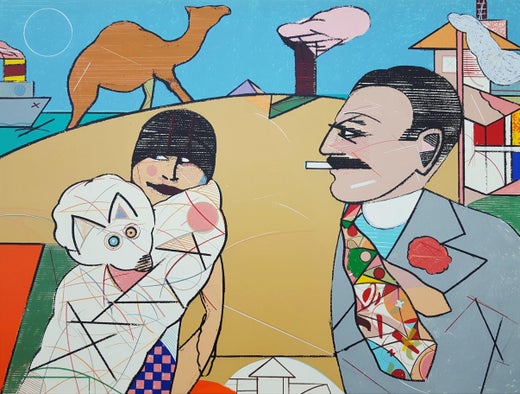
Richard MerkinMarilyn Monroe Pop Art 1969 Color Screenprint Richard Merkin1969
1969
$750List Price
About the Item
- Creator:Richard Merkin (1938 - 2009, American)
- Creation Year:1969
- Dimensions:Height: 26 in (66.04 cm)Width: 20 in (50.8 cm)
- Medium:
- Movement & Style:
- Period:
- Condition:
- Gallery Location:Surfside, FL
- Reference Number:1stDibs: LU38211138702
Richard Merkin
Richard Merkin’s (1938 – September 5, 2009) work conjures up scenes that evoke the raucous spirit of the 1920’s, 30’s and 40’s. In his witty, often eccentric illustrations, Merkin depicts movie stars, jazz musicians, sports heroes and literary impresarios co-mingling with more personal references. In his highly stylized approach to the figure, Merkin privileges color relationships, balance and juxtaposition over strictly literal descriptions of his subjects. And humor; there’s always humor.
About the Seller
4.9
Platinum Seller
Premium sellers with a 4.7+ rating and 24-hour response times
Established in 1995
1stDibs seller since 2014
1,846 sales on 1stDibs
Typical response time: 1 hour
Authenticity Guarantee
In the unlikely event there’s an issue with an item’s authenticity, contact us within 1 year for a full refund. DetailsMoney-Back Guarantee
If your item is not as described, is damaged in transit, or does not arrive, contact us within 7 days for a full refund. Details24-Hour Cancellation
You have a 24-hour grace period in which to reconsider your purchase, with no questions asked.Vetted Professional Sellers
Our world-class sellers must adhere to strict standards for service and quality, maintaining the integrity of our listings.Price-Match Guarantee
If you find that a seller listed the same item for a lower price elsewhere, we’ll match it.Trusted Global Delivery
Our best-in-class carrier network provides specialized shipping options worldwide, including custom delivery.You May Also Like
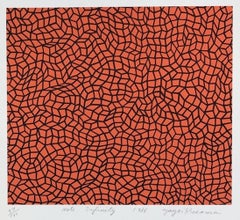
Infinity Nets (1986). Screenprint. Limited Edition 57/100 by Yayoi Kusama ABE 95
By Yayoi Kusama
Located in Hong Kong, HK
Yayoi Kusama
Infinity Nets (1986). Edition 57/100
Screenprint
[2 screens, 2 colors]
Signed, titled, dated and numbered 57/100 in pencil by the artist
28 x 32 cm [11 ¹/₃₂ x 12 ¹⁹/₃₂ ...
Category
1980s Pop Art Abstract Prints
Materials
Screen
$21,000
H 20.28 in Dm 14.34 in
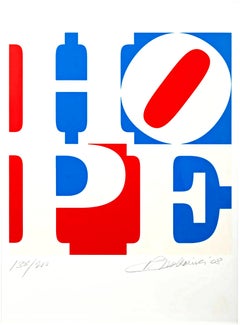
HOPE for America, signed and numbered silkscreen, Red White and Blue patriotic
By Robert Indiana
Located in New York, NY
Robert Indiana
HOPE, 2008
Oil silkscreen in colors on watermarked Coventry archival paper
25 × 19 inches
Edition 138/200
Signed, dated and number...
Category
Early 2000s Pop Art Abstract Prints
Materials
Screen
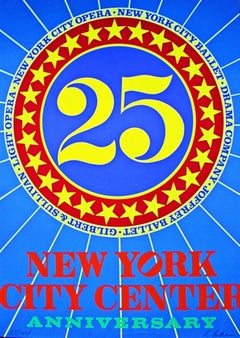
New York City Center mid 1960s geometric design Pop Art hand signed and numbered
By Robert Indiana
Located in New York, NY
Robert Indiana
New York City Center of Music and Drama (Hand signed limited edition), 1968
Color Silkscreen
35 × 25 inches
Edition 23/144
Hand signed and dated lower right recto; num...
Category
1960s Pop Art Abstract Prints
Materials
Screen
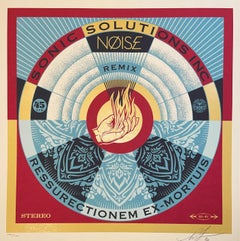
Shepard Fairey Print Signed & Numbered NØISE/SSI Resurrectionem Ex-Mortuis Remix
By Shepard Fairey
Located in Draper, UT
Manufacturer
Obey Giant
Edition Details
Year: 2021
Class: Art Print
Status: Official
Released: 03/30/21
Run: 387/400
Technique: Screen Print
Paper: Cream Specketone
Size: 18 X 18
Ma...
Category
2010s Pop Art Abstract Prints
Materials
Screen
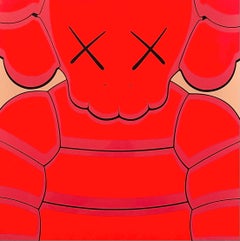
What Party (Orange), KAWS
By KAWS
Located in Fairfield, CT
Artist: KAWS (1974)
Title: What Party (Orange)
Year: 2020
Medium: Silkscreen on Saunders Waterford paper
Size: 22 x 22 inches
Edition: 100, plus 20 proofs
Condition: Excellent
Inscri...
Category
2010s Pop Art Abstract Prints
Materials
Screen
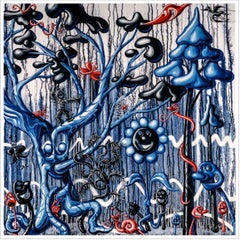
Furungle (Blue)
By Kenny Scharf
Located in Boca Raton, FL
Colorful, cartoonish faces and imagined creatures populate Kenny Scharf's fantastical murals, paintings, sculptures, and installations.
Category
21st Century and Contemporary Pop Art Abstract Prints
Materials
Screen
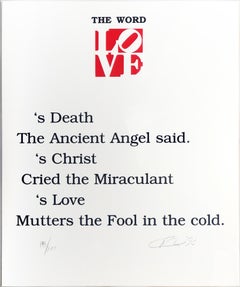
Book of Love - The Word, Screenprint by Robert Indiana
By Robert Indiana
Located in Long Island City, NY
A silkscreen Love print with poem by Robert Indiana from the Book of Love. Presented in a plexi-box frame.
Artist: Robert Indiana, American (1928 - )
...
Category
1990s Pop Art Abstract Prints
Materials
Screen
$1,500
H 24.25 in W 20.25 in
Circles of Confusion, Signed Abstract Pop Art Screenprint by James Rosenquist
By James Rosenquist
Located in Long Island City, NY
Artist: Peter Phillips, British (1939 - )
Title: Circles of Confusion from 11 Pop Artists
Year: 1965
Medium: Silkscreen, signed and numbered in pencil
Edition: 200, XXII/L
Size: 24 ...
Category
1960s Pop Art Abstract Prints
Materials
Screen
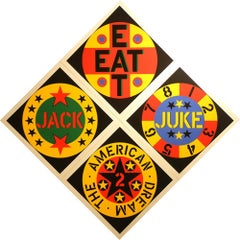
American Dream #2
By Robert Indiana
Located in Miami, FL
TECHNICAL INFORMATION:
Robert Indiana
American Dream #2
1982
Screenprint on 4 separate sheets
26 3/4 x 26 3/4 in. each sheet (77 1//2 x 77 1/2 in. overall)
A.P. of 9/15 (Artist's Pr...
Category
1980s Pop Art Abstract Prints
Materials
Screen
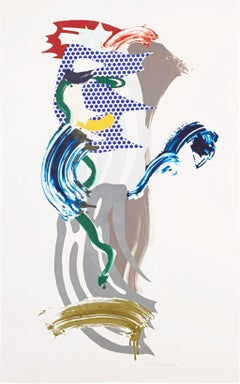
Blue Face
By Roy Lichtenstein
Located in New York, NY
A stunning example of abstracted imagery easily identifiable as the work of Roy Lichtenstein, Blue Face was created by the artist in 1989 as a truly mixed me...
Category
20th Century Pop Art Abstract Prints
Materials
Lithograph, Screen, Woodcut
More From This Seller
View All1970's Large Silkscreen Abstract Geometric Day Glo Serigraph Pop Art Print Neon
By Chryssa Vardea-Mavromichali
Located in Surfside, FL
Silkscreen on Arches paper, Hand signed and Numbered in Pencil. Serigraph in white, back, blue gray (silver).
Chryssa Vardea-Mavromichali (Greek: Χρύσα Βαρδέα-Μαυρομιχάλη; December 31, 1933 – December 23, 2013) was a Greek American artist who worked in a wide variety of media. An American art pioneer in light art and luminist sculpture widely known for her neon, steel, aluminum and acrylic glass installations, she has always used the mononym Chryssa professionally. She worked from the mid-1950s in New York City studios and worked since 1992 in the studio she established in Neos Kosmos, Athens, Greece.
Chryssa was born in Athens into the famous Mavromichalis family from the Mani Peninsula. one of her sisters, who studied medicine, was a friend of the poet and novelist Nikos Kazantzakis.
Chryssa began painting during her teenage years and also studied to be a social worker.In 1953, on the advice of a Greek art critic, her family sent her to Paris to study at the Académie de la Grande Chaumiere where Andre Breton, Edgard Varese, and Max Ernst were among her associates and Alberto Giacometti was a visiting professor.
In 1954, at age twenty-one, Chryssa sailed for the United States, arrived in New York and went to San Francisco, California to study at the California School of Fine Arts. Returning to New York in 1955, she became a United States citizen and established a studio in the city.
Chryssa's first major work was The Cycladic Books preceded American minimalism by seventeen years.
1961, Chryssa's first solo exhibition was mounted at The Guggenheim.
1963, Chryssa's work was shown at the Museum of Modern Art in curator Dorothy Canning Miller's Americans 1963 exhibition. The artists represented in the show also included Richard Anuszkiewicz, Lee Bontecou, Robert Indiana, Richard Lindner, Marisol, Claes Oldenburg, Ad Reinhardt, James Rosenquist and others.
1966, The Gates to Times Square, regarded as "one of the most important American sculptures of all time" and "a thrilling homage to the living American culture of advertising and mass communications." The work is a 10 ft cube installation of two huge letter 'A's through which visitors may walk into "a gleaming block of stainless steel and Plexiglas that seems to quiver in the play of pale blue neon light" which is controlled by programmed timers. First shown in Manhattan's Pace Gallery, it was given to the Albright-Knox Art Gallery in Buffalo, New York in 1972.
1972, The Whitney Museum of American Art mounted a solo exhibition of works by Chryssa.
That's All (early 1970s), the central panel of a triptych related to The Gates of Times Square, was acquired by the Museum of Modern Art between 1975 and 1979.
1973, Chryssa's solo exhibition at the Gallerie Denise René was reviewed for TIME magazine by art critic Robert Hughes before it went on to the Galleries Denise René in Düsseldorf and Paris.
Other works by Chryssa in composite honeycomb aluminum and neon in the 1980s and 1990s include Chinatown, Siren, Urban Traffic, and Flapping Birds.
Chryssa 60/90 retrospective exhibition in Athens in the Mihalarias Art Center. After her long absence from Greece, a major exhibition including large aluminum sculptures - cityscapes, "neon boxes" from the Gates to the Times Square, paintings, drawings etc. was held in Athens.
In 1992, after closing her SoHo studio, which art dealer Leo Castelli had described as "one of the loveliest in the world," Chryssa returned to Greece. She found a derelict cinema which had become a storeroom stacked with abandoned school desks and chairs, behind the old Fix Brewery near the city center in Neos Kosmos, Athens. Using the desks to construct enormous benches, she converted the space into a studio for working on designs and aluminum composite honeycomb sculptures...
Category
1980s Pop Art Abstract Prints
Materials
Screen
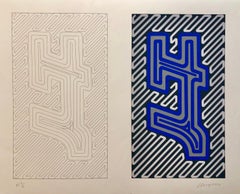
Surrealist Abstract Hebrew Shabbat Pop Art Silkscreen Judaica Jewish Serigraph
By Jozsef Jakovits
Located in Surfside, FL
Abstract Hebrew Prints on heavy mould made paper from small edition of 15. there is a facing page of text in Hungarian folded over. Hard edged geometric abstract prints in color base...
Category
1980s Pop Art Abstract Prints
Materials
Archival Paper, Screen
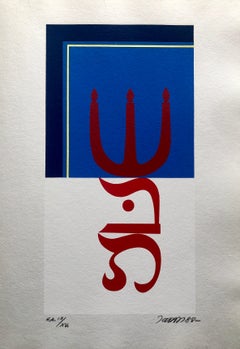
1970's Large Silkscreen Abstract Geometric Day Glo Serigraph Pop Art Print Neon
By Chryssa Vardea-Mavromichali
Located in Surfside, FL
Silkscreen on Arches paper, Hand signed and Numbered in Pencil. Serigraph in black, gray (silver).
Chryssa Vardea-Mavromichali (Greek: Χρύσα Βαρδέα-Μαυρομιχάλη; December 31, 1933 – December 23, 2013) was a Greek American artist who worked in a wide variety of media. An American art pioneer in light art and luminist sculpture widely known for her neon, steel, aluminum and acrylic glass installations, she has always used the mononym Chryssa professionally. She worked from the mid-1950s in New York City studios and worked since 1992 in the studio she established in Neos Kosmos, Athens, Greece.
Chryssa was born in Athens into the famous Mavromichalis family from the Mani Peninsula. one of her sisters, who studied medicine, was a friend of the poet and novelist Nikos Kazantzakis.
Chryssa began painting during her teenage years and also studied to be a social worker.In 1953, on the advice of a Greek art critic, her family sent her to Paris to study at the Académie de la Grande Chaumiere where Andre Breton, Edgard Varese, and Max Ernst were among her associates and Alberto Giacometti was a visiting professor.
In 1954, at age twenty-one, Chryssa sailed for the United States, arrived in New York and went to San Francisco, California to study at the California School of Fine Arts. Returning to New York in 1955, she became a United States citizen and established a studio in the city.
Chryssa's first major work was The Cycladic Books preceded American minimalism by seventeen years.
1961, Chryssa's first solo exhibition was mounted at The Guggenheim.
1963, Chryssa's work was shown at the Museum of Modern Art in curator Dorothy Canning Miller's Americans 1963 exhibition. The artists represented in the show also included Richard Anuszkiewicz, Lee Bontecou, Robert Indiana, Richard Lindner, Marisol, Claes Oldenburg, Ad Reinhardt, James Rosenquist and others.
1966, The Gates to Times Square, regarded as "one of the most important American sculptures of all time" and "a thrilling homage to the living American culture of advertising and mass communications." The work is a 10 ft cube installation of two huge letter 'A's through which visitors may walk into "a gleaming block of stainless steel and Plexiglas that seems to quiver in the play of pale blue neon light" which is controlled by programmed timers. First shown in Manhattan's Pace Gallery, it was given to the Albright-Knox Art Gallery in Buffalo, New York in 1972.
1972, The Whitney Museum of American Art mounted a solo exhibition of works by Chryssa.
That's All (early 1970s), the central panel of a triptych related to The Gates of Times Square, was acquired by the Museum of Modern Art between 1975 and 1979.
1973, Chryssa's solo exhibition at the Gallerie Denise René was reviewed for TIME magazine by art critic Robert Hughes before it went on to the Galleries Denise René in Düsseldorf and Paris.
Other works by Chryssa in composite honeycomb aluminum and neon in the 1980s and 1990s include Chinatown, Siren, Urban Traffic, and Flapping Birds.
Chryssa 60/90 retrospective exhibition in Athens in the Mihalarias Art Center. After her long absence from Greece, a major exhibition including large aluminum sculptures - cityscapes, "neon boxes" from the Gates to the Times Square, paintings, drawings etc. was held in Athens.
In 1992, after closing her SoHo studio, which art dealer Leo Castelli had described as "one of the loveliest in the world," Chryssa returned to Greece. She found a derelict cinema which had become a storeroom stacked with abandoned school desks and chairs, behind the old Fix Brewery near the city center in Neos Kosmos, Athens. Using the desks to construct enormous benches, she converted the space into a studio for working on designs and aluminum composite honeycomb sculptures...
Category
1980s Pop Art Abstract Prints
Materials
Screen
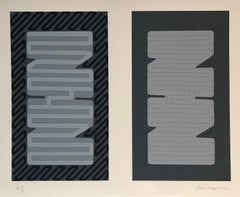
Pop Art Aspen Road Sign D'arcangelo Silkscreen Chiron Press Vintage Art Poster
Located in Surfside, FL
Allan D'Arcangelo (American/New York, 1930-1998),
"Aspen Center of Contemporary Art",
1967
silkscreen, hand signed in pencil, dated, numbered "45/200" and blind stamped "Chiron Press, New York, NY"
32 in. x 24 in.
Allan D'Arcangelo (1930-1998) was an American artist and printmaker, best known for his paintings of highways and road signs that border on pop art and minimalism, precisionism, Abstract illusionism and hard-edge painting, and also surrealism. His subject matter is distinctly American and evokes, at times, a cautious outlook on the future of this country. Allan D'Arcangelo was the son of Italian immigrants. He studied at the University of Buffalo from 1948–1953, where he got his bachelor's degree in history. After college, he moved to Manhattan and picked up his studies again at the New School of Social Research and the City University of New York, City College. At this time, he encountered Abstract Expressionist painters who were in vogue at the moment. After joining the army in the mid 1950s, he used the GI Bill to study painting at Mexico City College from 1957–59, driving there over 12 days in an old bakery truck retrofitted as a camper. However, he returned to New York in 1959, in search of the unique American experience. It was at this time that his painting took on a cool sensibility reminiscent of Roy Lichtenstein and Andy Warhol. His interests engaged with the environment, anti-Vietnam War protests, and the commodification and objectification of female sexuality. D'Arcangelo first achieved recognition in 1962, when he was invited to contribute an etching to The International Anthology of Contemporary Engraving: America Discovered; his first solo exhibition came the next year, at the Thiebaud Gallery in New York City. In 1965 he contributed three screenprints to Original Edition's 11 Pop Artists portfolio. By the 1970s, D'Arcangelo had received significant recognition in the art world. He was well known for his paintings of quintessentially American highways and infrastructure, and in 1971 was commissioned by the Department of the Interior to paint the Grand Coulee Dam in Washington state. However, his sense of morality always trumped his interest in art world fame. In 1975, he decided to quit the gallery that had been representing him for years, Marlborough Gallery, because of the way they handled Mark Rothko legacy.
D'Arcangelo rejected Abstract Expressionism, though his early work has a painterly and somewhat expressive feel. He quickly turned to a style of art that seemed to border on Pop Art and Minimalism, Precisionism and Hard-Edge painting. Evidently, he didn't fit neatly in the category of Pop Art, though he shared subjects (women, signs, Superman) and techniques (stencil, assemblage) with these artists.He turned to expansive, if detached scenes of the American highway. These paintings are reminiscent of Giorgio de Chirico-though perhaps not as interested in isolation-and Salvador Dali-though there is a stronger interest in the present and disinterest in the past. These paintings also have a sharp quality that is reminiscent of the precisionist style, or more specifically, Charles Sheeler. 1950s, Before D'Arcangelo returned to New York, his style was roughly figurative and reminiscent of folk art. During the early 1960s, Allan D'Arcangelo was linked with Pop Art. "Marilyn" (1962) depicts an illustrative head and shoulders on which the facial features are marked by lettered slits to be "fitted" with the eyebrows, eyes, nose and mouth which appear off to the right in the composition. In "Madonna and Child," (1963) the featureless faces of Jackie Kennedy and Caroline are ringed with haloes, enough to make their status as contemporary icons perfectly clear.
Select Exhibitions:
Fischbach Gallery, New York,
Ileana Sonnabend Gallery, Paris,
Gallery Müller, Stuttgart, Germany
Hans Neuendorf Gallery, Hamburg, Germany
Dwan Gallery...
Category
1960s Pop Art Abstract Prints
Materials
Lithograph, Screen
Silkscreen Day Glo Fluorescent Japanese Gyu-chan Neo Dada Art Print Birdie Litho
By Ushio Shinohara
Located in Surfside, FL
19 x 15.5 with backing 12 x 12 image
Ushio Shinohara (born 1932, Tokyo), nicknamed “Gyu-chan”, is a Japanese Neo-Dadaist artist. His bright, large work has been exhibited internationally at institutions including the Hara Museum of Contemporary Art, Centre Georges Pompidou, the Guggenheim Museum SoHo, National Museum of Modern Art, Tokyo, Leo Castelli Gallery, New York, Museum of Contemporary Art, Los Angeles and The Metropolitan Museum of Art, Seoul and others. Shinohara and his wife, Noriko, are the subjects of a documentary film by Zachary Heinzerling called Cutie and the Boxer (2013).
Shinohara's parents instilled in him a love for painters such as Paul Cézanne, Vincent Van Gogh and Paul Gauguin. His father was a tanka poet who was taught by Wakayama Bokusui. Shinohara’s mother was a painter who went to the Woman’s Art University (Joshibijutsu Daigaku) in Tokyo.
In 1952 Shinohara entered the Tokyo Art University (later renamed to Tokyo University of the Arts), majoring in oil painting, however he left before graduation in 1957.
In 1960 Shinohara participated in a group called "Neo-Dada Organizers". (Masunobu Yoshimura, Genpei Akasegawa, Shusaku Arakawa, Ushio Shinohara, Sho Kazakura, Tomio Miki, Tetsumi Kudo...
Category
1960s Pop Art Abstract Prints
Materials
Screen
1980 Large Pop Art Silkscreen Abstract Op Art Jagged Edge Bright Color Serigraph
By Nicholas Krushenick
Located in Surfside, FL
Green, Red, Silver and Black and White. Large Pop Art Silkscreen.
Nicholas Krushenick (May 31, 1929 – February 5, 1999) was an American abstract painter whose artistic style straddle...
Category
1980s Pop Art Abstract Prints
Materials
Screen