Want more images or videos?
Request additional images or videos from the seller
1 of 9

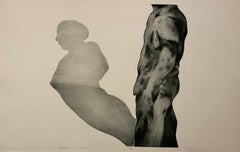
John Baldessari
Studio

1988

You May Also Like

Modernist Figurative Pop Art Etching and Aquatint "the Artist" Michael Mazur
By Michael Mazur
Located in Surfside, FL
Michael Mazur "The Artist" Hand signed and editioned from the edition of 50 1967 Michael Burton Mazur (1935-August 18, 2009) was an American artist who was described by William Grim...
Category

Early 2000s American Modern Abstract Prints

Materials

Lithograph, Screen

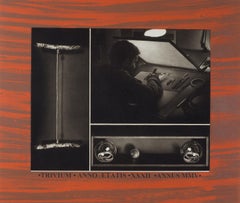
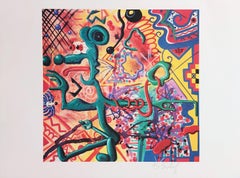
Trivium MMV
By Francisco Souto
Located in New Orleans, LA
In medieval universities, the trivium comprised the three subjects that were taught first: grammar, logic, and rhetoric. The word is a Latin term meaning "the three ways" or "the thr...
Category

Early 2000s American Modern Figurative Prints

Materials

Mezzotint, Lithograph, Screen

Trivium MMV
$487 Sale Price
35% Off
H 17 in W 20 in
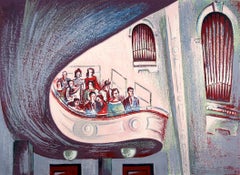
"Balcony" 1938 WPA Print Mid 20th Century American Broadway Theatre Modernism
By Leon Bibel
Located in New York, NY
"Balcony" 1938 WPA Print Mid 20th Century American Broadway Theatre Modernism. Silk screen on paper, 15” x 20". Numbered 15/20 lower left. Pencil si...
Category

1930s American Modern Figurative Prints

Materials

Paper, Screen

Ratfinkbonerthunk : Surrealist Rat - Original Giclee Print, Handsigned
By Kenny Scharf
Located in Paris, IDF
Kenny Scharf Ratfinkbonerthunk : Surrealist Rat, 1990 Original Giclee Print Handsigned in pencil On Arches vellum 56 x 76 cm (c. 22 x 30 in) Published by Editions Vermorel in 1990 ...
Category

1990s American Modern Figurative Prints

Materials

Giclée, Screen

Interlude, Screenprint by Will Barnet
By Will Barnet
Located in Long Island City, NY
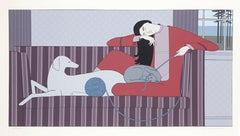
Artist: Will Barnet, American (1911 - 2012) Title: Interlude Year: 1982 Medium: Serigraph, signed and numbered in pencil Edition: AP Image Size: 20 x 38 inches Size: 25.5 x 42.5 in. (64.77 x 107.95 cm) Fig 179, pg 70 from Will Barnet: Prints 1931-2005, published by John Szoke...
Category

1980s American Modern Figurative Prints

Materials

Screen

Circe 2
By Will Barnet
Located in San Francisco, CA
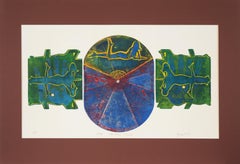
This artwork titled "Circe" 1979 is an original colors serigraph on Wove paper by noted American artist Will Barnet, 1911-2012. It is hand signed, titled and numbered 43/100 in pencil by the artist. The image size (circle) is 18 x 18 inches, sheet size is 23.25 x 24 inches. It is in excellent condition, has never been framed. About the artist: Born in 1911 in Beverly, Massachusetts, Barnet knew by the age of ten that he wanted to be an artist. As a student, he studied with Philip Leslie Hale at the School of the Museum of Fine Arts, Boston and viewed first-hand John Singer Sargent at work on the murals of the Boston Public Library. In 1930, Barnet studied at the Art Students League of New York, with Stuart Davis and Charles Locke, beginning his long association with the school. Here he concentrated on painting as well as printmaking, and, in 1936, he became the official printer for the Art Students League. There, he later instructed students in the graphic arts at the school and taught alongside the likes of Yasuo Kuniyoshi, Robert Beverly Hale and Richard Pousette-Dart. Barnet influenced a generation of artists, including James Rosenquist, Knox Martin, Emil Milan, Paul Jenkins, Ethel Fisher...
Category

Late 20th Century American Modern Figurative Prints

Materials

Screen

Circe 2
$1,800
H 23.25 in W 24 in D 0.01 in
Modernist Silkscreen Screenprint 'El Station, Interior' NYC Subway, WPA Artist
By Anthony Velonis
Located in Surfside, FL
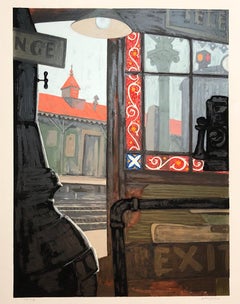
screenprint printed in color ink on wove paper. New York City subway station interior. Anthony Velonis (1911 – 1997) was an American painter and designer born in New York City who helped introduce the public to silkscreen printing in the early 20th century. While employed under the federal Works Progress Administration, WPA during the Great Depression, Velonis brought the use of silkscreen printing as a fine art form, referred to as the "serigraph," into the mainstream. By his own request, he was not publicly credited for coining the term. He experimented and mastered techniques to print on a wide variety of materials, such as glass, plastics, and metal, thereby expanding the field. In the mid to late 20th century, the silkscreen technique became popular among other artists such as Robert Rauschenberg and Andy Warhol. Velonis was born into a relatively poor background of a Greek immigrant family and grew up in the tenements of New York City. Early on, he took creative inspiration from figures in his life such as his grandfather, an immigrant from the mountains in Greece, who was "an ecclesiastical painter, on Byzantine style." Velonis attended James Monroe High School in The Bronx, where he took on minor artistic roles such as the illustration of his high school yearbook. He eventually received a scholarship to the NYU College of Fine Arts, into which he was both surprised and ecstatic to have been admitted. Around this time he took to painting, watercolor, and sculpture, as well as various other art forms, hoping to find a niche that fit. He attended NYU until 1929, when the Great Depression started in the United States after the stock market crash. Around the year 1932, Velonis became interested in silk screen, together with fellow artist Fritz Brosius, and decided to investigate the practice. Working in his brother's sign shop, Velonis was able to master the silkscreen process. He reminisced in an interview three decades later that doing so was "plenty of fun," and that a lot of technology can be discovered through hard work, more so if it is worked on "little by little." Velonis was hired by Mayor LaGuardia in 1934 to promote the work of New York's city government via posters publicizing city projects. One such project required him to go on a commercial fishing trip to locations including New Bedford and Nantucket for a fortnight, where he primarily took photographs and notes, and made sketches. Afterward, for a period of roughly six months, he was occupied with creating paintings from these records. During this trip, Velonis developed true respect and affinity for the fishermen with whom he traveled, "the relatively uneducated person," in his words. Following this, Velonis began work with the Public Works of Art Project (PWAP), an offshoot of the Civil Works Administration (CWA), where he was assigned to serve the different city departments of New York. After the formation of the federal Works Progress Administration, which hired artists and sponsored projects in the arts, he also worked in theater. Velonis began working for the federal WPA in 1935. He kept this position until 1936 or 1938, at which point he began working in the graphic art division of the Federal Art Project, which he ultimately led. Under various elements of the WPA program, many young artists, writers and actors gained employment that helped them survive during the Depression, as well as contributing works that created an artistic legacy for the country. When interviewed in December 1994 by the Library of Congress about his time in the WPA, Velonis reflected that he had greatly enjoyed that period, saying that he liked the "excitement" and "meeting all the other artists with different points of view." He also said in a later interview that "the contact and the dialogue with all those artists and the work that took place was just invaluable." Among the young artists he hired was Edmond Casarella, who later developed an innovative technique using layered cardboard for woodcuts. Velonis introduced silkscreen printing to the Poster Division of the WPA. As he recalled in a 1965 interview: "I suggested that the Poster division would be a lot more productive and useful if they had an auxiliary screen printing project that worked along with them. And apparently this was very favorably received..." As a member of the Federal Art Project, a subdivision of the WPA, Velonis later approached the Public Use of Arts Committee (PUAC) for help in "propagandizing for art in the parks, in the subways, et cetera." Since the Federal Art Project could not be "self-promoting," an outside organization was required to advertise their art more extensively. During his employment with the Federal Art Project, Velonis created nine silkscreen posters for the federal government. Around 1937-1939 Velonis wrote a pamphlet titled "Technical Problems of the Artist: Technique of the Silkscreen Process," which was distributed to art centers run by the WPA around the country. It was considered very influential in encouraging artists to try this relatively inexpensive technique and stimulated printmaking across the country. In 1939, Velonis founded the Creative Printmakers Group, along with three others, including Hyman Warsager. They printed both their own works and those of other artists in their facility. This was considered the most important silkscreen shop of the period. The next year, Velonis founded the National Serigraph Society. It started out with relatively small commercial projects, such as "rather fancy" Christmas cards that were sold to many of the upscale Fifth Avenue shops...
Category

1980s American Modern Figurative Prints

Materials

Screen

Headstand (San Francisco Museum of Modern Art) - Exhibition Poster
By Keith Haring
Located in Paris, IDF
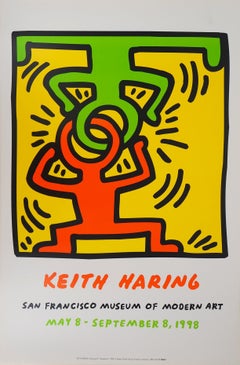
Keith Haring Headstand Original vintage exhibition Poster printed in Screenprint On thick paper 90 x 60 cm (c. 36 x 24 in) INFORMATION: Official screenprint poster for the Haring e...
Category

1980s American Modern Figurative Prints

Materials

Screen

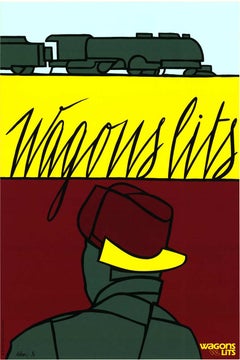
Original "Wagon Lits" pop art style serigraph travel by train poster
By Valerio Adami
Located in Spokane, WA
Original “Wagon Lits” serigraph poster by the artist Valerio Adami. It was printed in France by GrafiCaza (Michel Caza), one of the finest serigraph companies on woven paper—in exce...
Category

1990s American Modern Figurative Prints

Materials

Screen

"Dodge Rebellion Girls" - 1967 Original Silkscreen on Paper Artists Proof
By Marc Foster Grant
Located in Soquel, CA
"Dodge Rebellion Girls" - 1967 Silkscreen on Paper 1967 color silkscreen depicting the Dodge Rebellion Girls by Marc Foster Grant (American, b. 1947). A silhouette of the 'dodge gi...
Category

1960s American Modern Figurative Prints

Materials

Paper, Ink, Screen

More From This Seller

View All
Study/Falling Man (Series I)
By Ernest Tino Trova
Located in Missouri, MO
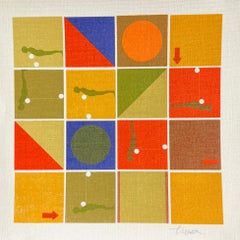
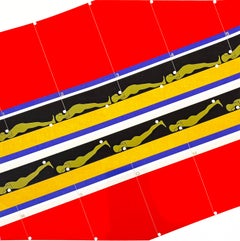
Study/Falling Man (Series I), 1967 By. Ernest Tino Trova (American, 1927-2009) Signed Lower Right in Pencil Screenprint, Available in Black or Silver Frame Unframed: 6 x 6 inches Wit...
Category

20th Century American Modern Abstract Prints

Materials

Screen

Study/Falling Man (Series I)
By Ernest Tino Trova
Located in Missouri, MO
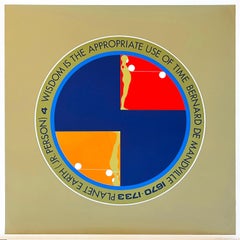
Study/Falling Man (Series I) By. Ernest Tino Trova (American, 1927-2009) 24 x 24 inches Wrapped to Foam Core Signed Artist Proof Lower Right Ernest Tino Trova (American, 1927-2009) ...
Category

1960s American Modern Abstract Prints

Materials

Screen

Trova/Index, Waves
By Ernest Tino Trova
Located in Missouri, MO
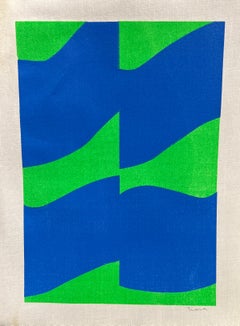
Trova/Index, Waves, 1969 By. Ernest Tino Trova (American, 1927-2009) Signed in Pencil Lower Right Unframed: 10.5 x 7.5 inches With Frame: 15.25 x 11.75 inches Known for his Falling ...
Category

20th Century American Modern Abstract Prints

Materials

Screen

Study/Falling Man (Series II)
By Ernest Tino Trova
Located in Missouri, MO
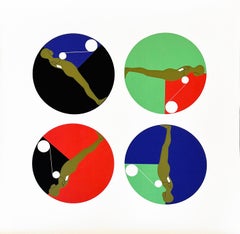
Study/Falling Man (Series II), 1967 By. Ernest Tino Trova (American, 1927-2009) 24 x 24 inches Wrapped on Foam core Signed Artist Proof Lower Right Ernest Tino Trova (American, 1927...
Category

1960s American Modern Abstract Prints

Materials

Screen

Study/Falling Man (Series I)
By Ernest Tino Trova
Located in Missouri, MO
Study/Falling Man (Series I), 1967 By. Ernest Tino Trova (American, 1927-2009) 24 x 24 inches Wrapped to Foam Core Signed Artist Proof Lower Right Ernest Tino Trova (American, 1927-...
Category

1960s American Modern Abstract Prints

Materials

Screen

Study/Falling Man (Series II)
By Ernest Tino Trova
Located in Missouri, MO
Study/Falling Man (Series II), 1967 By. Ernest Tino Trova (American, 1927-2009) 24 x 24 inches Signed Artist Proof Lower Right Wrapped to Foam Core Ernest Tino Trova (American, 1927...
Category

1960s American Modern Abstract Prints

Materials

Screen

Still Thinking About These?

All Recently Viewed