Want more images or videos?
Request additional images or videos from the seller
1 of 3
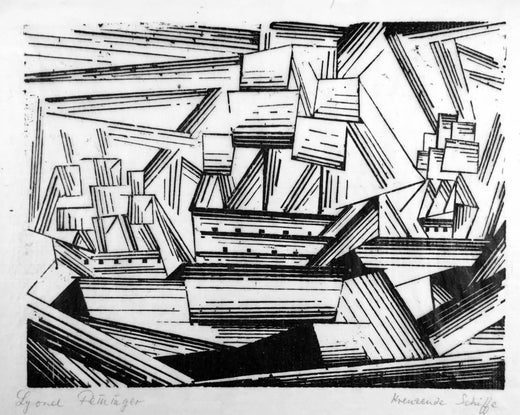
Lyonel Feininger'Ausfahrender Dampfer Odin (Outboard Steamer Odin)' — German Expressionism1918
1918
Price:$4,200
About the Item
- Creator:Lyonel Feininger (1871-1956, American)
- Creation Year:1918
- Dimensions:Height: 3.19 in (8.11 cm)Width: 4.44 in (11.28 cm)
- Medium:
- Movement & Style:
- Period:
- Condition:
- Gallery Location:Myrtle Beach, SC
- Reference Number:Seller: 1042061stDibs: LU532312589172
Lyonel Feininger
Lionel Feininger (1871–1956), a German-American painter, graphic artist, and caricaturist, developed a distinctive style influenced by Cubism and Expressionism. Born in New York City but raised in Germany, Feininger honed his skills at the Hamburg School of Arts and Crafts before studying under renowned artists in Berlin. Initially associated with the avant-garde group "Die Brücke" (The Bridge), Feininger's style evolved over time, gravitating towards Cubism after being inspired by artists like Picasso and Braque. His participation in the "Der Blaue Reiter" (The Blue Rider) exhibition in 1911 further solidified his reputation as an essential figure in the Expressionist movement. Returning to the United States during World War I, Feininger became associated with the American avant-garde, though the Nazis later targeted his works in the "Degenerate Art" exhibition. Feininger experimented with various mediums throughout his career, producing bold and vibrant works depicting urban landscapes and architectural motifs. His legacy as a pioneer of modern art continues to resonate, with his contributions to Cubism, Expressionism, and abstract art celebrated worldwide. Feininger passed away in 1956, leaving behind a rich and influential body of work.
About the Seller
5.0
Recognized Seller
These prestigious sellers are industry leaders and represent the highest echelon for item quality and design.
Platinum Seller
Premium sellers with a 4.7+ rating and 24-hour response times
Established in 1995
1stDibs seller since 2016
334 sales on 1stDibs
Typical response time: 1 hour
Associations
International Fine Print Dealers Association
Authenticity Guarantee
In the unlikely event there’s an issue with an item’s authenticity, contact us within 1 year for a full refund. DetailsMoney-Back Guarantee
If your item is not as described, is damaged in transit, or does not arrive, contact us within 7 days for a full refund. Details24-Hour Cancellation
You have a 24-hour grace period in which to reconsider your purchase, with no questions asked.Vetted Professional Sellers
Our world-class sellers must adhere to strict standards for service and quality, maintaining the integrity of our listings.Price-Match Guarantee
If you find that a seller listed the same item for a lower price elsewhere, we’ll match it.Trusted Global Delivery
Our best-in-class carrier network provides specialized shipping options worldwide, including custom delivery.You May Also Like
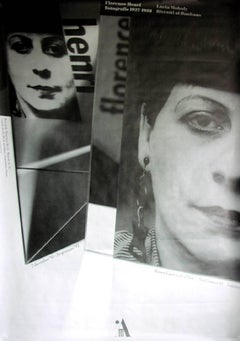
Florence Henri
By Bruno Monzuzzi
Located in New York, NY
Ritratti al Bauhaus. Photo-offset poster.
Museo cantonale d'arte Lugano
Year: 1991.
Monguzzi studied in Geneva and London, spent part of his early career in at the studio of Antonio Boggeri, in Milan. The inspiration of the experimental and visually-daring work of the avant garde designers Herbert Bayer, El Lissitsky, Jan Tschichold, Piet Zwart, Paul Schuitema, Ladislav Sutnar...
Category
1990s Bauhaus Figurative Prints
Materials
Offset
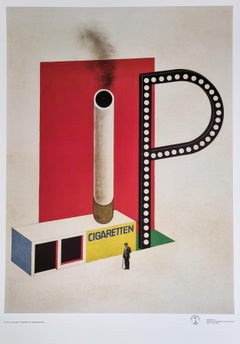
Sale and Marketing Kiosk for P Cigarettes (Bauhaus) (20% OFF + Free Shipping)
By Herbert Bayer
Located in Kansas City, MO
Herbert Bayer
Sale and Marketing Kiosk for P Cigarettes (Verkauf- und Werbekiosk, Zigarettenmarke P ), 1924
Offset Lithograph
Year: 1994
Size: 33.2 × 23.2 inches
Publisher: Bauhaus A...
Category
1920s Bauhaus Prints and Multiples
Materials
Lithograph
$120 Sale Price
20% Off
H 33.2 in W 23.2 in
BENDIX ALUFROID original horizontal French poster
Located in Spokane, WA
Original Bendix Alufroid French Lithographic Vintage Poster by Hervé Morvan from the 1960s. Archival linen-backed and in very fine condition, ready for framing.
Add a touch of cla...
Category
1960s Bauhaus Figurative Prints
Materials
Lithograph

$796 Sale Price
20% Off
H 43 in W 30.5 in D 0.05 in
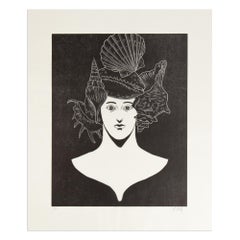
Nicolas Party, Portrait with Shells - Original Woodcut, Signed Print
By Nicolas Party
Located in Hamburg, DE
Nicolas Party (Swiss, b. 1980)
Portrait with Shells, 2021
Medium: Woodcut on HM-5 Gampi-shi
Dimensions: 45.7 x 38.1 cm (18 x 15 inches)
Edition of 50: Hand-signed and numbered
Condit...
Category
21st Century and Contemporary Contemporary Portrait Prints
Materials
Woodcut
$6,707
H 18 in W 15.01 in
The Heroine Umekawa in "Meido no Kiyaku"
Located in Fairlawn, OH
Title: The Heroine Umekawa in "Meido no Kiyaku"
Medium: Color woodcut with mica background, silver metallic pigment, and "gofun" for the snow effect
Date Of Execution: 1923
Dimension...
Category
1920s Edo Figurative Prints
Materials
Woodcut

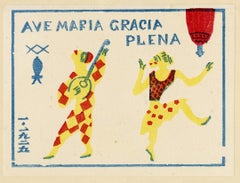
Ave Maria-Nanban Music
Located in Fairlawn, OH
Ave Maria-Nanban Music
Color woodcut with mica sprinkles, 1925
Signed Hide in image, Signed Kawanishi Hide on printed mount
From: Dojin zasshi, Hanga Magazine, Volume 5, No. 4
Condi...
Category
1920s Other Art Style Figurative Prints
Materials
Woodcut
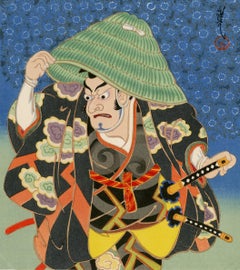
Fuwa, Kabuki Actor
By Masamitsu Ota
Located in Fairlawn, OH
Fuwa, Kabuki actor
Color woodblock, 1931
From: “Kabuki Jahachi-Ban” (Eighteen Kabuki Plays) by the Ichikawa Family
Publisher: Gekiga Kanko Kai
Carver: Okura Hanbei
Printer: Shinmi Yo...
Category
1930s Other Art Style Figurative Prints
Materials
Woodcut
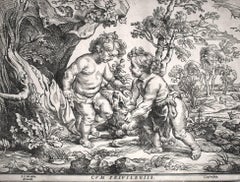
Christ and the Little Saint John Playing with the Lamb (2nd State)
By Christoffel Jegher
Located in Chicago, IL
Woodcut after Peter Paul Rubens (Siegen 1577 - 1640 Antwerp)
337 x 451 mm.; 13 1/4 x 17 3/4 inches
Provenance:
The Metropolitan Museum of Art, New York, Duplicate stamp on verso...
Category
17th Century Baroque Figurative Prints
Materials
Woodcut
$8,500
H 13.25 in W 17.75 in
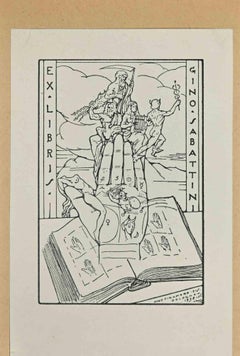
Ex Libris- Greek Deities - Woodcut Print - 1938
Located in Roma, IT
Ex Libris- Greek Deities is a Modern Artwork realized by Gino Sabattini in 1938.
Woodcut print on paper.
Good conditions.
Signed on the plate and dated.
Category
1930s Modern Figurative Prints
Materials
Woodcut
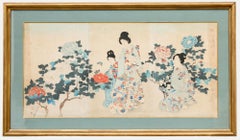
Yoshu Chikanobu (1838-1912) - Japanese Woodblock, Amongst the Flowers Triptych
By Yoshu Chikanobu
Located in Corsham, GB
A delightful triptych by the Japanese ukiyo-e artist Yoshu Chikanobu (1838-1912). The three sections combine to make a single image of women in richly decorated kimonos surrounded by...
Category
19th Century Figurative Prints
Materials
Woodcut
More From This Seller
View All'Church with House and Tree' – Artist's Personal Letterhead, 1940s Modernism
By Lyonel Feininger
Located in Myrtle Beach, SC
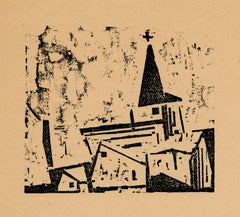
Lyonel Feininger, 'Church with House and Tree (Kirche mit Haus und Baum)', woodcut, 1936, one of a small but unknown number of letterhead proofs; Prasse W290 IV. Annotated 'PW 290 state IV / IV 3669', in pencil, in the bottom right sheet corner. With the artist's typed address and date adjacent to the letterhead image: 'Falls Village, Connecticut September 26th, 1940'.
A fine impression, on buff, wove letterhead stock; several small losses, and tears, in the sheet edges (not affecting the image area); a crease in the bottom right sheet edge, otherwise in good condition. Very scarce.
Image size: 2 3/8 x 2 3/4 inches; sheet size 11 x 8 5/8 inches. Archivally sleeved, unmatted.
Feininger moved from Germany to New York City in 1938 and began spending his summers in Falls Village in 1940.
Exhibited: 'Lyonel Feininer, Woodcuts Used As Letterheads'; Associated American Artists; Feb 4 - March 2, 1974; New York, NY.
ABOUT THE ARTIST
Lyonel Feininger (1871-1956) was born in New York City into a musical family—his father was a violinist and composer, his mother was a singer and pianist. He studied violin with his father, and by the age of 12, he was performing in public, but he also drew incessantly, most notably the steamboats and sailing ships on the Hudson and East Rivers, and the landscape around Sharon, Conn., where he spent time on a farm owned by a family friend. At the age of 16 he left New York to study music and art in Germany, from where his parents emigrated. Drawn more to the visual arts, he attended schools in Hamburg, Berlin, and Paris from 1887 to 1892.
After completing his studies, Feininger began his artistic career as a cartoonist and illustrator, his originality leading him to great success. In 1906, after working for a dozen years in Germany, he was offered a job as a cartoonist at the Chicago Tribune, the largest circulation newspaper in the Midwest. He worked there for a year, inventing what became the standard design for the comic strip: in the words of John Carlin, “an overall pattern. . . that allowed the page to be read both as a series of elements one after the other, like language and as a group of juxtaposed images, like visual art.” His originality did not end there: he went on to become one of the great abstract painters. Like Kandinsky, music was his model, but Kandinsky only knew music from the outside—as a listener (inspired initially by Wagner, then by Schoenberg)—while Feininger knew it from the inside. He lived in Paris from 1906 to 1908, during which time he met and was influenced by the work of progressive painters Robert Delaunay and Jules Pascin, as well as that of Paul Cezanne and Vincent van Gogh. He began painting full-time, developing his distinctive Iyrical style based on Cubist and Expressionist idioms and a concern for the emotive qualities of light and color. He exhibited with the Der Blaue Reiter group in 1913, and in 1917, he had his first solo exhibition at Galerie Der Sturm in Berlin.
One year after his solo exhibition, in 1918, Feininger began making woodcuts. He became enamored with the medium, producing an impressive 117 in his first year of exploring the printmaking medium. In 1919 at the invitation of the architect Walter Gropius, he was appointed the first master at the newly formed Staatliches Bauhaus in Weimar. His woodcut of a cathedral crowned...
Category
1930s Bauhaus Figurative Prints
Materials
Woodcut
'Little Locomotive' – Artist's Personal Letterhead, Bauhaus Modernism
By Lyonel Feininger
Located in Myrtle Beach, SC
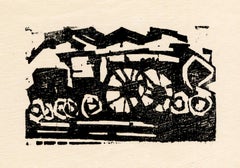
Lyonel Feininger, 'Little Locomotive (Kleine Lokomotive)', woodcut, 1936, one of a small but unknown number of letterhead proofs; Prasse W158. Annotated 'W 158' (Feininger catalogue number) and '1936' in pencil, in the bottom right sheet corner.
A fine impression, on cream, laid letterhead stock; hinge remains on the left and right top sheet edges, verso, in excellent condition. Very scarce.
Image size 2 1/4 x 3 5/16 inches; sheet size 10 x 7 inches. Archivally sleeved, unmatted.
Exhibited: 'Lyonel Feininer, Woodcuts Used As Letterheads'; Associated American Artists; Feb 4 - March 2, 1974; New York, NY.
Collections: Cleveland Museum of Art, Museum of Modern Art, Staatliche Museen zu Berlin (East Berlin KK).
ABOUT THE ARTIST
Lyonel Feininger (1871-1956) was born in New York City into a musical family—his father was a violinist and composer, his mother was a singer and pianist. He studied violin with his father, and by the age of 12, he was performing in public, but he also drew incessantly, most notably the steamboats and sailing ships on the Hudson and East Rivers, and the landscape around Sharon, Conn., where he spent time on a farm owned by a family friend. At the age of 16 he left New York to study music and art in Germany, from where his parents emigrated. Drawn more to the visual arts, he attended schools in Hamburg, Berlin, and Paris from 1887 to 1892.
After completing his studies, Feininger began his artistic career as a cartoonist and illustrator, his originality leading him to great success. In 1906, after working for a dozen years in Germany, he was offered a job as a cartoonist at the Chicago Tribune, the largest circulation newspaper in the Midwest. He worked there for a year, inventing what became the standard design for the comic strip: in the words of John Carlin, “an overall pattern. . . that allowed the page to be read both as a series of elements one after the other, like language and as a group of juxtaposed images, like visual art.” His originality did not end there: he went on to become one of the great abstract painters. Like Kandinsky, music was his model, but Kandinsky only knew music from the outside—as a listener (inspired initially by Wagner, then by Schoenberg)—while Feininger knew it from the inside. He lived in Paris from 1906 to 1908, during which time he met and was influenced by the work of progressive painters Robert Delaunay and Jules Pascin, as well as that of Paul Cezanne and Vincent van Gogh. He began painting full-time, developing his distinctive Iyrical style based on Cubist and Expressionist idioms and a concern for the emotive qualities of light and color. He exhibited with the Der Blaue Reiter group in 1913, and in 1917, he had his first solo exhibition at Galerie Der Sturm in Berlin.
One year after his solo exhibition, in 1918, Feininger began making woodcuts. He became enamored with the medium, producing an impressive 117 in his first year of exploring the printmaking medium. In 1919 at the invitation of the architect Walter Gropius, he was appointed the first master at the newly formed Staatliches Bauhaus in Weimar. His woodcut of a cathedral crowned...
Category
1930s Bauhaus Figurative Prints
Materials
Woodcut
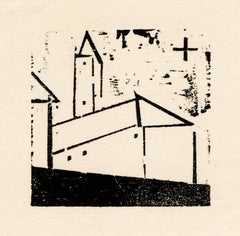
'Church with Star' – Artist's Personal Letterhead, Bauhaus Modernism
By Lyonel Feininger
Located in Myrtle Beach, SC
Lyonel Feininger, 'Church with Star (Kirche mit Stern)', woodcut, 1936, one of a small but unknown number of letterhead proofs; Prasse W265. Annotated 'W 265' (Feininger catalogue number) and inventory no. '2808' in pencil, in the bottom right sheet corner. A fine impression, on cream, laid letterhead stock; hinge remains on the left and right top sheet edges, verso, in excellent condition. Very scarce.
Image size 2 3/8 x 2 3/8 inches; sheet size 10 1/16 x 7 1/16 inches. Archivally sleeved, unmatted.
ABOUT THE ARTIST
Lyonel Feininger (1871-1956) was born in New York City into a musical family—his father was a violinist and composer, his mother was a singer and pianist. He studied violin with his father, and by the age of 12, he was performing in public, but he also drew incessantly, most notably the steamboats and sailing ships on the Hudson and East Rivers, and the landscape around Sharon, Conn., where he spent time on a farm owned by a family friend. At the age of 16 he left New York to study music and art in Germany, from where his parents emigrated. Drawn more to the visual arts, he attended schools in Hamburg, Berlin, and Paris from 1887 to 1892.
After completing his studies, Feininger began his artistic career as a cartoonist and illustrator, his originality leading him to great success. In 1906, after working for a dozen years in Germany, he was offered a job as a cartoonist at the Chicago Tribune, the largest circulation newspaper in the Midwest. He worked there for a year, inventing what became the standard design for the comic strip: in the words of John Carlin, “an overall pattern. . . that allowed the page to be read both as a series of elements one after the other, like language and as a group of juxtaposed images, like visual art.” His originality did not end there: he went on to become one of the great abstract painters. Like Kandinsky, music was his model, but Kandinsky only knew music from the outside—as a listener (inspired initially by Wagner, then by Schoenberg)—while Feininger knew it from the inside. He lived in Paris from 1906 to 1908, during which time he met and was influenced by the work of progressive painters Robert Delaunay and Jules Pascin, as well as that of Paul Cezanne and Vincent van Gogh. He began painting full-time, developing his distinctive Iyrical style based on Cubist and Expressionist idioms and a concern for the emotive qualities of light and color. He exhibited with the Der Blaue Reiter group in 1913, and in 1917, he had his first solo exhibition at Galerie Der Sturm in Berlin.
One year after his solo exhibition, in 1918, Feininger began making woodcuts. He became enamored with the medium, producing an impressive 117 in his first year of exploring the printmaking medium. In 1919 at the invitation of the architect Walter Gropius, he was appointed the first master at the newly formed Staatliches Bauhaus in Weimar. His woodcut of a cathedral crowned...
Category
1930s Bauhaus Figurative Prints
Materials
Woodcut
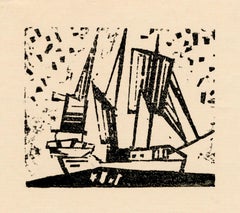
'Three Masted Ship, 2' – Artist's Personal Letterhead, Bauhaus Modernism
By Lyonel Feininger
Located in Myrtle Beach, SC
Lyonel Feininger, 'Three Masted Ship, 2 (Dreimastiges Schiff, 2)', woodcut, 1937, one of a small but unknown number of letterhead proofs; Prasse W296. Feininger estate stamp and inventory no. 'W 865' in pencil, bottom left sheet corner. Annotated 'W 296' and 'on block : 3702a' in pencil, bottom right sheet corner.
A fine impression, on cream, laid, letterhead stock; hinge remains on the left and right top sheet edges, verso, in excellent condition. Very scarce.
Image size 2 1/4 x 2 11/16 inches; sheet size 10 x 6 3/4 inches. Archivally sleeved, unmatted.
Exhibited: 'Lyonel Feininer, Woodcuts Used As Letterheads'; Associated American Artists; Feb 4 - March 2, 1974; New York, NY.
ABOUT THE ARTIST
Lyonel Feininger (1871-1956) was born in New York City into a musical family—his father was a violinist and composer, his mother was a singer and pianist. He studied violin with his father, and by the age of 12, he was performing in public, but he also drew incessantly, most notably the steamboats and sailing ships on the Hudson and East Rivers, and the landscape around Sharon, Conn., where he spent time on a farm owned by a family friend. At the age of 16 he left New York to study music and art in Germany, from where his parents emigrated. Drawn more to the visual arts, he attended schools in Hamburg, Berlin, and Paris from 1887 to 1892.
After completing his studies, Feininger began his artistic career as a cartoonist and illustrator, his originality leading him to great success. In 1906, after working for a dozen years in Germany, he was offered a job as a cartoonist at the Chicago Tribune, the largest circulation newspaper in the Midwest. He worked there for a year, inventing what became the standard design for the comic strip: in the words of John Carlin, “an overall pattern. . . that allowed the page to be read both as a series of elements one after the other, like language and as a group of juxtaposed images, like visual art.” His originality did not end there: he went on to become one of the great abstract painters. Like Kandinsky, music was his model, but Kandinsky only knew music from the outside—as a listener (inspired initially by Wagner, then by Schoenberg)—while Feininger knew it from the inside. He lived in Paris from 1906 to 1908, during which time he met and was influenced by the work of progressive painters Robert Delaunay and Jules Pascin, as well as that of Paul Cezanne and Vincent van Gogh. He began painting full-time, developing his distinctive Iyrical style based on Cubist and Expressionist idioms and a concern for the emotive qualities of light and color. He exhibited with the Der Blaue Reiter group in 1913, and in 1917, he had his first solo exhibition at Galerie Der Sturm in Berlin.
One year after his solo exhibition, in 1918, Feininger began making woodcuts. He became enamored with the medium, producing an impressive 117 in his first year of exploring the printmaking medium. In 1919 at the invitation of the architect Walter Gropius, he was appointed the first master at the newly formed Staatliches Bauhaus in Weimar. His woodcut of a cathedral crowned...
Category
1930s Bauhaus Figurative Prints
Materials
Woodcut
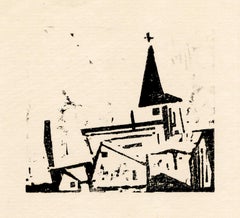
'Church with House and Tree' – Artist's Personal Letterhead, Bauhaus Modernism
By Lyonel Feininger
Located in Myrtle Beach, SC
Lyonel Feininger, 'Church with House and Tree (Kirche mit Haus und Baum)', woodcut, 1936, one of a small but unknown number of letterhead proofs; Prasse W290 V. Inscribed 'J. F. note paper', in pencil, in the artist’s hand; with the Feininger estate stamp and catalog no. 'W 859' in pencil. Annotated 'W.290 V state 3609' in pencil, in the bottom right sheet corner.
A fine impression, on cream, laid letterhead stock; hinge remains on the left and right top sheet edges, verso, in excellent condition. Very scarce.
Image size 2 3/8 x 2 3/4 inches; sheet size 10 x 7 5/16 inches. Archivally sleeved, unmatted.
Exhibited: 'Lyonel Feininer, Woodcuts Used As Letterheads'; Associated American Artists; Feb 4 - March 2, 1974; NY, NY.
ABOUT THE ARTIST
Lyonel Feininger (1871-1956) was born in New York City into a musical family—his father was a violinist and composer, his mother was a singer and pianist. He studied violin with his father, and by the age of 12, he was performing in public. Still, he also drew incessantly, most notably the steamboats and sailing ships on the Hudson and East Rivers, and the landscape around Sharon, Conn., where he spent time on a farm owned by a family friend. At the age of 16 he left New York to study music and art in Germany, from where his parents emigrated. Drawn more to the visual arts, he attended schools in Hamburg, Berlin, and Paris from 1887 to 1892.
After completing his studies, Feininger began his artistic career as a cartoonist and illustrator, his originality leading him to great success. In 1906, after working for a dozen years in Germany, he was offered a job as a cartoonist at the Chicago Tribune, the largest circulation newspaper in the Midwest. He worked there for a year, inventing what became the standard design for the comic strip: in the words of John Carlin, “an overall pattern. . . that allowed the page to be read both as a series of elements one after the other, like language and as a group of juxtaposed images, like visual art.” His originality did not end there: he went on to become one of the great abstract painters. Like Kandinsky, music was his model, but Kandinsky only knew music from the outside—as a listener (inspired initially by Wagner, then by Schoenberg)—while Feininger knew it from the inside. He lived in Paris from 1906 to 1908, during which time he met and was influenced by the work of progressive painters Robert Delaunay and Jules Pascin, as well as that of Paul Cezanne and Vincent van Gogh. He began painting full-time, developing his distinctive Iyrical style based on Cubist and Expressionist idioms and a concern for the emotive qualities of light and color. He exhibited with the Der Blaue Reiter group in 1913, and in 1917, he had his first solo exhibition at Galerie Der Sturm in Berlin.
One year after his solo exhibition, in 1918, Feininger began making woodcuts. He became enamored with the medium, producing an impressive 117 in his first year of exploring the printmaking medium. In 1919 at the invitation of the architect Walter Gropius, he was appointed the first master at the newly formed Staatliches Bauhaus in Weimar. His woodcut of a cathedral crowned...
Category
1930s Bauhaus Figurative Prints
Materials
Woodcut
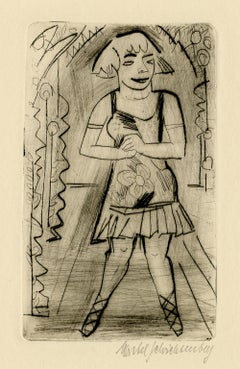
'Varietesoubrette, Schwalbennest' also Dancer — 1920s German Expressionism
Located in Myrtle Beach, SC
Martel Schwichtenberg (1896-1945), 'Varietésoubrette, Schwalbennest (Variety Soubrette, Swallow’s Nest), drypoint, 1922. Signed in pencil. A fine, richly-inked impression; the full sheet of cream wove paper, with wide margins (3 3/4 to 5 1/4 inches), in excellent condition. Image size 7 3/16 x 4 5/16 inches; sheet size 16 3/8 x 12 1/8 inches. Archivally matted to museum standards, unframed.
Published in Die Schaffenden...
Category
1920s Bauhaus Figurative Prints
Materials
Drypoint