Want more images or videos?
Request additional images or videos from the seller
1 of 9
Utagawa Kunisada (Toyokuni III)Prince Genji in Exile at Suma.1853
1853
$3,000List Price
About the Item
- Creator:Utagawa Kunisada (Toyokuni III) (1786-1864, Japanese)
- Creation Year:1853
- Dimensions:Height: 31 in (78.74 cm)Width: 20 in (50.8 cm)
- Medium:
- Movement & Style:
- Period:
- Condition:
- Gallery Location:Storrs, CT
- Reference Number:1stDibs: LU33523879242
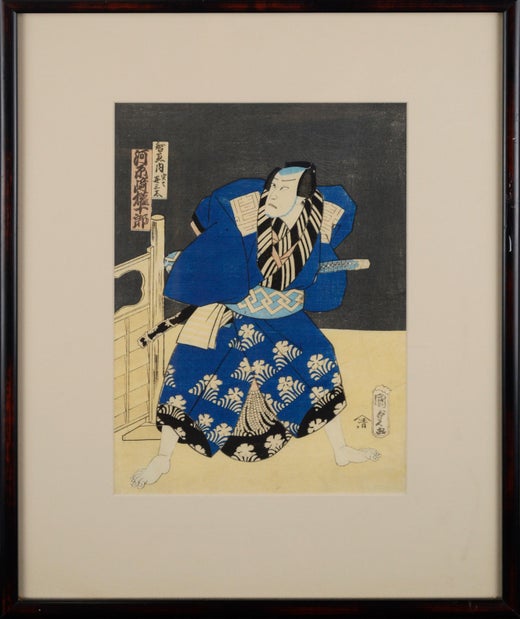
Utagawa Kunisada (Toyokuni III)
Born in the Honjo district of Edo as Kunisada Tsunoda, Kunisada’s family owned a small hereditary ferryboat service. Though his father, an amateur poet, died when Kunisada was a child, the family business provided some financial security. During his childhood, he showed considerable promise in painting and drawing. Due to strong familial ties with literary and theatrical circles, he spent time studying actor portraits. At age 14, he was admitted to study under Toyokuni, head of the Utagawa school. Kunisada's work embodies the characteristics of the Utagawa school, focusing on traditional subjects such as kabuki, bijin (beautiful women), shunga (erotic prints), and historical prints. His first known print dates to 1807, his first illustrated book to 1808. Kunisada’s career took off from the beginning. Many of his works became overnight successes and he was considered the “star attraction†of the Utagawa school. He signed his works “Kunisada,†sometimes with the studio names of Gototei and Kochoro affixed. In 1844, he adopted the name of his teacher and became Toyokuni III. Kunisada passed away in 1864 in the same neighborhood that he was born. He was 70 years old. Kunis
About the Seller
5.0
Recognized Seller
These prestigious sellers are industry leaders and represent the highest echelon for item quality and design.
Gold Seller
Premium sellers maintaining a 4.3+ rating and 24-hour response times
Established in 1977
1stDibs seller since 2016
729 sales on 1stDibs
Typical response time: 7 hours
Associations
International Fine Print Dealers Association
Authenticity Guarantee
In the unlikely event there’s an issue with an item’s authenticity, contact us within 1 year for a full refund. DetailsMoney-Back Guarantee
If your item is not as described, is damaged in transit, or does not arrive, contact us within 7 days for a full refund. Details24-Hour Cancellation
You have a 24-hour grace period in which to reconsider your purchase, with no questions asked.Vetted Professional Sellers
Our world-class sellers must adhere to strict standards for service and quality, maintaining the integrity of our listings.Price-Match Guarantee
If you find that a seller listed the same item for a lower price elsewhere, we’ll match it.Trusted Global Delivery
Our best-in-class carrier network provides specialized shipping options worldwide, including custom delivery.You May Also Like
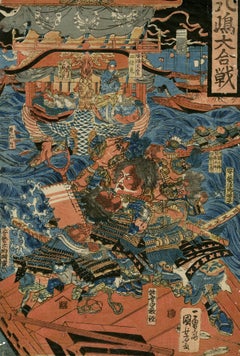
The Battle of Dan-no-ura in Yashima, Nagato Province in the First Year .....
By Utagawa Yoshitora
Located in Middletown, NY
The Battle of Dan-no-ura in Yashima, Nagato Province in the First Year of the Bunji Era (1185)
Tokyo c. 1830
Woodblock print (nishiki-e) with ink and hand-coloring in watercolor on handmade mulberry paper, 14 7/16 x 9 15/16 inches (367 x 252 mm), ōban tate-e, the full sheet. In good condition with some handling creases. Colors are fresh and extremely vibrant. The right panel from the triptych by Yoshitora depicting one of Japan's most storied naval battles. An impression of this work may be found in the permanent collection of the Honolulu Museum of Art.
The great naval battle of Dan-no-ura in 1185 was the final climax in a long series of bitter wars between two powerful families in feudal Japan...
Category
Early 19th Century Edo Figurative Prints
Materials
Watercolor, Handmade Paper, Woodcut
$1,500
H 14.44 in W 9.94 in
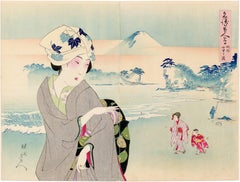
Beauties on the Beach with view of Mount Fuji
By Yoshu Chikanobu
Located in Burbank, CA
Shichirigahama, Sagami Province. A beauty in the foreground waves to her young companions, who run towards her on the beach. The beauty at left wears a western-style golden ring. We ...
Category
1890s Edo Landscape Prints
Materials
Handmade Paper, Mulberry Paper, Woodcut
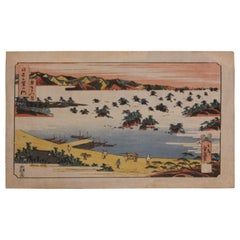
Edo Landscape Japanese Woodblock Print
By Utagawa Hiroshige (Ando Hiroshige)
Located in Houston, TX
Edo Meisho woodblock print of a famous Japanese coastal dock. This woodblock is most likely apart of the series "One Hundred Famous Views of Edo." The woodblock print is printed on r...
Category
1850s Edo Landscape Prints
Materials
Woodcut
$1,500
H 10 in W 15 in D 0.004 in
Saruwaka-machi District and Kinryûzan Temple Seen from Matsuchiyama
By Utagawa Hiroshige (Ando Hiroshige)
Located in Houston, TX
Three women in the Saruwaka-machi District with a view of Kinryûzan Temple seen from the famous landmark Matsuchiyama. The woodblock print is from the series "Famous Places in Edo". ...
Category
1850s Edo Figurative Prints
Materials
Woodcut
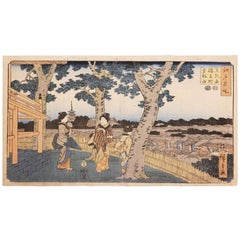
$3,200
H 9.5 in W 14 in D 0.004 in
Japanese Beauty Admiring Kirifuri Waterfall
By Yoshu Chikanobu
Located in Burbank, CA
A beauty turns to admire the Kirifuri Waterfall in Nikko Province. She holds the handle of an umbrella and wears fashionable clothing that is beautifully printed. This series pairs f...
Category
1890s Edo Landscape Prints
Materials
Handmade Paper, Mulberry Paper, Woodcut
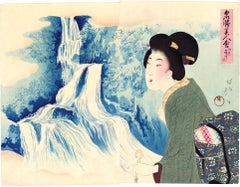
$940 Sale Price
20% Off
H 14.02 in W 18.67 in
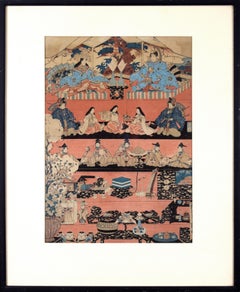
"Various Himochi" Wagashi Festival Japanese Woodblock Print by Utagawa Toyokuni
By Utagawa Toyokuni
Located in Soquel, CA
"Various Himochi" Wagashi Festival Japanese Woodblock Print by Utagawa Toyokuni
Rare oversized early 19th century 5-tiered woodblock by Utagawa Ichiyosai Toyokuni, (Japan, 1769-1825), a Japanese lord and wife oversee a sekku festival of food, music, and dolls or toys. '"oshi" is the first day of “Mi (Snake)” in the third month of the lunar calendar. This day, known in modern Japan as the Girls' Festival, originated in China as a form of purification ceremony in which water and drinking peach blossom wine were used to drive away evil. Many kinds of hishi-mochi appear in this picture of hina ningyo (dolls associated with Hinamatsuri, or the Girl’s Day) from Omochae.
The custom of eating special dishes at events throughout the year and at milestones in people's lives has existed since ancient times. This paragraph specifically focuses on the annual event called sekku, and life events that involve eating sweets. Joshi is the first day of “Mi (Snake)” in the third month of the lunar calendar. This day, known in modern Japan as the Girls' Festival, originated in China as a form of purification ceremony in which water and drinking peach blossom wine were used to drive away evil. According to the Keiso saijiki, in ancient China, on the third day of the third lunar month, people ate “ryuzetsuhan,” which is the juice of gogyo (Jersey cudweed) mixed with rice flour and nectar. In Japan, there is a record in the Heian period history book Nihon Montoku tenno jitsuroku [839-5] that it was an annual event to make kusamochi using gogyo on the third day of the third month of the lunar calendar, which may have been influenced by Chinese customs.
The tradition of eating kusamochi on the third day of the third month of the lunar calendar continued after that. By the Edo period, however, hishimochi had come to be used as a sweet to serve on the third day of the third month. A picture of a hishimochi is included in the Morisada manko , which we mentioned in Part 1. According to it, hishimochi in the Edo period were often three layers of green-white-green instead of the now common red-white-green. However, it is possible to see from our collection that not all hishimochi were made in this way. Omochae published in 1857, is a good example. Omochae is a type of ukiyoe print...
Category
1820s Edo Figurative Prints
Materials
Ink, Rice Paper, Woodcut
$1,480 Sale Price
20% Off
H 26.75 in W 21.75 in D 0.25 in
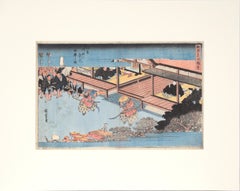
Sumiyoshi: Dengaku dance performed during an Onda ceremony - Woodblock Print
By Utagawa Hiroshige
Located in Soquel, CA
Sumiyoshi: Dengaku dance performed during an Onda ceremony - Woodblock Print
Bright woodblock print by Utagawa Hiroshige (Japanese, 1797-1858). In this scene, two dancers with swords and fans are facing each other, in the center of a courtyard. There are spectators surrounding them, including nobles in black clothing on a balcony.
Presented in a new off-white mat with foamcore backing.
Mat size: 16"H x 20"W
Paper size: 9.63"H x 14.5W"
Utagawa Hiroshige (1797-1858, sometimes called Ando Hiroshige) was the second of the two great masters of the Japanese landscape woodblock print...
Category
1830s Edo Figurative Prints
Materials
Ink, Rice Paper, Woodcut
$680 Sale Price
20% Off
H 16 in W 20 in D 0.25 in
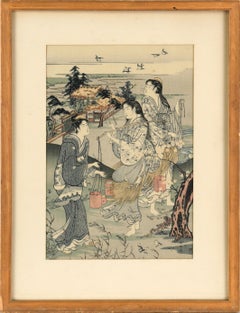
"Plovers at Tamagawa" from "Six Jewel Rivers" - Woodblock Print on Paper
Located in Soquel, CA
"Plovers at Tamagawa" from "Six Jewel Rivers" - Woodblock Print on Paper
This print, sometimes titled "Chidori No Tamagawa" "Plovers at Tamagawa", is from the series Mu Tamagawa ("Six Views of Tama River", also known as "Six Jewel Rivers" or "Six Crystal Rivers") by Kubo Shunman...
Category
Late 18th Century Edo Landscape Prints
Materials
Paper, Ink, Woodcut
$880 Sale Price
20% Off
H 21 in W 16 in D 0.75 in
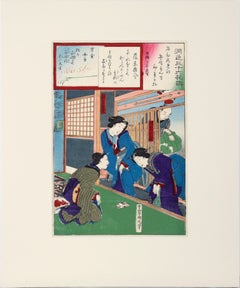
"Enshoku Sanju-roku Kasen" (Thirty-six Enchanting Flowers) Woodblock on paper
By Toyohara Kunichika
Located in Soquel, CA
"Enshoku Sanju-roku Kasen" (Thirty-six Enchanting Flowers) Woodblock on paper
Elegant woodblock print by Toyohara Kunuchika (Japanese, 1835-1900). Three women are in talking with each other inside, while a man waits outside holding a bag of some kind. The colors in this piece are rich and saturated, primarily blues, greens, and purple.
Mat size: 16"H x 20"W
Paper size: 14.75"H x 9.88"W
Born in 1835, Toyohara Kunichika grew up in the Kyobashi district of Edo in the midst of merchants and artisans. In 1848, at age 13, he was accepted as an apprentice into the studio of Utagawa Kunisada I...
Category
1880s Edo Figurative Prints
Materials
Ink, Rice Paper, Woodcut
$380 Sale Price
20% Off
H 20 in W 16 in D 0.25 in
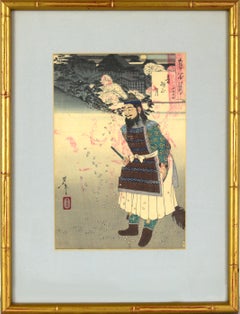
One Hundred Aspects of the Moon, Mt Otawa Moon - Bright God Tamura
By Tsukioka Yoshitoshi
Located in Soquel, CA
"Mount Otawa Moon: Bright God Tamura" - Woodblock on Paper by Tsukioka Yoshitoshi
From the series "One Hundred Aspects of the Moon"
This piece depicts the general Sakanoe no Tamura...
Category
1880s Edo Figurative Prints
Materials
Paper, Ink, Woodcut
$750
H 20.5 in W 15.5 in D 0.75 in
More From This Seller
View AllA Mirage
By James McBey
Located in Storrs, CT
A Mirage. 1928. Etching. Hardie 238. 11 13/16 x 14 3/8 (sheet 12 3/16 x 18 3/4). Edition 76, #46. Illustrated: Fine Prints of the Year, 1928 and 1938; Holmes, Etchings of Today. A ri...
Category
1920s Modern Landscape Prints
Materials
Drypoint, Etching
$1,750 Sale Price
30% Off
The Thames from Waterloo.
By William Walcot R. E. Hon. R. I. B. A.
Located in Storrs, CT
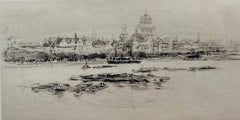
The Thames from Waterloo Bridge. 1913. Etching. Dickins 12. 3 3/4 x 7 1/16 (sheet 7 x 10 15/16). Edition 100. A fine proof with tonal wiping, printed on cream-wove paper. Signed in pencil.
Architectural draughtsman, etcher. Born in Lustdorf, near Odessa, Russia, to a British father and Russian mother. Traveled extensively with his family before studying architecture in St Petersburg, with further studies at Ecole des Beaux-Arts and Atelier Redan, Paris. Practiced architecture in Moscow and was co-designer of the Metropole Hotel, in 1898. Moved to London in 1907 and was employed as an architectural perspectivist. After a sponsored visit to Rome and Venice he had a solo exhibit at the Fine Art Society, 1912, 'Watercolours of London and Venice'; followed by a further four shows. He also exhibited at the Royal Academy, Royal Society of British Artists, Royal Society of Painter-Etchers..., and Connell & Sons. His etchings were published in London by H C Dickens,1913-24, and a folio of his work 'Architectural watercolors and etchings of William Walcot' was published, in 1919. Elected RE, 1920; FRIBA, 1922; Associate British School at Rome. A foremost architectural draughtsman, he worked from studios in London, Oxford and Rome.
The complete set of The Arteries of Great Britain includes: The Thames, The Tyne, The Forth, The Clyde, The Mersey. Signed in pencil .Housed in a 16 x 20 inch mat suitable for framing.
Opened in 1890, the Forth Bridge...
Category
Early 20th Century Modern Landscape Prints
Materials
Etching
$620 Sale Price
20% Off
Charing Cross - The Statue of Charles I.
By William Walcot R. E. Hon. R. I. B. A.
Located in Storrs, CT
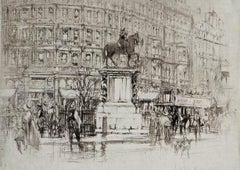
Charing Cross -- The Statue of Charles I. 1919. Etching with aquatint and drypoint. 3 5/8 x 4 7/8 (sheet 9 1/8 x 11 3/8). A fine proof with tonal wiping, printed on cream-wove paper. Signed in pencil.
Charing Cross is located at the junction of the Strand, Whitehall, and Cockspur Street in Central London, England. The name originates from the Eleanor cross installed by King Edward I as a memorial to his wife, Eleanor of Castile at the former hamlet of Charing. Since 1675, the cross site has been occupied by a statue of King Charles I mounted on a horse. The pedestal is thought to be designed by Wren and carved by Grinling Gibbons.
Chelsea Old Church, also known as All Saints, is an Anglican church, on Old Church Street, Chelsea, London SW3, England, near Albert Bridge. It is the church for a parish in the Diocese of London, part of the Church of England. Inside the Grade I listed building, there is seating for 400 people. There is a memorial plaque to the author Henry James (1843–1916) who lived nearby on Cheyne Walk. To the west of the church is a small public garden containing a sculpture by Sir Jacob Epstein.
When he was seventeen,William Walcot began to study architecture under Louis Benois at the Imperial Academy of Art in Saint Petersburg. He went to Paris where he continued his studies at the Ecole des Beaux-Arts and the Atelier Redon. He practiced as an architect briefly in Moscow, designing the Hotel...
Category
Early 20th Century Modern Landscape Prints
Materials
Drypoint, Etching, Aquatint
$780 Sale Price
20% Off
Timber Raft on the Rhine
By Sir Frank Short
Located in Storrs, CT
Timber Raft on the Rhine (after the watercolor by J.M.W. Turner in the National Gallery). 1898. Mezzotint. Hardie 66. 8 1/4 x 11 11/16 (sheet 10 5/16 x 13 1/2). Edition 100. A rich, ...
Category
1890s Romantic Landscape Prints
Materials
Mezzotint
Twixt Dawn and Day
By Sir Frank Short
Located in Storrs, CT
Twixt Day and Dawn. 1919. Aquatint. Hardie catalog 165 state ii. Image 9 7/8 x 11 1/2 (sheet 13 9/16 x 16 7/8). A masterly inked impression produces subtle lighting variations throu...
Category
Early 20th Century Modern Landscape Prints
Materials
Aquatint
$500 Sale Price
39% Off
San Marco [Venice].
By William Walcot R. E. Hon. R. I. B. A.
Located in Storrs, CT
William Walcot. R.E., R.I.B.A. San Marco. Etching with drypoint and aquatint. Dickins 66, Harvey-Lee 91. 3 7/8 x 5 7/8 (sheet 9 1/4 x 12 1/8). Venice set, # 2. Edition 415. A rich impression printed on cream wove paper. Fold in the margin, well outside the image; otherwise good condition. Signed in pencil. Housed in a 16 x 20-inch archival mat.
Soon after Walcot's arrival in England, the Fine Art Society sponsored a trip sent to Italy. This scene is one of four small drypoints that resulted from the artist’s stay in Venice.
When he was seventeen, he began to study architecture under Louis Benois at the Imperial Academy of Art in Saint Petersburg. He went to Paris where he continued his studies at the Ecole des Beaux-Arts and the Atelier Redon. He practiced as an architect briefly in Moscow, designing the Hotel Metropole...
Category
Early 20th Century Modern Landscape Prints
Materials
Drypoint, Etching, Aquatint
![San Marco [Venice].](https://a.1stdibscdn.com/william-walcot-prints-works-on-paper-san-marco-venice-for-sale/a_3352/a_101504721690399029260/sanmarcoimage3_master.jpg?width=240)
Still Thinking About These?
All Recently ViewedMore Ways To Browse
Tale Of Genji
Gold Whistle
Britto Love
Brooklyn Museum Poster
Bruno Da Osimo
Buckskin Dress
Bullfight Poster
Calder Braniff Airlines 1976
Camille Billops
Cecile Plaisance Vanity Fair
Cecilia Vicuna
Chagall Accordionist
Chagall Homecoming
Chagall Serenade
Chairs Harold Altman
Charles Bibbs
Chi Chien Wang
Claude Mellan